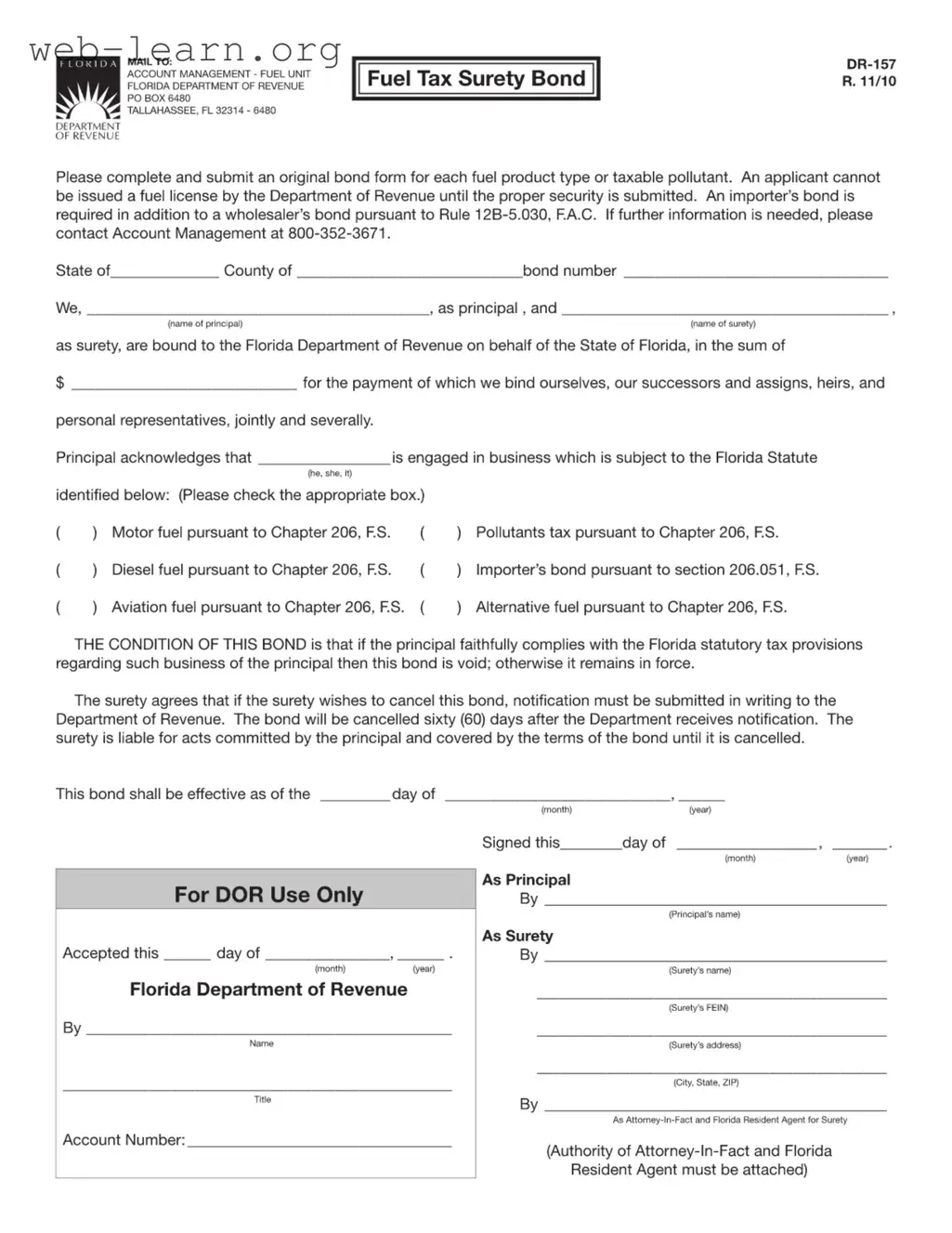
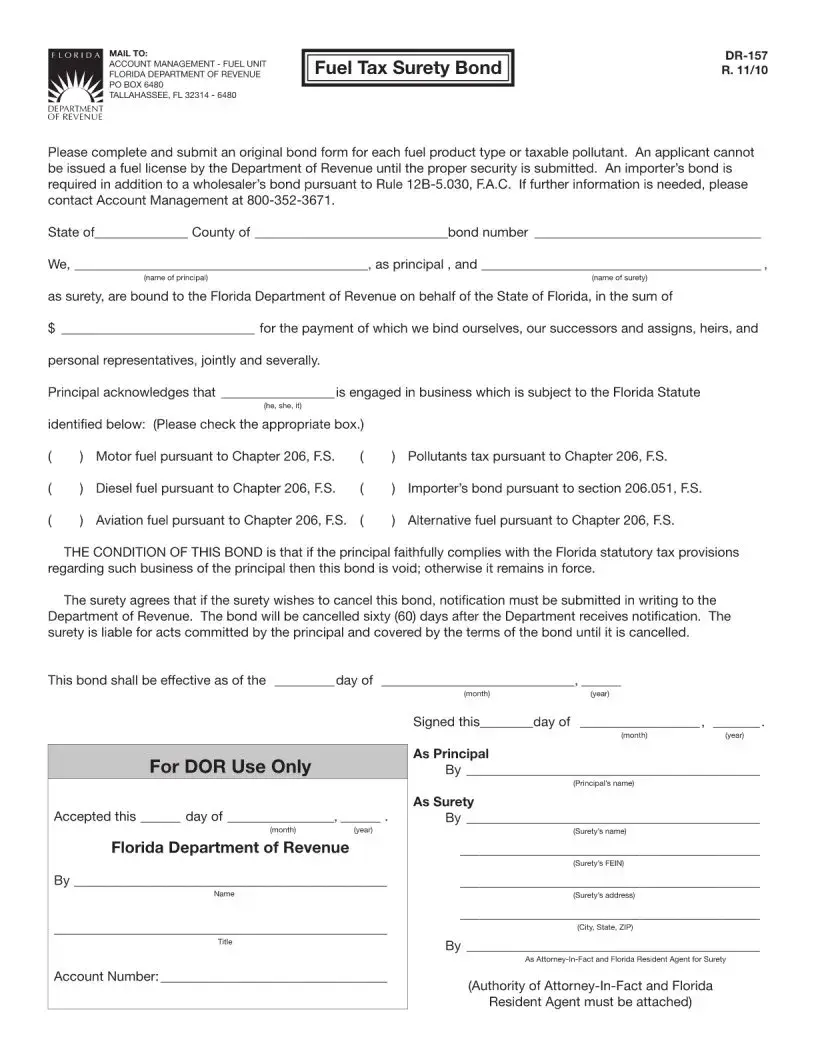
The Florida DR 157 form is an essential document for businesses involved in the fuel industry within the state. This form serves as a Fuel Tax Surety Bond, which is a requirement for obtaining a fuel license from the Florida Department of Revenue. Before a license can be issued, applicants must submit an original bond for each type of fuel product or taxable pollutant they handle. The form outlines the obligations of the principal, who is the business applying for the bond, and the surety, which guarantees compliance with Florida's tax laws. It specifies the amount of the bond and includes various fuel categories, such as motor fuel, diesel fuel, and aviation fuel, among others. Additionally, the bond remains in effect as long as the principal adheres to the state's statutory tax provisions. If the surety wishes to cancel the bond, they must notify the Department of Revenue in writing, and the bond will be canceled 60 days after receipt of that notification. Understanding the DR 157 form is crucial for any business looking to navigate the regulatory landscape of fuel taxation in Florida.
| Fact Name | Fact Description |
|---|---|
| Form Purpose | The Florida DR-157 form serves as a Fuel Tax Surety Bond required by the Florida Department of Revenue. |
| Governing Law | This form is governed by Florida Statutes, particularly Chapter 206, which outlines tax provisions for fuel products. |
| Submission Requirement | An original bond form must be submitted for each type of fuel product or taxable pollutant. |
| License Issuance | The Department of Revenue will not issue a fuel license until the proper security, represented by the bond, is submitted. |
| Types of Bonds | Applicants may need to submit multiple bonds, including an importer’s bond and a wholesaler’s bond as per Rule 12B-5.030, F.A.C. |
| Bond Conditions | The bond remains in force unless the principal complies with the Florida statutory tax provisions. |
| Surety Notification | If a surety wishes to cancel the bond, they must provide written notification to the Department of Revenue. |
| Cancellation Period | The bond will be canceled 60 days after the Department receives the cancellation notification. |
| Liability of Surety | The surety remains liable for actions committed by the principal under the bond terms until cancellation occurs. |
| Effective Date | The bond is effective from the date specified in the form, which must be filled out by the principal. |
Filling out the Florida DR 157 form is an important step in securing a fuel tax surety bond. Completing this form accurately ensures that your application for a fuel license can move forward. Below are the steps to help you fill out the form correctly.
Once you have completed the form, make sure to submit it to the Florida Department of Revenue at the address provided on the form. This is essential for your application to be processed. If you have any questions or need assistance, don’t hesitate to contact Account Management at the number listed on the form.
What is the Florida DR-157 form?
The Florida DR-157 form is a Fuel Tax Surety Bond required by the Florida Department of Revenue. This form ensures that businesses involved in the sale or distribution of certain fuel products comply with state tax laws. It acts as a financial guarantee that taxes will be paid, thus protecting the state’s revenue.
Who needs to submit the DR-157 form?
Any business that engages in the sale or distribution of motor fuel, diesel fuel, aviation fuel, alternative fuel, or pollutants must submit a DR-157 form. This includes both wholesalers and importers, as an importer’s bond is necessary in addition to a wholesaler’s bond.
How do I complete the DR-157 form?
To complete the DR-157 form, you must fill out your business information, including the bond number, and select the appropriate box for the type of fuel or pollutant you are dealing with. You will also need to provide the amount of the bond and include signatures from both the principal and surety. Make sure to submit an original bond form for each fuel product type or taxable pollutant.
What happens if I do not submit the DR-157 form?
If you do not submit the DR-157 form, the Florida Department of Revenue will not issue a fuel license to your business. This means you will be unable to legally sell or distribute the fuel products covered by the bond.
How can I cancel the bond associated with the DR-157 form?
If the surety wishes to cancel the bond, they must submit a written notification to the Florida Department of Revenue. The bond will be canceled 60 days after the Department receives this notification. Until the bond is officially canceled, the surety remains liable for any acts committed by the principal that are covered by the bond.
What is the bond amount required on the DR-157 form?
The bond amount will vary depending on the type of fuel or pollutant being handled and is specified on the form. It is important to consult with the Florida Department of Revenue or a legal advisor to determine the appropriate amount for your specific situation.
Where do I send the completed DR-157 form?
Once completed, the DR-157 form should be mailed to the following address:
How can I contact the Florida Department of Revenue for more information?
If you need further assistance or have questions about the DR-157 form, you can contact the Florida Department of Revenue's Account Management at 800-352-3671. They can provide additional guidance and clarification on the requirements.
What is the effective date of the bond?
The bond becomes effective on the date specified in the DR-157 form. This date is typically the day the bond is signed. Ensure that this date is accurate to avoid any issues with compliance.
What if I need to make changes to the DR-157 form after submission?
If you need to make changes to the DR-157 form after it has been submitted, you may need to submit a new form or contact the Florida Department of Revenue for instructions on how to proceed. It is advisable to keep records of all communications and submitted forms.
Filling out the Florida DR-157 form can be straightforward, but many individuals make common mistakes that can delay the process. One frequent error is failing to provide an original bond form for each fuel product type or taxable pollutant. The Department of Revenue requires a separate bond for each category, and submitting only one can lead to rejection.
Another mistake is neglecting to include the bond number. This number is crucial for identifying the bond and ensuring that it is properly processed. Without it, the application may be considered incomplete, causing unnecessary delays.
Applicants often overlook the requirement to check the appropriate box indicating the type of business engaged in. This step is essential as it defines the scope of the bond. If this section is left blank or incorrectly filled out, it can lead to confusion and potential issues with compliance.
Moreover, many individuals forget to include the effective date of the bond. This date is important for establishing when the bond becomes valid. If this information is missing, it can complicate matters when verifying the bond's status.
Another common error is not providing the correct contact information for the surety. The address, name, and FEIN must be accurate to ensure that the Department of Revenue can reach the surety if needed. Inaccuracies can lead to complications in communication and processing.
Additionally, some applicants fail to sign the form properly. Both the principal and the surety must provide their signatures. If either signature is missing, the bond will not be accepted, and the application will be delayed.
Many people also neglect to attach the necessary documentation regarding the authority of the Attorney-In-Fact and Florida Resident Agent. This documentation is crucial for validating the surety's ability to act on behalf of the principal. Without it, the bond may be deemed invalid.
Finally, a lack of attention to detail in the submission process can lead to errors. Ensure that the form is sent to the correct address and that all required information is included. Double-checking the submission can save time and prevent unnecessary complications.
The Florida DR-157 form, also known as the Fuel Tax Surety Bond, is a crucial document for businesses involved in the fuel industry. It ensures compliance with Florida's fuel tax laws by requiring a bond as security. Several other forms and documents are often used in conjunction with the DR-157 to facilitate various aspects of fuel tax compliance and licensing. Below is a list of these documents, each with a brief description.
These forms and documents play a vital role in the compliance process for businesses involved in the fuel industry in Florida. Understanding their purpose and requirements can help ensure that all regulatory obligations are met efficiently.
The Florida DR 157 form is a specific type of bond related to fuel taxes. Several other documents serve similar purposes in different contexts. Here are four documents that share similarities with the DR 157 form:
When filling out the Florida DR-157 form, it is essential to follow specific guidelines to ensure accuracy and compliance. Here are eight things to do and avoid:
Following these guidelines will help facilitate the processing of your bond and ensure compliance with Florida's tax regulations.
The Florida DR 157 form is often misunderstood. Here are seven common misconceptions about this form:
Understanding these misconceptions can help ensure compliance with Florida's fuel tax regulations and facilitate a smoother application process.
When filling out and using the Florida DR 157 form, keep the following key takeaways in mind: