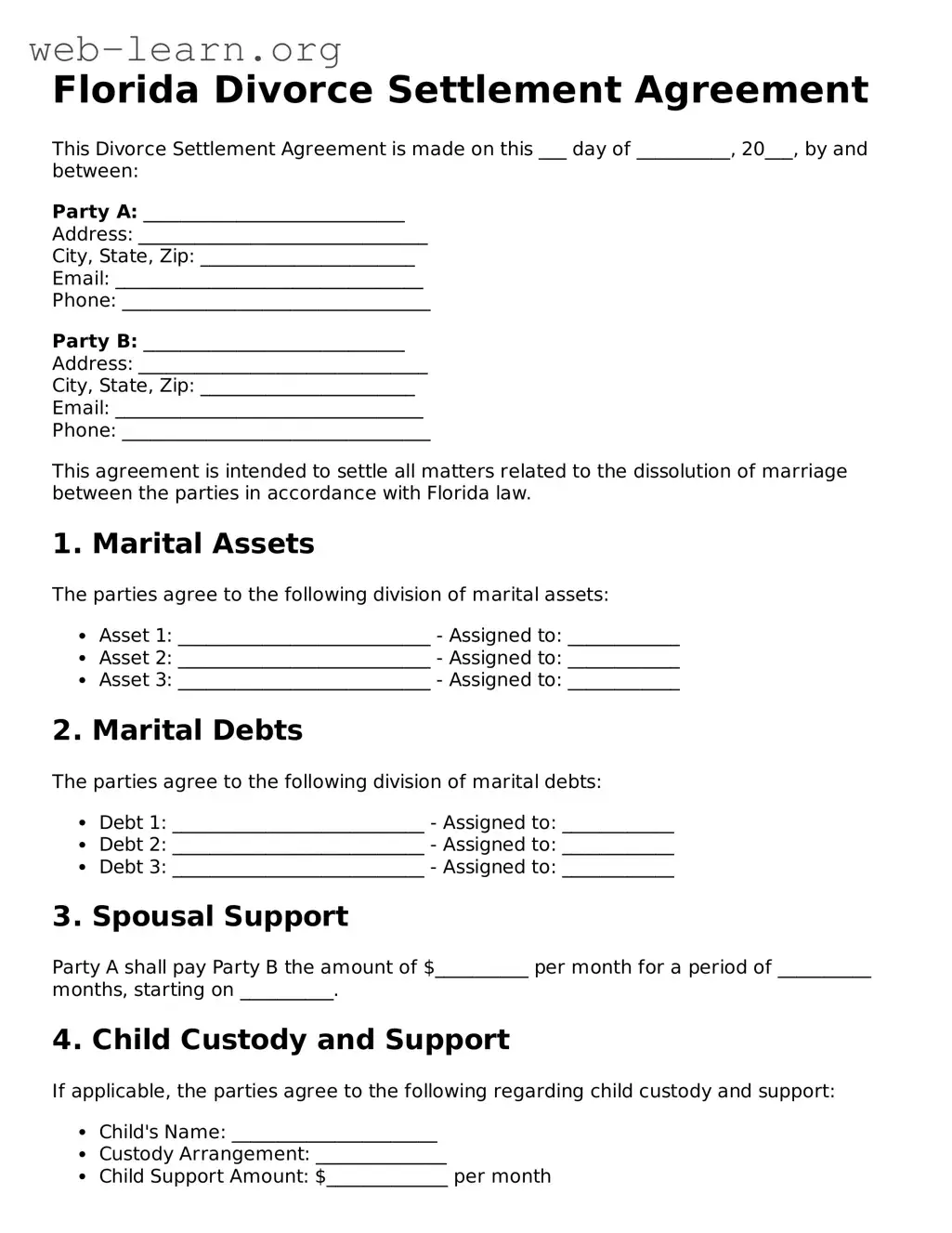
In the state of Florida, navigating a divorce can be a complex process, but the Divorce Settlement Agreement form plays a crucial role in streamlining the proceedings. This form serves as a written document that outlines the terms agreed upon by both parties regarding the division of assets, child custody arrangements, and spousal support. It addresses key issues such as the distribution of marital property, debts, and any other financial obligations that may arise during the dissolution of marriage. Additionally, the agreement must comply with Florida laws to ensure that it is enforceable in court. By clearly detailing each party's rights and responsibilities, this form not only facilitates a smoother transition into post-marital life but also minimizes the potential for future disputes. Understanding the components of this form is essential for anyone undergoing a divorce in Florida, as it lays the groundwork for a fair and equitable settlement.
Florida Divorce Settlement Agreement
This Divorce Settlement Agreement is made on this ___ day of __________, 20___, by and between:
Party A: ____________________________
Address: _______________________________
City, State, Zip: _______________________
Email: _________________________________
Phone: _________________________________
Party B: ____________________________
Address: _______________________________
City, State, Zip: _______________________
Email: _________________________________
Phone: _________________________________
This agreement is intended to settle all matters related to the dissolution of marriage between the parties in accordance with Florida law.
1. Marital Assets
The parties agree to the following division of marital assets:
2. Marital Debts
The parties agree to the following division of marital debts:
3. Spousal Support
Party A shall pay Party B the amount of $__________ per month for a period of __________ months, starting on __________.
4. Child Custody and Support
If applicable, the parties agree to the following regarding child custody and support:
5. Final Agreement
This document represents the entire agreement between the parties. Any modifications must be made in writing and signed by both parties.
By signing below, both parties agree to the terms outlined in this Divorce Settlement Agreement.
Party A Signature: ____________________________ Date: ____________
Party B Signature: ____________________________ Date: ____________
This agreement is executed in accordance with the laws of the State of Florida.
| Fact Name | Details |
|---|---|
| Purpose | The Florida Divorce Settlement Agreement form outlines the terms of the divorce, including asset division, alimony, and child custody arrangements. |
| Governing Law | This form is governed by Florida Statutes, specifically Chapter 61, which addresses dissolution of marriage. |
| Filing Requirement | Both parties must sign the agreement, and it should be filed with the court as part of the divorce proceedings. |
| Modification | Once approved by the court, the terms of the agreement can only be modified through a formal court order. |
Filling out the Florida Divorce Settlement Agreement form is an important step in finalizing your divorce. This document outlines how you and your spouse have agreed to divide your assets, debts, and responsibilities. Once completed, this form will need to be submitted to the court for approval, moving you closer to finalizing your divorce.
What is a Florida Divorce Settlement Agreement?
A Florida Divorce Settlement Agreement is a legal document that outlines the terms of a divorce between two parties. It covers various aspects such as property division, child custody, child support, and alimony. This agreement serves as a roadmap for how both parties will handle their responsibilities and rights after the divorce. By reaching a settlement, couples can avoid a lengthy court battle, making the process smoother and often less stressful.
How do I create a Divorce Settlement Agreement?
Creating a Divorce Settlement Agreement typically involves several steps:
Is a Divorce Settlement Agreement legally binding?
Yes, once signed and notarized, a Divorce Settlement Agreement is legally binding. This means that both parties are required to adhere to the terms outlined in the agreement. If one party fails to comply, the other can seek enforcement through the court. However, it’s important to note that the agreement must be fair and reasonable to be upheld in court.
Can I modify the Divorce Settlement Agreement later?
Yes, it is possible to modify a Divorce Settlement Agreement, but certain conditions must be met. If circumstances change significantly—such as a job loss, a change in income, or a change in the needs of children—either party can request a modification. This typically requires filing a motion with the court to have the agreement reviewed and amended. It's advisable to consult with a lawyer during this process to ensure that any changes are legally valid.
What happens if my spouse and I cannot agree on the terms?
If you and your spouse cannot reach an agreement, the case may proceed to court. In this situation, a judge will make decisions regarding property division, custody, and support based on the evidence presented. This can be a lengthy and costly process, so it is often beneficial to seek mediation or legal counsel to help facilitate negotiations before resorting to litigation.
When completing the Florida Divorce Settlement Agreement form, individuals often make several common mistakes that can lead to complications down the line. Understanding these pitfalls can help ensure a smoother process. One frequent error is failing to provide complete and accurate information. Incomplete forms can delay proceedings and create misunderstandings between parties.
Another mistake is not fully understanding the implications of the agreements being made. For example, individuals may agree to terms regarding asset division or child custody without fully considering the long-term consequences. It is crucial to think through each decision carefully to avoid regret later.
Many people also overlook the importance of clear and specific language. Vague terms can lead to differing interpretations, which may result in disputes after the agreement is finalized. It’s essential to be as precise as possible when describing the terms of the settlement.
Additionally, some individuals fail to account for future changes in circumstances. Life can be unpredictable, and agreements should include provisions for modifications if necessary. This foresight can save both parties from potential conflicts in the future.
Another common mistake involves neglecting to include all relevant assets and debts. Omitting property or financial obligations can lead to significant issues later. Both parties should take the time to list everything comprehensively to avoid surprises.
Lastly, individuals sometimes forget to seek legal advice before finalizing the agreement. Even if both parties appear to be in agreement, having a professional review the document can provide valuable insights and help prevent costly mistakes. A little guidance can go a long way in ensuring that the settlement is fair and enforceable.
A Florida Divorce Settlement Agreement form is a crucial document in the divorce process, outlining the terms agreed upon by both parties. Several other forms and documents often accompany this agreement to ensure a comprehensive legal framework for the divorce proceedings. Below are four commonly used documents.
These documents work together with the Florida Divorce Settlement Agreement to facilitate a smoother divorce process. Each serves a distinct purpose, ensuring that all aspects of the divorce are addressed and legally documented.
The Divorce Settlement Agreement is a crucial document in the divorce process, but it shares similarities with several other legal documents. Each of these documents serves a unique purpose while also addressing issues related to separation, division of assets, and responsibilities. Here are seven documents that are similar to the Divorce Settlement Agreement:
Understanding these documents can help individuals navigate the complexities of divorce and ensure that their rights and responsibilities are clearly defined and legally recognized.
When filling out the Florida Divorce Settlement Agreement form, it is crucial to approach the task with care and attention. Here is a list of things to consider.
Completing the Divorce Settlement Agreement form accurately is vital for a smooth divorce process. Each step should be approached with diligence to ensure that all parties understand and agree to the terms. Failure to adhere to these guidelines may lead to complications or delays in the divorce proceedings.
When it comes to the Florida Divorce Settlement Agreement form, several misconceptions can lead to confusion. Here’s a list of common misunderstandings:
Understanding these misconceptions can help couples navigate the divorce process more effectively and ensure that their rights and interests are protected.
Filling out and using the Florida Divorce Settlement Agreement form is a critical step in the divorce process. This document outlines the terms agreed upon by both parties, ensuring clarity and mutual understanding. Here are key takeaways to consider:
By keeping these points in mind, individuals can navigate the complexities of the Divorce Settlement Agreement process with greater confidence and clarity.
Mutual Divorce Agreement Sample - Use this form to ensure compliance with state laws regarding divorce settlements.
Mutual Divorce Agreement Sample - It can simplify the complexities of separating finances and responsibilities.
Louisiana Community Property Settlement Form - It can specify how to handle changes in employment or income.