Homepage Blank Florida Divorce Decree Form
Outline

The Florida Divorce Decree form is an essential document for individuals seeking to dissolve their marriage, particularly when dependent or minor children are involved. This form, officially known as the Petition for Dissolution of Marriage with Dependent or Minor Child(ren), is designed for couples who have children together or when one spouse is expecting a child. Before filing, it is crucial that at least one spouse has resided in Florida for a minimum of six months. The form must be completed accurately, printed in black ink, and signed in the presence of a notary public or deputy clerk. Once finalized, the original must be filed with the circuit court clerk in the appropriate county, while a copy should be kept for personal records. The process also involves notifying the other spouse—referred to as the respondent—of the petition, which can be done through personal or constructive service. Additionally, the form addresses various aspects of the divorce process, including child support, alimony, and the division of marital assets and liabilities. It emphasizes the importance of following specific procedures, such as e-filing and electronic service of documents, to ensure compliance with Florida’s judicial rules. Understanding these key components can help streamline the divorce process and facilitate a smoother transition for all parties involved.


Sample - Florida Divorce Decree Form

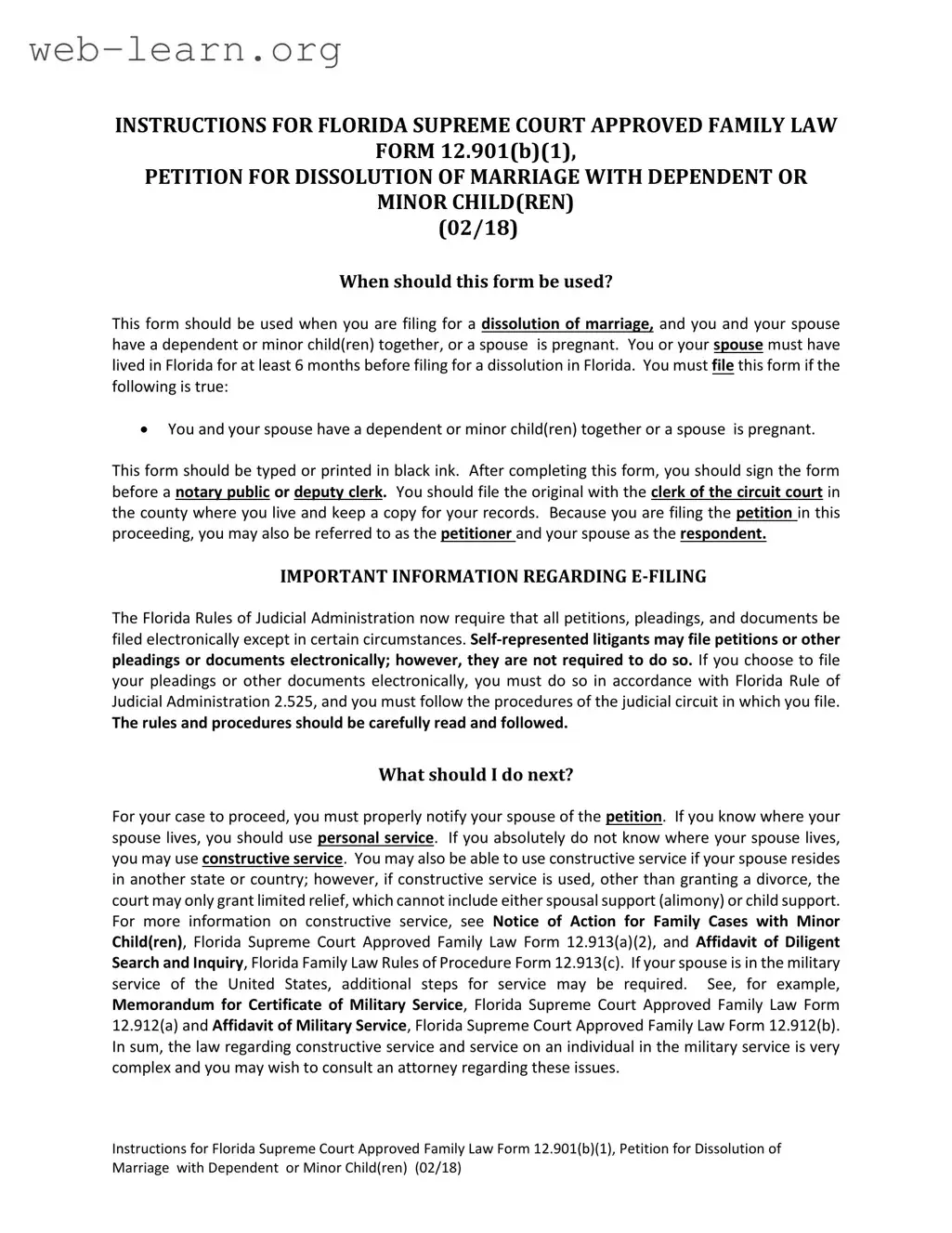
Instructions for Florida Supreme Court Approved Family Law Form 12.901(b)(1), Petition for Dissolution of
Marriage with Dependent or Minor Child(ren) (02/18)
INSTRUCTIONS FOR FLORIDA SUPREME COURT APPROVED FAMILY LAW
FORM 12.901(b)(1),
PETITION FOR DISSOLUTION OF MARRIAGE WITH DEPENDENT OR
MINOR CHILD(REN)
(02/18)
When should this form be used?
This form should be used when you are filing for a dissolution of marriage, and you and your spouse
have a dependent or minor child(ren) together, or a spouse is pregnant. You or your spouse must have
lived in Florida for at least 6 months before filing for a dissolution in Florida. You must file this form if the
following is true:
You and your spouse have a dependent or minor child(ren) together or a spouse is pregnant.
This form should be typed or printed in black ink. After completing this form, you should sign the form
before a notary public or deputy clerk. You should file the original with the clerk of the circuit court in
the county where you live and keep a copy for your records. Because you are filing the petition in this
proceeding, you may also be referred to as the petitioner and your spouse as the respondent.
IMPORTANT INFORMATION REGARDING E-FILING
The Florida Rules of Judicial Administration now require that all petitions, pleadings, and documents be
filed electronically except in certain circumstances. Self-represented litigants may file petitions or other
pleadings or documents electronically; however, they are not required to do so. If you choose to file
your pleadings or other documents electronically, you must do so in accordance with Florida Rule of
Judicial Administration 2.525, and you must follow the procedures of the judicial circuit in which you file.
The rules and procedures should be carefully read and followed.
What should I do next?
For your case to proceed, you must properly notify your spouse of the petition. If you know where your
spouse lives, you should use personal service. If you absolutely do not know where your spouse lives,
you may use constructive service. You may also be able to use constructive service if your spouse resides
in another state or country; however, if constructive service is used, other than granting a divorce, the
court may only grant limited relief, which cannot include either spousal support (alimony) or child support.
For more information on constructive service, see Notice of Action for Family Cases with Minor
Child(ren), Florida Supreme Court Approved Family Law Form 12.913(a)(2), and Affidavit of Diligent
Search and Inquiry, Florida Family Law Rules of Procedure Form 12.913(c). If your spouse is in the military
service of the United States, additional steps for service may be required. See, for example,
Memorandum for Certificate of Military Service, Florida Supreme Court Approved Family Law Form
12.912(a) and Affidavit of Military Service, Florida Supreme Court Approved Family Law Form 12.912(b).
In sum, the law regarding constructive service and service on an individual in the military service is very
complex and you may wish to consult an attorney regarding these issues.
Instructions for Florida Supreme Court Approved Family Law Form 12.901(b)(1), Petition for Dissolution of
Marriage with Dependent or Minor Child(ren) (02/18)
If personal service is used, your spouse has 20 days to answer after being served with your petition. Your
case will then generally proceed in one of the following three ways:
DEFAULT. If after 20 days, your spouse has not filed an answer, you may file a Motion for Default, Florida
Supreme Court Approved Family Law Form 12.922(a), with the clerk of court. Then, if you have filed all
of the required papers, you may contact the clerk, family law intake staff, or judicial assistant to set a
final hearing. You must notify your spouse of the hearing by using a Notice of Hearing (General), Florida
Supreme Court Approved Family Law Form 12.923, or other appropriate notice of hearing form.
UNCONTESTED. If your spouse files an answer that agrees with everything in your petition or an answer
and waiver, and you have complied with mandatory disclosure and filed all of the required papers, you
may contact the clerk, family law intake staff, or judicial assistant to set a final hearing. You must notify
your spouse of the hearing by using a Notice of Hearing (General), Florida Supreme Court Approved
Family Law Form 12.923, or other appropriate notice of hearing form.
CONTESTED. If your spouse files an answer or an answer and counterpetition, which disagrees with or
denies anything in your petition, and you are unable to settle the disputed issues, you should file a Notice
for Trial, Florida Supreme Court Approved Family Law Form 12.924, after you have complied with
mandatory disclosure and filed all of the required papers. Some circuits may require the completion of
mediation before a final hearing may be set. You should contact the clerk, family law intake staff, or
judicial assistant for instructions on how to set your case for trial (final hearing). If your spouse files an
answer and counterpetition, you should answer the counterpetition within 20 days using an Answer to
Counterpetition, Florida Supreme Court Approved Family Law Form 12.903(d).
Where can I look for more information?
Before proceeding, you should read General Information for Self-Represented Litigants found at the
beginning of these forms. The words that are in bold underline in these instructions are defined there.
For further information, see chapter 61, Florida Statutes.
IMPORTANT INFORMATION REGARDING E-SERVICE ELECTION
After the initial service of process of the petition or supplemental petition by the Sheriff or certified
process server, the Florida Rules of Judicial Administration now require that all documents required or
permitted to be served on the other party must be served by electronic mail (e-mail) except in certain
circumstances. You must strictly comply with the format requirements set forth in the Rules of Judicial
Administration. If you elect to participate in electronic service, which means serving or receiving pleadings
by electronic mail (e-mail), or through the Florida Courts E-Filing Portal, you must review Florida Rule of
Judicial Administration 2.516. You may find this rule at www.flcourts.org through the link to the Rules of
Judicial Administration provided under either Family Law Forms: Getting Started, or Rules of Court in the
A-Z Topical Index.
SELF-REPRESENTED LITIGANTS MAY SERVE DOCUMENTS BY E-MAIL; HOWEVER, THEY ARE NOT
REQUIRED TO DO SO. If a self-represented litigant elects to serve and receive documents by e-mail, the
procedures must always be followed once the initial election is made.
Instructions for Florida Supreme Court Approved Family Law Form 12.901(b)(1), Petition for Dissolution of
Marriage with Dependent or Minor Child(ren) (02/18)
To serve and receive documents by e-mail, you must designate your e-mail addresses by using the
Designation of Current Mailing and E-mail Address, Florida Supreme Court Approved Family Law Form
12.915, and you must provide your e-mail address on each form on which your signature appears. Please
CAREFULLY read the rules and instructions for: Certificate of Service (General), Florida Supreme Court
Approved Family Law Form 12.914; Designation of Current Mailing and E-mail Address, Florida Supreme
Court Approved Family Law Form 12.915; and Florida Rule of Judicial Administration 2.516.
Special notes...
If you do not have the money to pay the filing fee, you may obtain an Application for Determination of
Civil Indigent Status from the clerk, fill it out, and the clerk will determine whether you are eligible to have
filing fees deferred.
If you want to keep your address confidential because you are the victim of sexual battery, aggravated
child abuse, aggravated stalking, harassment, aggravated battery, or domestic violence, do not enter the
address, telephone, and fax information at the bottom of this form. Instead, file a Request for Confidential
Filing of Address, Florida Supreme Court Approved Family Law Form 12.980(h).
With this form, you must also file the following:
Uniform Child Custody Jurisdiction and Enforcement Act (UCCJEA) Affidavit, Florida Supreme
Court Approved Family Law Form 12.902(d).
Child Support Guidelines Worksheet, Florida Family Law Rules of Procedure Form 12.902(e), if
you are asking that child support be ordered in the final judgment. (If you do not know your
spouse’s income, you may file this worksheet after your spouse’s financial affidavit has been
served on you.)
Affidavit of Corroborating Witness, Florida Supreme Court Approved Family Law Form 12.902(i)
OR photocopy of current Florida driver’s license, Florida identification card, or voter’s registration
card (issue date of copied document must be at least six months before date case is actually filed
with the clerk of the circuit court).
Marital Settlement Agreement for Dissolution of Marriage with Dependent or Minor Child(ren),
Florida Supreme Court Approved Family Law Form 12.902(f)(1), if you and your spouse have
reached an agreement on any or all of the issues.
Notice of Social Security Number, Florida Supreme Court Approved Family Law Form 12.902(j).
Family Law Financial Affidavit, Florida Family Law Rules of Procedure Form 12.902(b) or (c). (This
must be filed with the petition if the petitioner seeks to establish child support. Otherwise, it
must be filed within 45 days of service of the petition on the respondent.)
Certificate of Compliance with Mandatory Disclosure, Florida Family Law Rules of Procedure
Form 12.932. (This must be filed within 45 days of service of the petition on the respondent, if not
filed at the time of the petition, unless you and your spouse have agreed not to exchange these
documents.)
Parenting Plan, Florida Supreme Court Approved Family Law Form 12.995(a), (b), or (c). If the
parents have reached an agreement, a signed and notarized Parenting Plan should be attached.
If the parents have not reached an agreement, a proposed Parenting Plan may be filed.
Parenting Plan and Time-Sharing. If you and your spouse are unable to agree on parenting arrangements
and a time-sharing schedule, a judge will decide for you as part of establishing a Parenting Plan. The judge
Instructions for Florida Supreme Court Approved Family Law Form 12.901(b)(1), Petition for Dissolution of
Marriage with Dependent or Minor Child(ren) (02/18)
will decide the parenting arrangements and time-sharing based on the child(ren)’s best interests.
Regardless of whether there is an agreement, the court reserves jurisdiction to modify issues relating to
the minor child(ren).
The judge may request a parenting plan recommendation or appoint a guardian ad litem in your case.
This means that a neutral person will review your situation and report to the judge concerning parenting
issues. The purpose of such intervention is to be sure that the best interests of the child(ren) is (are) being
served. For more information, you may consult section 61.13, Florida Statutes.
A parenting course must be completed prior to entry of the final judgment. You should contact the clerk,
family law intake staff, or judicial assistant about requirements for parenting courses where you live.
Listed below are some terms with which you should become familiar before completing your petition. If
you do not fully understand any of the terms below or their implications, you should speak with an
attorney before going any further.
Shared Parental Responsibility
Sole Parental Responsibility
Supervised Time-Sharing
No contact
Parenting Plan
Parenting Plan Recommendation
Time-Sharing Schedule
Child Support. Both parents are required to provide financial support for their minor or dependent
child(ren); however, the court may order one parent to pay child support to the other parent. Florida
has adopted guidelines for determining the amount of child support to be paid. These guidelines are
based on the combined income of both parents and take into account the financial contributions of both
parents and the number of overnights the child(ren) spend with each parent. You must file a Family Law
Financial Affidavit, Florida Family Law Rules of Procedure Form 12.902(b) or (c), and your spouse will be
required to do the same. From your financial affidavits, you should be able to calculate the amount of
child support that should be paid using the Child Support Guidelines Worksheet, Florida Family Law Rules
of Procedure Form 12.902(e). Because the child support guidelines take several factors into consideration,
change over time, and vary from state to state, your child support obligation may be more or less than
that of other people in seemingly similar situations.
Alimony. Alimony may be awarded to a spouse if the judge finds that one spouse has an actual need for
it and also finds that the other spouse has the ability to pay. If you want alimony, you must request it in
writing in the original petition. If you do not request alimony in writing before the final hearing, it is
waived (you may not request it later). You may request permanent alimony, bridge-the-gap alimony,
durational alimony, , and/or rehabilitative alimony. If alimony is awarded, the judge may order periodic
payments, payments in lump sum, or both.
Marital/Nonmarital Assets and Liabilities. Florida law requires an equitable distribution of marital
assets and marital liabilities. “Equitable” does not necessarily mean “equal.” Many factors, including
child support, time-sharing, and alimony awards, may lead the court to make an unequal (but still
equitable) distribution of assets and liabilities. Nonmarital assets and nonmarital liabilities are those
Instructions for Florida Supreme Court Approved Family Law Form 12.901(b)(1), Petition for Dissolution of
Marriage with Dependent or Minor Child(ren) (02/18)
assets and liabilities which the parties agree or the court determines belong to, or are the responsibility
of, only one of the parties. If the parties agree or the court finds an asset or liability to be nonmarital, the
judge will not consider it when distributing marital assets and liabilities.
Temporary Relief. If you need temporary relief regarding temporary use of assets, temporary
responsibility for liabilities, parental responsibility and time-sharing with child(ren), temporary child
support, or temporary alimony, you may file a Motion for Temporary Support and Time-Sharing with
Dependent or Minor Child(ren), Florida Supreme Court Approved Family Law Form 12.947(a). For more
information, see the instructions for that form.
Marital Settlement Agreement. If you and your spouse are able to reach an agreement on any or all of
the issues, you should file a Marital Settlement Agreement for Dissolution of Marriage with Dependent
or Minor Child(ren), Florida Supreme Court Approved Family Law Form 12.902(f)(1). Both of you must
sign this agreement before a notary public or deputy clerk. Any issues on which you are unable to agree
will be considered contested and settled by the judge at the final hearing.
Parenting Plan. In all cases involving minor or dependent child(ren), a Parenting Plan shall be approved
or established by the court. If you and your spouse have reached an agreement, you should file one of the
following: Parenting Plan, Florida Supreme Court Approved Family Law Form 12.995(a), Safety-Focused
Parenting Plan, Florida Supreme Court Approved Family Law Form 12.995(b), or Relocation/Long-
Distance Parenting Plan, Florida Supreme Court Approved Family Law Form 12.995(c), which addresses
the time-sharing schedule for the child(ren). If you have not reached an agreement, a proposed Parenting
Plan may be filed. If the parties are unable to agree, a Parenting Plan will be established by the court.
Final Judgment Form. These family law forms contain a Final Judgment of Dissolution of Marriage with
Dependent or Minor Child(ren), Florida Supreme Court Approved Family Law Form 12.990(c)(1), which
the judge may use if your case is contested. If you and your spouse reach an agreement on all of the issues,
the judge may use a Final Judgment of Dissolution of Marriage with Dependent or Minor Child(ren)
(Uncontested), Florida Supreme Court Approved Family Law Form 12.990(b)(1). You should check with
the clerk, family law intake staff, or judicial assistant to see if you need to bring a final judgment with you
to the hearing. If so, you should type or print the heading, including the circuit, county, case number,
division, and the parties’ names, and leave the rest blank for the judge to complete at your hearing or
trial.
Nonlawyer. Remember, a person who is NOT an attorney is called a nonlawyer. If a nonlawyer helps you
fill out these forms, that person must give you a copy of a Disclosure from Nonlawyer, Florida Family Law
Rules of Procedure Form 12.900(a), before he or she helps you. A nonlawyer helping you fill out these
forms also must put his or her name, address, and telephone number on the bottom of the last page of
every form he or she helps you complete.
Florida Supreme Court Approved Family Law Form 12.901(b)(1), Petition for Dissolution of Marriage with
Dependent or Minor Child(ren) (02/18)
IN THE CIRCUIT COURT OF THE JUDICIAL CIRCUIT,
IN AND FOR COUNTY, FLORIDA
Case No.:
Division:
In re: The Marriage of:
______________________________,
Petitioner,
and
_______________________________,
Respondent.
PETITION FOR DISSOLUTION OF MARRIAGE WITH
DEPENDENT OR MINOR CHILD(REN)
I, {full legal name} , the
Petitioner, being sworn, certify that the following statements are true:
1. JURISDICTION/RESIDENCE
_____Petitioner _____ Respondent _____ Both has (have) lived in Florida for at least 6 months
before the filing of this Petition for Dissolution of Marriage.
2. Petitioner _____ is or _____ is not a member of the military service.
Respondent _____ is or _____ is not a member of the military service.
3. MARRIAGE HISTORY
Date of marriage: {month, day, year} ___________________
Date of separation: {month, day, year}__________________ (___Please indicate if approximate)
Place of marriage: {county, state, country} __________________________________________
4. DEPENDENT OR MINOR CHILD(REN)
{Choose all that apply}
a. _____ Petitioner is pregnant. Baby is due on: {date} _____
b. _____ Respondent is pregnant. Baby is due on: {date} ________________________
c. _____ The minor (under 18) child(ren) common to both parties are:
Name Birth date
______________________________________________________________________________
______________________________________________________________________________
______________________________________________________________________________
Florida Supreme Court Approved Family Law Form 12.901(b)(1), Petition for Dissolution of Marriage with
Dependent or Minor Child(ren) (02/18)
______________________________________________________________________________
______________________________________________________________________________
______________________________________________________________________________
d. ___The minor child(ren) born or conceived during the marriage who are not common to
both parties are:
Name Birth date
______________________________________________________________________________
______________________________________________________________________________
The birth parent (s) of the above minor child(ren) is (are): {name and address}
______________________________________________________________________________
______________________________________________________________________________
e.___The child(ren) common to both parties who are 18 or older but who are dependent upon
the parties due to a mental or physical disability are:
Name Birth date
______________________________________________________________________________
______________________________________________________________________________
5. A completed Family Law Financial Affidavit, Florida Family Law Rules of Procedure Form
12.902(b) or (c) {choose only one} _____ is filed with this petition or _____ will be timely filed.
6. A completed Uniform Child Custody Jurisdiction and Enforcement Act (UCCJEA) Affidavit, Florida
Supreme Court Approved Family Law Form 12.902(d), is filed with this petition. (You must
complete and attach this form in a dissolution of marriage with minor child(ren)).
7. A completed Notice of Social Security Number, Florida Supreme Court Approved Family Law
Form 12.902(j), is filed with this petition.
8. This petition for dissolution of marriage should be granted because:
{Choose only one}
a. ____ The marriage is irretrievably broken.
OR
b. ____ One of the parties has been adjudged mentally incapacitated for a period of 3 years prior
to the filing of this petition. A copy of the Judgment of Incapacity is attached.
SECTION I. MARITAL ASSETS AND LIABILITIES
1. ____ There are no marital assets or liabilities.
OR
Florida Supreme Court Approved Family Law Form 12.901(b)(1), Petition for Dissolution of Marriage with
Dependent or Minor Child(ren) (02/18)
2. ____ There are marital assets or liabilities. All marital and nonmarital assets and liabilities are
(or will be) listed in the financial affidavits, Florida Family Law Rules of Procedure Form
12.902(b) or (c), filed in this case.
{Indicate all that apply}
a.____ All marital assets and liabilities have been divided by a written agreement between the
parties, which is attached, to be incorporated into the final judgment of dissolution of
marriage. (The parties may use Marital Settlement Agreement for Dissolution of Marriage
with Dependent or Minor Child(ren), Florida Supreme Court Approved Family Law Form
12.902(f)(1).
b.____ The Court should determine how the assets and liabilities of this marriage are to be
distributed, under section 61.075, Florida Statutes.
c.____ Petitioner ____Respondent should be awarded an interest in the other spouse’s
property because:
______________________________________________________________________________
______________________________________________________________________________
______________________________________________________________________________
______________________________________________________________________________
SECTION II. SPOUSAL SUPPORT (ALIMONY)
1. ____ Petitioner ____Respondent forever gives up any right to spousal support (alimony)
from the other spouse.
OR
2. ____ Petitioner _____Respondent requests that the Court order the other spouse to pay the
following spousal support (alimony) and claims that he or she has an actual need for the support
that he or she is requesting and that the other spouse has the ability to pay that support.
Spousal support (alimony) is requested in the amount of $________________ every: _____
week _____ other week _____ month, or _________other ________________ beginning {date}
________________ and continuing until {date or event} ___________________________.
Explain why the Court should order _____Petitioner _____Respondent to pay, and any specific
request(s) for type of alimony (temporary, permanent, bridge-the-gap, durational, rehabilitative,
and/or lump sum):
.
3. _____Other provisions relating to alimony, including any tax treatment and consequences:
______________________________________________________________________________
______________________________________________________________________________
______________________________________________________________________________.
Florida Supreme Court Approved Family Law Form 12.901(b)(1), Petition for Dissolution of Marriage with
Dependent or Minor Child(ren) (02/18)
4. _____ Petitioner requests life insurance on the other spouse’s life, provided by that spouse, to
secure such support.
SECTION III. PARENTING PLAN ESTABLISHING PARENTAL RESPONSIBILITY AND TIME-SHARING
1. The minor child(ren) currently reside(s) with _____ Petitioner _____ Respondent _____ Other:
{explain} ___________________________________________________________
2. Parental Responsibility. It is in the child(ren)’s best interests that parental responsibility be:
{Choose only one}
a. ____ shared by both parents;
b. ____ awarded solely to _____ Petitioner _____ Respondent . Shared parental responsibility
would be detrimental to the child(ren) because:________________________
______________________________________________________________________________
______________________________________________________________________________
______________________________________________________________________________.
3. Parenting Plan and Time-Sharing. It is in the best interests of the child(ren) that the family be
ordered to comply with a Parenting Plan that _____ includes _____ does not include parental
time- sharing with the child(ren). For purposes of a Parenting Plan, the Petitioner will be referred
to as {name or designation}____________________, and the Respondent will be referred to as
{name or designation}_________________________________. The Petitioner states that it is in
the best interests of the child(ren) that:
{Choose only one}
a.____ The attached proposed Parenting Plan should be adopted by the court. The parties
{Choose only one} _____ have _____ have not agreed to the Parenting Plan.
b. _____Each child will have time-sharing with both parents as follows: __________________
_____________________________________________________________________
_____________________________________________________________________
____________________________________________________________________________
(_____ Indicate if a separate sheet is attached.)
c. ____ The court should establish a Parenting Plan with the following provisions for:
{Insert name or designation of the appropriate parent in the space provided}
____ No time-sharing for Parent _____________
____ Limited time-sharing with Parent __________
____ Supervised Time-Sharing for Parent ___________Parent___________;
____ Supervised or third-party exchange of the child(ren).
____ Explain:
______________________________________________________________________________
______________________________________________________________________________
______________________________________________________________________________
4. Explain why this request is in the best interests of the child(ren):
______________________________________________________________________________
______________________________________________________________________________
______________________________________________________________________________
______________________________________________________________________________.
Florida Supreme Court Approved Family Law Form 12.901(b)(1), Petition for Dissolution of Marriage with
Dependent or Minor Child(ren) (02/18)
SECTION IV. CHILD SUPPORT
{Choose all that apply}
1. _____Petitioner requests that the Court award child support as determined by Florida’s child
support guidelines, section 61.30, Florida Statutes. A completed Child Support Guidelines
Worksheet, Florida Family Law Rules of Procedure Form 12.902(e), _____ is, or _____ will be
filed. Such support should be ordered retroactive to:
a. ____ the date of separation {date} _________________________.
b. ____ the date of the filing of this petition.
c. ____ other {date} ____________ {explain} ___________________________________.
2. _____Petitioner requests that the Court award child support to be paid beyond the age of 18
years because:
a.____ the following child(ren) {name(s)}
is (are) dependent because of a mental or physical incapacity which began before the
age of 18. {explain}
.
b.____ the following child(ren) {name(s)}______________________________is (are) dependent
in fact, is (are) in high school, and are between the ages of 18 and 19; said child(ren) is (are)
performing in good faith with reasonable expectation of graduation before the age of 19.
3. _____Petitioner requests that the Court award a child support amount that is more than or less
than Florida’s child support guidelines and understands that a Motion to Deviate from Child
Support Guidelines, Florida Supreme Court Approved Family Law Form 12.943, must be filed
before the Court will consider this request.
4. _____Petitioner requests that medical/dental insurance for the minor child(ren) be provided
by:
{Choose only one}
a. ____ Petitioner
b. ____ Respondent.
5. _____Petitioner requests that uninsured medical/dental expenses for the child(ren) be paid:
{Choose only one}
a. ____by Petitioner;
b. ____by Respondent;
c. ____equally by the spouses {each spouse pays one-half}.
d. ____according to the percentages in the Child Support Guidelines Worksheet, Florida Family
Law Rules of Procedure Form 12.902(e).
e. ____Other {explain}: __________________________________________________________
______________________________________________________________________________
______________________________________________________________________________

Form Information

Fact Name Fact Details
Usage of the Form This form is used for filing a dissolution of marriage when there are dependent or minor children involved, or if a spouse is pregnant.
Residency Requirement At least one spouse must have lived in Florida for a minimum of six months prior to filing for divorce.
Filing Method The original form must be filed with the clerk of the circuit court in the county of residence, and a copy should be kept for personal records.
Notification of Spouse Proper notification of the spouse is required after filing. This can be done through personal service or constructive service if the spouse's location is unknown.
Governing Laws The divorce process is governed by Chapter 61 of the Florida Statutes, which outlines the procedures and requirements for dissolution of marriage.

Detailed Guide for Filling Out Florida Divorce Decree

Filling out the Florida Divorce Decree form is a crucial step in the divorce process when children are involved. After completing this form, you will need to notify your spouse and follow through with the necessary legal procedures to move your case forward.

  1. Begin by obtaining the Florida Supreme Court Approved Family Law Form 12.901(b)(1). Ensure that you have the most recent version of the form.
  2. Type or print the form in black ink. Make sure your handwriting is clear and legible.
  3. Fill in your name and address as the petitioner at the top of the form.
  4. Provide your spouse's name and address in the designated section. If you do not know your spouse's address, consider the options for constructive service.
  5. Indicate the number of dependent or minor children you have together. Include their names and birthdates in the appropriate sections.
  6. Complete the sections regarding the marital assets and liabilities. List any properties, debts, and financial information that is relevant to your case.
  7. If applicable, include any requests for alimony or child support. Clearly state your needs and the reasons for these requests.
  8. Sign the form in front of a notary public or deputy clerk to validate it.
  9. Make copies of the completed form for your records before filing.
  10. File the original form with the clerk of the circuit court in your county. Be prepared to pay the filing fee, or apply for a fee waiver if necessary.
  11. After filing, you must notify your spouse of the petition. Choose between personal service or constructive service based on your circumstances.

Once you have filed the form and served your spouse, you will need to follow the next steps according to your spouse's response. Depending on whether they contest the divorce or agree with the terms, your case may proceed in different ways. Keep in mind that timely action is essential to ensure a smooth process.

Obtain Answers on Florida Divorce Decree

  1. What is the Florida Divorce Decree form?

    The Florida Divorce Decree form, specifically the Petition for Dissolution of Marriage with Dependent or Minor Child(ren), is a legal document used to initiate the divorce process when a couple has children together or one spouse is pregnant. This form outlines the request for the dissolution of marriage and sets the stage for further proceedings regarding child custody, support, and division of assets.

  2. When should I use this form?

    This form should be used if you and your spouse have a dependent or minor child(ren) together, or if one spouse is pregnant. Additionally, either you or your spouse must have lived in Florida for at least six months before filing. If these conditions are met, you can proceed with filing the form.

  3. How do I file the form?

    After completing the form, you must sign it in front of a notary public or deputy clerk. The original form should be filed with the clerk of the circuit court in your county, and it is advisable to keep a copy for your records. Electronic filing is now required for most documents, but self-represented litigants can choose to file in person if they prefer.

  4. What happens after I file the petition?

    Once the petition is filed, you must notify your spouse. This can be done through personal service if you know their whereabouts. If you cannot locate your spouse, constructive service may be an option, but it has limitations. Your spouse will have 20 days to respond to the petition after being served.

  5. What if my spouse does not respond?

    If your spouse does not file a response within the 20-day period, you may file a Motion for Default. This allows you to proceed with your case without their input. Following this, you can set a final hearing if all required documents have been filed.

  6. What if my spouse agrees with the petition?

    If your spouse agrees with everything in your petition and files an answer, the case may proceed as uncontested. You must still comply with mandatory disclosures and file all necessary documents to set a final hearing.

  7. What if my spouse contests the petition?

    If your spouse files a response that disagrees with any part of your petition, the case is considered contested. In this situation, you may need to file a Notice for Trial after complying with mandatory disclosures. Mediation may also be required before setting a final hearing.

  8. What documents do I need to file along with the petition?

    Along with the petition, you may need to file several additional documents, such as a Family Law Financial Affidavit, a Child Support Guidelines Worksheet, and a Parenting Plan. If you have reached an agreement with your spouse, a Marital Settlement Agreement should also be included.

  9. What if I cannot afford the filing fee?

    If you are unable to pay the filing fee, you can request an Application for Determination of Civil Indigent Status from the clerk. This application will help determine if you qualify for a fee waiver.

  10. What if I want to keep my address confidential?

    If you are a victim of domestic violence or other qualifying circumstances, you can file a Request for Confidential Filing of Address. This will help protect your personal information during the divorce process.

Common mistakes

Filling out the Florida Divorce Decree form can be a daunting task, and many individuals make common mistakes that can complicate the process. One significant error is failing to provide accurate information about residency. To file for divorce in Florida, at least one spouse must have lived in the state for a minimum of six months. If this requirement is overlooked, the court may dismiss the case, causing delays and additional stress.

Another frequent mistake involves neglecting to properly notify the other spouse of the petition. After filing, the petitioner is responsible for ensuring that the respondent receives the necessary documents. Many people mistakenly believe that simply filing the paperwork is enough. Without proper service, the court may not have jurisdiction to proceed with the case, leading to further complications.

Additionally, individuals often forget to include all required supporting documents when submitting their divorce petition. Important forms such as the Family Law Financial Affidavit and the Child Support Guidelines Worksheet must be included if applicable. Omitting these documents can result in delays as the court may require them before moving forward with the case.

Lastly, many people underestimate the importance of completing the form accurately and thoroughly. Small errors, such as misspellings or incorrect dates, can lead to significant issues down the line. It’s essential to double-check all entries and ensure that everything is filled out correctly. Taking the time to review the form can save individuals from unnecessary headaches during the divorce process.

Documents used along the form

When navigating the process of divorce in Florida, several forms and documents play a crucial role alongside the Florida Divorce Decree. Each of these documents serves a specific purpose, helping to ensure that the divorce proceedings are handled smoothly and fairly. Below is a list of essential forms that you may encounter during this process.

  • Petition for Dissolution of Marriage: This is the initial document filed to begin the divorce process. It outlines the reasons for the divorce and the desired outcomes regarding children, property, and support.
  • Family Law Financial Affidavit: This form requires both parties to disclose their financial information, including income, expenses, assets, and debts. It is vital for determining support obligations.
  • Marital Settlement Agreement: If both spouses reach an agreement on the terms of the divorce, this document outlines the agreed-upon arrangements regarding property division, child custody, and support.
  • Parenting Plan: In cases involving minor children, this plan details the arrangements for parenting time and responsibilities. It can be agreed upon by both parties or established by the court.
  • Child Support Guidelines Worksheet: This worksheet helps calculate the appropriate amount of child support based on the parents' incomes and the time spent with the children.
  • Notice of Hearing: This document notifies both parties of the scheduled court hearing, ensuring that everyone is aware of important dates and times.
  • Final Judgment of Dissolution of Marriage: This is the document issued by the court that finalizes the divorce, incorporating all agreements made by the parties or decisions made by the judge.

Understanding these documents is essential for anyone going through a divorce in Florida. Each form plays a pivotal role in ensuring that the process is clear and equitable, helping to protect the rights and responsibilities of both parties involved. Always consider seeking guidance if you have questions or need assistance with these forms.

Similar forms

The Florida Divorce Decree form shares similarities with several other legal documents used in family law. Each of these documents serves a specific purpose in the divorce process and addresses various aspects of family dynamics. Below are five documents that are comparable to the Florida Divorce Decree:

  • Marital Settlement Agreement: This document outlines the terms agreed upon by both spouses regarding the division of assets, liabilities, child custody, and support. Like the Divorce Decree, it formalizes agreements and can be incorporated into the final judgment of divorce.
  • Parenting Plan: Similar to the Divorce Decree, the Parenting Plan details the arrangements for child custody and visitation. It is essential for cases involving minor children and ensures that the best interests of the children are prioritized, much like the considerations made in the Divorce Decree.
  • Final Judgment of Dissolution of Marriage: This document is the court's final decision that officially ends the marriage. It is closely related to the Divorce Decree, as both serve as legal confirmations of the dissolution of marriage and outline the terms agreed upon or decided by the court.
  • Family Law Financial Affidavit: This affidavit provides a comprehensive overview of each spouse's financial situation, including income, expenses, and assets. It is crucial for determining alimony and child support, just as the Divorce Decree addresses these financial obligations.
  • Notice of Hearing: This document is used to inform parties involved in the divorce about scheduled court proceedings. Like the Divorce Decree, it is a formal communication that plays a role in the legal process, ensuring all parties are aware of important dates and decisions.

Dos and Don'ts

When filling out the Florida Divorce Decree form, there are important guidelines to follow. Here is a list of things you should and shouldn't do:

  • Do use black ink or type the form to ensure clarity and legibility.
  • Do sign the form in front of a notary public or deputy clerk before filing.
  • Do keep a copy of the completed form for your records after filing it with the clerk of the circuit court.
  • Do ensure that you have lived in Florida for at least six months before filing.
  • Don't neglect to properly notify your spouse of the petition, as this is crucial for the case to proceed.
  • Don't forget to file the necessary supporting documents, such as the Family Law Financial Affidavit and Parenting Plan, if applicable.

Misconceptions

  • Misconception 1: The Florida Divorce Decree form is only for couples without children.
  • This is incorrect. The form is specifically designed for couples who have dependent or minor children together or when one spouse is pregnant. It addresses issues related to child custody, support, and parenting plans.

  • Misconception 2: You can file for divorce in Florida without living there for six months.
  • In reality, at least one spouse must have lived in Florida for a minimum of six months before filing for a dissolution of marriage. This residency requirement is crucial for the court's jurisdiction over the case.

  • Misconception 3: Completing the form is the only step in the divorce process.
  • Filing the form is just the beginning. After submission, you must properly notify your spouse, and depending on their response, your case may proceed as contested, uncontested, or by default.

  • Misconception 4: You cannot file electronically if you are representing yourself.
  • This is false. Self-represented litigants are allowed to file electronically, although they are not required to do so. If you choose this option, you must follow specific procedures set by the court.

  • Misconception 5: Child support is automatically granted without any calculations.
  • This is misleading. The court uses guidelines based on both parents' incomes and other factors to determine child support. You must submit a Family Law Financial Affidavit to facilitate this process.

  • Misconception 6: Alimony is guaranteed in every divorce case.
  • Alimony is not a certainty. It is awarded only if one spouse demonstrates a need and the other has the ability to pay. You must explicitly request it in your petition, or you may waive your right to it.

Key takeaways

Here are key takeaways regarding the Florida Divorce Decree form:

  • Eligibility: Use this form when filing for divorce with minor children or if a spouse is pregnant. Residency in Florida for at least six months is required.
  • Filing Process: Complete the form in black ink, sign it before a notary, and file the original with the circuit court clerk.
  • Notification: Properly notify your spouse of the petition using personal or constructive service.
  • Response Time: If served personally, your spouse has 20 days to respond to the petition.
  • Case Progression: The case may proceed as default, uncontested, or contested based on your spouse's response.
  • Child Support: Both parents must financially support their children, and guidelines determine the amount based on combined income.
  • Alimony Requests: Request alimony in writing within the original petition; failure to do so waives the right to request it later.
  • Parenting Plan: A Parenting Plan is required for minor children, which can be agreed upon or determined by the court.
  • Final Judgment: The judge will issue a Final Judgment based on whether the case is contested or uncontested.