Homepage Blank Florida Dh 1777 Form
Outline

The Florida DH 1777 form plays a crucial role in ensuring the safety and health of nonresidential buildings by facilitating mandatory radon measurements. This form is specifically designed for facilities other than single or multi-family dwellings, encompassing a wide range of establishments such as assisted living facilities, hospitals, schools, and correctional facilities. It requires detailed information about the facility and its owner, including names, addresses, and contact details. Additionally, the form collects essential building information, such as the number of stories, age of the building, and the type of foundation. It also outlines the HVAC system in place, which can significantly affect radon levels. The results section captures the measurement type, dates, and the individual responsible for performing the radon measurement. For facilities employing their own staff for testing, a certification section ensures compliance with state regulations. Once completed, the form must be submitted to the Department of Health's Bureau of Environmental Health, either by mail or electronically, making it an integral part of Florida's commitment to public health and safety.
Sample - Florida Dh 1777 Form

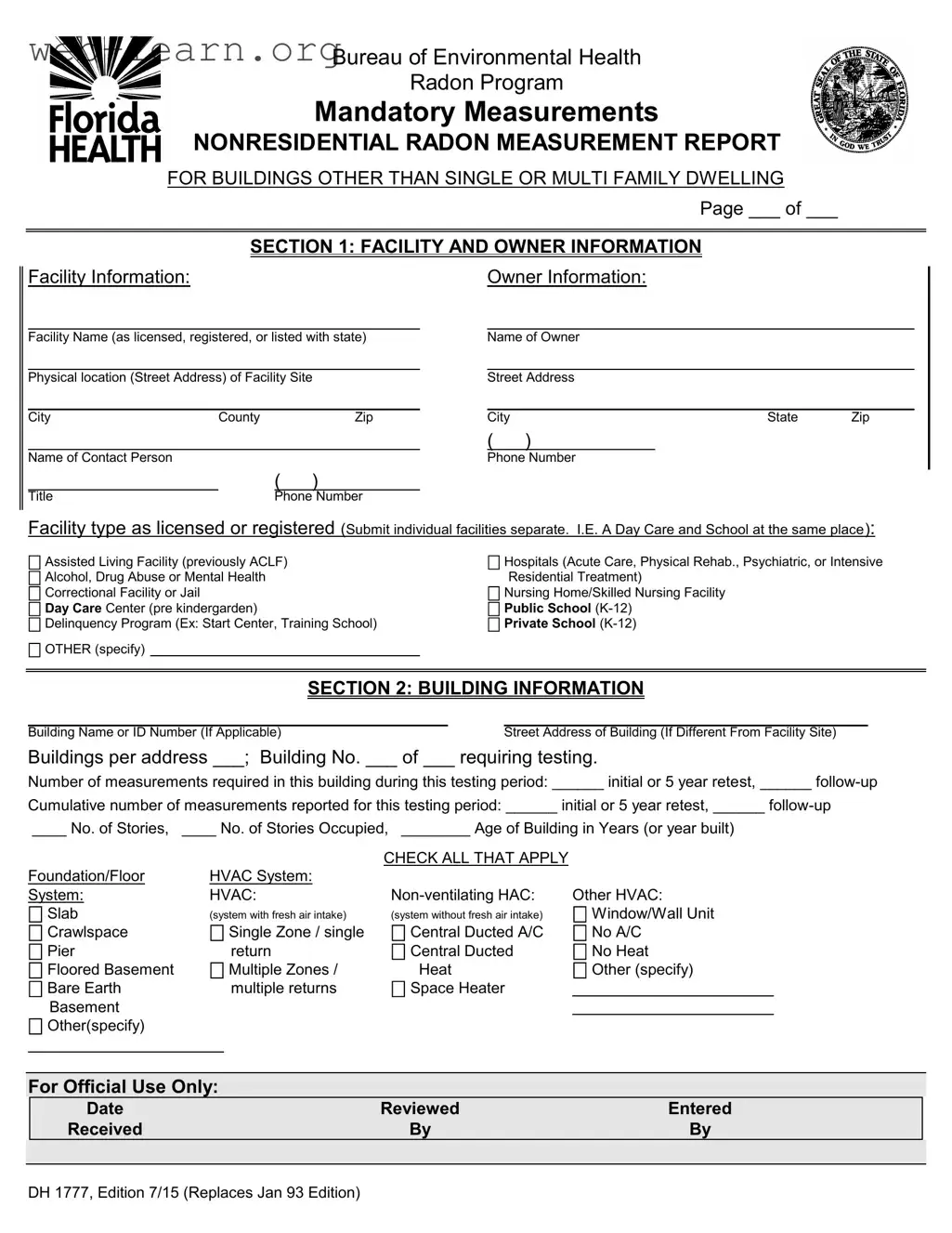
Bureau of Environmental Health
Radon Program
Mandatory Measurements
NONRESIDENTIAL RADON MEASUREMENT REPORT
FOR BUILDINGS OTHER THAN SINGLE OR MULTI FAMILY DWELLING
Page ___ of ___
SECTION 1: FACILITY AND OWNER INFORMATION
Facility Information:
Facility Name (as licensed, registered, or listed with state)
Physical location (Street Address) of Facility Site
City County Zip
Name of Contact Person
( )
Title Phone Number
Owner Information:
Name of Owner
Street Address
City State Zip
( )
Phone Number
Facility type as licensed or registered (Submit individual facilities separate. I.E. A Day Care and School at the same place):
Assisted Living Facility (previously ACLF)
Alcohol, Drug Abuse or Mental Health
Correctional Facility or Jail
Day Care Center (pre kindergarden)
Delinquency Program (Ex: Start Center, Training School)
Hospitals (Acute Care, Physical Rehab., Psychiatric, or Intensive
Residential Treatment)
Nursing Home/Skilled Nursing Facility
Public School (K-12)
Private School (K-12)
OTHER (specify)
SECTION 2: BUILDING INFORMATION
Building Name or ID Number (If Applicable)
Street Address of Building (If Different From Facility Site)
Buildings per address ___; Building No. ___ of ___ requiring testing.
Number of measurements required in this building during this testing period: ______ initial or 5 year retest, ______ follow-up
Cumulative number of measurements reported for this testing period: ______ initial or 5 year retest, ______ follow-up
____ No. of Stories, ____ No. of Stories Occupied, ________ Age of Building in Years (or year built)
CHECK ALL THAT APPLY
Foundation/Floor
System:
Slab
Crawlspace
Pier
Floored Basement
Bare Earth
Basement
Other(specify)
HVAC System:
HVAC:
(system with fresh air intake)
Single Zone / single
return
Multiple Zones /
multiple returns
Non-ventilating HAC:
(system without fresh air intake)
Central Ducted A/C
Central Ducted
Heat
Space Heater
Other HVAC:
Window/Wall Unit
No A/C
No Heat
Other (specify)
For Official Use Only:
Date Reviewed Entered
Received By By
DH 1777, Edition 7/15 (Replaces Jan 93 Edition)
SECTION 3: RESULTS
Measurement Type:
Initial or 5 Year Retest,
Follow-up
Dates of Measurement: FROM / / TO / /
Name of Person who performed Measurement (Placed Device) Certificate No. (If Applicable)
Story Room Result Units
Device
Time in Hours
P for pCi/L or W for WL
AC-Activated Carbon Adsorption, AT-Alpha Track, CR-Continuous Radon Monitor, CW-Continuous
Working Level Monitor, EL-Electret Ion Chamber Long Term, ES-Electret Ion Chamber Short Term, LS-
Liquid Scintillation, RP-RPISU, UT-Unfiltered Alpha Track
SECTION 4
COMPLETE ONLY IF MEASUREMENTS ARE PERFORMED BY A RADON MEASUREMENT BUSINESS
Name of Business and Cert. No.
Name of Specialist and Cert. No.
Signature of Specialist
SECTION 5
COMPLETE ONLY IF MEASUREMENTS ARE PERFORMED BY STAFF EMPLOYED BY THE FACILITY
I hereby certify that the Radon measurements reported herein have been performed in accordance
with Chapter 64E-5, Florida Administrative Code, and Chapter 404, Florida Statutes.
Authorized Representative of Facility
Date
Upon completion of this form, send to:
Department of Health
Bureau of Environmental Health / Radon Program
4052 Bald Cypress Way, Bin #A12
Tallahassee, FL 32399-1720
You may scan the report and email it to RadonReports@FLhealth.gov
For Assistance in Completing this Form call 1-800-543-8279

Form Information

Fact Name Description
Purpose The Florida DH 1777 form is used for reporting radon measurements in nonresidential buildings, ensuring compliance with health standards.
Governing Laws This form is governed by Chapter 64E-5 of the Florida Administrative Code and Chapter 404 of the Florida Statutes.
Measurement Types Measurements can be categorized as initial, 5-year retests, or follow-ups, depending on the testing requirements of the facility.
Submission Instructions After completing the form, it must be sent to the Department of Health, Bureau of Environmental Health, or can be emailed to [email protected].

Detailed Guide for Filling Out Florida Dh 1777

Completing the Florida DH 1777 form requires careful attention to detail. Each section needs accurate information to ensure compliance with state regulations. After filling out the form, you will need to submit it to the appropriate department for processing.

  1. Begin with Section 1, which includes both Facility and Owner Information. Fill in the Facility Name, Physical Location, City, County, and Zip Code.
  2. Provide the Name of the Contact Person and Owner, along with their respective Street Address, City, State, and Zip Code.
  3. Include the Phone Number and Title of the Contact Person.
  4. Select the Facility Type from the provided options, marking only one box.
  5. Move to Section 2, which focuses on Building Information. Enter the Building Name or ID Number if applicable.
  6. Fill in the Street Address of the Building if it differs from the Facility Site.
  7. Indicate the number of buildings per address and specify which building requires testing.
  8. Document the number of measurements required during this testing period, distinguishing between initial or 5-year retest and follow-up measurements.
  9. Record the cumulative number of measurements reported for this testing period.
  10. Specify the number of stories and occupied stories of the building, along with the age of the building.
  11. Choose the appropriate Foundation/Floor System from the options given.
  12. Provide details about the HVAC System, checking all that apply.
  13. Proceed to Section 3 for Results. Indicate the Measurement Type and the Dates of Measurement.
  14. Enter the Name of the Person who performed the measurement and their Certificate Number, if applicable.
  15. Fill in the Story, Room, Result, and Units, along with the Time in Hours for the measurement.
  16. If measurements were performed by a Radon Measurement Business, complete Section 4 with the Business Name and Specialist information.
  17. If performed by staff at the facility, complete Section 5 with the Authorized Representative's name and date.
  18. After completing the form, send it to the Department of Health Bureau of Environmental Health at the specified address or email it to the provided email address.

Obtain Answers on Florida Dh 1777

  1. What is the purpose of the Florida DH 1777 form?

    The Florida DH 1777 form is a mandatory measurement report for nonresidential buildings, specifically designed for facilities that are not single or multi-family dwellings. This form is used to document radon measurement results and ensure compliance with state regulations. It helps track radon levels in various types of facilities, such as hospitals, schools, and nursing homes, to protect public health.

  2. Who is required to complete the DH 1777 form?

    The form must be completed by authorized representatives of facilities that are required to monitor radon levels. This includes owners or designated contact persons for various types of nonresidential buildings, such as assisted living facilities, correctional facilities, and public schools. Each facility must submit a separate form for compliance.

  3. What information is needed to complete the DH 1777 form?

    To accurately fill out the DH 1777 form, several key pieces of information are required:

    • Facility name and physical address
    • Owner's contact information
    • Type of facility (e.g., hospital, day care center)
    • Building information, including age and foundation type
    • Details about the HVAC system
    • Measurement results, including dates and types of measurements

    Completing the form thoroughly ensures accurate reporting and compliance with state regulations.

  4. How are radon measurements reported on the DH 1777 form?

    Radon measurements are reported in a specific section of the DH 1777 form. Users must indicate whether the measurement is an initial test, a five-year retest, or a follow-up. Additionally, the form requires the name of the person who performed the measurement, the results in appropriate units (pCi/L or WL), and the duration of the measurement. This data is crucial for assessing radon levels and determining necessary actions.

  5. Where should the completed DH 1777 form be submitted?

    Once the DH 1777 form is completed, it must be submitted to the Department of Health, specifically the Bureau of Environmental Health/Radon Program. The mailing address is:

    Department of Health
    Bureau of Environmental Health / Radon Program
    4052 Bald Cypress Way, Bin #A12
    Tallahassee, FL 32399-1720

    Alternatively, the form can be scanned and emailed to [email protected]. For assistance with completing the form, individuals can call 1-800-543-8279.

Common mistakes

Filling out the Florida DH 1777 form is crucial for ensuring compliance with radon measurement regulations. However, several common mistakes can hinder the process. One significant error is failing to provide complete facility and owner information. This includes omitting the facility name, physical location, or contact details. Without this information, the form may be deemed incomplete, leading to delays in processing.

Another frequent mistake involves incorrect building information. Many individuals neglect to specify the correct building name or ID number, or they may confuse the street address of the building with that of the facility site. It is essential to ensure that these details are accurate and clearly stated, as discrepancies can result in further complications.

Additionally, individuals often miscalculate the number of measurements required during the testing period. This section is vital for determining compliance with state regulations. Failing to report the correct number of initial or follow-up measurements can lead to significant issues, including potential penalties.

Moreover, misunderstanding the HVAC system options is a common pitfall. The form requires specific selections regarding the type of HVAC system in use. Selecting the wrong option or leaving it blank can create confusion and may affect the interpretation of results. It’s important to check all that apply carefully.

Many people also overlook the requirement for signatures and certifications. If measurements are performed by a radon measurement business or facility staff, the appropriate signatures must be included. Omitting this step can invalidate the report and necessitate resubmission.

Finally, failing to send the completed form to the correct address or email can cause delays in processing. It is vital to double-check the submission details to ensure that the report reaches the Department of Health Bureau of Environmental Health promptly. Taking these steps can help avoid unnecessary setbacks and ensure compliance with radon measurement regulations.

Documents used along the form

The Florida DH 1777 form is essential for reporting radon measurements in nonresidential buildings. However, several other documents may accompany this form to ensure compliance with health and safety regulations. Below is a list of related forms and documents that can provide additional context and support for the radon measurement process.

  • Florida DH 1778: This form is used for the radon mitigation system installation report. It documents the methods and materials used to reduce radon levels in a building.
  • Florida DH 1769: This is the radon measurement business certification form. It verifies that the business conducting the radon tests is licensed and qualified to perform such measurements.
  • Radon Measurement Protocol: This document outlines the procedures and guidelines for conducting radon measurements, ensuring consistency and reliability in testing methods.
  • Radon Mitigation System Design Plan: This plan details the design and layout of a radon mitigation system, including specifications for installation and expected performance outcomes.
  • Florida Department of Health Radon Program Brochure: This informational brochure provides an overview of radon, its health risks, and guidance on testing and mitigation options available to building owners.
  • Radon Measurement Device Calibration Certificate: This certificate confirms that the measurement devices used for testing have been calibrated according to industry standards, ensuring accurate results.
  • Post-Mitigation Radon Measurement Report: After installing a mitigation system, this report documents the radon levels in the building to confirm that the system is effectively reducing radon concentrations.
  • Facility Inspection Report: This report includes findings from inspections related to the building’s compliance with health and safety regulations, which may impact radon levels.

These documents work together to create a comprehensive approach to radon measurement and mitigation in Florida. By understanding each form's purpose, facility owners can better navigate the requirements and ensure the safety of their buildings.

Similar forms

The Florida DH 1777 form is a crucial document used for reporting radon measurements in nonresidential buildings. Several other forms share similarities with it, primarily in their purpose of collecting information related to health and safety in various facilities. Here’s a list of eight documents that are similar to the Florida DH 1777 form:

  • Florida DH 1760: This form is used for reporting radon measurements in residential properties. Like the DH 1777, it requires facility information and measurement results, but it focuses on single-family and multi-family dwellings.
  • Florida DH 1776: This document serves as a radon measurement report for schools. It shares a similar structure with the DH 1777, including sections for facility details and measurement results, tailored specifically for educational institutions.
  • EPA Form 590: This is a radon testing report form used nationwide. It collects data on radon levels and requires similar facility and measurement information, making it comparable to the DH 1777 in its purpose.
  • OSHA Form 300: Used for recording workplace injuries and illnesses, this form collects detailed information about incidents. While focused on health and safety, its data collection format resembles the structured approach of the DH 1777.
  • State Health Department Radon Report: Many states have their own radon reporting forms that align closely with the DH 1777. These forms collect similar data on radon levels and facility characteristics, emphasizing public health.
  • Florida Department of Health Environmental Health Form: This form is used for various environmental health assessments. It shares the need for facility and measurement data, similar to the DH 1777, but may cover different environmental hazards.
  • Radon Measurement Business Certification Form: This document certifies businesses that conduct radon measurements. It requires information about the business and the measurements performed, paralleling the data collection aspect of the DH 1777.
  • Indoor Air Quality Assessment Form: This form assesses the quality of indoor air in various facilities. It collects data on environmental conditions, much like the DH 1777 gathers information on radon levels and facility characteristics.

Each of these forms plays a role in ensuring safety and compliance within different types of facilities, highlighting the importance of accurate data collection in protecting public health.

Dos and Don'ts

When filling out the Florida DH 1777 form, keep these important tips in mind:

  • Double-check all facility and owner information for accuracy.
  • Use clear and legible handwriting or type the information to avoid confusion.
  • Ensure that you check all applicable boxes regarding the facility type and HVAC system.
  • Submit the form promptly to the Department of Health after completion.

Avoid these common mistakes:

  • Do not leave any sections blank; complete every required field.
  • Avoid using abbreviations or acronyms that may not be universally understood.
  • Do not forget to sign and date the form if required.
  • Refrain from submitting the form without reviewing it for errors first.

Misconceptions

Understanding the Florida DH 1777 form is essential for compliance, but several misconceptions can lead to confusion. Here are six common misunderstandings:

  • It’s only for residential buildings. The DH 1777 form is specifically designed for nonresidential buildings, including facilities like schools, hospitals, and daycares.
  • Only certified professionals can submit the form. While it is recommended to have trained personnel conduct radon measurements, facility staff can also perform the tests and submit the form.
  • Measurements are optional. For certain facilities, such as schools and daycare centers, radon measurements are mandatory and must be reported.
  • All buildings need the same number of measurements. The required number of measurements can vary based on the building type and its size. Always check specific requirements for your facility.
  • Once submitted, the form cannot be amended. If errors are found after submission, you can contact the Department of Health to correct the information.
  • The results are only for the owner’s knowledge. Results must be reported to the Department of Health, and appropriate actions may be required based on those results.

Addressing these misconceptions promptly can help ensure compliance and maintain a safe environment in nonresidential facilities.

Key takeaways

When filling out and using the Florida DH 1777 form, it is essential to keep the following key takeaways in mind:

  • Accurate Information: Ensure that all facility and owner information is complete and accurate. This includes the facility name, physical location, and contact details.
  • Building Details: Provide specific building information, including the age of the building, number of stories, and foundation type. This data is crucial for proper assessment.
  • Measurement Results: Clearly document the measurement type, dates, and results. Include the name of the person who performed the measurement and their certification number if applicable.
  • Submission Process: After completing the form, submit it to the Department of Health Bureau of Environmental Health via mail or email. For assistance, a contact number is provided for inquiries.