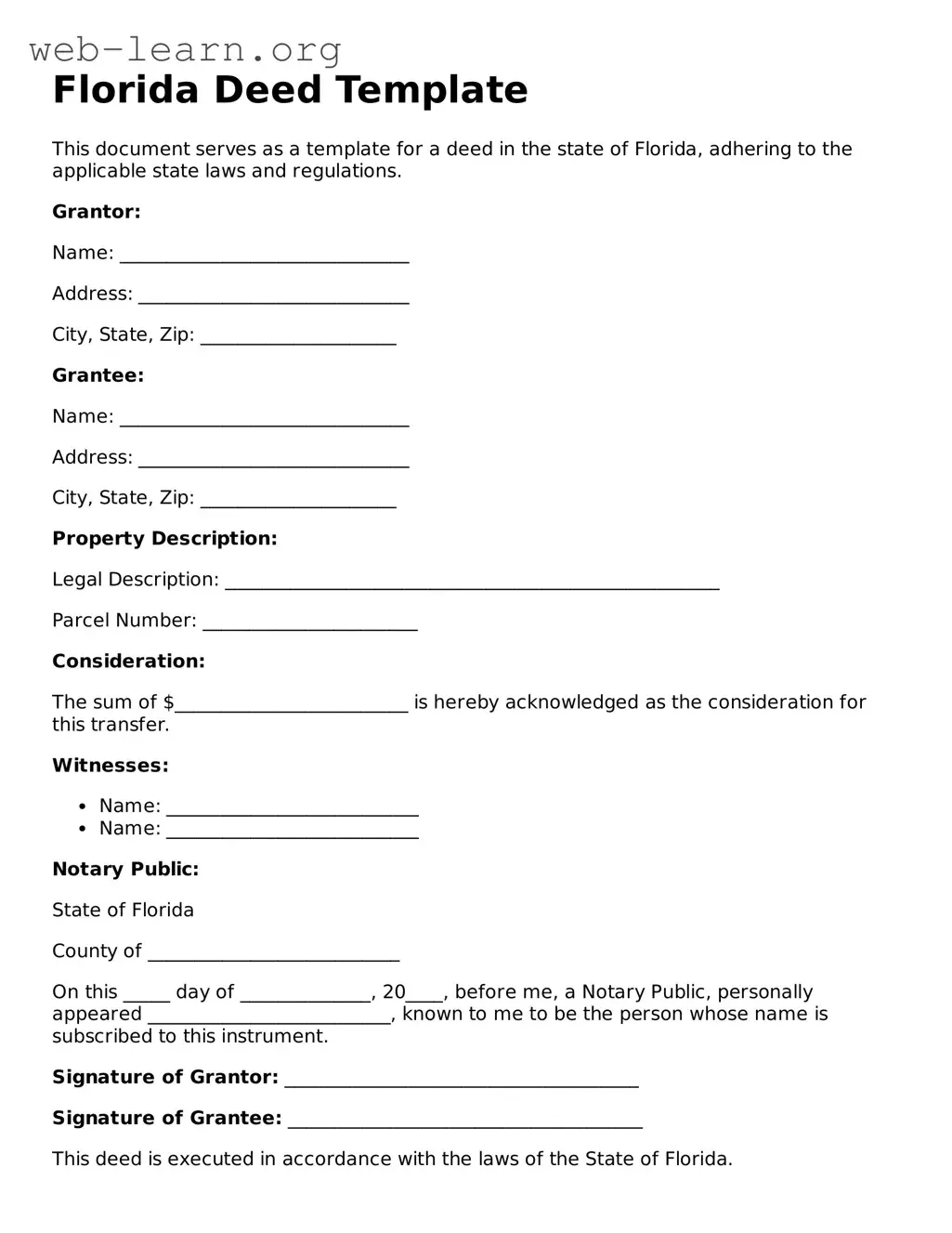
The Florida Deed form is a crucial document in real estate transactions, serving as the official record of property transfer between parties. It outlines essential details such as the names of the grantor (the seller) and grantee (the buyer), along with a clear description of the property being conveyed. This form also specifies the type of deed being used, which can vary depending on the nature of the transfer—common types include warranty deeds, quitclaim deeds, and special purpose deeds. Additionally, the Florida Deed form must be signed and notarized to ensure its validity. It is important to note that the deed must be recorded with the local county clerk to provide public notice of the new ownership. Understanding these key aspects is vital for anyone involved in buying or selling property in Florida, as they help protect the rights of both parties and facilitate a smooth transaction.
Florida Deed Template
This document serves as a template for a deed in the state of Florida, adhering to the applicable state laws and regulations.
Grantor:
Name: _______________________________
Address: _____________________________
City, State, Zip: _____________________
Grantee:
Name: _______________________________
Address: _____________________________
City, State, Zip: _____________________
Property Description:
Legal Description: _____________________________________________________
Parcel Number: _______________________
Consideration:
The sum of $_________________________ is hereby acknowledged as the consideration for this transfer.
Witnesses:
Notary Public:
State of Florida
County of ___________________________
On this _____ day of ______________, 20____, before me, a Notary Public, personally appeared __________________________, known to me to be the person whose name is subscribed to this instrument.
Signature of Grantor: ______________________________________
Signature of Grantee: ______________________________________
This deed is executed in accordance with the laws of the State of Florida.
| Fact Name | Details |
|---|---|
| Definition | A Florida deed form is a legal document used to transfer ownership of real property in Florida. |
| Types of Deeds | Common types include warranty deeds, quitclaim deeds, and special warranty deeds. |
| Governing Law | The Florida Statutes, particularly Chapter 689, govern the execution and validity of deeds. |
| Execution Requirements | For a deed to be valid, it must be signed by the grantor and acknowledged before a notary public. |
| Recording | Deeds must be recorded in the county where the property is located to provide public notice of ownership. |
| Consideration | While not always required, a nominal consideration (such as $10) is often included in the deed. |
| Legal Description | A precise legal description of the property must be included in the deed to avoid ambiguity. |
| Transfer Tax | Florida imposes a documentary stamp tax on the transfer of real estate, based on the sale price. |
| Title Insurance | Purchasing title insurance is recommended to protect against potential title defects after the transfer. |
| Revocation | A deed can be revoked by the grantor, but this typically requires a formal process and new documentation. |
After completing the Florida Deed form, you will need to submit it to the appropriate county clerk's office for recording. This step is essential to ensure that the transfer of property ownership is officially recognized. Following the recording, you should keep a copy for your records.
What is a Florida Deed form?
A Florida Deed form is a legal document used to transfer ownership of real estate in the state of Florida. It serves as a record of the transaction and outlines the details of the property being transferred, including the names of the buyer and seller, a description of the property, and any conditions of the sale. There are several types of deeds, such as warranty deeds and quitclaim deeds, each serving different purposes depending on the nature of the transaction.
Who needs to use a Florida Deed form?
Anyone involved in the sale or transfer of real estate in Florida should use a Florida Deed form. This includes:
Using the appropriate deed form ensures that the transfer is legally recognized and protects the rights of all parties involved.
How do I complete a Florida Deed form?
Completing a Florida Deed form involves several steps:
It is advisable to consult with a legal professional if you have questions or need assistance in completing the form.
What happens after the Florida Deed form is recorded?
Once the Florida Deed form is recorded, several important things occur:
Recording the deed is a crucial step in protecting the new owner's rights and ensuring that the transaction is legally binding.
Filling out a Florida Deed form can seem straightforward, but many people make common mistakes that can lead to complications down the line. Understanding these pitfalls can save time and frustration. Here are six mistakes to watch out for when completing this important document.
One frequent error involves incorrect names. It’s essential to ensure that the names of all parties involved are spelled correctly and match their legal identification. A simple typo can create confusion and potentially invalidate the deed. Additionally, if a person is married, both spouses typically need to be included in the deed, even if only one spouse is the primary owner. Omitting a spouse can lead to legal disputes in the future.
Another common mistake is failing to properly describe the property. The legal description of the property must be accurate and detailed. This description often includes lot numbers, block numbers, or other identifiers specific to the property. Relying on a general address can lead to ambiguity and challenges in property ownership. It’s advisable to consult a property survey or tax records to ensure accuracy.
Many individuals overlook the importance of signatures. All parties involved in the transaction must sign the deed for it to be valid. In some cases, a witness may also be required, depending on the type of deed being used. Not having the necessary signatures can render the deed unenforceable. Always double-check that everyone who needs to sign has done so.
Moreover, people sometimes forget to have the deed notarized. In Florida, notarization is often required to ensure the authenticity of the signatures. A notary public verifies the identity of the signers and confirms that they are signing willingly. Without notarization, the deed may not hold up in court or during a property transfer.
Another mistake involves not recording the deed with the county clerk’s office. Once the deed is signed and notarized, it must be filed to provide public notice of the ownership change. Failing to record the deed can lead to issues with future buyers or lenders who may not recognize the transfer of ownership. Recording the deed protects your legal rights and interests in the property.
Finally, individuals often neglect to seek legal advice or assistance when filling out the deed. While it may seem like a simple task, the implications of errors can be significant. Consulting with a legal professional can help clarify any uncertainties and ensure that the deed is completed correctly. This proactive approach can prevent headaches and costly mistakes in the future.
The Florida Deed form is a crucial document in the process of transferring property ownership. However, several other forms and documents often accompany the deed to ensure a smooth transaction and compliance with state regulations. Below is a list of these related documents, each serving a specific purpose in the property transfer process.
In summary, these documents play a vital role in the property transfer process in Florida. Each serves to protect the interests of both the buyer and seller, ensuring that all aspects of the transaction are clearly defined and legally binding.
The Deed form is a critical document in property transactions, but it shares similarities with several other legal documents. Here are four documents that are comparable to a Deed form:
When filling out the Florida Deed form, attention to detail is crucial. Here is a guide on what to do and what to avoid:
When dealing with Florida deed forms, several misconceptions can lead to confusion. Understanding these misunderstandings is essential for anyone involved in property transactions in the state. Below are nine common misconceptions, along with clarifications to help clear up any confusion.
Many people assume that all deed forms are interchangeable. In reality, different types of deeds serve specific purposes, such as warranty deeds, quitclaim deeds, and special purpose deeds. Each has its own legal implications and protections.
While notarization is often required for a deed to be recorded, it is not always necessary for the deed to be valid. The essential requirement is that the deed must be signed by the grantor.
Some believe that a deed must be filed with the county clerk right after it is signed. While it is advisable to record a deed promptly to protect against claims from third parties, the deed is still valid without immediate recording.
Many people think that only licensed attorneys can draft a deed. However, individuals can prepare their own deeds, provided they follow the legal requirements set forth by Florida law.
Some may believe that a verbal agreement can constitute a deed. In Florida, a deed must be in writing to be legally enforceable, ensuring clarity and preventing disputes.
While it is true that a deed is a binding document once executed, it can be amended or revoked under certain circumstances. This often requires a new deed to be drafted and recorded.
Not all property transfers necessitate a deed. For example, property transferred through a will or trust may not require a separate deed, as the transfer occurs through the terms of the estate planning document.
Many people think deeds apply solely to real estate transactions. However, deeds can also be used for personal property transfers, such as vehicles or boats, depending on the circumstances.
Recording a deed provides public notice but does not guarantee that it cannot be contested. Various legal grounds exist for challenging a deed, such as fraud or lack of capacity.
By addressing these misconceptions, individuals can navigate the complexities of Florida deed forms with greater confidence and clarity. Understanding the nuances of property transfer is crucial for making informed decisions.
When dealing with the Florida Deed form, understanding the process is essential for a smooth transaction. Here are some key takeaways to consider:
By following these guidelines, individuals can navigate the Florida Deed process more effectively.
Warranty Deed Form - Understanding how to read a deed is essential for any property owner.
Warranty Deed Form Idaho - This document can help streamline the transfer process for all parties.
Alabama Deed Transfer Form - Real estate agents frequently assist clients with the Deed process.