In Florida, homeowners facing the possibility of foreclosure may find a Deed in Lieu of Foreclosure to be a viable alternative. This legal document allows a homeowner to voluntarily transfer ownership of their property back to the lender in exchange for the cancellation of the mortgage debt. It can provide a smoother exit from financial distress, helping to avoid the lengthy and often stressful foreclosure process. When executed properly, this form can benefit both parties: homeowners can mitigate the impact on their credit score, while lenders can recover their investment without the costs associated with foreclosure proceedings. Essential elements of the form include the identification of the parties involved, a clear description of the property, and the acknowledgment of the homeowner's voluntary decision to relinquish their rights. Additionally, the form typically outlines any potential liabilities or agreements related to the transaction, ensuring that both the lender and homeowner understand their responsibilities. By choosing a Deed in Lieu of Foreclosure, homeowners may find a pathway to financial recovery, while lenders can streamline their asset management processes.
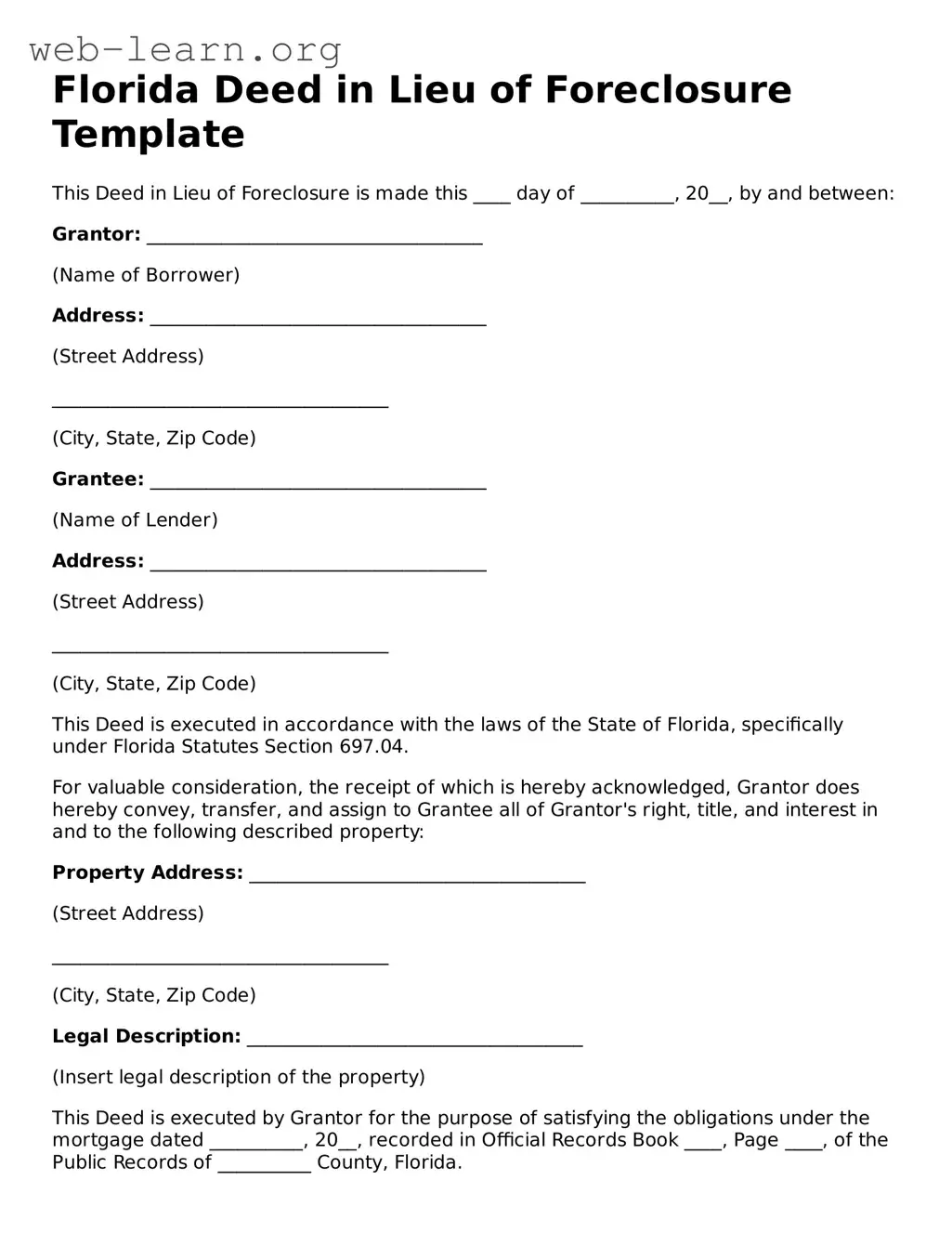
Florida Deed in Lieu of Foreclosure Template
This Deed in Lieu of Foreclosure is made this ____ day of __________, 20__, by and between:
Grantor: ____________________________________
(Name of Borrower)
Address: ____________________________________
(Street Address)
____________________________________
(City, State, Zip Code)
Grantee: ____________________________________
(Name of Lender)
Address: ____________________________________
(Street Address)
____________________________________
(City, State, Zip Code)
This Deed is executed in accordance with the laws of the State of Florida, specifically under Florida Statutes Section 697.04.
For valuable consideration, the receipt of which is hereby acknowledged, Grantor does hereby convey, transfer, and assign to Grantee all of Grantor's right, title, and interest in and to the following described property:
Property Address: ____________________________________
(Street Address)
____________________________________
(City, State, Zip Code)
Legal Description: ____________________________________
(Insert legal description of the property)
This Deed is executed by Grantor for the purpose of satisfying the obligations under the mortgage dated __________, 20__, recorded in Official Records Book ____, Page ____, of the Public Records of __________ County, Florida.
The Grantor hereby represents and warrants that:
In consideration of this deed, the Grantee agrees to:
IN WITNESS WHEREOF, the Grantor has executed this Deed as of the day and year first above written.
______________________________
(Signature of Grantor)
______________________________
(Printed Name of Grantor)
STATE OF FLORIDA
COUNTY OF _______________
Before me, the undersigned authority, personally appeared ________________________, who is known to me or has produced ______________________ as identification, and who did take an oath and says that he/she executed the foregoing instrument for the purposes therein expressed.
WITNESS my hand and official seal this ____ day of __________, 20__.
______________________________
(Notary Public Signature)
______________________________
(Printed Name of Notary Public)
My Commission Expires: ________________
| Fact Name | Description |
|---|---|
| Definition | A deed in lieu of foreclosure is a legal document where a borrower voluntarily transfers ownership of their property to the lender to avoid foreclosure. |
| Governing Laws | The process is governed by Florida Statutes, particularly Chapter 697, which addresses mortgages and deeds. |
| Eligibility | Homeowners facing financial difficulties may be eligible if they are unable to keep up with mortgage payments. |
| Advantages | This process can help borrowers avoid the lengthy and costly foreclosure process while minimizing damage to their credit score. |
| Disadvantages | Borrowers may still be liable for any deficiency balance if the property's value is less than the mortgage owed. |
| Process | Typically, the borrower must submit a request to the lender, who will review the financial situation before accepting the deed. |
| Impact on Credit | A deed in lieu of foreclosure is less damaging to a credit score than a foreclosure but will still have negative effects. |
| Tax Implications | Borrowers may face tax consequences, as the IRS could consider forgiven debt as taxable income. |
| Alternatives | Alternatives include loan modifications, short sales, and traditional foreclosure, each with its own implications. |
After completing the Florida Deed in Lieu of Foreclosure form, you'll need to submit it to the appropriate parties. This typically includes your lender and possibly the county clerk's office. Ensure you keep copies of all documents for your records.
A Deed in Lieu of Foreclosure is a legal agreement where a homeowner voluntarily transfers ownership of their property to the lender to avoid foreclosure. This option can be beneficial for both parties. The homeowner can mitigate the negative impact on their credit score, while the lender can save time and resources that would otherwise be spent on the foreclosure process.
There are several advantages to consider:
While a Deed in Lieu of Foreclosure can be advantageous, it is important to be aware of potential risks:
To begin the process, follow these steps:
It is advisable to consult with a legal or financial advisor to ensure that you understand the implications and to help you navigate the process effectively.
Filling out the Florida Deed in Lieu of Foreclosure form can be a complex process. Many individuals make mistakes that can complicate or delay their efforts. One common error is failing to provide accurate property information. The legal description of the property must be precise. Any discrepancies can lead to confusion and potential legal issues down the line.
Another frequent mistake is neglecting to include all necessary signatures. Both the borrower and any co-borrowers must sign the document. Missing a signature can invalidate the deed and prolong the foreclosure process. It’s essential to double-check that all parties have signed before submission.
Inadequate understanding of the implications of a deed in lieu is another pitfall. Some individuals may not fully grasp how this action affects their credit score and future borrowing potential. It’s crucial to consult with a financial advisor or legal expert to understand these consequences thoroughly.
People often overlook the requirement for a notary. The deed must be notarized to be legally binding. Without this step, the document may not be accepted by the lender, resulting in additional complications.
Another common mistake involves failing to communicate with the lender. It is vital to keep the lender informed throughout the process. Lack of communication can lead to misunderstandings and may hinder the acceptance of the deed.
Some individuals mistakenly believe that a deed in lieu eliminates all debt. While it can relieve some financial burdens, it may not cover all associated costs, such as taxes or other liens. Understanding the full scope of liabilities is essential.
Additionally, people sometimes rush the process. Filling out the form hastily can lead to errors or omissions. Taking the time to review each section carefully can prevent unnecessary delays.
Another error involves not providing supporting documentation. Lenders often require additional paperwork to process the deed. Failing to include these documents can result in rejection or delays in the acceptance of the deed.
Some individuals also forget to check for outstanding liens on the property. If there are existing liens, the deed in lieu may not be accepted until those are resolved. Conducting a thorough title search can help identify any issues beforehand.
Lastly, misunderstanding the timeline for submission can lead to issues. It’s important to be aware of any deadlines set by the lender. Missing a deadline can complicate the process and may lead to foreclosure proceedings continuing.
A Deed in Lieu of Foreclosure is a legal document that allows a homeowner to transfer ownership of their property back to the lender to avoid foreclosure. When engaging in this process, several other forms and documents are often necessary to ensure a smooth transaction. Below is a list of commonly used documents that complement the Deed in Lieu of Foreclosure.
Understanding these documents is essential for anyone considering a Deed in Lieu of Foreclosure. Each plays a vital role in protecting both the borrower and the lender throughout the process, ensuring that all parties are informed and their interests are safeguarded.
The Deed in Lieu of Foreclosure is a legal document that allows a homeowner to voluntarily transfer their property to the lender in order to avoid foreclosure. Several other documents share similarities with this form, particularly in their purpose of resolving financial distress or transferring property rights. Below is a list of nine such documents, along with a brief explanation of how each one relates to the Deed in Lieu of Foreclosure.
Understanding these documents can provide insight into the various options available to homeowners facing financial difficulties. Each document serves a unique purpose, yet they all share the common goal of addressing property ownership and financial obligations.
When filling out the Florida Deed in Lieu of Foreclosure form, it’s important to approach the task with care. Here are some essential do's and don'ts to consider:
By following these guidelines, you can help ensure a smoother process as you navigate this important step in the foreclosure process.
Many people have misunderstandings about the Florida Deed in Lieu of Foreclosure. Here are five common misconceptions:
While a deed in lieu can help eliminate the mortgage obligation, it does not always guarantee that all debt is forgiven. The lender may still pursue a deficiency judgment in some cases.
A deed in lieu of foreclosure is different from a short sale. In a short sale, the property is sold for less than the mortgage amount, and the lender must approve the sale. A deed in lieu involves transferring ownership directly to the lender without a sale.
Both a deed in lieu and foreclosure can negatively impact your credit score. The difference in impact varies by individual circumstances, but a deed in lieu is still considered a serious derogatory mark.
The deed in lieu process can take time and may involve negotiations with the lender. It is not always a straightforward solution and requires careful consideration.
While it can relieve some financial burdens, a deed in lieu does not necessarily release you from all liabilities. You may still face tax implications or other financial responsibilities depending on your situation.
When dealing with the Florida Deed in Lieu of Foreclosure form, it's important to understand several key aspects to ensure a smooth process. Here are some essential takeaways:
By keeping these points in mind, homeowners can navigate the Deed in Lieu of Foreclosure process more effectively.
What Does an Arizona Homeowner Lose When Choosing to Use Deed in Lieu of Foreclosure? - Homeowners should document all communications with the lender regarding the deed.
California Voluntary Property Surrender Document - A Deed in Lieu can offer a way out of a difficult financial situation with dignity.