Homepage Blank Florida Complaint Form
Outline

When faced with concerns about an attorney's conduct in Florida, individuals can utilize the Florida Complaint form as a structured way to voice their grievances. This form is divided into several key sections, each designed to gather specific information that will assist in the evaluation of the complaint. The first part requires the complainant to provide personal details, including their name, address, and contact information. This ensures that the Florida Bar can reach out for any necessary follow-up. Next, the form requests details about the attorney in question, emphasizing the importance of providing accurate contact information to avoid confusion, especially since many attorneys may share similar names. The third section delves into the facts and allegations, where the complainant must outline the specific issues in chronological order, supported by relevant documentation. This is crucial, as vague claims without factual backing may hinder the investigation process. Additionally, the form allows for the inclusion of witnesses, should there be any who can corroborate the claims made. Finally, the complainant must sign the form, affirming the truthfulness of their statements under penalty of perjury. It is essential to follow the guidelines closely, as any deviation could result in delays or rejection of the complaint. Understanding these components can significantly enhance the effectiveness of the complaint process.


Sample - Florida Complaint Form

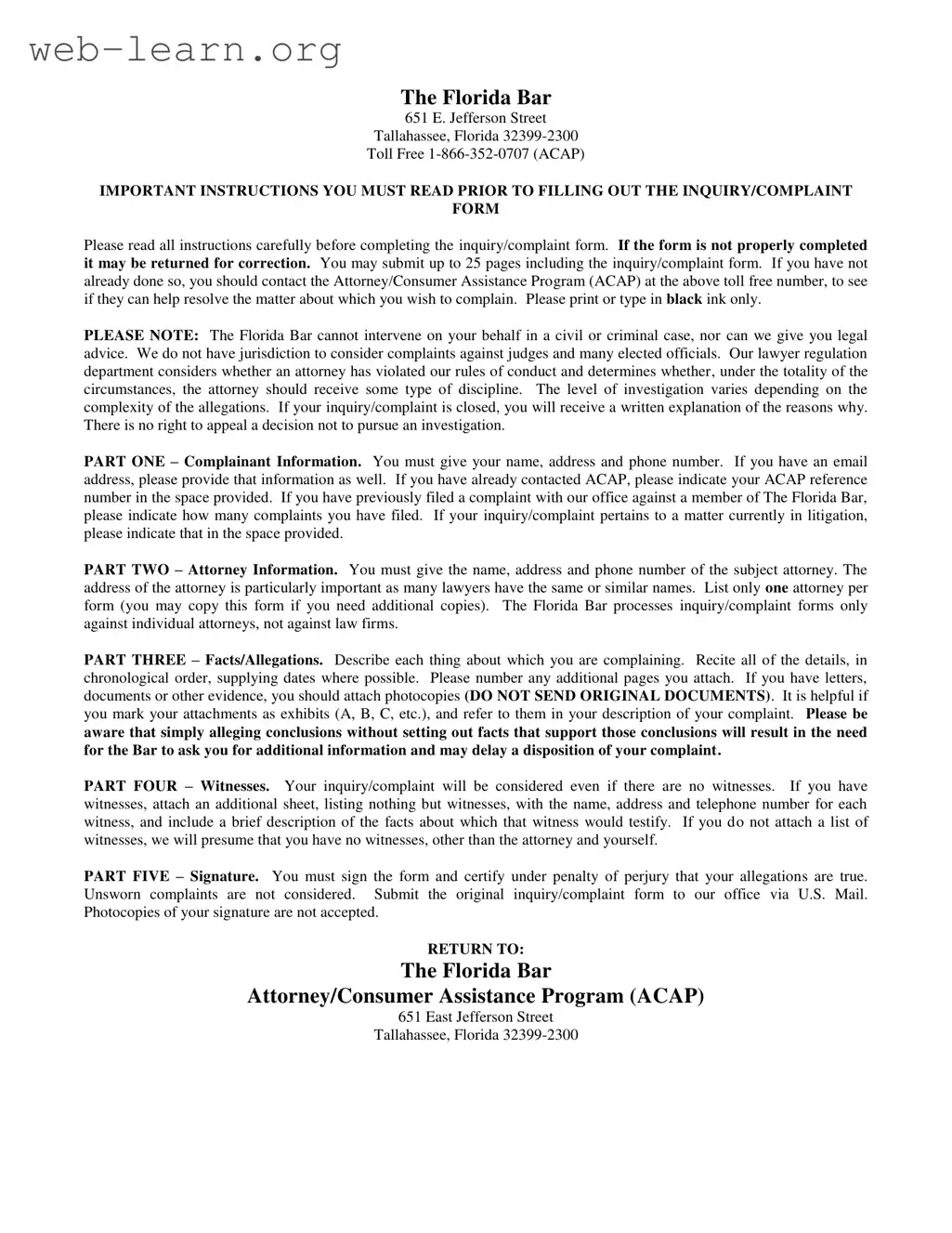
The Florida Bar
651 E. Jefferson Street
Tallahassee, Florida 32399-2300
Toll Free 1-866-352-0707 (ACAP)
IMPORTANT INSTRUCTIONS YOU MUST READ PRIOR TO FILLING OUT THE INQUIRY/COMPLAINT
FORM
Please read all instructions carefully before completing the inquiry/complaint form. If the form is not properly completed
it may be returned for correction. You may submit up to 25 pages including the inquiry/complaint form. If you have not
already done so, you should contact the Attorney/Consumer Assistance Program (ACAP) at the above toll free number, to see
if they can help resolve the matter about which you wish to complain. Please print or type in black ink only.
PLEASE NOTE: The Florida Bar cannot intervene on your behalf in a civil or criminal case, nor can we give you legal
advice. We do not have jurisdiction to consider complaints against judges and many elected officials. Our lawyer regulation
department considers whether an attorney has violated our rules of conduct and determines whether, under the totality of the
circumstances, the attorney should receive some type of discipline. The level of investigation varies depending on the
complexity of the allegations. If your inquiry/complaint is closed, you will receive a written explanation of the reasons why.
There is no right to appeal a decision not to pursue an investigation.
PART ONE Complainant Information. You must give your name, address and phone number. If you have an email
address, please provide that information as well. If you have already contacted ACAP, please indicate your ACAP reference
number in the space provided. If you have previously filed a complaint with our office against a member of The Florida Bar,
please indicate how many complaints you have filed. If your inquiry/complaint pertains to a matter currently in litigation,
please indicate that in the space provided.
PART TWO Attorney Information. You must give the name, address and phone number of the subject attorney. The
address of the attorney is particularly important as many lawyers have the same or similar names. List only one attorney per
form (you may copy this form if you need additional copies). The Florida Bar processes inquiry/complaint forms only
against individual attorneys, not against law firms.
PART THREE Facts/Allegations. Describe each thing about which you are complaining. Recite all of the details, in
chronological order, supplying dates where possible. Please number any additional pages you attach. If you have letters,
documents or other evidence, you should attach photocopies (DO NOT SEND ORIGINAL DOCUMENTS). It is helpful if
you mark your attachments as exhibits (A, B, C, etc.), and refer to them in your description of your complaint. Please be
aware that simply alleging conclusions without setting out facts that support those conclusions will result in the need
for the Bar to ask you for additional information and may delay a disposition of your complaint.
PART FOUR Witnesses. Your inquiry/complaint will be considered even if there are no witnesses. If you have
witnesses, attach an additional sheet, listing nothing but witnesses, with the name, address and telephone number for each
witness, and include a brief description of the facts about which that witness would testify. If you do not attach a list of
witnesses, we will presume that you have no witnesses, other than the attorney and yourself.
PART FIVE Signature. You must sign the form and certify under penalty of perjury that your allegations are true.
Unsworn complaints are not considered. Submit the original inquiry/complaint form to our office via U.S. Mail.
Photocopies of your signature are not accepted.
RETURN TO:
The Florida Bar
Attorney/Consumer Assistance Program (ACAP)
651 East Jefferson Street
Tallahassee, Florida 32399-2300
NOTICE
Mailing Instructions
The Florida Bar converts its disciplinary files to electronic media. All submissions are being scanned
into an electronic record and hard copies are discarded. To help ensure the timely processing of your
inquiry/complaint, please review the following guidelines prior to submitting it to our office.
1. Please limit your submission to no more than 25 pages including exhibits. If you have
additional documents available, please make reference to them in your written submission as
available upon request. Should Bar counsel need to obtain copies of any such documents, a
subsequent request will be sent to you.
2. Please do not bind, or index your documents. You may underline but do not highlight
documents under any circumstances. We scan documents for use in our disciplinary files and
when scanned, your document highlighting will either not be picked up or may obscure any
underlying text.
3. Please refrain from attaching media such as audio tapes or CDs, oversized documents, or
photographs. We cannot process any media that cannot be scanned into the electronic record.
4. Please do not submit your original documents. All documents will be discarded after
scanning and we will not be able to return any originals submitted to our office. The only
original document that should be provided to our office is the inquiry/complaint form.
5. Please do not submit confidential or privileged information. Documents submitted to our
office become public record. Confidential/privileged information should be redacted. Such
information includes, but is not limited to, bank account numbers, social security numbers, credit
card account numbers, medical records, dependency matters, termination of parental rights,
guardian ad litem records, child abuse records, adoption records, documents containing names of
minor children, original birth and death certificates, Baker Act records, grand jury records, and
juvenile delinquency records. If information of this nature is important to your submission,
please describe the nature of the information and indicate that it is available upon request. Bar
counsel will contact you to make appropriate arrangements for the protection of any such
information that is required as part of the investigation of the complaint.
Please be aware that materials received that do not meet these guidelines may be returned. Thank
you for your consideration in this respect.
The Florida Bar
Inquiry/Complaint Form
PART ONE (See Page 1, PART ONE Complainant Information.):
Your Name: _________________________________________________________________________
Organization: ________________________________________________________________________
Address: ____________________________________________________________________________
City, State, Zip Code: __________________________________________________________________
Telephone: __________________________________________________________________________
E-mail: _____________________________________________________________________________
ACAP Reference No.: _________________________________________________________________
Have you ever filed a complaint against a member of The Florida Bar: Yes ______ No ______
If yes, how many complaints have you filed? ______
Does this complaint pertain to a matter currently in litigation? Yes ______ No ______
PART TWO (See Page 1, PART TWO Attorney Information.):
Attorney’s Name: _____________________________________________________________________
Address: ____________________________________________________________________________
City, State, Zip Code: __________________________________________________________________
Telephone: __________________________________________________________________________
PART THREE (See Page 1, PART THREE Facts/Allegations.): The specific thing or things I
am complaining about are: (attach additional sheets as necessary)
PART FOUR (See Page 1, PART FOUR Witnesses.): The witnesses in support of my
allegations are: [see attached sheet].
PART FIVE (See Page 1, PART FIVE Signature.): Under penalties of perjury, I declare that
the foregoing facts are true, correct and complete.
_________________________________________________
Print Name
_________________________________________________
Signature
_________________________________________________
Date

Form Information

Fact Name Description
Submission Limit The Florida Complaint form allows for a maximum of 25 pages to be submitted, including the inquiry/complaint form itself.
Jurisdiction Limitations The Florida Bar cannot consider complaints against judges or many elected officials, nor can it provide legal advice.
Signature Requirement Complainants must sign the form and certify that their allegations are true under penalty of perjury. Unsworn complaints will not be accepted.
Public Record All documents submitted to The Florida Bar become public records. Confidential or privileged information must be redacted before submission.

Detailed Guide for Filling Out Florida Complaint

Filling out the Florida Complaint form is an important step in addressing concerns about an attorney's conduct. Once completed, the form should be submitted to the Florida Bar for review. It is essential to provide accurate and thorough information to facilitate the investigation process.

  1. Obtain the Florida Complaint form from the Florida Bar website or their office.
  2. Read all instructions carefully before starting to fill out the form.
  3. In PART ONE – Complainant Information, provide your name, organization (if applicable), address, city, state, zip code, telephone number, and email address. Include your ACAP reference number if you have one.
  4. Indicate whether you have previously filed a complaint against a member of The Florida Bar and, if so, how many complaints you have filed. Also, specify if your complaint pertains to a matter currently in litigation.
  5. In PART TWO – Attorney Information, enter the attorney's name, address, city, state, zip code, and telephone number. Ensure the address is accurate to avoid confusion with similarly named attorneys.
  6. In PART THREE – Facts/Allegations, detail your complaint in chronological order. Include specific dates and describe the facts supporting your allegations. Number any additional pages you attach and mark them as exhibits (A, B, C, etc.).
  7. In PART FOUR – Witnesses, list any witnesses who can support your claims. Attach an additional sheet with their names, addresses, and telephone numbers, along with a brief description of what they can testify about.
  8. In PART FIVE – Signature, sign and date the form, certifying that your allegations are true under penalty of perjury. Remember, unsworn complaints will not be accepted.
  9. Submit the original form via U.S. Mail to the Florida Bar at the address provided. Do not send photocopies of your signature or original documents other than the complaint form itself.

Obtain Answers on Florida Complaint

  1. What is the purpose of the Florida Complaint form?

    The Florida Complaint form is designed for individuals who wish to report concerns about the conduct of an attorney licensed in Florida. It allows you to provide detailed information about your complaint, which the Florida Bar will review to determine if any violations of professional conduct have occurred.

  2. Who should use this form?

    This form is intended for anyone who believes that an attorney has behaved unethically or in violation of the Florida Bar's rules of conduct. If you have a specific issue with an attorney, this is the appropriate channel to express your concerns.

  3. What information do I need to provide?

    You will need to provide personal information such as your name, address, and contact details. Additionally, you'll need to include the attorney's name and contact information, a detailed description of your complaint, and any witnesses who can support your allegations. Be sure to include any relevant documents as photocopies.

  4. How do I ensure my complaint is processed smoothly?

    To facilitate the processing of your complaint, follow these guidelines:

    • Limit your submission to 25 pages, including attachments.
    • Avoid binding or indexing your documents.
    • Do not submit original documents, as they will not be returned.
    • Ensure you do not include confidential or privileged information, as submissions become public records.
  5. What happens if I do not complete the form correctly?

    If the form is not filled out properly, it may be returned to you for corrections. It's essential to read all instructions carefully and provide complete information to avoid delays in processing.

  6. Can I appeal if my complaint is closed?

    No, there is no right to appeal a decision made by the Florida Bar not to pursue an investigation. If your inquiry or complaint is closed, you will receive a written explanation outlining the reasons for this decision.

  7. What if I have witnesses to support my complaint?

    If you have witnesses, you should list their names, addresses, and contact information on an additional sheet. Include a brief description of what each witness can testify about. If you do not provide this information, it will be assumed that there are no witnesses other than yourself and the attorney involved.

  8. How should I submit the form?

    The completed form must be mailed to the Florida Bar's Attorney/Consumer Assistance Program (ACAP) at the address provided in the instructions. Make sure to send the original form, as photocopies of signatures are not accepted.

  9. What kind of assistance can the Attorney/Consumer Assistance Program provide?

    Before filing a complaint, you may want to contact the ACAP to see if they can help resolve your issue informally. They can provide guidance on your situation and may help you find a resolution without the need for a formal complaint.

Common mistakes

Filling out the Florida Complaint form can be a straightforward process, but many individuals make common mistakes that can hinder their complaint. One significant error is failing to read the instructions carefully. The form clearly states that incomplete submissions may be returned for correction. Ignoring this can lead to delays in the processing of the complaint.

Another frequent mistake involves providing insufficient or incorrect information about the attorney in question. Each complaint must include the attorney's name, address, and phone number. Omitting any of these details can complicate the investigation process. Additionally, listing multiple attorneys on one form is not allowed, as the Florida Bar processes complaints against individual attorneys only.

Many complainants also struggle with the facts and allegations section. A common error is presenting vague claims without supporting details. The form requires a chronological account of events, including dates and specific incidents. Simply stating conclusions without backing them up with facts can lead to a request for more information, which may delay the resolution of the complaint.

Witness information is another area where mistakes often occur. Some individuals neglect to list witnesses or fail to provide adequate details about them. If witnesses exist, it is essential to include their names, addresses, and a brief description of what they can testify to. Without this information, the Florida Bar may presume there are no witnesses, limiting the investigation's scope.

Finally, failing to sign the form correctly is a common oversight. The form must be signed under penalty of perjury, and unsworn complaints are not accepted. Photocopies of signatures are also not allowed. This requirement emphasizes the importance of submitting an original, signed document to ensure that the complaint is considered valid.

Documents used along the form

When filing a complaint with the Florida Bar, there are several other forms and documents that may be necessary or helpful. Understanding these documents can streamline the process and ensure that all relevant information is included. Here’s a list of common forms and documents that often accompany the Florida Complaint form.

  • Cover Letter: This letter introduces your complaint and summarizes the key points. It sets the tone for your submission and provides context for the reviewer.
  • Exhibits: These are documents that support your complaint. They can include emails, contracts, or any other relevant paperwork. Label them clearly (A, B, C, etc.) for easy reference.
  • Witness List: If you have witnesses who can support your claims, provide their names and contact information. This helps the Bar understand who might provide additional testimony.
  • Prior Complaints: If you have filed previous complaints against the same attorney, include a summary of those cases. This information can be important for context.
  • ACAP Correspondence: If you have communicated with the Attorney/Consumer Assistance Program, include any relevant correspondence. This shows that you sought assistance before filing a formal complaint.
  • Litigation Documents: If your complaint involves an ongoing legal matter, include relevant court documents. This could be case filings or motions that relate to your complaint.
  • Affidavit: In some cases, you may want to include a sworn statement detailing your claims. This adds credibility to your allegations.
  • Legal Research: If applicable, include any legal research that supports your claims. This could be case law or statutes that are relevant to your situation.
  • Timeline of Events: A chronological timeline can help clarify the sequence of events related to your complaint. This makes it easier for the reviewer to understand your case.
  • Personal Statement: A brief statement from you outlining your experience and the impact of the attorney’s actions can provide a personal touch to your complaint.

Including the right documents can significantly enhance the clarity and effectiveness of your complaint. Ensure that everything is well-organized and clearly labeled to facilitate a smooth review process. Taking these steps can help you feel more confident as you navigate this important matter.

Similar forms

  • Complaint Form: Similar to the Florida Complaint form, a general complaint form is used in various contexts to formally raise issues or grievances. Both require detailed information about the complainant, the subject of the complaint, and a clear description of the allegations. The structure often includes sections for facts, witnesses, and signatures, ensuring that all necessary information is collected for review.
  • Grievance Form: In professional settings, a grievance form serves a similar purpose. It allows individuals to report misconduct or dissatisfaction with services. Like the Florida Complaint form, it typically asks for specific details about the incident, the parties involved, and any supporting evidence, ensuring a thorough investigation can occur.
  • Incident Report: An incident report is often used in workplaces or schools to document specific events or issues. Similar to the Florida Complaint form, it requires factual descriptions, dates, and witness information. Both documents aim to provide a clear record of events to facilitate further action or investigation.
  • Legal Petition: A legal petition, which can be filed in court, shares similarities with the Florida Complaint form in that it outlines grievances and requests specific remedies. Both documents require a clear statement of facts and allegations, although a legal petition is typically more formal and may involve legal terminology.
  • Consumer Complaint Form: This form is used by consumers to report issues with products or services. Like the Florida Complaint form, it collects information about the complainant, the business involved, and the nature of the complaint. Both forms aim to address grievances and seek resolution through appropriate channels.

Dos and Don'ts

When filling out the Florida Complaint form, it’s important to follow specific guidelines to ensure your submission is accepted. Here are ten things you should and shouldn't do:

  • Do read all instructions carefully before starting the form.
  • Don't submit more than 25 pages, including any attachments.
  • Do provide your name, address, and phone number clearly.
  • Don't use original documents; only photocopies are accepted.
  • Do describe your complaint in chronological order with specific details.
  • Don't highlight any text; it may not scan properly.
  • Do sign the form and certify that your allegations are true.
  • Don't submit confidential information without redacting it first.
  • Do attach copies of any relevant evidence, marking them as exhibits.
  • Don't bind or index your documents in any way.

Following these guidelines will help ensure that your complaint is processed smoothly and efficiently.

Misconceptions

Understanding the Florida Complaint form can be challenging. Here are some common misconceptions that people may have:

  • Misconception 1: The Florida Bar can intervene in my legal case.
  • Many believe that the Florida Bar can step in to help with civil or criminal cases. However, the Bar does not have the authority to intervene in these matters.

  • Misconception 2: I can submit my original documents with the complaint.
  • Some individuals think they can send original documents. In reality, only the inquiry/complaint form should be submitted as an original. All other documents must be photocopies.

  • Misconception 3: The complaint process is quick and straightforward.
  • People often expect a fast resolution. The investigation can take time, especially if the allegations are complex. Patience is important during this process.

  • Misconception 4: I need witnesses to file a complaint.
  • While having witnesses can strengthen a complaint, it is not mandatory. The inquiry/complaint will still be considered even without witnesses.

  • Misconception 5: I can highlight important sections in my documents.
  • Some may think that highlighting will help emphasize key points. However, highlighting can obscure text when documents are scanned, so it is best to avoid this.

  • Misconception 6: I can appeal if my complaint is closed.
  • Many assume that they can appeal a decision. Unfortunately, there is no right to appeal if the Florida Bar decides not to pursue an investigation.

Key takeaways

Here are some key takeaways for filling out and using the Florida Complaint form:

  • Read Instructions Carefully: Before you start, read all the instructions to avoid mistakes that could delay your complaint.
  • Contact ACAP First: Consider contacting the Attorney/Consumer Assistance Program (ACAP) for help with your issue before submitting a complaint.
  • Limit Your Submission: You can submit a maximum of 25 pages, including the complaint form and any attachments.
  • Provide Accurate Information: Fill in your personal details, including name, address, and phone number. If you have an email, include it too.
  • Focus on Facts: Clearly describe your complaint in chronological order. Provide specific details and avoid vague allegations.
  • Witness Information: If you have witnesses, list their names and contact details on a separate sheet. If not, the Bar will assume there are none.
  • Sign the Form: Make sure to sign the form. Unsworn complaints will not be accepted, and photocopies of your signature are not valid.