Homepage Blank Florida Commissary Letter Of Agreement Form
Outline

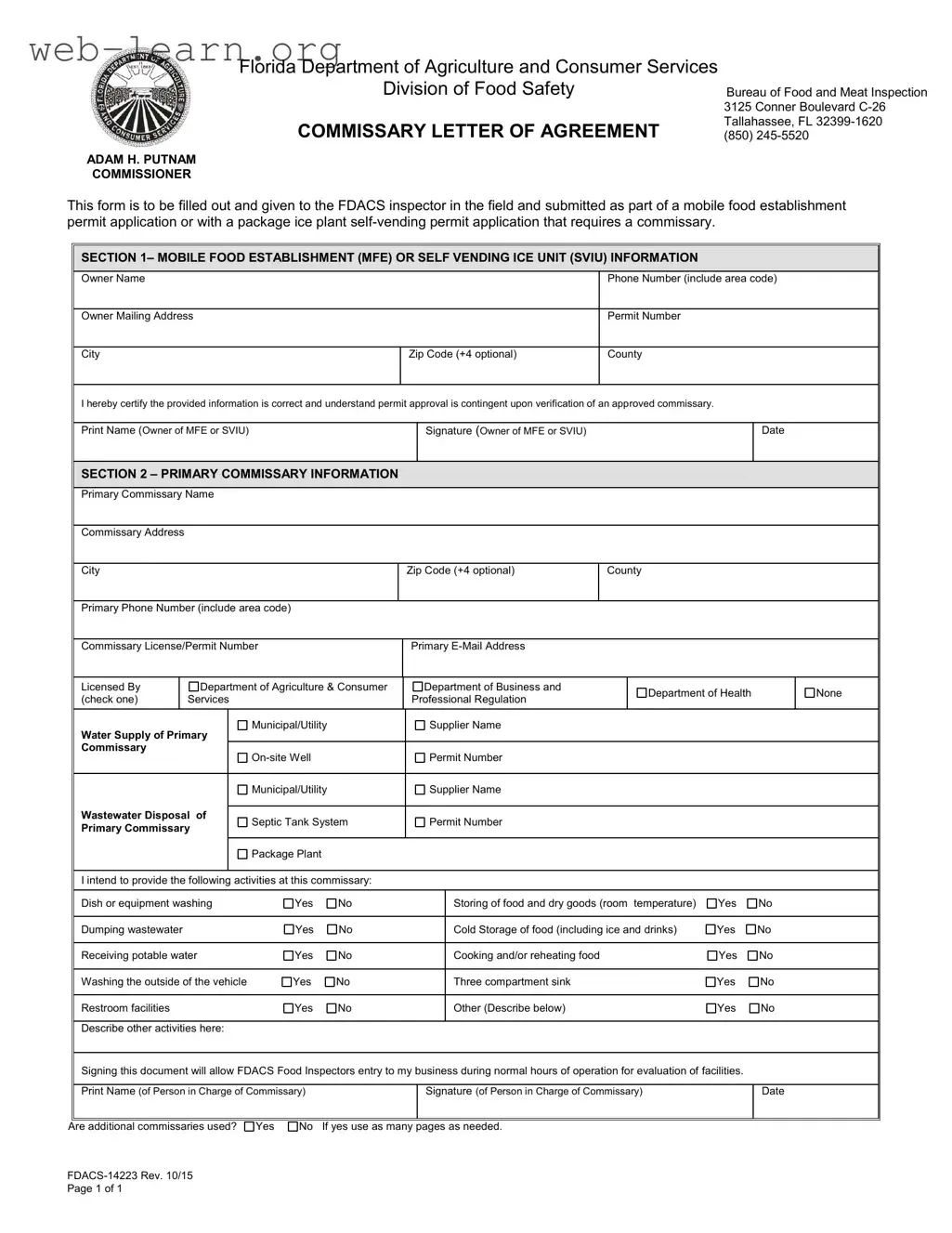
The Florida Commissary Letter of Agreement form plays a crucial role in the regulation of mobile food establishments and self-vending ice units. This form is essential for anyone seeking a permit to operate such businesses in Florida. It must be completed and presented to the Florida Department of Agriculture and Consumer Services (FDACS) inspector during field inspections. The form requires detailed information about both the mobile food establishment or ice unit and the primary commissary, including names, addresses, and contact information. Additionally, it outlines the specific activities that will take place at the commissary, such as food storage, dishwashing, and wastewater disposal. By signing this document, the owner certifies the accuracy of the provided information and grants FDACS inspectors access to evaluate the facilities during normal operating hours. This agreement not only ensures compliance with state regulations but also promotes food safety and public health, making it a vital step in the permitting process for mobile food vendors in Florida.
Sample - Florida Commissary Letter Of Agreement Form

FDACS-14223 Rev. 10/15
Page 1 of 1
Florida Department of Agriculture and Consumer Services
Division of Food Safety
COMMISSARY LETTER OF AGREEMENT
This form is to be filled out and given to the FDACS inspector in the field and submitted as part of a mobile food establishment
permit application or with a package ice plant self-vending permit application that requires a commissary.
Are additional commissaries used?
Yes No If yes use as many pages as needed.
SECTION 1 MOBILE FOOD ESTABLISHMENT (MFE) OR SELF VENDING ICE UNIT (SVIU) INFORMATION
Owner Name
Phone Number (include area code)
Owner Mailing Address
Permit Number
City
Zip Code (+4 optional)
County
I hereby certify the provided information is correct and understand permit approval is contingent upon verification of an approved commissary.
Print Name (Owner of MFE or SVIU)
Signature (Owner of MFE or SVIU)
Date
SECTION 2 PRIMARY COMMISSARY INFORMATION
Primary Commissary Name
Commissary Address
Zip Code (+4 optional)
County
Primary Phone Number (include area code)
Commissary License/Permit Number
Primary E-Mail Address
Licensed By
(check one)
Department of Agriculture & Consumer
Services
Department of Business and
Professional Regulation
Department of Health
None
Water Supply of Primary
Commissary
Municipal/Utility
Supplier Name
On-site Well
Permit Number
Wastewater Disposal of
Primary Commissary
Municipal/Utility
Supplier Name
Septic Tank System
Permit Number
Package Plant
I intend to provide the following activities at this commissary:
Dish or equipment washing Yes No
Storing of food and dry goods (room temperature) Yes No
Dumping wastewater Yes No
Cold Storage of food (including ice and drinks) Yes No
Receiving potable water Yes No
Cooking and/or reheating food Yes No
Washing the outside of the vehicle Yes No
Three compartment sink Yes No
Restroom facilities Yes No
Other (Describe below) Yes No
Describe other activities here:
Signing this document will allow FDACS Food Inspectors entry to my business during normal hours of operation for evaluation of facilities.
Print Name (of Person in Charge of Commissary)
Signature (of Person in Charge of Commissary)
Date
Bureau of Food and Meat Inspection
3125 Conner Boulevard C-26
Tallahassee, FL 32399-1620
(850) 245-5520
ADAM H. PUTNAM
COMMISSIONER

Form Information

Fact Name Description
Purpose This form is used for mobile food establishment permit applications and package ice plant self-vending permit applications that require a commissary.
Governing Body The form is regulated by the Florida Department of Agriculture and Consumer Services.
Submission Requirement The completed form must be submitted to the FDACS inspector in the field.
Sections The form contains two main sections: one for the mobile food establishment or self-vending ice unit information, and another for primary commissary information.
Certification The owner must certify that the provided information is correct and acknowledge that permit approval depends on commissary verification.
Contact Information Owners must provide their name, phone number, mailing address, and permit number.
Commissary Details Information required includes the primary commissary's name, address, phone number, and license/permit number.
Activities The form allows the owner to specify activities conducted at the commissary, such as food storage and washing equipment.
Inspection Access Signing the document grants FDACS Food Inspectors access to the business for facility evaluations during normal hours of operation.
Additional Commissaries If multiple commissaries are used, additional pages can be submitted as needed.

Detailed Guide for Filling Out Florida Commissary Letter Of Agreement

Filling out the Florida Commissary Letter Of Agreement form is a crucial step for mobile food establishments and self-vending ice units. This document must be completed accurately to ensure compliance with state regulations. Once the form is filled out, it should be submitted to the Florida Department of Agriculture and Consumer Services (FDACS) inspector in the field as part of the permit application process.

  1. Begin with **Section 1**: Enter the owner’s name, phone number (including area code), and mailing address.
  2. Provide the permit number, city, zip code (optional), and county.
  3. Certify the accuracy of the information by printing the owner’s name, signing, and dating the form.
  4. Move to **Section 2**: Fill in the primary commissary name and address, including city and zip code (optional), and county.
  5. List the primary phone number (including area code) and the commissary license/permit number.
  6. Enter the primary email address and check the appropriate box for the licensing department (Department of Agriculture & Consumer Services, Department of Business and Professional Regulation, Department of Health, or None).
  7. Provide the name of the primary municipal/utility supplier and the on-site well permit number if applicable.
  8. Indicate the wastewater disposal method by checking the appropriate box (septic tank system or permit number).
  9. In the section regarding activities at the commissary, answer "Yes" or "No" for each listed activity, such as dish washing, food storage, and cold storage.
  10. If there are additional activities, describe them in the provided space.
  11. Print the name of the person in charge of the commissary, then sign and date the document.
  12. Finally, indicate whether additional commissaries are used and provide information as needed on separate pages.

Obtain Answers on Florida Commissary Letter Of Agreement

  1. What is the purpose of the Florida Commissary Letter Of Agreement form?

    The Florida Commissary Letter Of Agreement form serves as an essential document for mobile food establishments and self-vending ice units. It must be filled out and submitted to the Florida Department of Agriculture and Consumer Services (FDACS) as part of the permit application process. This form ensures that the mobile food business has a designated commissary that meets health and safety standards.

  2. Who needs to complete this form?

    Any owner of a mobile food establishment (MFE) or self-vending ice unit (SVIU) is required to complete this form. It is crucial for those who plan to operate a mobile food business in Florida, as it verifies the relationship between the mobile unit and the commissary, which is vital for compliance with health regulations.

  3. What information is required on the form?

    The form requires detailed information about both the mobile food establishment and the primary commissary. Key sections include:

    • Owner's name, contact information, and permit number.
    • Commissary's name, address, and contact details.
    • Activities that will be conducted at the commissary, such as food storage and dishwashing.

    Completing this information accurately is crucial for the approval of your permit.

  4. What happens after the form is submitted?

    Once the Florida Commissary Letter Of Agreement form is submitted, it will be reviewed by FDACS inspectors. They may conduct an evaluation of the commissary facilities to ensure compliance with health and safety regulations. Approval of your mobile food establishment permit is contingent upon the verification of an approved commissary.

  5. Can additional commissaries be used?

    Yes, if your mobile food establishment utilizes more than one commissary, you can indicate this on the form. You may need to use additional pages to provide the necessary information for each commissary. It is essential to ensure that all commissaries meet the required health standards.

  6. What are the responsibilities of the commissary owner?

    The owner of the commissary is responsible for ensuring that the facility meets all health and safety requirements. By signing the form, they grant FDACS food inspectors the right to enter the business during normal operating hours for evaluation purposes. This oversight helps maintain the standards necessary for public health and safety.

Common mistakes

Filling out the Florida Commissary Letter of Agreement form can be straightforward, but mistakes can lead to delays or even rejection of your application. Here are nine common errors to watch out for.

One frequent mistake is incomplete contact information. Ensure that you provide the full name, phone number, and mailing address of the owner. Omitting any of these details can cause confusion and may result in your application being returned.

Another common error is failing to verify the commissary license or permit number. This number is crucial for the approval process. Double-check that it is accurate and current. If the number is incorrect, it could raise red flags during the review.

People often forget to check the boxes regarding the activities they plan to conduct at the commissary. This section is essential for the inspector to understand how you intend to use the facility. Not indicating whether you will be cooking or storing food can lead to misunderstandings.

Additionally, some applicants neglect to provide a description of other activities if they check "Yes" in that section. This omission can leave the inspectors without vital information about your operations, which may hinder the approval process.

Another mistake is not signing the form. Both the owner of the mobile food establishment and the person in charge of the commissary must sign. A missing signature can render the document invalid, requiring you to start over.

Misunderstanding the municipal/utility supplier section is also common. Make sure you accurately identify whether you are using a municipal supply or an on-site well. This detail is important for health and safety regulations.

Some applicants do not provide the correct date when signing the form. It’s essential to include the date to establish the timeline of your application. A missing or incorrect date can lead to complications later on.

Another oversight involves not indicating whether additional commissaries are used. If you check "Yes," be prepared to submit extra pages as needed. Failing to do so can lead to incomplete information being submitted.

Lastly, ensure that you have the correct county listed. This detail is often overlooked, but it is vital for jurisdictional purposes. An incorrect county can complicate the approval process.

By avoiding these common mistakes, you can streamline your application process and increase the likelihood of a successful permit approval.

Documents used along the form

The Florida Commissary Letter of Agreement form plays a crucial role in the process of obtaining permits for mobile food establishments and self-vending ice units. However, several other documents are often required to ensure compliance with state regulations. Below is a list of these documents, each serving a specific purpose in the overall application process.

  • Mobile Food Establishment Permit Application: This application is necessary for any business intending to operate a mobile food unit. It includes details about the business, the types of food sold, and the intended locations of operation.
  • Self-Vending Ice Plant Permit Application: Similar to the mobile food establishment application, this document is specifically tailored for businesses that plan to sell packaged ice. It outlines operational details and health safety measures.
  • Food Safety Plan: This plan outlines the procedures a business will follow to ensure food safety. It includes information on food handling, storage, and sanitation practices to prevent foodborne illnesses.
  • Commissary Inspection Report: This report documents the results of an inspection conducted at the commissary. It verifies that the facility meets health and safety standards required by the Florida Department of Agriculture and Consumer Services.
  • Proof of Commissary Agreement: This document serves as evidence of the agreement between the mobile food unit and the commissary. It must outline the services provided by the commissary, such as food storage and equipment cleaning.
  • Employee Health Records: These records ensure that all employees handling food are free from communicable diseases. They often include medical evaluations and training certifications related to food safety.
  • Menu and Recipe Documentation: A detailed menu and recipes may be required to review the types of food being served. This helps ensure compliance with nutritional guidelines and food safety regulations.
  • Equipment Specifications: This document outlines the equipment used in the mobile unit and commissary. It includes details about cooking appliances, refrigeration units, and sanitation equipment to confirm they meet safety standards.
  • Waste Disposal Agreement: An agreement that details how waste will be disposed of from the mobile unit and commissary. It ensures that waste management practices comply with local regulations.
  • Water Supply Agreement: This agreement specifies the source of potable water for the mobile unit. It confirms that the water supply meets health standards and is safe for food preparation.

Each of these documents plays a vital role in ensuring that mobile food establishments and self-vending ice units operate safely and legally within Florida. Proper preparation and submission of these forms can significantly streamline the permitting process and help avoid potential compliance issues.

Similar forms

The Florida Commissary Letter Of Agreement form is similar to several other documents used in food service and mobile food operations. Below is a list of ten documents that share similarities with this form:

  • Mobile Food Vendor Permit Application: This document is required for vendors operating food trucks or carts. It collects information about the vendor and their food preparation methods, similar to how the Commissary Letter Of Agreement outlines the relationship between the mobile food establishment and the commissary.
  • Food Service Establishment Permit Application: This application is necessary for traditional brick-and-mortar restaurants. It includes details about the establishment's operations and facilities, akin to the information required in the Commissary Letter Of Agreement.
  • Temporary Food Event Application: Used for events like fairs or festivals, this form ensures that temporary food vendors meet health and safety standards. It parallels the Commissary Letter Of Agreement by requiring proof of a safe food preparation location.
  • Health Department Inspection Report: This document provides an evaluation of a food establishment's compliance with health regulations. Like the Commissary Letter Of Agreement, it involves inspections to ensure safety and proper operations.
  • Food Handler Training Certificate: This certificate proves that food handlers have completed training in safe food handling practices. It supports the purpose of the Commissary Letter Of Agreement by ensuring that all parties involved understand food safety.
  • Commissary Agreement for Food Trucks: This specific agreement outlines the terms between food truck operators and commissaries. It serves a similar purpose to the Florida Commissary Letter Of Agreement by detailing responsibilities and permissions.
  • Waste Disposal Agreement: This document outlines how waste will be handled and disposed of for food operations. It complements the Commissary Letter Of Agreement by ensuring that waste management practices are in place.
  • Water Supply Agreement: This agreement specifies the terms of potable water supply for food operations. It is similar to the Commissary Letter Of Agreement as it addresses essential services needed for safe food preparation.
  • Food Safety Plan: This plan outlines procedures to ensure food safety in food establishments. Like the Commissary Letter Of Agreement, it emphasizes compliance with health regulations and safe food practices.
  • Equipment Rental Agreement: This document details the rental terms for kitchen equipment. It relates to the Commissary Letter Of Agreement by ensuring that all necessary equipment for food preparation is accounted for and in compliance with regulations.

Dos and Don'ts

When filling out the Florida Commissary Letter Of Agreement form, it is important to follow specific guidelines to ensure accuracy and compliance. Here are five things to do and five things to avoid:

  • Do provide accurate and complete information for all required fields.
  • Do double-check your contact information, including phone numbers and addresses.
  • Do ensure that the person signing the form is authorized to do so.
  • Do clearly indicate all activities you intend to conduct at the commissary.
  • Do submit the form to the FDACS inspector in the field as instructed.
  • Don't leave any required fields blank; incomplete forms may delay processing.
  • Don't use outdated or incorrect permit numbers; this can lead to confusion.
  • Don't forget to sign and date the form; an unsigned form is not valid.
  • Don't provide misleading information about your activities at the commissary.
  • Don't submit the form without verifying all details with the appropriate parties.

Misconceptions

Understanding the Florida Commissary Letter Of Agreement form is crucial for anyone involved in mobile food establishments or self-vending ice units. However, several misconceptions can lead to confusion and compliance issues. Here are four common misconceptions:

  • Misconception 1: The form is optional for mobile food establishments.
  • This is incorrect. The Florida Commissary Letter Of Agreement form is a mandatory requirement for obtaining a permit. It must be submitted to the Florida Department of Agriculture and Consumer Services (FDACS) as part of the application process.

  • Misconception 2: The commissary can be located anywhere.
  • Not true. The commissary must be a licensed facility that meets specific health and safety standards. It should be approved by the FDACS to ensure compliance with state regulations.

  • Misconception 3: Only one commissary can be used for multiple mobile food units.
  • This is a misunderstanding. Multiple commissaries can be utilized as long as each one is properly documented on the form. This flexibility allows operators to manage their logistics effectively.

  • Misconception 4: The form does not require the owner's signature.
  • This is false. The form must be signed by the owner of the mobile food establishment or self-vending ice unit. This signature certifies that all information provided is accurate and that the owner understands the terms of the agreement.

Key takeaways

When filling out the Florida Commissary Letter of Agreement form, it is essential to keep the following key points in mind:

  • Accurate Information: Ensure all details, such as owner name, address, and contact information, are correct. This accuracy is crucial for permit approval.
  • Commissary Verification: Understand that the approval of your mobile food establishment or self-vending ice unit permit depends on the verification of an approved commissary.
  • Activities Listed: Clearly indicate all activities you plan to conduct at the commissary. This includes washing equipment, storing food, and disposing of wastewater.
  • Inspector Access: By signing the form, you grant FDACS Food Inspectors permission to enter your business for evaluations during normal operating hours.