Homepage Blank Florida Codicil Form
Outline

The Florida Codicil form serves as an important legal document for individuals wishing to make changes to their existing wills. This form allows a testator, or the person who created the will, to add, modify, or revoke specific provisions without the need to rewrite the entire will. In the codicil, the testator identifies themselves and provides details such as their name, address, and the date of the original will. The form includes sections for revoking previous provisions, adding new gifts or changes to existing gifts, and confirming the validity of the will as amended. Witnesses play a crucial role in this process, as their signatures are required to validate the codicil. By utilizing this form, individuals can ensure that their last wishes are accurately reflected, providing peace of mind for both themselves and their loved ones.


Sample - Florida Codicil Form

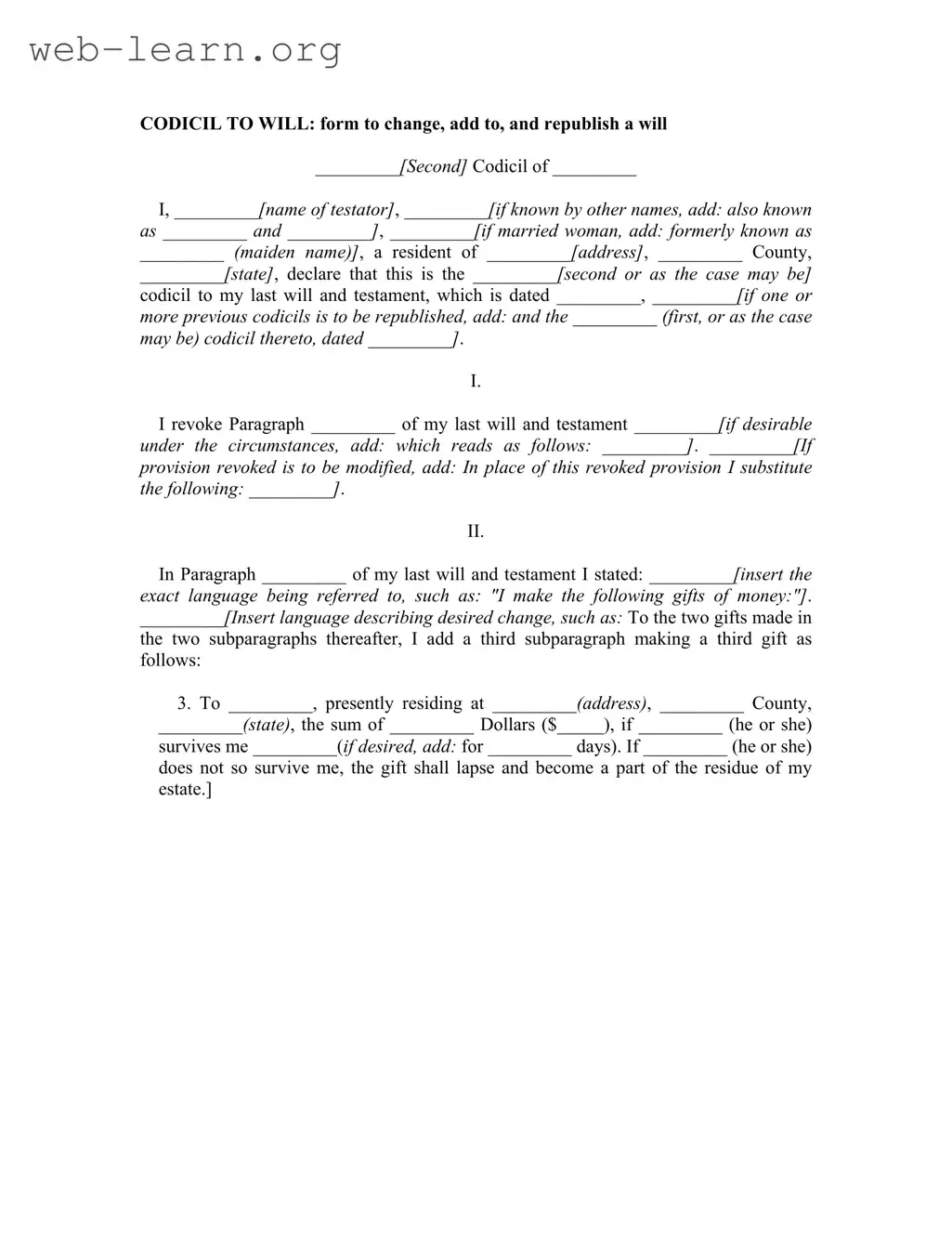
CODICIL TO WILL: form to change, add to, and republish a will
_________[Second] Codicil of _________
I, _________[name of testator], _________[if known by other names, add: also known
as _________ and _________], _________[if married woman, add: formerly known as
_________ (maiden name)], a resident of _________[address], _________ County,
_________[state], declare that this is the _________[second or as the case may be]
codicil to my last will and testament, which is dated _________, _________[if one or
more previous codicils is to be republished, add: and the _________ (first, or as the case
may be) codicil thereto, dated _________].
I.
I revoke Paragraph _________ of my last will and testament _________[if desirable
under the circumstances, add: which reads as follows: _________]. _________[If
provision revoked is to be modified, add: In place of this revoked provision I substitute
the following: _________].
II.
In Paragraph _________ of my last will and testament I stated: _________[insert the
exact language being referred to, such as: "I make the following gifts of money:"].
_________[Insert language describing desired change, such as: To the two gifts made in
the two subparagraphs thereafter, I add a third subparagraph making a third gift as
follows:
3. To _________, presently residing at _________(address), _________ County,
_________(state), the sum of _________ Dollars ($_____), if _________ (he or she)
survives me _________(if desired, add: for _________ days). If _________ (he or she)
does not so survive me, the gift shall lapse and become a part of the residue of my
estate.]
III.
I hereby confirm and republish my will dated _________, _________[if previous
codicil is to be republished, add: and my codicil to that will dated _________] in all
respects other than those above-mentioned.
I subscribe my name to this codicil on _________[date], at _________[address],
_________ County, _________[state], in the presence of _________, _________, and
_________, attesting witnesses, who subscribe their names to this codicil on
_________[date] at my request and in my presence.
[Signature]
ATTESTATION CLAUSE
On the date last above written, _________[testator's name], known to us to be the
person whose signature ap-pears at the end of this codicil, declared to us, the
undersigned, that the foregoing instrument, consisting of _________pages, including the
page on which we have signed as witnesses, was the _________[number, such as:
second] codicil to _________[his or her] will dated _________. _________[He or She]
then signed the codicil in our presence and, at _________[his or her] request, in
_________[his or her] presence and in the presence of each other, we now sign our
names as witnesses.
_________, residing at _________
[Signature] [Street, city, state]
_________,
residing at
_________
[Signature] [Street, city, state]
_________,
residing at
_________
[Signature]
[Street, city, state]

Form Information

Fact Name Details
Purpose The Florida Codicil form allows individuals to change, add to, or republish their existing will.
Governing Law This form is governed by Florida Statutes, Chapter 732, which pertains to wills and estates.
Testator Requirements The testator must be at least 18 years old and of sound mind to create a valid codicil.
Revocation The codicil can revoke specific paragraphs of the original will, providing clarity on the testator's wishes.
Witness Requirement At least two witnesses must sign the codicil in the presence of the testator to validate the document.
Publication By signing the codicil, the testator republished the original will, ensuring it remains effective except for the specified changes.
Address Details The form requires the testator’s address and county, ensuring proper identification and jurisdiction.
Signature The testator must sign the codicil, and the date of signing must be included for legal purposes.

Detailed Guide for Filling Out Florida Codicil

Filling out the Florida Codicil form is a straightforward process that allows you to make changes to your existing will. After completing the form, it will need to be signed and witnessed according to Florida law to ensure its validity. Here are the steps to fill out the form:

  1. Begin by writing the title at the top of the form as "CODICIL TO WILL."
  2. Fill in the number of the codicil (e.g., "Second") and your name as the testator.
  3. If you have other names, include them in the designated space, and if you are a married woman, add your maiden name.
  4. Provide your residential address, including county and state.
  5. State that this is the codicil to your last will and testament, and include the date of your original will.
  6. If applicable, mention any previous codicils and their dates.
  7. In Section I, specify the paragraph number of your will that you wish to revoke. If you want to include the text of that paragraph, do so in the space provided.
  8. If you are modifying a provision, write the new text that will replace the revoked provision.
  9. In Section II, quote the exact language from your will that you are referencing.
  10. Describe the changes you want to make, including any new gifts and their recipients, along with their addresses and the amount of money involved.
  11. In Section III, confirm and republish your original will and any previous codicils, ensuring to include their dates.
  12. Sign the codicil on the specified date at your address, including county and state.
  13. Gather your witnesses. You will need at least two. They must sign the form in your presence and in the presence of each other.
  14. Have your witnesses fill in their names, signatures, and addresses in the attestation clause at the end of the form.

Obtain Answers on Florida Codicil

  1. What is a Florida Codicil form?

    A Florida Codicil form is a legal document used to make changes, additions, or revocations to an existing will. It allows individuals to modify specific provisions without having to create an entirely new will. This form must be executed with the same formalities as a will, including signatures from the testator and witnesses.

  2. When should I use a Codicil?

    A Codicil should be used when there are minor changes to be made to an existing will. For example, if you want to add a new beneficiary, change an existing provision, or revoke a specific clause, a Codicil is appropriate. It is important to note that if the changes are extensive, it may be more prudent to draft a new will.

  3. What are the requirements for executing a Codicil in Florida?

    To execute a Codicil in Florida, the following requirements must be met:

    • The testator must be at least 18 years old and of sound mind.
    • The Codicil must be in writing.
    • The testator must sign the Codicil.
    • At least two witnesses must sign the Codicil in the presence of the testator.
  4. Can I revoke a previous Codicil?

    Yes, a previous Codicil can be revoked by executing a new Codicil that specifically states the revocation or by destroying the previous Codicil. It is advisable to clearly indicate which provisions are being revoked to avoid confusion.

  5. How does a Codicil affect my existing will?

    A Codicil modifies the existing will by adding, changing, or revoking specific provisions. It does not replace the entire will unless explicitly stated. The original will remains valid except for the sections that the Codicil addresses.

  6. Is it necessary to have a lawyer to create a Codicil?

    While it is not legally required to have a lawyer to create a Codicil, seeking legal advice can be beneficial. A lawyer can ensure that the Codicil is properly drafted, executed, and complies with state laws, reducing the risk of potential disputes in the future.

Common mistakes

Filling out the Florida Codicil form can be straightforward, but many make critical mistakes that can lead to complications. One common error is failing to clearly identify the testator. It's essential to include the full name and any known aliases. This helps ensure that there is no confusion about who is making the changes to the will.

Another frequent mistake is not properly stating the date of the original will or previous codicils. Each codicil should reference the exact date of the original will and any prior codicils. Omitting this information can create uncertainty about which documents are being amended.

People often overlook the importance of specificity when revoking or modifying provisions. Simply stating that a paragraph is revoked is not enough. It’s crucial to include the exact language of the paragraph being revoked and to clearly articulate any new provisions being substituted. Vague language can lead to disputes among beneficiaries.

Additionally, some individuals forget to include the necessary details about the gifts being made. When adding new gifts, it’s vital to specify the recipient's full name and address. This ensures that the intended beneficiary is clearly identified, reducing the risk of challenges later on.

Witness signatures are another area where mistakes frequently occur. The law requires that the codicil be signed in the presence of at least two witnesses. Failing to have the correct number of witnesses or not ensuring they are present at the time of signing can invalidate the codicil.

Many people also neglect to date the codicil. The date of signing is important for establishing the order of documents. Without a date, it may be unclear which codicil is the most recent, leading to potential conflicts.

Another mistake is not keeping a copy of the codicil with the original will. It’s essential to store all related documents together. This makes it easier for executors and beneficiaries to find and understand the testator's intentions.

Some individuals fail to communicate their changes to relevant parties. Informing family members and executors about the codicil can prevent misunderstandings and disputes down the line. Open communication can help ensure that everyone is on the same page regarding the testator's wishes.

Lastly, many people do not seek legal advice when making significant changes to their estate plans. Consulting with an attorney can provide valuable guidance and help avoid common pitfalls, ensuring that the codicil is valid and enforceable.

Documents used along the form

When creating or modifying a will, several important documents often accompany the Florida Codicil form. Each of these documents serves a specific purpose in ensuring that your wishes are clearly communicated and legally recognized. Here’s a brief overview of some commonly used forms.

  • Last Will and Testament: This is the primary document that outlines how your assets will be distributed upon your death. It names beneficiaries and may appoint guardians for minor children.
  • Power of Attorney: This document allows you to designate someone to make financial or legal decisions on your behalf if you become incapacitated. It ensures that your affairs can be managed without court intervention.
  • Healthcare Proxy: Also known as a medical power of attorney, this form allows you to appoint someone to make medical decisions for you if you are unable to do so. It is essential for ensuring your healthcare wishes are respected.
  • Living Will: This document outlines your preferences regarding medical treatment and end-of-life care. It provides guidance to your healthcare providers and loved ones about your wishes in critical situations.
  • Trust Documents: If you establish a trust, these documents detail how the trust will be managed and how assets will be distributed. Trusts can help avoid probate and provide more control over asset distribution.
  • Affidavit of Witnesses: This document may be used to confirm the validity of your will or codicil. It includes statements from witnesses who can attest that you were of sound mind and not under duress when signing your documents.

Understanding these documents can help ensure that your estate planning is comprehensive and aligned with your wishes. Each plays a crucial role in safeguarding your intentions and providing clarity for your loved ones during difficult times.

Similar forms

The Florida Codicil form serves a specific purpose in estate planning, allowing individuals to modify their existing wills. However, several other documents share similarities with the codicil in terms of function and intent. Here’s a look at ten such documents:

  • Last Will and Testament: This is the primary document that outlines how a person's assets will be distributed after their death. Like a codicil, it can be updated to reflect changes in circumstances or wishes.
  • Living Will: While a codicil pertains to asset distribution, a living will outlines a person's healthcare preferences. Both documents serve to clarify an individual's intentions regarding their wishes.
  • Power of Attorney: This document grants someone the authority to make decisions on behalf of another. Similar to a codicil, it can be updated or revoked as needed, ensuring that the right person has the authority to act when necessary.
  • Trust Amendment: Just as a codicil modifies a will, a trust amendment updates the terms of a trust. Both documents allow for adjustments to be made without starting from scratch.
  • Revocation of Will: This document formally cancels a previous will. Similar to a codicil, it reflects a change in the testator's intentions but serves to eliminate rather than modify provisions.
  • Durable Power of Attorney for Healthcare: This document allows someone to make healthcare decisions for another if they become incapacitated. Like a codicil, it can be revised to reflect changes in relationships or preferences.
  • Advance Healthcare Directive: This document combines a living will and a durable power of attorney for healthcare. Both serve to communicate an individual's healthcare wishes, ensuring they are respected.
  • Letter of Instruction: While not a legal document, this letter provides guidance to executors and family members about personal wishes. Like a codicil, it can be updated to reflect changing preferences.
  • Executor Appointment: This document designates an executor for the estate. Similar to a codicil, it can be altered to reflect changes in relationships or preferences for who should manage the estate.
  • Beneficiary Designation Form: Often used for life insurance policies or retirement accounts, this form specifies who will receive benefits upon death. Like a codicil, it can be updated to reflect changes in personal circumstances.

Understanding these documents can help you navigate your estate planning needs more effectively. Each serves a unique purpose but shares the common goal of ensuring that your wishes are honored.

Dos and Don'ts

When filling out the Florida Codicil form, it is important to follow certain guidelines to ensure that your changes are valid and respected. Here are five things you should and shouldn't do:

  • Do clearly identify yourself by providing your full name and any other names you may be known by.
  • Don't leave any required fields blank. Missing information can lead to confusion or invalidate your codicil.
  • Do specify which paragraphs of your original will you are revoking or modifying.
  • Don't use vague language. Be specific about the changes you want to make to avoid misinterpretation.
  • Do have at least two witnesses sign the codicil in your presence to ensure its legality.

By adhering to these guidelines, you can help ensure that your intentions are clearly communicated and legally binding.

Misconceptions

Misconceptions about the Florida Codicil form can lead to confusion when making changes to a will. Here are ten common misconceptions explained:

  • A codicil is the same as a new will. A codicil is not a new will; it is an amendment to an existing will. It allows changes without needing to rewrite the entire document.
  • All changes require a new codicil. Not every change needs a codicil. Minor changes may be made verbally or through other means, but it’s best to document them formally for clarity.
  • A codicil can be handwritten. While a codicil can be handwritten, it must still meet specific legal requirements to be valid. Typed documents are often clearer and more formal.
  • Witnesses are not necessary for a codicil. Witnesses are generally required to validate a codicil, just like a will. Their signatures help confirm the testator's intent.
  • Once a codicil is created, the original will is no longer valid. The original will remains valid unless it is explicitly revoked. The codicil modifies the will, but it does not replace it.
  • A codicil can only add provisions. A codicil can both add and revoke provisions of a will. It can change existing terms or remove them entirely.
  • Only lawyers can create a codicil. While it’s advisable to seek legal advice, individuals can create a codicil on their own as long as they follow the legal requirements.
  • Codicils must be notarized. Notarization is not always necessary. However, having a notary can add an extra layer of validation.
  • All codicils are permanent. Codicils can be revoked or modified just like a will. Changes can be made at any time as long as the legal requirements are met.
  • Codicils are only for significant changes. Codicils can be used for both major and minor changes. Even small adjustments can be documented for clarity and legal protection.

Key takeaways

When filling out and using the Florida Codicil form, consider these key takeaways:

  • Purpose of the Codicil: A codicil is used to change, add to, or clarify a will. It allows you to make updates without creating an entirely new will.
  • Identification: Clearly state your name and any other names you are known by. This ensures your identity is clear and helps avoid confusion.
  • Revocation and Modification: If you are revoking a specific paragraph from your will, clearly state which one it is. If you intend to modify it, provide the new language that replaces the revoked part.
  • Witness Requirement: The codicil must be signed in the presence of at least two witnesses. They should also sign the document, confirming they witnessed your signature.
  • Confirmation of Original Will: The codicil confirms and republishes your original will in all respects not mentioned in the codicil. This maintains the validity of your existing wishes.