Homepage Blank Florida Clemency Application Form
Outline

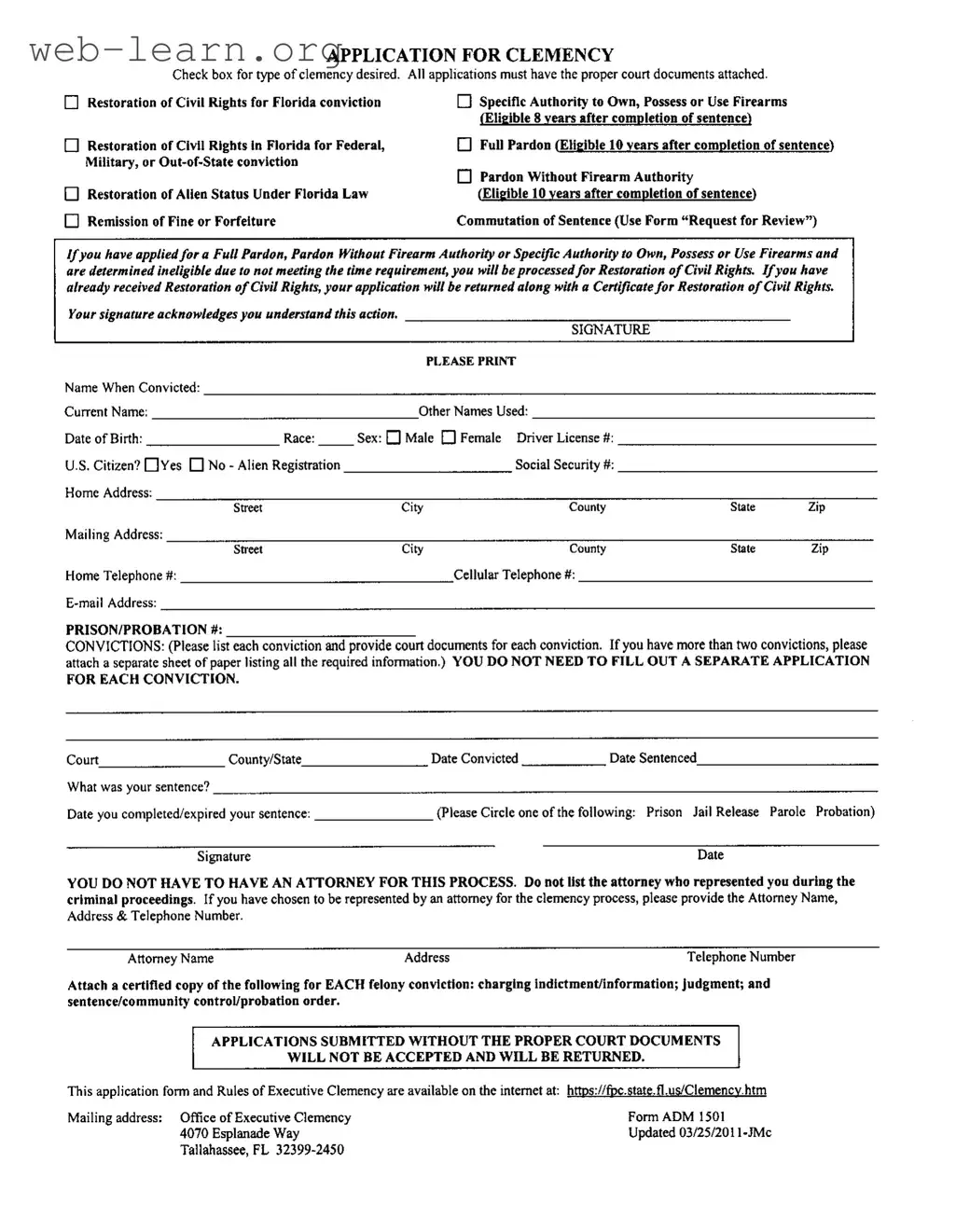
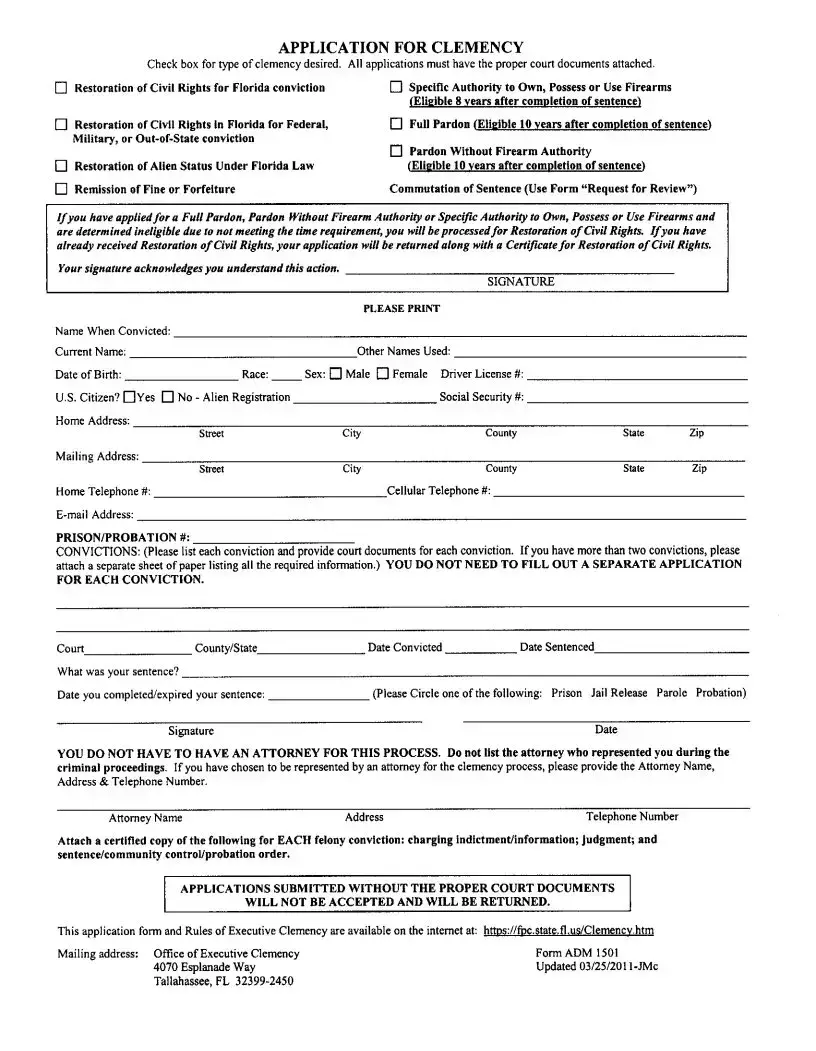
The Florida Clemency Application form is an essential tool for individuals seeking to restore their civil rights or obtain a pardon after a conviction. This form allows applicants to check off the type of clemency they desire, such as restoration of civil rights for Florida convictions or federal convictions, and even remission of fines. Each application must be accompanied by the appropriate court documents to ensure proper processing. For those looking to regain the right to own or possess firearms, there are specific eligibility requirements, including a waiting period of eight years after completing a sentence. A full pardon or a pardon without firearm authority requires a ten-year waiting period. If an applicant is determined ineligible for a full pardon due to timing, they may still receive restoration of civil rights. The application also collects personal information, including names used, date of birth, and details about convictions. It’s important to note that applicants do not need to hire an attorney for this process, although they can choose to have legal representation if desired. Submitting the application without the necessary court documents will result in rejection, so careful attention to detail is crucial. The form is available online, making it accessible for anyone looking to navigate this important process.
Sample - Florida Clemency Application Form

Form Information

Fact Name Details
Types of Clemency The application allows for various types of clemency, including Restoration of Civil Rights, Full Pardon, and Commutation of Sentence.
Eligibility Requirements Eligibility for certain clemency types requires completion of a sentence, with specific timeframes (e.g., 8 years for firearm authority).
Required Attachments Applicants must attach proper court documents for each felony conviction; applications without these will be returned.
Signature Requirement The applicant's signature indicates understanding of the application process and its implications.
Representation Applicants do not need an attorney for the clemency process, but may choose to have one if desired.
Governing Law The clemency application is governed by the Florida Constitution and Rules of Executive Clemency.

Detailed Guide for Filling Out Florida Clemency Application

Filling out the Florida Clemency Application form is an important step for those seeking clemency. Ensure that you have all necessary documents ready before you begin. This process requires careful attention to detail, as incomplete applications may be returned.

  1. Obtain the Application Form: Download the Florida Clemency Application form from the official website or request a physical copy.
  2. Check the Type of Clemency: At the top of the form, check the box for the type of clemency you are applying for.
  3. Gather Required Documents: Collect the necessary court documents for each felony conviction. This includes the charging indictment, judgment, and sentence order.
  4. Complete Personal Information: Fill in your name at the time of conviction, current name, date of birth, and any other names used. Provide your race, sex, driver’s license number, and social security number.
  5. Provide Contact Information: Enter your home address, mailing address, home telephone number, cellular telephone number, and email address.
  6. List Convictions: For each conviction, provide the court name, sentence, county/state, date convicted, date sentenced, and the date you completed your sentence. Indicate whether you were released from prison, jail, parole, or probation.
  7. Sign the Application: Sign the application to acknowledge that you understand the process and requirements.
  8. Attach Documents: Ensure that you attach certified copies of the required court documents for each felony conviction.
  9. Mail the Application: Send your completed application and documents to the Office of Executive Clemency at the provided mailing address.

After submitting your application, you will wait for a response from the Office of Executive Clemency. Make sure to keep a copy of everything you send for your records. Good luck with your application!

Obtain Answers on Florida Clemency Application

  1. What types of clemency can I apply for in Florida?

    Florida offers several types of clemency options. You can apply for:

    • Restoration of Civil Rights for a Florida conviction
    • Restoration of Civil Rights for Federal, Military, or Out-of-State convictions
    • Restoration of Alien Status under Florida Law
    • Remission of Fine or Forfeiture
    • Specific Authority to Own, Possess, or Use Firearms (eligible 8 years after completing your sentence)
    • Full Pardon (eligible 10 years after completing your sentence)
    • Pardon Without Firearm Authority (eligible 10 years after completing your sentence)
    • Commutation of Sentence (requires a separate form)
  2. What documents do I need to submit with my application?

    To complete your application, you must attach proper court documents for each felony conviction. This includes:

    • Charging indictment or information
    • Judgment
    • Sentence, community control, or probation order

    Without these documents, your application will be returned.

  3. Do I need an attorney to apply for clemency?

    No, you do not need an attorney for this process. You can submit your application on your own. However, if you choose to have an attorney represent you, include their contact information in your application.

  4. What if I have multiple convictions?

    You do not need to fill out a separate application for each conviction. Instead, list all your convictions on the same application. If you have more than two convictions, attach a separate sheet with the required information.

  5. What happens if I am ineligible for a Full Pardon?

    If you apply for a Full Pardon or other specific authorities and are found ineligible due to not meeting the time requirements, your application will be processed for Restoration of Civil Rights instead.

  6. Where can I find more information about the clemency process?

    You can find the application form and the Rules of Executive Clemency on the Florida Office of Executive Clemency website at this link. For mailing your application, use the following address:

    Office of Executive Clemency
    4070 Esplanade Way
    Tallahassee, FL 32399-2450

Common mistakes

Filling out the Florida Clemency Application form can be a daunting task. Many applicants make common mistakes that can delay the process or even result in the rejection of their application. Understanding these pitfalls can help ensure a smoother experience.

One frequent error is failing to check the correct box for the type of clemency desired. The application offers various options, including Restoration of Civil Rights and Full Pardon. Neglecting to indicate the appropriate choice can lead to confusion and unnecessary delays.

Another common mistake is not attaching the required court documents. The application specifically states that all submissions must include proper documentation for each felony conviction. Without these documents, the application will be returned, wasting valuable time and effort.

Many applicants also overlook the importance of providing accurate personal information. This includes details such as the name used at the time of conviction, date of birth, and social security number. Inaccuracies can complicate the verification process and lead to further issues.

Some individuals mistakenly believe they need to fill out separate applications for multiple convictions. However, the form clearly states that you do not need to submit a separate application for each conviction. This misunderstanding can lead to unnecessary paperwork and confusion.

Another area where applicants falter is in the completion of the conviction section. It’s crucial to list each conviction clearly and provide the necessary court documents. Omitting details or failing to provide the required documentation can result in a rejection of the application.

Applicants sometimes forget to sign the application. A signature is required to acknowledge understanding of the process and the actions being taken. Submitting an unsigned application can lead to immediate rejection.

Furthermore, some individuals mistakenly list their previous attorney on the application. The instructions specify that you should not include the attorney who represented you during the criminal proceedings. This can create confusion and may lead to unnecessary complications.

Finally, failing to provide accurate contact information can hinder communication. Applicants should ensure that their home address, email, and phone numbers are correct. Missing or incorrect contact details can delay the processing of the application.

By avoiding these common mistakes, applicants can improve their chances of a successful clemency application. Attention to detail and careful review of the instructions can make a significant difference in the outcome.

Documents used along the form

When applying for clemency in Florida, several important documents accompany the Florida Clemency Application form. Each document serves a specific purpose in supporting your application and ensuring that all necessary information is provided. Here’s a list of commonly required forms and documents:

  • Charging Indictment/Information: This document outlines the formal charges brought against you. It provides details about the nature of the offense and is essential for establishing the context of your conviction.
  • Judgment: The judgment document reflects the court's final decision regarding your case. It includes the verdict and any penalties imposed, which are critical for your clemency review.
  • Sentence/Community Control/Probation Order: This document details the specific terms of your sentence, including any probation or community control requirements. It helps clarify the conditions you were under after your conviction.
  • Certificate of Restoration of Civil Rights: If you have previously received restoration of civil rights, this certificate verifies that status. It is crucial for demonstrating your eligibility for further clemency actions.
  • Request for Review Form: If you are seeking a commutation of sentence, this form is necessary. It initiates the review process for your request to reduce your sentence.
  • Personal Statement: A personal statement allows you to express your reasons for seeking clemency. This narrative can highlight your rehabilitation and contributions to society since your conviction.
  • Character References: Letters from individuals who can vouch for your character and changes since your conviction can strengthen your application. These references may come from family, friends, or community leaders.
  • Proof of Rehabilitation: Documentation that demonstrates your efforts towards rehabilitation, such as completion of programs, employment records, or educational achievements, can be beneficial in your application.
  • Attorney Representation Form (if applicable): If you choose to have legal representation, this form provides the attorney's contact information and confirms their role in your clemency application process.

Gathering these documents thoroughly and accurately is vital for a successful clemency application. Each piece of information contributes to a comprehensive understanding of your case and your journey towards rehabilitation.

Similar forms

  • Parole Application Form: Similar to the clemency application, the parole application requires detailed personal information, including the applicant's conviction history and the completion of sentences. Both forms aim to assess eligibility for a second chance at freedom.
  • Expungement Application: Like the clemency application, this document seeks to clear a criminal record. It requires court documents and personal details, focusing on the applicant's eligibility based on their criminal history.
  • Restoration of Rights Application: This application is designed to restore civil rights after a felony conviction. It shares the requirement for documentation proving eligibility, similar to the clemency process.
  • Federal Pardon Application: This document is used to request a pardon from federal offenses. It mirrors the clemency application in that it requires a comprehensive overview of convictions and personal information.
  • Military Discharge Review Application: Individuals seeking to appeal their military discharge status must provide extensive personal and service history, akin to the requirements in the clemency application.
  • Certificate of Good Conduct Application: This form allows individuals to request a certificate that demonstrates rehabilitation. It requires similar personal disclosures and documentation regarding past convictions.
  • Judicial Release Application: Similar to the clemency application, this document seeks to modify or end a sentence early. It also demands detailed information about the individual’s criminal history and current circumstances.
  • Restoration of Voting Rights Application: This application focuses on reinstating voting rights after a felony conviction. It parallels the clemency application in its need for detailed personal and conviction-related information.
  • Application for Community Supervision Release: This document seeks to transition individuals from incarceration to community supervision. It shares the requirement for background information and documentation of prior offenses.
  • Application for Post-Conviction Relief: Individuals seeking to challenge their convictions can file this application. It requires a similar level of detail regarding the conviction history and personal information as the clemency application.

Dos and Don'ts

When filling out the Florida Clemency Application form, there are important guidelines to follow. Here are eight things to keep in mind:

  • Do check the appropriate box for the type of clemency you are seeking.
  • Do ensure all required court documents are attached to your application.
  • Do provide accurate and complete information about your convictions.
  • Do include your signature to acknowledge your understanding of the process.
  • Don't submit separate applications for multiple convictions; one application is sufficient.
  • Don't list the attorney who represented you during your criminal proceedings unless you are having an attorney represent you for clemency.
  • Don't forget to attach certified copies of necessary documents for each felony conviction.
  • Don't submit your application without the proper court documents, as it will be returned.

Following these guidelines can help ensure your application is processed smoothly.

Misconceptions

Here are 10 misconceptions about the Florida Clemency Application form, along with clarifications for each:

  1. All types of clemency require the same documents. Each type of clemency has specific documentation requirements. Ensure you check the guidelines for the clemency type you are applying for.
  2. Applications can be submitted without court documents. This is incorrect. Applications submitted without the proper court documents will be returned. Always attach the necessary documents.
  3. You need an attorney to apply for clemency. This is a common misconception. You do not need an attorney to complete the application process.
  4. Each conviction requires a separate application. This is false. You do not need to fill out a separate application for each conviction. You can list multiple convictions on one application.
  5. Restoration of Civil Rights is automatic after a certain period. Restoration is not automatic. You must apply and meet specific eligibility requirements.
  6. Only felons can apply for clemency. While most applicants are felons, individuals with certain misdemeanor convictions may also be eligible under specific circumstances.
  7. Submitting an application guarantees approval. This is misleading. Approval is not guaranteed and depends on various factors, including eligibility and the nature of the conviction.
  8. Past applications affect new applications. This is not necessarily true. Each application is reviewed independently, although prior denials may be considered.
  9. There is no deadline for submitting applications. There are no formal deadlines, but it is advisable to submit applications promptly to avoid delays.
  10. Once you receive clemency, you can own firearms immediately. This is incorrect. Specific authority to own or possess firearms has its own eligibility requirements, including an eight-year waiting period after completing the sentence.

Key takeaways

  • When filling out the Florida Clemency Application form, be sure to check the appropriate box for the type of clemency you are seeking. Options include restoration of civil rights, full pardon, and commutation of sentence.

  • Attach all required court documents for each felony conviction. Applications submitted without these documents will be returned. Ensure you include the charging indictment, judgment, and sentence documentation.

  • Understand that you do not need an attorney to complete the clemency process. However, if you choose to have legal representation, provide the attorney's contact information in the designated section.

  • After completing the application, sign it to acknowledge your understanding of the process. Be aware that if you do not meet eligibility requirements, your application may be processed for restoration of civil rights instead.