Homepage Blank Florida Addendum To Income Form
Outline

The Florida Addendum to Income Withholding Order is a crucial document in the realm of family law, specifically designed to facilitate the enforcement of child support and alimony payments through income deduction. This form must accompany the OMB Form 0970-0154, which is the Income Withholding for Support form, whenever the court mandates that support payments be made via income deduction. It outlines the responsibilities of the payor—typically the employer—who is required to deduct specified amounts from the obligor's income and remit these payments to the State of Florida Disbursement Unit. The form also details the timeline for deductions, stipulating that the first deduction must occur no later than 14 days after the income deduction order is served. Additionally, it emphasizes the importance of notifying the obligee and the court about any changes in the obligor's employment status. Understanding the intricacies of this addendum is essential for both payors and obligors, as it establishes clear guidelines for compliance and highlights the potential penalties for non-compliance. By adhering to these provisions, parties can ensure that support obligations are met in a timely and efficient manner, ultimately benefiting the well-being of the children and families involved.


Sample - Florida Addendum To Income Form

Instructions for Florida Family Law Rules of Procedure Form 12.996(d), Florida Addendum to Income Withholding
Order (07/13)
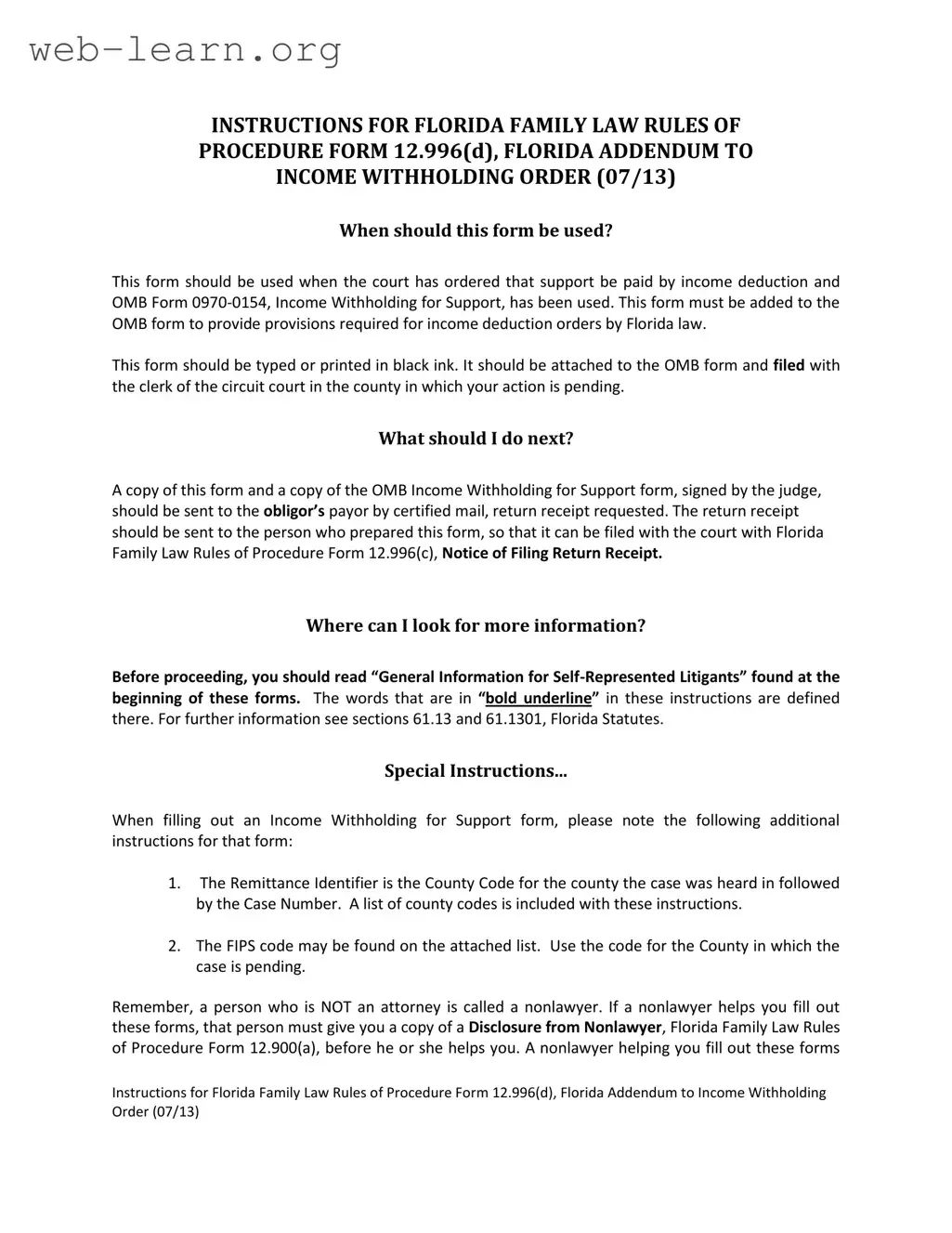
INSTRUCTIONS FOR FLORIDA FAMILY LAW RULES OF
PROCEDURE FORM 12.996(d), FLORIDA ADDENDUM TO
INCOME WITHHOLDING ORDER (07/13)
When should this form be used?
This form should be used when the court has ordered that support be paid by income deduction and
OMB Form 0970-0154, Income Withholding for Support, has been used. This form must be added to the
OMB form to provide provisions required for income deduction orders by Florida law.
This form should be typed or printed in black ink. It should be attached to the OMB form and filed with
the clerk of the circuit court in the county in which your action is pending.
What should I do next?
A copy of this form and a copy of the OMB Income Withholding for Support form, signed by the judge,
should be sent to the oligor’s payor by certified mail, return receipt requested. The return receipt
should be sent to the person who prepared this form, so that it can be filed with the court with Florida
Family Law Rules of Procedure Form 12.996(c), Notice of Filing Return Receipt.
Where can I look for more information?
Before proeedig, you should read Geeral Iforatio for “elf-Represeted Litigats foud at the
beginning of these forms. The words that are in bold underline
in these instructions are defined
there. For further information see sections 61.13 and 61.1301, Florida Statutes.
Special Instructions...
When filling out an Income Withholding for Support form, please note the following additional
instructions for that form:
1. The Remittance Identifier is the County Code for the county the case was heard in followed
by the Case Number. A list of county codes is included with these instructions.
2. The FIPS code may be found on the attached list. Use the code for the County in which the
case is pending.
Remember, a person who is NOT an attorney is called a nonlawyer. If a nonlawyer helps you fill out
these forms, that person must give you a copy of a Disclosure from Nonlawyer, Florida Family Law Rules
of Procedure Form 12.900(a), before he or she helps you. A nonlawyer helping you fill out these forms
Instructions for Florida Family Law Rules of Procedure Form 12.996(d), Florida Addendum to Income Withholding
Order (07/13)
also must put his or her name, address, and telephone number on the bottom of the last page of every
form he or she helps you complete.
FIPS and County Codes
COUNTY
ALACHUA
BAKER
BAY
BRADFORD
BREVARD
BROWARD
CALHOUN
CHARLOTTE
CITRUS
CLAY
COLLIER
COLUMBIA
DADE
DESOTO
DIXIE
DUVAL
ESCAMBIA
FLAGER
FRANKLIN
GADSDEN
GILCHRIST
GLADES
GULF
HAMILTON
HARDEE
HENDRY
HERNANDO
HIGHLANDS
HILLSBOROUGH
HOLMES
INDIAN RIVER
JACKSON
JEFFERSON
LAFAYETTE
FIPS
12001
12003
12005
12007
12009
12011
12013
12015
12017
12019
12021
12023
12025
12027
12029
12031
12033
12035
12037
12039
12041
12043
12045
12047
12049
12051
12053
12055
12057
12059
12061
12063
12065
12067
COUNTY CODE
01
02
03
04
05
06
07
08
09
10
11
12
13
14
15
16
17
18
19
20
21
22
23
24
25
26
27
28
29
30
31
32
33
34
COUNTY
LAKE
LEE
LEON
LEVY
LIBERTY
MADISON
MANATEE
MARION
MARTIN
MONROE
NASSAU
OKALOOSA
OKEECHOBEE
ORANGE
OSCEOLA
PALM BEACH
PASCO
PINELLAS
POLK
PUTNAM
ST. JOHNS
ST. LUCIE
SANTA ROSA
SARASOTA
SEMINOLE
SUMTER
SUWANNEE
TAYLOR
UNION
VOLUSIA
WAKULLA
WALTON
WASHINGTON
FIPS
12069
12071
12073
12075
12077
12079
12081
12083
12085
12087
12089
12091
12093
12095
12097
12099
12101
12103
12105
12107
12109
12111
12113
12115
12117
12119
12121
12123
12125
12127
12129
12131
12133
COUNTY
CODE
35
36
37
38
39
40
41
42
43
44
45
46
47
48
49
50
51
52
53
54
55
56
57
58
59
60
61
62
63
64
65
66
67
Florida Family Law Rules of Procedure Form 12.996(d), Florida Addendum to Income Withholding Order (07/13)
IN THE CIRCUIT COURT OF THE _____________________ JUDICIAL CIRCUIT,
IN AND FOR ______________________________ COUNTY, FLORIDA
Case No: ________________________
Division: ________________________
_________________________________,
Petitioner,
and
_________________________________,
Respondent.
FLORIDA ADDENDUM TO INCOME WITHHOLDING ORDER
THE PAYOR, {name}__________________________, IS HEREBY NOTIFIED that, under sections 61.13
and 61.1301, Florida Statutes, you have the responsibilities and rights set forth below with regard to the
Income Withholding Order/Notice for Support.
1. The Income Withholding Order/Notice for Support is enforceable against employers specifically
listed upon the form as well as all subsequent employers/payors of Obligor,
{name}____________________________, {address}__________________________________.
2. You are required to dedut fro the oligor’s ioe the aout speified i the ioe
withholding order, and in the case of a delinquency the amount specified in the notice of
delinquency, and to pay that amount to the State of Florida Disbursement Unit. The amount
actually deducted plus all administrative charges shall not be in excess of the amount allowed under
section 303(b) of the Consumer Credit Protection Act, 15 U.S.C. Section 1673(b), as amended.
3. You must implement the income deduction no later than the first payment date which occurs more
than 14 days after the date the income deduction order was served on you, and you shall conform
the aout speified i the ioe ithholdig order to the oligor’s pay yle. The ourt should
request at the time of the order that the payment cycle will reflect that of the obligor.
4. You must forward, within 2 days after each date the obligor is entitled to payment from you, to the
“tate of Florida Disurseet Uit, the aout deduted fro the oligor’s ioe, a stateet as
to whether the amount totally or partially satisfies the periodic amount specified in the income
withholding order, and the specific date each deduction is made. If the IV-D agency is enforcing the
order, you shall make these notifications to the agency.
5. If you fail to dedut the proper aout fro the oligor’s ioe, you are liale for the aout you
should have deducted, plus costs, interest, and reasonable attorneys fees.
Florida Family Law Rules of Procedure Form 12.996(d), Florida Addendum to Income Withholding Order (07/13)
6. You ay ollet up to $5 agaist the oligor’s ioe to reiurse you for the administrative costs
for the first income deduction and up to $2 for each deduction thereafter.
7. The Income Withholding Order/Notice for Support is binding on you until further notice by court
order or until you no longer provide income to the obligor.
8. When you no longer provide income to the obligor, you shall notify the obligee,
{name}_________________________, {address}__________________________________________,
ad proide the oligor’s last ko address ad the ae ad address of the oligor’s ew payor,
if known, utilizing the form contained within the Income Withholding Order/Notice for Support. If
you violate this provision, you are subject to a civil penalty not to exceed $250 for the first violation
or $500 for any subsequent violation. If the IV-D agency is enforcing the order, you shall make these
notifications to the agency instead of the obligee. Penalties shall be paid to the obligee or the IV-D
agency, whichever is enforcing the income deduction order.
9. You shall not discharge, refuse to employ, or take disciplinary action against an obligor because of
the requirement for income deduction. A violation of this provision subjects you to a civil penalty
not to exceed $250 for the first violation or $500 for any subsequent violation. Penalties shall be
paid to the obligee or the IV-D agency, whichever is enforcing the income deduction, if any alimony
or child support obligation is owing. If no alimony or child support obligation is owing, the penalty
shall be paid to the obligor.
10. The obligor may bring a civil action in the courts of this state against a payor who refuses to employ,
discharges, or otherwise disciplines an obligor because of income deduction. The obligor is entitled
to reinstatement of all wages and benefits lost, plus reasonable attorneys fees and costs incurred.
11. In a Title IV-D case, if an obligation to pay current support is reduced or terminated due to the
emancipation of a child and the obligor owes an arrearage, retroactive support, delinquency, or
costs, income deduction continues at the rate in effect immediately prior to emancipation until all
arrearages, retroactive support, delinquencies, and costs are paid in full or until the amount of
withholding is modified.
12. All notices to the obligee shall be sent to the address provided in this notice to payor, or any place
thereafter the obligee requests in writing.
13. An employer who employed 10 or more employees in any quarter during the preceding state fiscal
year or who was subject to and paid tax to the Department of Revenue in an amount of $20,000 or
more shall remit support payments deducted pursuant to an income deduction order or income
deduction notice and provide associated case data to the State Disbursement Unit by electronic
means approved by the department. Payors who are required to remit support payments
eletroially a fid ore iforatio o ho to do so y aessig the “tate Disurseet Uit’s
website at www.floridasdu.com ad likig o Payets. Payent options include Expert Pay,
Automated Clearing House (ACH) credit through your financial institution,
www.myfloridacounty.com
, or Western Union. Payors may contact the SDU Customer Service
Employer telephone line at
1-888-883-0743.
Florida Family Law Rules of Procedure Form 12.996(d), Florida Addendum to Income Withholding Order (07/13)
14. The amount of arrears owed, if any, is $____________. You must withhold an additional twenty
percent (20%) or more of the ongoing periodic obligation towards same at the rate of $________
per ____________ until full payment is made of any arrearage, attorneys fees and costsprovided
that no deduction shall be applied to attorneys fees and costs until the full amount of any arrearage
is paid. If a delinquency accrues after the order establishing, modifying, or enforcing support has
been entered and there is no existing order for repayment of the delinquency or a pre-existing
arrearage, a payor shall deduct $________per _____________ (which represents an additional
twenty percent (20%) of the current support obligation, or other amount agreed to by the parties)
until the delinquency and any attorneys fees and costs are paid in full. No deduction may be
applied to attorneys fees and costs until the delinquency is paid in full.
15. Pursuant to sections 61.13 and 61.1301, Florida Statutes, the amounts listed for payment on the
Income Withholding Order must be varied by the employer/payor for bonus income, or similar one-
time payment:
You shall deduct [Choose only one] ( ) the full amount, ( ) _______%, or ( ) none of the
income which is payable to the obligor in the form of a bonus or other similar one-time
payment, up to the amount of arrearage reported in the Income Deduction Order or the
remaining balance thereof, and forward the payment to the State of Florida Disbursement Unit.
For purposes of this subparagraph, ous eas a payet i additio to a oligor’s usual
compensation and which is in addition to any amounts contracted for or otherwise legally due
and shall not include any commission payments due an obligor.
16. Child Support Reduction/Termination Schedule. Child support amount listed on the IWO shall be
automatically reduced or terminated as set forth in the following schedule:
Please list
children
by initials
from eldest to
youngest
Insert in this
column the
day, month,
and year the
child support
obligation
terminates for
each
designated
child (see
instructions)
Insert in
this column
the amount
of child
support for
all minor
children
remaining
(including
designated
child).
Child 1
(Eldest)
Initials & year
of birth:
From the effective
date of this Income
Deduction Order
until the following
date:
Child 2
After the date set
Florida Family Law Rules of Procedure Form 12.996(d), Florida Addendum to Income Withholding Order (07/13)
Initials & year
of birth:
forth in the row
above until the
following date:
Child 3
Initials & year
of birth:
After the date set
forth in the row
above until the
following date:
Child 4
Initials & year
of birth:
After the date set
forth in the row
above until the
following date:
Child 5
Initials & year
of birth:
After the date set
forth in the row
above until the
following date:
(Continue on additional pages for additional children)
NOTE: This change only relates to the amount of the child support obligation portion of
the payments listed in the first page of the Income Withholding Order. If there is a child
support arrearage in a Title IV-D case, the amount will not be reduced due to the child
no longer being eligible for support pursuant to paragraph 11 above.
17. Additional information regarding the implementation of income deduction may be found at
www.floridasdu.com.
IF A NONLAWYER HELPED YOU FILL OUT THIS FORM, HE/SHE MUST FILL IN THE BLANKS BELOW
[fill in all blanks] This form was prepared for the: {choose only one} ( ) Petitioner ( ) Respondent
This form was completed with the assistance of:
{name of individual}_____________________________________________________________,
{name of business}_______________________________________________________________,
{address}_______________________________________________________________________,
{city}_____________________, {state}________, {telephone number}______________________.

Form Information

Fact Name Description
Purpose This form is used when a court orders support payments to be made through income deduction.
Governing Laws The form is governed by sections 61.13 and 61.1301 of the Florida Statutes.
Filing Requirements The form must be filed with the clerk of the circuit court along with the OMB Income Withholding for Support form.
Notification Process A copy of the form must be sent to the obligor's payor by certified mail, with a return receipt requested.
Income Deduction Timeline The income deduction must begin no later than the first payment date that occurs more than 14 days after the order is served.
Employer Responsibilities Employers must deduct specified amounts from the obligor's income and remit them to the State of Florida Disbursement Unit.
Penalties for Non-Compliance Failure to deduct the proper amount can result in liability for the amount that should have been deducted, plus costs and attorney fees.
Electronic Remittance Employers with 10 or more employees must remit support payments electronically, following guidelines from the State Disbursement Unit.

Detailed Guide for Filling Out Florida Addendum To Income

Completing the Florida Addendum To Income form involves several important steps to ensure accuracy and compliance with state regulations. This form is essential when a court has mandated that support payments be deducted from income. Following the correct procedure will help facilitate the processing of these payments and maintain proper records.

  1. Begin by typing or printing the form in black ink.
  2. Fill in the name of the judicial circuit and the county at the top of the form.
  3. Enter the case number and division information as required.
  4. Provide the names of both the petitioner and respondent in the designated spaces.
  5. In the section labeled "THE PAYOR," write the name of the individual or entity responsible for making payments.
  6. Clearly outline the obligations of the payor as specified in the form, ensuring all details are accurate and complete.
  7. Include the FIPS code for the county where the case is pending, which can be found in the accompanying list.
  8. Specify the remittance identifier, which includes the county code followed by the case number.
  9. Detail any amounts owed, including arrears and the percentage to be withheld for ongoing support obligations.
  10. Sign and date the form, and ensure that any nonlawyer assisting you has provided their name, address, and telephone number at the bottom of the last page.
  11. Attach this addendum to the OMB Income Withholding for Support form.
  12. Make copies of the completed forms for your records.
  13. File the forms with the clerk of the circuit court in the appropriate county.
  14. Send a copy of both forms to the payor via certified mail, return receipt requested.
  15. Keep the return receipt and file it with the court along with the Notice of Filing Return Receipt.

Obtain Answers on Florida Addendum To Income

  1. What is the purpose of the Florida Addendum to Income Withholding Order?

    This form is used to provide additional information required by Florida law when a court has ordered support to be paid through income deduction. It must be attached to the OMB Form 0970-0154, which is the Income Withholding for Support form. The addendum ensures compliance with specific state provisions regarding income deduction orders.

  2. When should I use this form?

    You should use the Florida Addendum to Income Withholding Order when the court has mandated that support payments be deducted from an individual’s income. It is essential to attach this addendum to the OMB form to fulfill the legal requirements for income deductions in Florida.

  3. How should I submit the form?

    The completed Florida Addendum must be filed with the clerk of the circuit court in the county where your case is pending. Additionally, you should send a copy of the form, along with the signed OMB form, to the obligor’s payor via certified mail, ensuring that you obtain a return receipt for your records.

  4. What happens if I do not follow the instructions correctly?

    Failure to properly complete or submit the form can lead to complications in the enforcement of the income deduction order. If the required deductions are not made, the payor may be held liable for the amount that should have been deducted, along with potential costs and legal fees.

  5. Who is responsible for making the income deductions?

    The payor, typically the employer, is responsible for deducting the specified amount from the obligor’s income. They must comply with the terms outlined in the income withholding order and ensure that the deductions are sent to the State of Florida Disbursement Unit in a timely manner.

  6. What should a payor do if they no longer employ the obligor?

    If the payor stops providing income to the obligor, they must notify the obligee and provide the obligor's last known address and the name and address of the new payor, if known. This notification is crucial to ensure that support payments continue to be processed without interruption.

  7. Are there penalties for non-compliance?

    Yes, payors can face civil penalties for failing to comply with the income deduction order. For instance, if a payor refuses to employ or disciplines an obligor due to the income deduction requirement, they may be subject to a civil penalty not exceeding $250 for the first violation and $500 for subsequent violations.

  8. What if the obligor has arrears?

    If the obligor owes arrears, the payor must withhold an additional percentage of the ongoing support obligation until the arrears are fully paid. The specific amount and percentage to be withheld will be detailed in the income withholding order.

  9. Where can I find more information about the process?

    For additional details, refer to the General Information for Self-Represented Litigants section at the beginning of the forms. You can also consult sections 61.13 and 61.1301 of the Florida Statutes for further guidance on income withholding orders and related procedures.

Common mistakes

When completing the Florida Addendum to Income form, individuals often make several common mistakes that can lead to complications in the income withholding process. Understanding these pitfalls can help ensure that the form is filled out correctly and efficiently.

One frequent error is failing to provide the correct County Code and FIPS code. Each county in Florida has a specific code that must be included on the form. If these codes are incorrect or omitted, it can result in delays or even the rejection of the form. It is crucial to double-check the codes against the provided list to avoid this mistake.

Another common mistake involves the remittance identifier. This identifier should be a combination of the county code and the case number. If the identifier is not formatted correctly, it can cause confusion for the payor and may hinder the processing of payments. Always ensure that this identifier is accurate and clearly written.

Additionally, individuals sometimes neglect to attach the required OMB form. The Florida Addendum to Income form must be filed alongside the Income Withholding for Support form. Failing to include this attachment can lead to complications in enforcement and compliance, as the court requires both documents to process the income deduction order.

People also often overlook the importance of sending copies of the completed forms via certified mail. It is essential to send the forms to the obligor’s payor and retain the return receipt. This step serves as proof that the payor received the necessary documents, and without it, there may be challenges in demonstrating compliance with the order.

Inaccuracies in the amounts specified for deductions can also create issues. Individuals sometimes miscalculate the amounts to be withheld for support and arrears. It is vital to ensure that these figures are correct, as errors can lead to financial discrepancies and potential legal consequences for the payor.

Furthermore, individuals may fail to provide their contact information or that of a nonlawyer who assisted in completing the form. If a nonlawyer helps with the form, their name, address, and phone number must be included. Omitting this information can lead to questions about the validity of the assistance provided.

Another mistake is not adhering to the specified timelines for implementing the income deductions. The form requires that deductions begin no later than 14 days after the order is served. Delays in compliance can result in penalties and additional complications for both the obligor and the payor.

Lastly, individuals sometimes forget to update the court if there are changes in the obligor's employment status or address. It is essential to notify the court and provide any new information to ensure that the income withholding order remains enforceable. Failure to do so can lead to complications in receiving support payments.

By being aware of these common mistakes and taking the necessary precautions, individuals can navigate the process of filling out the Florida Addendum to Income form more effectively. Attention to detail and compliance with the outlined requirements are crucial for ensuring that support obligations are met without unnecessary complications.

Documents used along the form

The Florida Addendum to Income Withholding Order is a vital document in the process of income deduction for support payments. It provides necessary details and instructions to ensure compliance with Florida law. Several other forms and documents are commonly used alongside this addendum to facilitate the support payment process. Below is a list of these forms, each briefly described for clarity.

  • Income Withholding for Support (OMB Form 0970-0154): This federal form initiates the income withholding process, detailing how much should be deducted from an obligor's income for child support or alimony.
  • Notice of Filing Return Receipt (Form 12.996(c)): This document is used to confirm that the obligor’s payor received the income withholding order and addendum, providing proof of compliance.
  • Disclosure from Nonlawyer (Form 12.900(a)): If a nonlawyer assists in filling out forms, this disclosure must be provided to ensure transparency and compliance with legal requirements.
  • Child Support Guidelines Worksheet: This form calculates the appropriate amount of child support based on the income of both parents and the needs of the child, ensuring fair support obligations.
  • Affidavit of Compliance: This document is used to affirm that the income withholding order has been properly implemented and that all required deductions have been made.
  • Petition for Modification of Child Support: If circumstances change, this form allows a party to request a change in the support amount, providing justification for the modification.
  • Order of Income Withholding: This court order formally directs the obligor's employer to withhold specified amounts from the obligor’s paycheck for support payments.
  • Response to Notice of Income Withholding: This form allows the payor or obligor to respond to the income withholding notice, providing any necessary information or objections regarding the withholding.

These forms work together to ensure that the income withholding process is executed smoothly and in accordance with Florida law. Understanding each document's purpose can help individuals navigate the complexities of support payments more effectively.

Similar forms

The Florida Addendum To Income form shares similarities with several other legal documents related to income withholding and support orders. Here’s a list of nine documents that are comparable:

  • Income Withholding for Support (IWO) Form: Like the Florida Addendum, this form is used to notify employers to withhold income for child support or alimony payments. Both documents ensure compliance with court orders.
  • Notice of Filing Return Receipt (Form 12.996(c)): This document is filed to confirm that the income withholding order was properly served. It parallels the Addendum by documenting the process of notifying involved parties.
  • Disclosure from Nonlawyer (Form 12.900(a)): This form is required when a nonlawyer assists in filling out legal documents. It relates to the Addendum by ensuring transparency in legal assistance.
  • Child Support Guidelines Worksheet: This worksheet is used to calculate child support obligations. It complements the Addendum by providing the financial basis for the amounts listed in income withholding orders.
  • Petition for Modification of Child Support: This document is filed to request changes in existing support orders. It is similar to the Addendum as both deal with the enforcement and adjustment of support obligations.
  • Final Judgment of Dissolution of Marriage: This legal document outlines the terms of a divorce, including support obligations. It relates to the Addendum by establishing the basis for income deductions.
  • Income Deduction Order: This order specifically directs the employer to withhold income for child support. It works in tandem with the Addendum to ensure compliance with the court's directives.
  • Notice of Delinquency: This notice informs the payor of any missed payments. It connects with the Addendum by detailing the consequences of failing to comply with income withholding orders.
  • Child Support Enforcement Agency Notices: These notices are sent by agencies to enforce support obligations. They are similar to the Addendum as both aim to ensure that support payments are made consistently.

Dos and Don'ts

Filling out the Florida Addendum To Income form can be a straightforward process if you follow the right steps. Here’s a helpful list of things to do and avoid to ensure your form is completed correctly.

  • Do use black ink or type your responses to ensure clarity.
  • Do attach this addendum to the OMB Income Withholding for Support form.
  • Do send a copy of the completed forms to the obligor’s payor via certified mail.
  • Do include the return receipt with your filing to the court.
  • Do ensure the Remittance Identifier and FIPS code are accurate and correctly filled out.
  • Don't forget to include your contact information if a nonlawyer assists you.
  • Don't leave out any required signatures, especially from the judge.
  • Don't ignore the specific deadlines for sending notifications to the payor.
  • Don't fail to notify the obligee when you stop providing income to the obligor.

By following these guidelines, you can navigate the process more smoothly and avoid common pitfalls. Remember, attention to detail is key when dealing with legal documents!

Misconceptions

  • Misconception 1: The Florida Addendum to Income form is optional.
  • This form is mandatory when the court has ordered income deduction for support. It must accompany the OMB form to comply with Florida law.

  • Misconception 2: Only attorneys can assist in filling out this form.
  • Nonlawyers can help, but they must provide a Disclosure from Nonlawyer and include their contact information on the form.

  • Misconception 3: The form does not need to be filed with the court.
  • This form must be filed with the clerk of the circuit court where your case is pending, along with the OMB form.

  • Misconception 4: The income withholding order is only for child support.
  • The order can also apply to alimony, making it relevant for various support obligations.

  • Misconception 5: Payors can ignore the income withholding order if they disagree with it.
  • Payors are legally obligated to comply with the order until it is modified or terminated by the court.

  • Misconception 6: The form does not specify how quickly payments must be forwarded.
  • Payors must forward the deducted amount to the State Disbursement Unit within two days after each payment date.

  • Misconception 7: There are no penalties for failing to comply with the order.
  • Failure to deduct the proper amount can result in liability for the missed amount, plus additional costs and attorney fees.

  • Misconception 8: The form is the same for all counties in Florida.
  • Each county has specific codes that must be used, and these codes vary across the state.

  • Misconception 9: Employers can terminate an employee due to income deduction requirements.
  • Discharging or disciplining an obligor for this reason is prohibited and can result in civil penalties.

  • Misconception 10: The form does not need to include the obligor's new employer information.
  • If the obligor changes jobs, the payor must provide the new employer's information to the obligee or IV-D agency.

Key takeaways

  • The Florida Addendum to Income form is essential when the court has mandated that support payments be deducted directly from an individual's income. It must accompany the OMB Income Withholding for Support form.

  • This form should be filled out clearly, either by typing or using black ink. It is important that it is attached to the OMB form before filing with the circuit court clerk in the appropriate county.

  • After completing the form, a copy, along with the signed OMB form, must be sent to the payor of the obligor via certified mail. This ensures there is a record of delivery.

  • Timeliness is crucial. The payor is required to begin income deductions no later than 14 days after receiving the income deduction order.

  • Employers must forward deducted amounts to the State of Florida Disbursement Unit within two days of the obligor's payment date. This includes providing a statement about whether the payment satisfies the required amount.

  • Failure to deduct the correct amount can lead to liability for the employer, who may be responsible for the amount that should have been deducted, along with additional costs.

  • Employers are prohibited from taking adverse employment actions against an obligor due to income deductions. Violating this rule may result in civil penalties.