Homepage Blank Fl Dr 312 Form
Outline

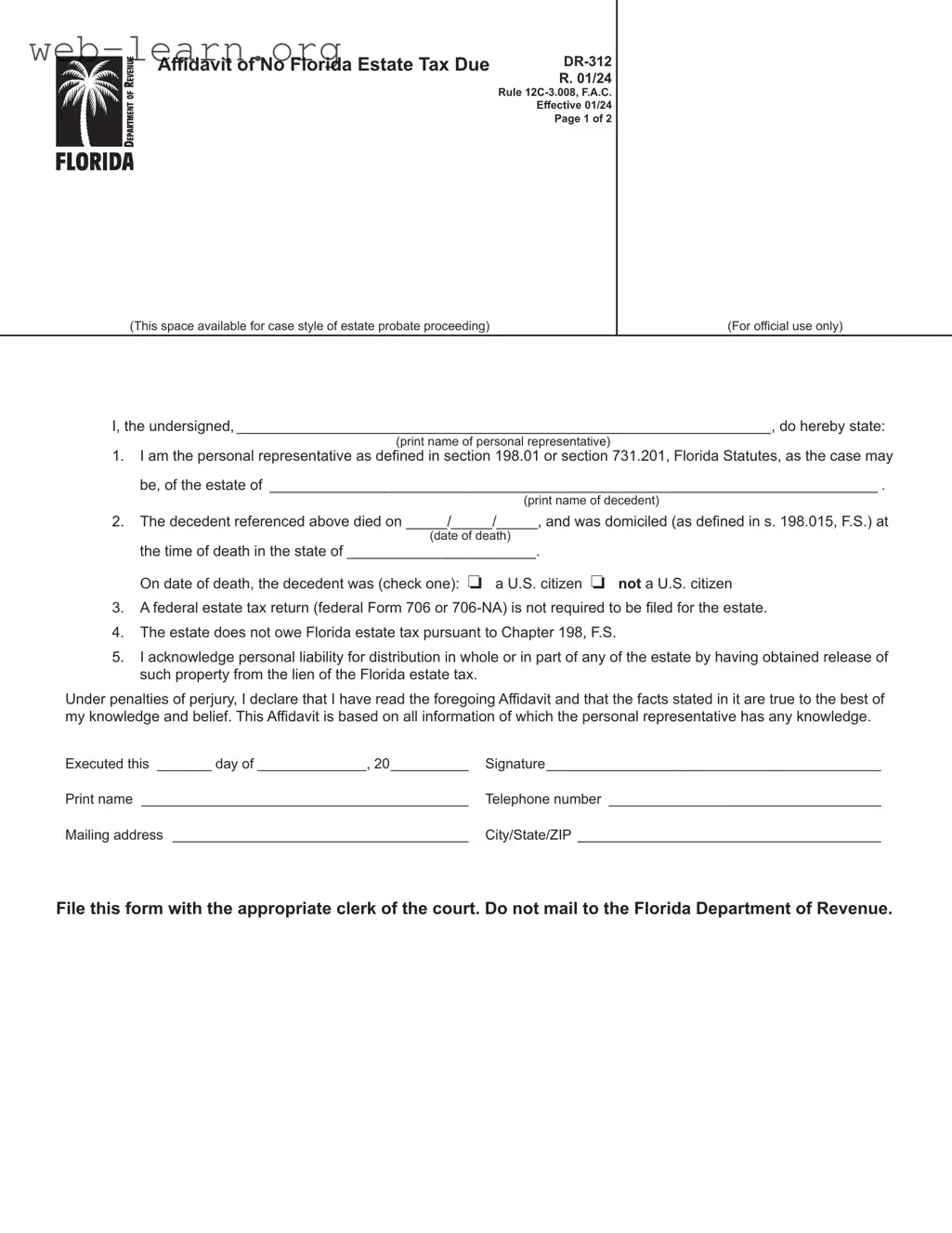
The FL DR 312 form, officially known as the Affidavit of No Florida Estate Tax Due, serves a crucial role in the estate administration process in Florida. Designed for personal representatives of estates, this form is necessary when there is no Florida estate tax owed and no requirement to file a federal estate tax return, specifically Form 706 or 706-NA. By completing this affidavit, the personal representative affirms that the decedent, who passed away while domiciled in Florida, does not have any outstanding estate tax obligations. The form requires essential details such as the decedent's name, date of death, and the representative's acknowledgment of personal liability for the distribution of estate property. Additionally, the FL DR 312 is admissible as evidence of nonliability for Florida estate tax, effectively removing any tax lien imposed by the Florida Department of Revenue. It is important to file this form with the appropriate clerk of the circuit court in the county where the decedent owned property, rather than sending it to the Florida Department of Revenue. Understanding the proper use and filing of the FL DR 312 can streamline the estate settlement process, ensuring compliance with state regulations while alleviating potential tax burdens.


Sample - Fl Dr 312 Form

A󰀩davit of No Florida Estate Tax Due
DR-312
R. 01/24
Rule 12C-3.008, F.A.C.
E󰀨ective 01/24
Page 1 of 2
(For o󰀩cial use only)(This space available for case style of estate probate proceeding)
I, the undersigned, _________________________________________________________________, do hereby state:
1. I am the personal representative as dened in section 198.01 or section 731.201, Florida Statutes, as the case may
be, of the estate of __________________________________________________________________________ .
2. The decedent referenced above died on _____/_____/_____, and was domiciled (as dened in s. 198.015, F.S.) at
the time of death in the state of _______________________.
On date of death, the decedent was (check one): o a U.S. citizen o not a U.S. citizen
3. A federal estate tax return (federal Form 706 or 706-NA) is not required to be led for the estate.
4. The estate does not owe Florida estate tax pursuant to Chapter 198, F.S.
5. I acknowledge personal liability for distribution in whole or in part of any of the estate by having obtained release of
such property from the lien of the Florida estate tax.
Under penalties of perjury, I declare that I have read the foregoing A󰀩davit and that the facts stated in it are true to the best of
my knowledge and belief. This A󰀩davit is based on all information of which the personal representative has any knowledge.
(print name of personal representative)
(print name of decedent)
(date of death)
Executed this _______ day of ______________, 20 __________ Signature ___________________________________________
Print name __________________________________________ Telephone number ___________________________________
Mailing address ______________________________________ City/State/ZIP _______________________________________
File this form with the appropriate clerk of the court. Do not mail to the Florida Department of Revenue.
Instructions for Completing Form DR-312
File this form with the appropriate clerk of the court if necessary. Do not mail to the Florida Department
of Revenue.
DR-312
R. 01/24
Page 2 of 2
General Information
If Florida estate tax is not due and a federal estate tax
return (federal Form 706 or 706-NA) is not required to be
led, the personal representatives of such estates may
complete Florida Form DR-312, Adavit of No Florida
Estate Tax Due. Note that the denition of “personal
representative” in Chapter 198, F.S., includes any
person who is in actual or constructive possession.
Therefore, this a󰀩davit may be used by “persons
in possession” of any property included in the
decedent’s gross estate.
Form DR-312 is admissible as evidence of nonliability
for Florida estate tax and will remove the Department’s
estate tax lien. The Florida Department of Revenue will
not issue Nontaxable Certicates for estates for which
the DR-312 has been duly led and no federal Form 706
or 706-NA is due.
The 3-inch by 3-inch space in the upper right corner of
the form is for the exclusive use of the clerk of the court.
Do not write, mark, or stamp in that space.
Where to File Form DR-312
Form DR-312 may be recorded directly with the clerk
of the circuit court in the county or counties where the
decedent owned property. Do not send this form to the
Florida Department of Revenue.
When to Use Form DR-312
Form DR-312 should be used when an estate is not
subject to Florida estate tax under Chapter 198, F.S., a
federal estate tax return (federal Form 706 or
706-NA) is not required to be led, and the
administrative proceedings commenced before
July 1, 2023.
NOTE: This form may NOT be used for estates that are
required to le federal form 706 or 706-NA.
Federal thresholds for ling federal Form 706 only:
(For informational purposes only. Please conrm with
Form 706 instructions.)
Date of Death
(year)
Dollar Threshold
for Filing Form 706
(value of gross estate)
2000 and 2001 $675,000
2002 and 2003 $1,000,000
2004 and 2005 $1,500,000
For 2006 and forward
go to the IRS website at
www.irs.gov to obtain
thresholds.
For thresholds for ling federal Form 706-NA
(nonresident alien decedent), contact your local Internal
Revenue Service o󰀩ce.
If an administration proceeding which commenced
before July 1, 2023 is pending for an estate, Form
DR-312 may be led in that proceeding. The case style
of the proceeding should be added in the large blank
space in the upper left portion of the DR-312. Form
DR-312 should be led with the clerk of the court and
duly recorded in the public records of the county or
counties where the decedent owned property.
Contact Us
Information and tutorials are available at oridarevenue.com/taxes/education.
Tax forms and brochures are available at oridarevenue.com/forms.
To speak with a Department of Revenue representative, call Taxpayer Services at 850-488-6800, Monday through
Friday, excluding holidays.
Reference Material
Rules are available at rules.org.
Rule Chapter 12C-3, Florida Administrative Code and Chapter 198, Florida Statutes.
Subscribe to Receive Email Alerts from the Department.
Subscribe to receive an email for ling due date reminders, Tax Information Publications (TIPs), or proposed rules.
Subscribe today at oridarevenue.com/dor/subscribe.

Form Information

Fact Name Details
Form Title Affidavit of No Florida Estate Tax Due DR-312
Governing Law Chapter 198, Florida Statutes
Effective Date January 2021
Purpose This form certifies that no Florida estate tax is due for the estate of the decedent.
Filing Requirement File with the clerk of the circuit court in the county where the decedent owned property.
Federal Return Status A federal estate tax return (Form 706 or 706-NA) is not required for the estate.
Personal Representative The individual filing must be the personal representative as defined in Florida law.
Liability Acknowledgment The personal representative acknowledges liability for distributions made from the estate.
Admissibility This affidavit is admissible as evidence of nonliability for Florida estate tax.
Contact Information For questions, contact Taxpayer Services at 850-488-6800.

Detailed Guide for Filling Out Fl Dr 312

After completing the Fl Dr 312 form, you will need to file it with the appropriate clerk of the court in the county where the decedent owned property. This form serves as an affidavit confirming that no Florida estate tax is due. Make sure to follow the steps carefully to ensure that all required information is provided.

  1. Begin by entering your name in the space provided for the personal representative.
  2. Fill in the name of the decedent in the designated area.
  3. Enter the date of death in the format of MM/DD/YYYY.
  4. Specify the state where the decedent was domiciled at the time of death.
  5. Select whether the decedent was a U.S. citizen or not by checking the appropriate box.
  6. Confirm that a federal estate tax return is not required for the estate.
  7. State that the estate does not owe Florida estate tax as per Chapter 198.
  8. Acknowledge personal liability for the distribution of any estate property by signing your name.
  9. Print your name below your signature.
  10. Provide your telephone number.
  11. Fill in your mailing address, including city, state, and ZIP code.
  12. Leave the 3-inch by 3-inch space in the upper right corner blank for the clerk's use.

Once you have completed the form, submit it directly to the clerk of the circuit court. Do not mail it to the Florida Department of Revenue.

Obtain Answers on Fl Dr 312

  1. What is the purpose of the FL DR 312 form?

    The FL DR 312 form, officially known as the Affidavit of No Florida Estate Tax Due, is used by personal representatives of estates to declare that no Florida estate tax is owed. This form is particularly relevant when a federal estate tax return is not required, indicating that the estate does not meet the threshold for tax liability under Florida law.

  2. Who is eligible to file the FL DR 312 form?

    Eligibility to file the FL DR 312 form is granted to personal representatives as defined in Florida Statutes. This includes individuals who are in actual or constructive possession of the decedent’s property. Additionally, anyone who has been appointed to manage the estate can complete and submit this affidavit.

  3. When should the FL DR 312 form be used?

    The form should be utilized when an estate is not subject to Florida estate tax under Chapter 198 of the Florida Statutes. It is also applicable when there is no requirement to file a federal estate tax return, specifically Forms 706 or 706-NA. If the estate meets the criteria for federal filing, this form cannot be used.

  4. Where should the FL DR 312 form be filed?

    The FL DR 312 form must be filed with the clerk of the circuit court in the county or counties where the decedent owned property. It is important to note that this form should not be mailed to the Florida Department of Revenue.

  5. What are the consequences of filing the FL DR 312 form?

    Filing the FL DR 312 form serves as evidence of nonliability for Florida estate tax. It effectively removes the Department of Revenue’s estate tax lien from the estate’s property. Once filed, the Florida Department of Revenue will no longer issue Nontaxable Certificates for estates that have submitted this affidavit.

  6. What information is required to complete the FL DR 312 form?

    To complete the FL DR 312 form, the personal representative must provide specific details including their name, the name of the decedent, the date of death, the decedent’s domicile at the time of death, and whether the decedent was a U.S. citizen. Additionally, the representative must affirm that a federal estate tax return is not required and acknowledge personal liability for any distributions made.

Common mistakes

Filling out the FL DR-312 form can be a straightforward process, but many individuals make common mistakes that can lead to delays or complications. Understanding these pitfalls can help ensure that the form is completed accurately and efficiently.

One frequent error is failing to provide the correct name of the decedent. It is crucial to ensure that the name printed matches the official documentation. Any discrepancies can result in the form being rejected or delayed. Additionally, omitting the date of death or providing an incorrect date can also cause significant issues. This date is essential for establishing the timeline of the estate and determining tax obligations.

Another mistake is neglecting to check the box indicating whether the decedent was a U.S. citizen. This detail is important as it can affect the estate's tax status. Furthermore, some individuals mistakenly believe that they can file the form with the Florida Department of Revenue. In reality, the FL DR-312 must be filed directly with the clerk of the court in the appropriate county.

Many people also overlook the requirement to acknowledge personal liability for the distribution of the estate. This acknowledgment is a critical component of the affidavit and must be understood fully before signing. Failing to read the affidavit carefully can lead to unintentional errors, such as signing without understanding the implications of personal liability.

Another common oversight involves not including complete contact information. The form requires a telephone number and mailing address, which are necessary for any follow-up communications. Incomplete information can hinder the processing of the form and lead to unnecessary delays.

Some individuals also forget to include the case style of the estate probate proceeding in the designated space. This detail is important for the court's records and should not be overlooked. Lastly, it's essential to remember that the form should not be altered in any way, especially in the designated area for the clerk of the court. Any markings in this area can lead to complications in processing the form.

By being aware of these common mistakes, individuals can navigate the completion of the FL DR-312 form more effectively. Attention to detail and careful review can save time and ensure that the estate is handled smoothly.

Documents used along the form

The FL DR 312 form, or Affidavit of No Florida Estate Tax Due, is essential for personal representatives of estates that are not subject to Florida estate tax. When utilizing this form, several other documents may be required or beneficial in the estate administration process. Below is a list of forms and documents that are commonly used alongside the FL DR 312.

  • Federal Form 706: This is the United States Estate (and Generation-Skipping Transfer) Tax Return. It is filed by estates that exceed the federal exemption limit, detailing the estate's assets and liabilities.
  • Federal Form 706-NA: This form is specifically for nonresident aliens. It serves a similar purpose to Form 706 but is tailored to the unique circumstances of nonresident decedents.
  • Death Certificate: A certified copy of the death certificate is often required to prove the decedent's passing and to establish the date of death for tax purposes.
  • Will: The decedent's last will and testament outlines how their assets should be distributed. It is a critical document in the probate process.
  • Letters of Administration: This document is issued by the court, granting the personal representative authority to manage the estate. It is essential for conducting estate business.
  • Inventory of Assets: This is a comprehensive list of all assets owned by the decedent at the time of death. It assists in determining the value of the estate.
  • Notice to Creditors: This document informs creditors of the decedent's passing and provides them with an opportunity to make claims against the estate.
  • Tax Clearance Certificate: This certificate confirms that all due taxes have been paid, which may be necessary for the distribution of assets.
  • Affidavit of Heirs: This document can establish the rightful heirs to the estate, particularly when there is no will or when the will is contested.
  • Final Accounting: This report details all financial transactions made during the administration of the estate, including income, expenses, and distributions to heirs.

These documents play a vital role in the estate administration process. Each serves a specific purpose, ensuring that the estate is managed according to legal requirements and the decedent's wishes. Personal representatives should ensure they have all necessary documentation to facilitate a smooth probate process.

Similar forms

The Florida Form DR-312, known as the Affidavit of No Florida Estate Tax Due, is similar to several other documents used in estate management and tax matters. Here are nine documents that share similarities with Form DR-312:

  • Federal Form 706: This is the U.S. estate tax return used to report the estate of a deceased person. Like DR-312, it is concerned with estate tax liability, but it is required under federal law when certain thresholds are met.
  • Federal Form 706-NA: This form is for nonresident aliens and serves a similar purpose as Form 706. Both forms help determine tax obligations, but 706-NA is specifically for non-U.S. citizens.
  • Florida Form DR-313: Known as the Affidavit of No Florida Estate Tax Due for Small Estates, this form is similar in that it is used to assert that no estate tax is owed, but it applies to smaller estates under specific value thresholds.
  • Florida Form DR-314: This is the Application for a Florida Estate Tax Waiver. It allows personal representatives to request a waiver of the estate tax. Like DR-312, it addresses estate tax matters but is focused on obtaining a waiver rather than declaring no tax due.
  • Florida Form DR-315: The Affidavit of Heirship is used to establish the heirs of a decedent. While DR-312 focuses on tax liability, both forms are essential in the probate process.
  • Florida Form DR-316: This is the Petition for Summary Administration. It allows for a simplified probate process for small estates, similar to DR-312 in that it aims to streamline the estate management process.
  • Florida Form DR-317: The Petition for Administration is used to initiate the probate process. While DR-312 deals with tax liability, both documents are integral to managing an estate.
  • Florida Form DR-318: This is the Notice of Administration, which informs interested parties about the probate process. Like DR-312, it is part of the formal notification process in estate management.
  • Florida Form DR-319: The Notice to Creditors is used to inform creditors of the decedent's passing and the estate's probate. Both DR-312 and DR-319 play roles in ensuring compliance with legal requirements during estate administration.

Each of these documents serves a specific purpose in the estate management process, similar to how Form DR-312 addresses the issue of Florida estate tax liability.

Dos and Don'ts

When filling out the FL DR 312 form, attention to detail is crucial. Here are six important dos and don'ts to keep in mind:

  • Do ensure you accurately print the name of the personal representative and the decedent.
  • Do confirm the date of death is correctly filled in.
  • Do check the appropriate box regarding the decedent's citizenship status.
  • Do file the form directly with the clerk of the circuit court.
  • Don't write or mark in the designated space for the clerk in the upper right corner.
  • Don't send the form to the Florida Department of Revenue.

Following these guidelines will help ensure a smooth process when completing the FL DR 312 form.

Misconceptions

Here are ten misconceptions about the Florida Form DR-312, Affidavit of No Florida Estate Tax Due, along with clarifications for each:

  • Misconception 1: The DR-312 form is only for large estates.
  • This form can be used for any estate that is not subject to Florida estate tax, regardless of size, as long as a federal estate tax return is not required.

  • Misconception 2: You must file the DR-312 with the Florida Department of Revenue.
  • In fact, this form should be filed directly with the clerk of the circuit court in the county where the decedent owned property.

  • Misconception 3: Filing the DR-312 means you are exempt from all taxes.
  • The DR-312 only addresses Florida estate tax. Other taxes, such as income or inheritance taxes, may still apply.

  • Misconception 4: The form can be submitted at any time after the decedent's death.
  • It should be filed promptly after determining that no Florida estate tax is due and that no federal return is required.

  • Misconception 5: You can use the DR-312 if a federal estate tax return is required.
  • This form cannot be used if a federal Form 706 or 706-NA is required to be filed.

  • Misconception 6: The DR-312 is only for personal representatives.
  • Any person in actual or constructive possession of property in the decedent’s estate can complete this affidavit.

  • Misconception 7: The form is not legally binding.
  • The DR-312 is a legal document that, when executed, serves as evidence of nonliability for Florida estate tax and can remove the tax lien.

  • Misconception 8: You need a lawyer to file the DR-312.
  • While legal advice can be helpful, it is not necessary to have a lawyer complete and file this form.

  • Misconception 9: The DR-312 can be used in any state.
  • This form is specific to Florida and should only be used for estates within the state.

  • Misconception 10: The form does not require a signature.
  • A signature from the personal representative is mandatory, as it affirms the truthfulness of the information provided.

Key takeaways

  • Form DR-312 is used to declare that no Florida estate tax is due for a decedent's estate.

  • This affidavit must be filed with the clerk of the circuit court in the county where the decedent owned property.

  • It is essential to ensure that a federal estate tax return (Form 706 or 706-NA) is not required before using this form.

  • Completing this form can help remove the Florida estate tax lien from the estate.

  • The personal representative must sign the form and provide their contact information.

  • Do not send Form DR-312 to the Florida Department of Revenue; it is only for the court clerk.