Homepage Blank First Report Of Injury Florida Form
Outline

The First Report of Injury Florida form is an essential document for reporting workplace injuries or illnesses to the Division of Workers' Compensation. This form serves multiple purposes, including documenting the employee's information, the nature of the injury, and details about the employer. It requires the employee's name, Social Security number, and a description of the accident, including the time and location of the incident. Employers must also provide their company information, such as the federal ID number and the nature of their business. Importantly, the form addresses whether wages will continue to be paid instead of workers' compensation, which can significantly affect the employee's financial situation. Additionally, the form includes sections for the employer's and employee's signatures, confirming the accuracy of the information provided. Understanding how to complete this form accurately is crucial for both employees and employers, as it initiates the claims process and ensures compliance with Florida's workers' compensation laws.

Sample - First Report Of Injury Florida Form

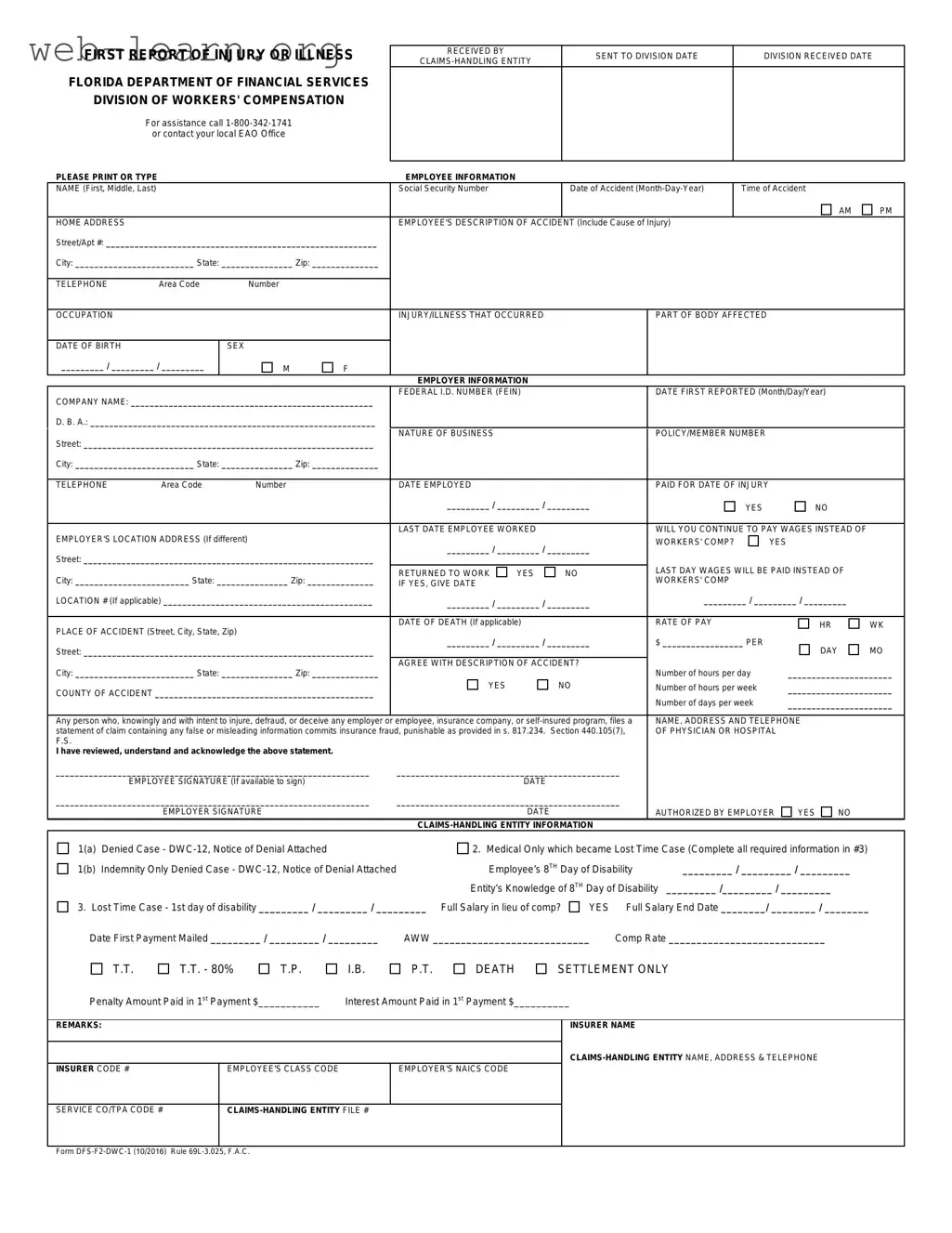
FIRST REPORT OF INJURY OR ILLNESS
RECEIVED BY
CLAIMS-HANDLING ENTITY
SENT TO DIVISION DATE DIVISION RECEIVED DATE
FLORIDA DEPARTMENT OF FINANCIAL SERVICES
DIVISION OF WORKERS' COMPENSATION
For assistance call 1-800-342-1741
or contact your local EAO Office
PLEASE PRINT OR TYPE EMPLOYEE INFORMATION
NAME (First, Middle, Last) Social Security Number Date of Accident (Month-Day-Year) Time of Accident
AM PM
HOME ADDRESS
Street/Apt #: _________________________________________________________
City: _________________________ State: _______________ Zip: ______________
EMPLOYEE'S DESCRIPTION OF ACCIDENT (Include Cause of Injury)
TELEPHONE Area Code Number
OCCUPATION INJURY/ILLNESS THAT OCCURRED PART OF BODY AFFECTED
DATE OF BIRTH
_________ / _________ / _________
SEX
M F
EMPLOYER INFORMATION
COMPANY NAME: ___________________________________________________
D. B. A.: ____________________________________________________________
FEDERAL I.D. NUMBER (FEIN) DATE FIRST REPORTED (Month/Day/Year)
Street: _____________________________________________________________
City: _________________________ State: _______________ Zip: ______________
NATURE OF BUSINESS POLICY/MEMBER NUMBER
TELEPHONE Area Code Number DATE EMPLOYED
_________ / _________ / _________
PAID FOR DATE OF INJURY
YES NO
EMPLOYER'S LOCATION ADDRESS (If different)
Street: _____________________________________________________________
LAST DATE EMPLOYEE WORKED
_________ / _________ / _________
WILL YOU CONTINUE TO PAY WAGES INSTEAD OF
WORKERS' COMP?
YES
City: ________________________ State: _______________ Zip: ______________
LOCATION # (If applicable) ____________________________________________
RETURNED TO WORK
YES
NO
IF YES, GIVE DATE
_________ / _________ / _________
LAST DAY WAGES WILL BE PAID INSTEAD OF
WORKERS' COMP
_________ / _________ / _________
PLACE OF ACCIDENT (Street, City, State, Zip)
Street: _____________________________________________________________
DATE OF DEATH (If applicable)
_________ / _________ / _________
RATE OF PAY
$ _________________ PER
HR WK
DAY MO
City: _________________________ State: _______________ Zip: ______________
COUNTY OF ACCIDENT ______________________________________________
AGREE WITH DESCRIPTION OF ACCIDENT?
YES
NO
Number of hours per day
Number of hours per week
Number of days per week
______________________
______________________
______________________
Any person who, knowingly and with intent to injure, defraud, or deceive any employer or employee, insurance company, or self-insured program, files a
statement of claim containing any false or misleading information commits insurance fraud, punishable as provided in s. 817.234. Section 440.105(7),
F.S.
I have reviewed, understand and acknowledge the above statement.
__________________________________________________________________ _______________________________________________
EMPLOYEE SIGNATURE (If available to sign) DATE
__________________________________________________________________ _______________________________________________
EMPLOYER SIGNATURE DATE
NAME, ADDRESS AND TELEPHONE
OF PHYSICIAN OR HOSPITAL
AUTHORIZED BY EMPLOYER
YES NO
CLAIMS-HANDLING ENTITY INFORMATION
1(a) Denied Case - DWC-12, Notice of Denial Attached 2. Medical Only which became Lost Time Case (Complete all required information in #3)
1(b) Indemnity Only Denied Case - DWC-12, Notice of Denial Attached Employee’s 8
TH
Day of Disability _________ / _________ / _________
Entity’s Knowledge of 8
TH
Day of Disability _________ /_________ / _________
3. Lost Time Case - 1st day of disability _________ / _________ / _________ Full Salary in lieu of comp? YES Full Salary End Date ________/ ________ / ________
Date First Payment Mailed _________ / _________ / _________ AWW ____________________________ Comp Rate ____________________________
T.T. T.T. - 80% T.P. I.B. P.T. DEATH SETTLEMENT ONLY
Penalty Amount Paid in 1
st
Payment $___________ Interest Amount Paid in 1
st
Payment $__________
REMARKS: INSURER NAME
CLAIMS-HANDLING ENTITY NAME, ADDRESS & TELEPHONE
INSURER CODE #
EMPLOYEE'S CLASS CODE EMPLOYER'S NAICS CODE
SERVICE CO/TPA CODE #
CLAIMS-HANDLING ENTITY FILE #
Form DFS-F2-DWC-1 (10/2016) Rule 69L-3.025, F.A.C.
DWC-1 Purpose and Use Statement
The collection of the social security number on this form is
specifically authorized by Section 440.185(2), Florida
Statutes. The social security number will be used as a unique
identifier in Division of Workers' Compensation database
systems for individuals who have claimed benefits under
Chapter 440, Florida Statutes. It will also be used to identify
information and documents in those database systems
regarding individuals who have claimed benefits under
Chapter 440, Florida Statutes, for internal agency tracking
purposes and for purposes of responding to both public
records requests and subpoenas that require production of
specified documents. The social security number may also be
used for any other purpose specifically required or
authorized by state or federal law.

Form Information

Fact Name Description
Governing Law The First Report of Injury form is governed by Chapter 440 of the Florida Statutes.
Purpose This form is used to report workplace injuries or illnesses to the Florida Division of Workers' Compensation.
Submission Requirement Employers must submit this form within seven days of being notified of an injury.
Employee Information The form requires detailed employee information, including name, Social Security number, and occupation.
Accident Details Employees must describe the accident, including the cause and time of the incident.
Employer Information Employers must provide their name, Federal ID number, and nature of business on the form.
Wage Continuation Employers must indicate if they will continue to pay wages instead of workers' compensation benefits.
Fraud Warning The form includes a warning about the penalties for filing false claims, as per Section 440.105(7) of the Florida Statutes.
Signature Requirement Both the employee and employer must sign the form to validate the report.
Contact Information For assistance, individuals can call 1-800-342-1741 or contact their local Employee Assistance Office.

Detailed Guide for Filling Out First Report Of Injury Florida

Filling out the First Report of Injury form in Florida is an essential step in documenting workplace injuries or illnesses. After completing the form, it will need to be submitted to the appropriate claims-handling entity and the Division of Workers' Compensation. This process ensures that the injury is officially recorded and that the employee receives the necessary benefits.

  1. Obtain the First Report of Injury form from the Florida Department of Financial Services website or your employer.
  2. Fill in the "Received By" and "Sent To Division" sections at the top of the form, including the date received and date claims-handling entity.
  3. Provide employee information by entering the employee's full name, social security number, date and time of the accident, and home address.
  4. Detail the employee's description of the accident, including the cause of the injury.
  5. Enter the employee's telephone number, occupation, and the nature of the injury or illness that occurred.
  6. Specify the part of the body affected, date of birth, and sex of the employee.
  7. Fill in the employer information, including the company name, federal ID number, date first reported, and "Doing Business As" (D.B.A.) name if applicable.
  8. Provide the employer's address, nature of business, policy/member number, and telephone number.
  9. Indicate the date the employee was employed and whether they were paid for the date of injury.
  10. Complete the employer's location address if it differs from the company address, and enter the last date the employee worked.
  11. Indicate if the employer will continue to pay wages instead of workers' compensation and provide the last day wages will be paid.
  12. Fill in the rate of pay, place of accident, and, if applicable, the date of death.
  13. Confirm whether you agree with the description of the accident.
  14. Provide the county of the accident and the number of hours worked per day, week, and days per week.
  15. Read the fraud statement and sign the employee signature section if available, including the date.
  16. Have the employer sign and date the form, indicating if they are authorized.
  17. Complete the claims-handling entity information section as required.
  18. Review the entire form for accuracy before submission.

Obtain Answers on First Report Of Injury Florida

  1. What is the First Report of Injury Florida form?

    The First Report of Injury form is a document used in Florida to report workplace injuries or illnesses. It is essential for employees who have sustained injuries during work to fill out this form promptly. This report helps initiate the workers' compensation process, ensuring that the injured worker receives the necessary benefits and medical care.

  2. Who needs to fill out the form?

    The injured employee is primarily responsible for completing the First Report of Injury form. However, employers are also involved in the process. They must provide specific information about the incident and their business. Both parties play a critical role in ensuring the accuracy and completeness of the report.

  3. What information is required on the form?

    The form requests various details, including:

    • Employee's name, Social Security number, and date of birth
    • Date and time of the accident
    • Description of the accident and the cause of injury
    • Employer's information, including company name and federal ID number
    • Details about the injury, including the affected body part
    • Information regarding wages and whether the employer will continue to pay wages instead of workers' compensation

    Completing all sections accurately is crucial for a smooth claims process.

  4. How soon must the form be submitted?

    The First Report of Injury form should be submitted as soon as possible after the incident occurs. Florida law requires that employers report workplace injuries to their insurance carrier within seven days of learning about the injury. Timely submission helps ensure that the injured worker receives the benefits they need without unnecessary delays.

  5. What happens after the form is submitted?

    Once the First Report of Injury form is submitted, the claims-handling entity will review the information. They will determine whether the claim is valid and what benefits the injured worker is entitled to receive. The injured employee will be notified of the decision, and if the claim is accepted, they can begin receiving medical treatment and compensation as needed.

  6. What if there are inaccuracies in the form?

    Inaccuracies in the First Report of Injury form can lead to delays or denials of benefits. It is essential for both the employee and employer to review the information carefully before submission. If errors are discovered after submission, they should be corrected as soon as possible by notifying the claims-handling entity and providing the correct information.

Common mistakes

When completing the First Report of Injury form in Florida, individuals often make several common mistakes that can lead to delays or complications in processing their claims. One frequent error is failing to provide complete and accurate information about the employee. This includes not only the employee's name and social security number but also the date of the accident and a detailed description of how the injury occurred. Incomplete information can hinder the claims process and may result in the claim being denied.

Another mistake involves not including the correct employer information. It is essential to ensure that the company name, federal ID number, and nature of the business are accurately reported. Omitting or misreporting these details can create confusion and complicate the verification process. Additionally, if the employer's location differs from the primary business address, this should be clearly indicated to avoid any discrepancies.

Many people also overlook the importance of documenting the date and time of the accident. This information is critical for establishing the timeline of events leading to the injury. Failure to include this data can result in questions about the legitimacy of the claim. Furthermore, it is crucial to specify whether the employee was paid for the date of injury and whether wages will continue to be paid in lieu of workers' compensation.

Another common oversight is not providing a clear description of the accident. The employee's account should detail the cause of the injury and any relevant circumstances. A vague or incomplete description can lead to misunderstandings and may affect the outcome of the claim. It is advisable to be as specific as possible to ensure that all necessary information is available for review.

People often neglect to sign the form or to have the employer's signature included. Both signatures are vital for validating the report and confirming that the information provided is accurate. Without these signatures, the form may be considered incomplete, leading to further delays in processing the claim.

Lastly, individuals sometimes fail to review the form for accuracy before submission. Simple typographical errors or omissions can have significant consequences. Taking the time to double-check all entries can prevent unnecessary complications and ensure that the claim is processed smoothly. Being thorough and meticulous when filling out the First Report of Injury form is essential for a successful claims experience.

Documents used along the form

When filing a First Report of Injury in Florida, several other forms and documents may be needed to support the claim process. Below is a list of commonly used documents that accompany the First Report of Injury form.

  • DWC-12, Notice of Denial: This form is used by the claims-handling entity to formally deny a claim. It outlines the reasons for denial and provides the injured employee with necessary information regarding their rights and options.
  • Medical Records: Documentation from healthcare providers detailing the diagnosis, treatment, and prognosis of the injured employee. These records are crucial for verifying the injury and supporting the claim for benefits.
  • Employee's Wage Statement: A document that outlines the employee's earnings and pay history. This information is essential for calculating the average weekly wage (AWW) and determining compensation rates.
  • Incident Report: A report created by the employer detailing the circumstances of the accident. This document may include witness statements and descriptions of the events leading up to the injury.
  • Return to Work Release: A form completed by the healthcare provider indicating that the employee is fit to return to work. This document is necessary for reinstatement and may include any work restrictions.
  • Claim for Compensation (DWC-1): This form is submitted to initiate a workers' compensation claim. It provides detailed information about the injury and the employee's work history, allowing for the processing of benefits.

These documents play a vital role in the workers' compensation process. Having them prepared and submitted alongside the First Report of Injury can help ensure a smoother claims experience.

Similar forms

The First Report of Injury Florida form is similar to several other documents used in the context of workplace injuries and claims. Below are six documents that share similarities with the First Report of Injury form:

  • Workers' Compensation Claim Form: This form is used to initiate a claim for workers' compensation benefits. Like the First Report of Injury, it collects information about the employee, the accident, and the nature of the injury.
  • Employer's First Report of Injury: This document is completed by the employer to provide details about the injury as they understand it. It is similar in that it captures the same basic information regarding the incident and the employee.
  • Incident Report Form: Often used internally by employers, this form documents the details of an incident that led to an injury. It shares similarities with the First Report of Injury in terms of gathering information about what occurred and the circumstances surrounding the event.
  • Medical Authorization Form: This form allows healthcare providers to share medical information with the claims adjuster. It is related to the First Report of Injury as it is often used in conjunction with it to support the claim process.
  • Return to Work Form: This document is used to confirm an employee's ability to return to work after an injury. It is similar because it is part of the overall workers' compensation process and often follows the initial report of injury.
  • Notice of Denial Form: This form is used by insurers to formally deny a claim for workers' compensation benefits. It is related to the First Report of Injury as it may reference the initial report when explaining the reasons for denial.

Dos and Don'ts

When filling out the First Report of Injury form in Florida, it's crucial to ensure accuracy and completeness. Here are some important dos and don’ts to keep in mind:

  • Do provide complete and accurate information about the employee, including their full name, address, and Social Security number.
  • Do describe the accident in detail, including the cause of the injury and the specific part of the body affected.
  • Do ensure that the date and time of the accident are correctly noted.
  • Do review the form for any errors before submitting it to avoid delays in processing.
  • Don’t leave any sections blank; incomplete forms can lead to complications.
  • Don’t provide false or misleading information, as this could result in penalties for insurance fraud.

By following these guidelines, you can help ensure that the First Report of Injury form is filled out correctly and efficiently.

Misconceptions

Here are 10 common misconceptions about the First Report of Injury Florida form, along with clarifications for each:

  • It's only for severe injuries. Many believe this form is only necessary for serious injuries. However, it is required for any work-related injury or illness, regardless of severity.
  • You can submit it anytime. Some think there is no deadline. In reality, it must be submitted promptly after the injury occurs to ensure timely processing of claims.
  • Only employers can fill it out. While employers often handle the submission, employees can also provide their information and descriptions of the incident.
  • It’s only for physical injuries. This form covers both physical injuries and illnesses that arise from work conditions, including stress-related issues.
  • Filing means you will definitely receive compensation. Submitting the form does not guarantee that a claim will be approved or that compensation will be awarded.
  • All injuries must be reported immediately. Some injuries may not be apparent right away. It's crucial to report any injury as soon as it is recognized, even if it takes time to manifest.
  • It’s a simple form with no details needed. The form requires comprehensive information, including specifics about the injury, circumstances, and involved parties.
  • Only full-time employees need to report injuries. Part-time and temporary employees are also required to report injuries to ensure their rights are protected.
  • Once submitted, you can’t make changes. If errors are found after submission, corrections can be made, but they must be properly documented and submitted to the appropriate parties.
  • It's not important if I miss a detail. Every detail matters. Incomplete or inaccurate information can delay the processing of the claim or lead to denial.

Understanding these misconceptions can help ensure that the First Report of Injury Florida form is completed accurately and submitted on time, protecting both employee rights and employer responsibilities.

Key takeaways

Filling out the First Report of Injury form in Florida is an important step in the workers' compensation process. Here are key takeaways to keep in mind:

  • Complete Accuracy: Ensure all information is accurate to avoid delays in processing.
  • Print or Type: Use clear print or type to make the form legible.
  • Employee Details: Include the employee's full name, Social Security number, and contact information.
  • Accident Description: Provide a detailed description of the accident, including the cause of the injury.
  • Employer Information: Fill in the employer's name, address, and Federal ID number correctly.
  • Date of Injury: Clearly state the date and time of the accident.
  • Signature Requirement: Obtain signatures from both the employee and employer where applicable.
  • Fraud Warning: Be aware that providing false information can lead to serious legal consequences.
  • Submission Timing: Submit the form as soon as possible after the injury occurs.
  • Contact Information: If you need help, reach out to the Florida Department of Financial Services or your local EAO office.

Following these guidelines will help ensure that the form is completed correctly and efficiently, facilitating a smoother claims process.