Homepage Blank File Of Life Form
Outline

The File of Life form serves as a crucial tool for individuals to communicate essential medical information during emergencies. This form is designed to capture a comprehensive overview of a person's current medications, including both prescription and over-the-counter drugs, as well as herbal supplements. Users are encouraged to detail how often they take each medication and the reasons for their use. In addition to medication details, the form collects vital emergency medical information such as personal identification, contact information for healthcare providers, and insurance details. It also provides space for listing emergency contacts, recent surgeries, and any ongoing medical conditions. Individuals can check off various medical issues, allergies, and reactions, ensuring that first responders have a clear understanding of the patient's health status. To maintain accuracy, users are advised to update the form whenever there are changes in their medication or medical history. Keeping a copy of the File of Life form in a magnetic packet on the refrigerator and in a wallet or purse can significantly enhance safety and preparedness in emergencies. Additional copies of the form can be obtained online or through local health services, making it accessible for everyone.

Sample - File Of Life Form

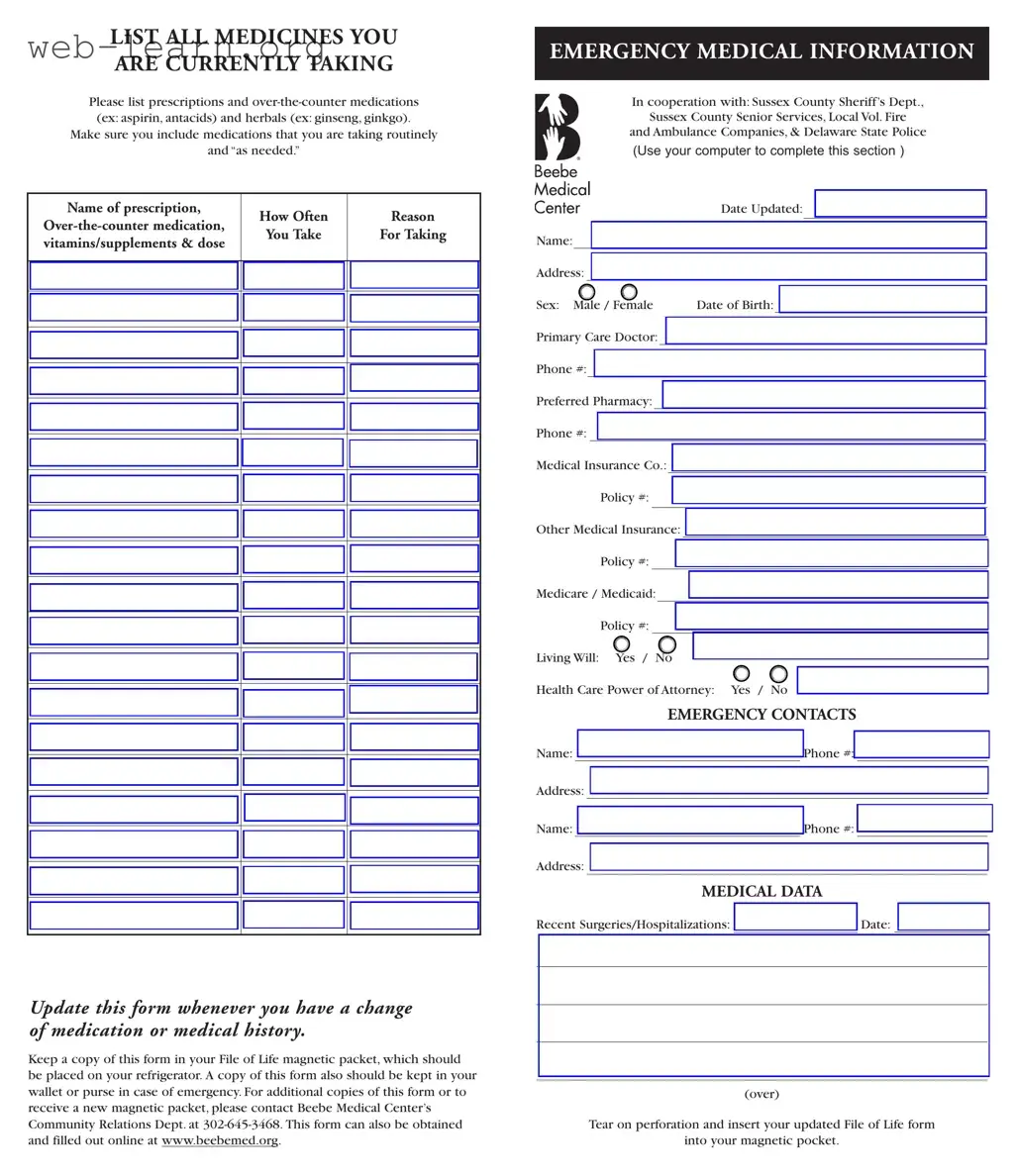
EMERGENCY MEDICAL INFORMATION
In cooperation with: Sussex County Sheriffs Dept.,
Sussex County Senior Services, Local Vol. Fire
and Ambulance Companies, & Delaware State Police
(Use your computer to complete this section )
Date Updated:
Name:
Address:
Sex: Male / Female Date of Birth:
Primary Care Doctor:
Phone #:
Preferred Pharmacy:
Phone #:
Medical Insurance Co.:
Policy #:
Other Medical Insurance:
Policy #:
Medicare / Medicaid:
Policy #:
Living Will: Yes / No
Health Care Power of Attorney: Yes / No
EMERGENCY CONTACTS
Name: Phone #:
Address:
Name: Phone #:
Address:
MEDICAL DATA
Recent Surgeries/Hospitalizations: Date:
(over)
LIST ALL MEDICINES YOU
ARE CURRENTLY TAKING
Please list prescriptions and over-the-counter medications
(ex: aspirin, antacids) and herbals (ex: ginseng, ginkgo).
Make sure you include medications that you are taking routinely
and “as needed.
Update this form whenever you have a change
of medication or medical history.
Keep a copy of this form in your File of Life magnetic packet, which should
be placed on your refrigerator. A copy of this form also should be kept in your
wallet or purse in case of emergency. For additional copies of this form or to
receive a new magnetic packet, please contact Beebe Medical Center’s
Community Relations Dept. at 302-645-3468. This form can also be obtained
and filled out online at www
.beebemed.org.
Name of prescription,
Over-the-counter medication,
vitamins/supplements & dose
How Often
You Take
Reason
For Taking
Tear on perforation and insert your updated File of Life form
into your magnetic pocket.
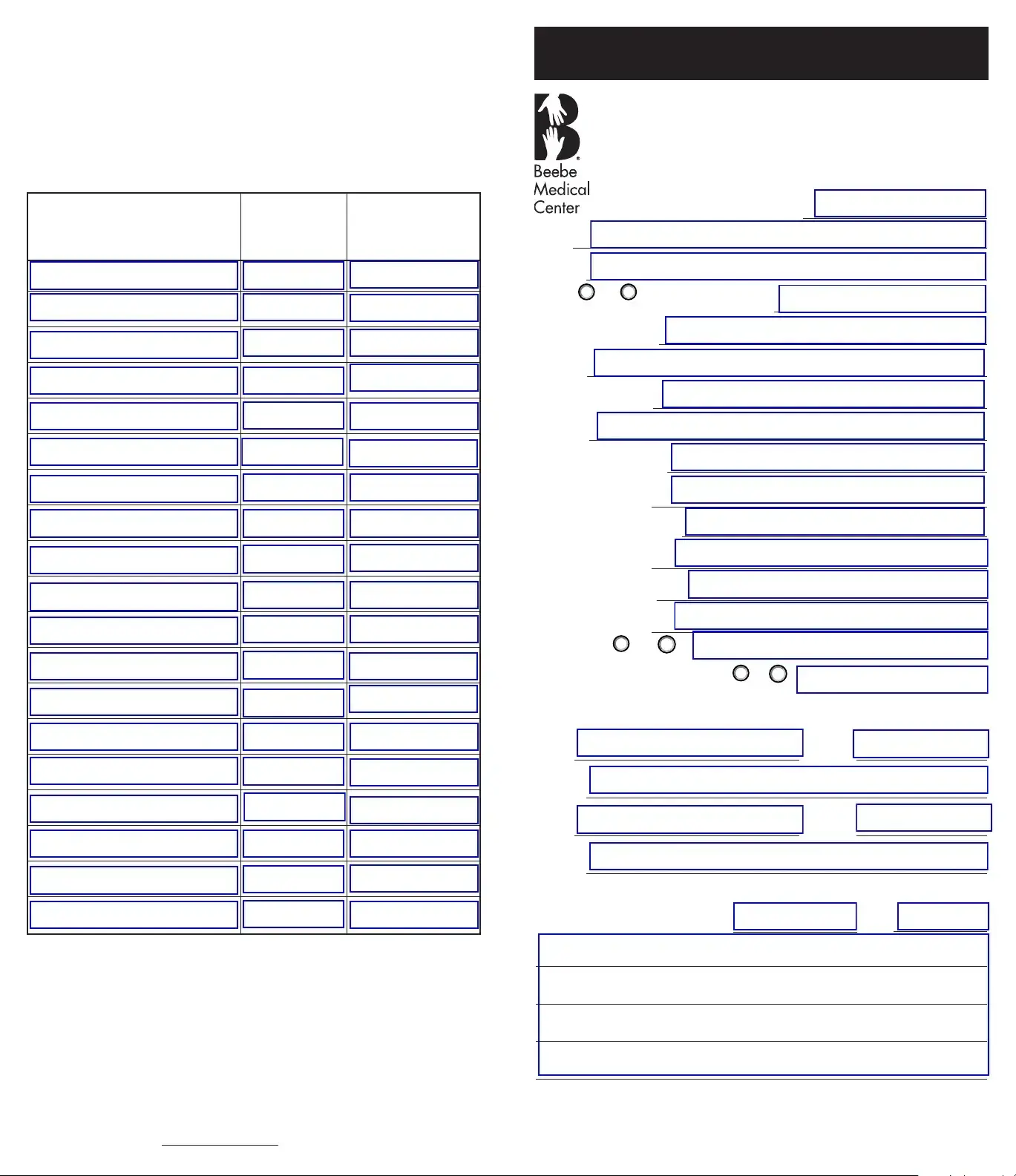
UNIVERSAL MEDICATION FORM
(Use pencil on this form to allow for easy changing)
Date Updated:
Name:
Address:
Sex: Male / Female Date of Birth:
Primary Care Doctor:
Phone #:
Preferred Pharmacy:
Phone #:
Medical Insurance Co.:
Policy #:
Other Medical Insurance:
Policy #:
Medicare / Medicaid:
Policy #:
MEDICINE ALLERGIES/REACTIONS (describe reaction)
Drug:
Reaction:
MEDICAL CONDITIONS
(check all that apply)
Update this form whenever you have a change
of medication or medical history.
Keep a copy of this form in your File of Life magnetic packet, which should
be placed on your refrigerator. A copy of this form also should be kept in your
wallet or purse in case of emergency. For additional copies of this form or
to receive a new magnetic packet, please contact Beebe Medical Center’s
Community Relations Dept. at 302-645-3468. This form can also be obtained
and filled out online at www.beebemed.org.
ALLERGIES
(check all that apply)
HEART DISEASE LUNG DISEASE KIDNEY
DISEASE
CHF/Heart Failure COPD/Emphysema Failure
High Blood Pressure Asthma Insufficiency
Low Blood Pressure Fibrosis Dialysis
High Cholesterol Pneumonia Kidney Stones
Irregular Heart Beat Bronchitis Infections
Pacemaker Shortness of Breath
Heart Attack Coughing
Angina or Chest Pain Lung Pain
Heart Surgery/
ByPass/Stent
STOMACH NEUROLOGICAL MALIGNANCY/
DISEASE DISEASE CANCER
Bowel Obstruction Stroke Lung
Bleeding Bleeding in Brain Liver
Diverticulitis Seizures Breast
Hiatal Hernia Multiple Sclerosis Stomach
GERD/Reflux Parkinson Leukemia
Diarrhea Headaches Colon
Blood in Stools Alzheimers or Skin
Memory Loss Other:
ENDOCRINE OTHER
DISEASE
Diabetes Arthritis Vision
Thyroid: Back Problem Problems
HIV Other
Sickle Cell
Weight Gain
Weight Loss
High
Low
Aspirin Laytex Tetracycline
Barbiturates Lidocaine X-Ray Dye
Codeine Morphine No Known Allergy
Demerol Novocain Other:
Insect Stings Penicillin
Horse Serum or Sulfa
Vaccines

Form Information

Fact Name Description
Purpose The File of Life form is designed to provide critical medical information to emergency responders when a person is unable to communicate their needs.
Contents This form includes sections for medications, emergency contacts, medical conditions, allergies, and insurance information.
Medications Users are encouraged to list all medications, including prescriptions, over-the-counter drugs, and herbal supplements, along with their dosages and purposes.
Emergency Contacts It is important to include at least two emergency contacts, providing their names and phone numbers for quick access during emergencies.
Accessibility The form should be kept in a magnetic packet on the refrigerator and a copy in the wallet or purse for easy access by emergency personnel.
Updates Users should update the form whenever there is a change in medication or medical history to ensure accuracy.
Obtaining the Form Additional copies can be requested from Beebe Medical Center’s Community Relations Department or downloaded from their website.
Governing Law This form is utilized in accordance with Delaware state laws regarding medical emergency preparedness and patient information.
Usage in Emergencies Emergency responders are trained to look for this form in a patient's home, making it a vital resource in critical situations.

Detailed Guide for Filling Out File Of Life

Filling out the File Of Life form is essential for ensuring that emergency responders have the necessary information about your medical history, medications, and emergency contacts. Follow these steps carefully to complete the form accurately.

  1. Begin by listing all medications you are currently taking. Include prescriptions, over-the-counter medications, and herbal supplements. For each medication, provide the name, how often you take it, and the reason for taking it.
  2. Fill in your emergency medical information. Use your computer to complete this section. Include the date updated, your name, address, sex, date of birth, primary care doctor, and their phone number. Also, provide details about your preferred pharmacy and medical insurance information.
  3. List your emergency contacts. Write down the names, phone numbers, and addresses of at least two people who can be contacted in case of an emergency.
  4. Check all relevant medical conditions that apply to you. This includes heart disease, lung disease, kidney disease, and more. Make sure to be thorough.
  5. Indicate any allergies you have by checking the appropriate boxes. Include any known drug allergies and describe any reactions you have experienced.
  6. Complete the universal medication form using a pencil. This allows for easy updates in the future. Fill in the date updated, your name, address, sex, date of birth, primary care doctor, and their phone number.
  7. Once completed, tear along the perforation and insert the updated form into your magnetic pocket.
  8. Keep a copy of this form in your File of Life magnetic packet on your refrigerator. Also, store a copy in your wallet or purse for emergencies.
  9. For additional copies or to receive a new magnetic packet, contact Beebe Medical Center’s Community Relations Dept. at 302-645-3468 or visit www.beebemed.org.

Obtain Answers on File Of Life

  1. What is the File of Life form?

    The File of Life form is a vital document designed to provide emergency responders with essential medical information about an individual during a crisis. It includes details such as current medications, medical history, allergies, and emergency contacts. By having this information readily available, it can significantly improve the quality of care received in emergencies.

  2. How should I complete the File of Life form?

    To complete the File of Life form, you should list all medications you are currently taking, including prescriptions, over-the-counter drugs, and herbal supplements. For each medication, include the name, frequency of use, and the reason for taking it. Additionally, provide personal information such as your name, address, date of birth, and details about your primary care doctor and insurance. Make sure to check all relevant medical conditions and allergies.

  3. Where should I keep the File of Life form?

    It is recommended to keep the completed File of Life form in a magnetic packet on your refrigerator. This location is easily accessible for emergency responders. Additionally, you should carry a copy in your wallet or purse, ensuring that your medical information is available no matter where you are.

  4. How often should I update the File of Life form?

    Updating the File of Life form is crucial whenever there is a change in your medication, medical history, or emergency contact information. Regularly reviewing and refreshing the information ensures that it remains accurate and useful in an emergency situation.

  5. How can I obtain additional copies of the File of Life form?

    If you need additional copies of the File of Life form or a new magnetic packet, you can contact Beebe Medical Center’s Community Relations Department at 302-645-3468. Alternatively, the form can also be accessed and filled out online at www.beebemed.org.

Common mistakes

Filling out the File Of Life form is crucial for ensuring your health information is accessible in emergencies. However, many individuals make common mistakes that can compromise the effectiveness of this important document. One prevalent error is failing to list all medications. It is essential to include every prescription, over-the-counter medication, and herbal supplement you take. Omitting even one can lead to dangerous interactions or inadequate treatment during a medical emergency.

Another mistake involves not updating the form regularly. Medical conditions and medications can change frequently. Neglecting to revise your File Of Life form after any significant health change can result in outdated information being provided to emergency responders. This oversight can delay appropriate care and may even worsen your condition.

People often overlook the importance of including emergency contacts. Providing accurate names and phone numbers for family members or friends who can be reached in an emergency is vital. In some cases, individuals may list contacts who are unavailable or unreachable, which can hinder timely communication during critical moments.

Additionally, many individuals do not specify the dosage of their medications. Simply naming a medication without detailing how much you take can lead to confusion. Emergency personnel need precise information to administer the correct treatment, especially if they need to provide medications in a critical situation.

Some individuals mistakenly assume that their primary care doctor’s information is unnecessary. It is vital to include your doctor’s name and phone number on the form. This information allows emergency responders to quickly reach out for additional medical history or guidance, ensuring that you receive the best possible care.

Lastly, failing to indicate allergies and reactions can have severe consequences. If you have allergies to specific medications or substances, clearly stating them on the form is imperative. Emergency responders must know this information to avoid administering anything that could trigger a dangerous reaction.

Documents used along the form

The File Of Life form is a crucial document for ensuring that emergency responders have immediate access to your medical information. Alongside this form, there are several other important documents that can provide additional context and details about your health. Here’s a brief overview of four commonly used forms that complement the File Of Life form.

  • Universal Medication Form: This form lists all medications you are currently taking, including prescriptions and over-the-counter drugs. It allows for easy updates with a pencil, making it simple to keep your information current. It also includes sections for allergies and reactions to medications.
  • Living Will: A living will outlines your preferences for medical treatment in case you become unable to communicate your wishes. It provides guidance to healthcare providers and family members about the types of medical care you want or do not want in critical situations.
  • Health Care Power of Attorney: This document designates a person to make medical decisions on your behalf if you are unable to do so. It is essential to choose someone you trust to advocate for your health care preferences.
  • Emergency Contact List: This list includes names and phone numbers of individuals who should be contacted in case of an emergency. Having this information readily available can expedite communication during critical situations.

By keeping these documents updated and accessible, you can ensure that your medical information is clear and available when it matters most. It’s always a good idea to review these forms regularly and make any necessary changes to reflect your current health status.

Similar forms

The File of Life form serves as a vital tool for individuals to communicate their medical information effectively in emergencies. Several other documents share similarities with the File of Life form in terms of purpose and content. Below is a list of seven documents that are comparable:

  • Emergency Medical Information Card: This card typically includes critical health details, such as allergies, medications, and emergency contacts, similar to the File of Life form. It is designed for quick reference during medical emergencies.
  • Medication List: A comprehensive list of all medications a person is taking, including dosages and reasons for use. This document aligns closely with the medication section of the File of Life form, ensuring that emergency responders have access to essential medication information.
  • Advance Directive: This document outlines an individual's preferences for medical treatment in case they become unable to communicate. Like the File of Life form, it addresses critical health care decisions and can be vital in emergencies.
  • Health Care Power of Attorney: This document designates someone to make medical decisions on behalf of an individual if they are incapacitated. It complements the emergency contact information found in the File of Life form.
  • Patient Medical History Form: This form provides a detailed account of a person's past medical conditions, surgeries, and treatments. It shares similarities with the medical data section of the File of Life form, as both aim to provide a comprehensive view of an individual's health background.
  • Allergy Alert Card: This card lists specific allergies and reactions, similar to the allergy section of the File of Life form. It serves as a quick reference for medical personnel to avoid potential allergens during treatment.
  • Universal Medication Form: This document collects similar information regarding medications and allergies, allowing for easy updates. It parallels the File of Life form by providing essential medical data in a concise format.

Dos and Don'ts

When filling out the File of Life form, it is important to ensure accuracy and clarity. Here are some guidelines to follow:

  • Do provide a complete list of all medications, including prescriptions, over-the-counter drugs, and herbal supplements.
  • Don't omit any medications, even those taken occasionally or as needed.
  • Do include detailed information about your primary care doctor and preferred pharmacy.
  • Don't forget to update the form whenever there is a change in your medications or medical history.
  • Do check all relevant medical conditions and allergies accurately.
  • Don't use abbreviations that may not be understood by emergency responders.
  • Do keep a copy of the completed form in your magnetic packet on the refrigerator.
  • Don't leave the form in a location that is not easily accessible in case of an emergency.
  • Do use a pencil for any entries that may need to be changed in the future.
  • Don't hesitate to reach out for additional copies or assistance if needed.

Following these guidelines will help ensure that your File of Life form is both effective and useful in an emergency situation.

Misconceptions

Understanding the File of Life form is essential for ensuring that emergency responders have the necessary information to provide appropriate care. However, several misconceptions can lead to confusion about its purpose and use. Here are ten common misconceptions:

  • The File of Life is only for seniors. This form is beneficial for individuals of all ages, especially those with medical conditions or on multiple medications.
  • You only need to fill it out once. The form should be updated regularly, especially when there are changes in medications or medical history.
  • It is not necessary to keep a copy in your wallet. Having a copy in your wallet ensures that emergency personnel can access your information, even if you are unable to communicate.
  • All information is optional. While some sections may seem less critical, providing complete information can be vital in an emergency.
  • Emergency responders do not look for the File of Life form. Many emergency personnel are trained to look for this form, especially if they see the magnetic packet on your refrigerator.
  • It is only for medical information. The form also includes emergency contacts and important personal details that can aid responders.
  • You cannot fill it out online. The File of Life form can be obtained and completed online, making it easier to keep your information updated.
  • It is not necessary to list over-the-counter medications. Listing all medications, including over-the-counter and herbal supplements, is crucial for ensuring safe treatment.
  • The File of Life form is not secure. The information is intended for emergency use only and is kept confidential by emergency responders.
  • Once filled out, it is not important to check it again. Regular reviews of the form are necessary to ensure that all information remains accurate and up to date.

Key takeaways

Here are six key takeaways about filling out and using the File Of Life form:

  • List All Medications: Include every prescription, over-the-counter medication, and herbal supplement you take. Be specific about how often you take each one and the reason for use.
  • Emergency Medical Information: Fill out personal details such as your name, address, date of birth, and emergency contacts. This information is vital for healthcare providers in emergencies.
  • Keep It Updated: Regularly update the form whenever there are changes in your medications or medical history. This ensures that the information remains accurate and useful.
  • Store It Safely: Place the completed form in the File of Life magnetic packet on your refrigerator. Also, keep a copy in your wallet or purse for easy access during emergencies.
  • Contact for Assistance: If you need additional copies or a new magnetic packet, reach out to Beebe Medical Center’s Community Relations Department at 302-645-3468.
  • Online Access: You can fill out the form online at www.beebemed.org. This option provides convenience and ease of updating your information.