Homepage Blank Fee Worksheet Form
Outline

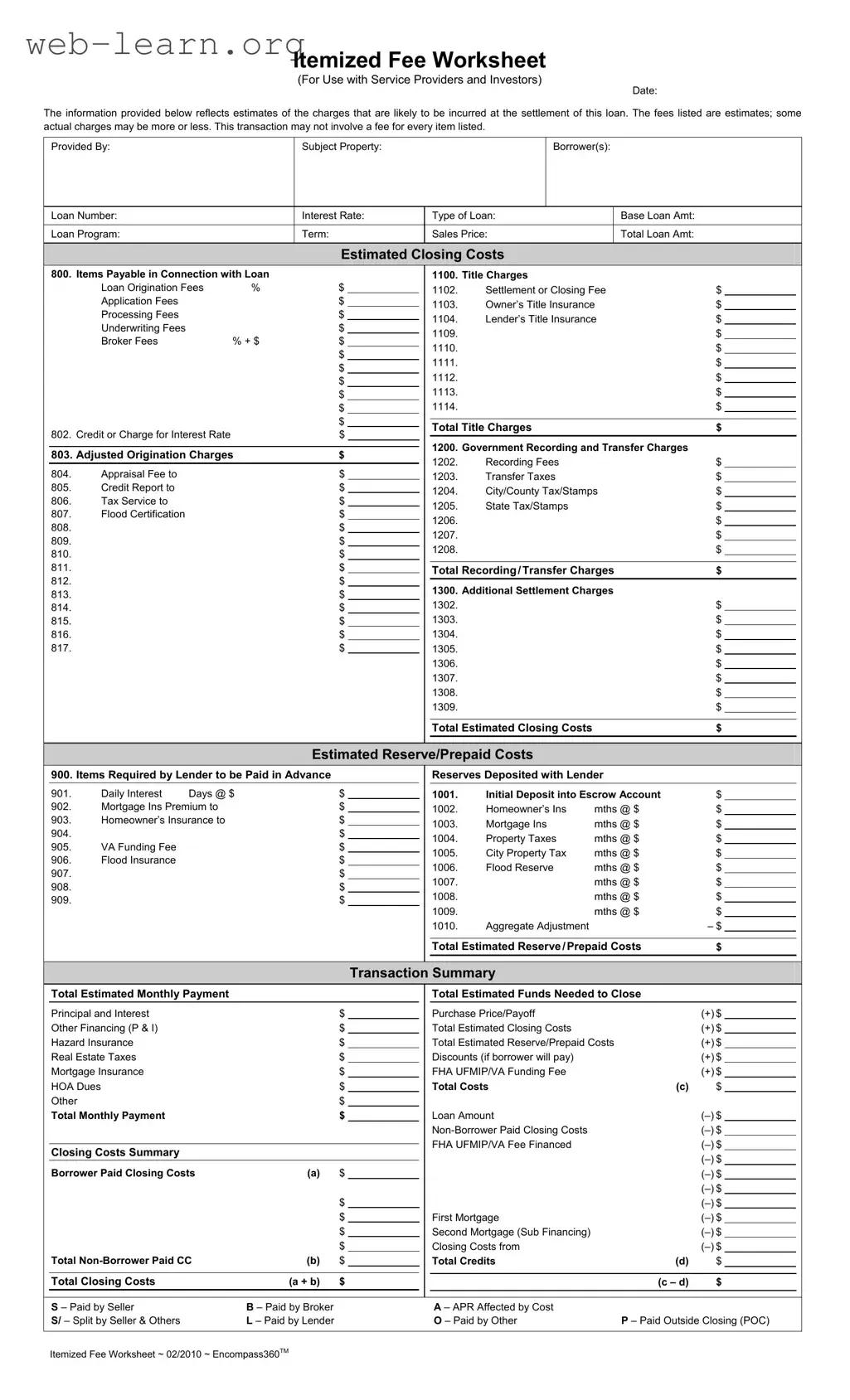
The Fee Worksheet form serves as a crucial tool for individuals navigating the complexities of loan settlements. It provides a detailed breakdown of estimated charges that borrowers can expect to incur during the closing process. This worksheet not only lists various fees associated with the loan but also categorizes them into specific sections such as title charges, recording and transfer charges, and additional settlement charges. Each item is designed to give clarity on costs like loan origination fees, appraisal fees, and title insurance, among others. Additionally, the form accounts for estimated reserves and prepaid costs, ensuring that borrowers understand their financial obligations before finalizing a loan. By offering a comprehensive overview, the Fee Worksheet empowers borrowers to make informed decisions and prepares them for the financial aspects of their real estate transactions.
Sample - Fee Worksheet Form

Itemized Fee Worksheet ~ 02/2010 ~ Encompass360
TM
Itemized Fee Worksheet
(For Use with Service Providers and Investors)
Date:
The information provided below reflects estimates of the charges that are likely to be incurred at the settlement of this loan. The fees listed are estimates; some
actual charges may be more or less. This transaction may not involve a fee for every item listed.
Provided By: Subject Property: Borrower(s):
Loan Number: Interest Rate: Type of Loan: Base Loan Amt:
Loan Program: Term: Sales Price: Total Loan Amt:
Estimated Closing Costs
800. Items Payable in Connection with Loan
Loan Origination Fees % $
Application Fees $
Processing Fees $
Underwriting Fees $
Broker Fees % + $ $
$
$
$
$
$
$
802. Credit or Charge for Interest Rate $
803. Adjusted Origination Charges
$
804. Appraisal Fee to $
805. Credit Report to $
806. Tax Service to $
807. Flood Certification $
808. $
809. $
810. $
811. $
812. $
813. $
814. $
815. $
816. $
817. $
1100. Title Charges
1102. Settlement or Closing Fee $
1103. Owner’s Title Insurance $
1104. Lender’s Title Insurance $
1109. $
1110. $
1111. $
1112. $
1113. $
1114. $
Total Title Charges
$
1200. Government Recording and Transfer Charges
1202. Recording Fees $
1203. Transfer Taxes $
1204. City/County Tax/Stamps $
1205. State Tax/Stamps $
1206. $
1207. $
1208. $
Total Recording / Transfer Charges
$
1300. Additional Settlement Charges
1302. $
1303. $
1304. $
1305. $
1306. $
1307. $
1308. $
1309. $
Total Estimated Closing Costs
$
Estimated Reserve/Prepaid Costs
900. Items Required by Lender to be Paid in Advance
901. Daily Interest Days @ $ $
902. Mortgage Ins Premium to $
903. Homeowner’s Insurance to $
904. $
905. VA Funding Fee $
906. Flood Insurance $
907. $
908. $
909. $
Reserves Deposited with Lender
1001. Initial Deposit into Escrow Account $
1002. Homeowner’s Ins mths @ $ $
1003. Mortgage Ins mths @ $ $
1004. Property Taxes mths @ $ $
1005. City Property Tax mths @ $ $
1006. Flood Reserve mths @ $ $
1007. mths @ $ $
1008. mths @ $ $
1009. mths @ $ $
1010. Aggregate Adjustment $
Total Estimated Reserve / Prepaid Costs
$
Transaction Summary
Total Estimated Monthly Payment
Principal and Interest $
Other Financing (P & I) $
Hazard Insurance $
Real Estate Taxes $
Mortgage Insurance $
HOA Dues $
Other $
Total Monthly Payment $
Closing Costs Summary
Borrower Paid Closing Costs (a) $
$
$
$
$
Total Non-Borrower Paid CC (b) $
Total Closing Costs
(a + b) $
Total Estimated Funds Needed to Close
Purchase Price/Payoff (+) $
Total Estimated Closing Costs (+) $
Total Estimated Reserve/Prepaid Costs (+) $
Discounts (if borrower will pay) (+) $
FHA UFMIP/VA Funding Fee (+) $
Total Costs (c) $
Loan Amount (–) $
Non-Borrower Paid Closing Costs (–) $
FHA UFMIP/VA Fee Financed (–) $
(–) $
(–) $
(–) $
(–) $
First Mortgage (–) $
Second Mortgage (Sub Financing) (–) $
Closing Costs from (–) $
Total Credits (d) $
(c – d) $
S – Paid by Seller
S/ – Split by Seller & Others
B – Paid by Broker
L – Paid by Lender
A – APR Affected by Cost
O – Paid by Other
P – Paid Outside Closing (POC)

Form Information

Fact Name Description
Purpose The Fee Worksheet is designed to provide an itemized estimate of charges that may be incurred during the settlement of a loan.
Estimates The fees listed are estimates. Actual charges may vary, and not all items may incur a fee.
Applicable Laws This form is governed by the Real Estate Settlement Procedures Act (RESPA) and varies by state regulations.
Components The worksheet includes sections for loan charges, recording fees, and estimated closing costs among other details.

Detailed Guide for Filling Out Fee Worksheet

Filling out the Fee Worksheet form is an essential step in the loan process. This form helps you estimate the various costs associated with your loan, ensuring you have a clear understanding of what to expect at closing. Follow these steps to complete the form accurately.

  1. Date: Write the date on which you are filling out the form.
  2. Provided By: Enter the name of the person or organization providing the loan.
  3. Subject Property: Fill in the address of the property involved in the transaction.
  4. Borrower(s): List the names of all borrowers taking out the loan.
  5. Loan Number: If applicable, write the loan number assigned to this transaction.
  6. Interest Rate: Indicate the interest rate for the loan.
  7. Type of Loan: Specify the type of loan you are applying for.
  8. Base Loan Amount: Enter the base amount of the loan.
  9. Loan Program: Identify the loan program you are using.
  10. Term: Fill in the term of the loan, usually in years.
  11. Sales Price: Provide the sales price of the property.
  12. Total Loan Amount: Write the total amount of the loan requested.
  13. Estimated Closing Costs: Begin itemizing the estimated closing costs in the designated sections, including:
    • Loan Origination Fees
    • Settlement or Closing Fee
    • Owner’s Title Insurance
    • Lender’s Title Insurance
    • Broker Fees
    • Other applicable fees
  14. Total Title Charges: Calculate and enter the total title charges.
  15. Government Recording and Transfer Charges: List any applicable recording fees and transfer taxes.
  16. Additional Settlement Charges: Include any other settlement-related charges.
  17. Estimated Reserve/Prepaid Costs: Fill in the required reserves and prepaid costs, including:
    • Daily Interest
    • Mortgage Insurance Premium
    • Homeowner’s Insurance
    • Property Taxes
  18. Transaction Summary: Summarize all costs and payments, including the total estimated monthly payment and total estimated funds needed to close.
  19. Closing Costs Summary: Calculate the total closing costs and any applicable credits.

Once you have completed the Fee Worksheet, review all entries for accuracy. This will help ensure that you have a comprehensive understanding of your financial obligations as you move forward in the loan process.

Obtain Answers on Fee Worksheet

  1. What is the purpose of the Fee Worksheet form?

    The Fee Worksheet form serves as a detailed estimate of the charges associated with a loan settlement. It provides a breakdown of potential costs that borrowers may incur, helping them understand the financial obligations related to their loan.

  2. Who should use the Fee Worksheet form?

    This form is primarily intended for use by service providers and investors involved in real estate transactions. Borrowers can also benefit from reviewing this document to gain clarity on the estimated costs of their loan.

  3. What types of fees are included in the Fee Worksheet?

    The Fee Worksheet includes various categories of fees, such as:

    • Loan origination fees
    • Title charges
    • Government recording and transfer charges
    • Additional settlement charges
    • Estimated reserves and prepaid costs

    Each category provides a detailed list of specific charges that may apply.

  4. Are the fees listed in the Fee Worksheet final?

    No, the fees presented in the Fee Worksheet are estimates. Actual charges may vary and could be higher or lower than those listed. It is important for borrowers to review their final closing statement for the exact amounts.

  5. How can I determine my total estimated closing costs?

    Total estimated closing costs can be calculated by summing all the fees listed under the “Estimated Closing Costs” section of the Fee Worksheet. This includes items payable in connection with the loan, title charges, and any additional settlement charges.

  6. What are reserve/prepaid costs?

    Reserve/prepaid costs are amounts that the lender requires to be paid in advance. These may include items such as mortgage insurance premiums, homeowner’s insurance, and property taxes. These costs are typically deposited into an escrow account to cover future payments.

  7. Can I negotiate any of the fees listed in the Fee Worksheet?

    Yes, many fees can be negotiated. It is advisable for borrowers to discuss potential adjustments with their lender or service provider. This may include loan origination fees, closing costs, or other charges that can vary by lender.

  8. What should I do if I notice discrepancies in the Fee Worksheet?

    If you find discrepancies in the Fee Worksheet, it is crucial to address them promptly. Contact your lender or service provider to clarify any inconsistencies. Open communication can help resolve issues before the closing process begins.

  9. How does the Fee Worksheet affect my overall loan process?

    The Fee Worksheet plays a significant role in your loan process by providing transparency regarding costs. Understanding these fees helps borrowers make informed decisions and prepares them for the financial responsibilities associated with their loan.

Common mistakes

Filling out the Fee Worksheet form can be a daunting task, and many people make mistakes that can lead to confusion or delays in the loan process. One common mistake is failing to provide accurate information in the “Subject Property” section. This information is crucial for identifying the property involved in the transaction. If the details are incorrect, it can cause issues down the line, including problems with title searches or closing documents.

Another frequent error occurs in the section for “Estimated Closing Costs.” People often overlook the importance of itemizing each fee accurately. It is essential to list all applicable fees, including loan origination fees and title charges. Neglecting to include these can result in an underestimation of the total costs, which can surprise borrowers at closing.

Many individuals also make the mistake of not updating the “Interest Rate” and “Loan Amount” fields. These figures can change frequently, and using outdated numbers can lead to significant discrepancies in the final loan terms. Always double-check these amounts before submitting the form.

Another area where errors often occur is in the “Items Required by Lender to be Paid in Advance” section. Borrowers may forget to include necessary reserves or prepaid costs, such as homeowner's insurance or property taxes. These costs are critical for ensuring that the lender receives all required payments upfront.

In addition, people sometimes fail to account for “Non-Borrower Paid Closing Costs.” This section is important for accurately reflecting who is responsible for which costs. Not including these costs can lead to confusion and disputes later in the process.

Lastly, borrowers may misinterpret the “Transaction Summary” section. This part consolidates all costs, payments, and credits. If any part of this summary is filled out incorrectly, it can affect the overall understanding of the financial obligations involved in the loan.

By being aware of these common mistakes, individuals can take steps to fill out the Fee Worksheet form more accurately. Attention to detail is key. A thorough review can help ensure a smoother loan process and a more positive experience overall.

Documents used along the form

When preparing for a loan settlement, several documents complement the Fee Worksheet form. Each document serves a specific purpose and provides essential information that helps borrowers understand their financial obligations. Below are four common documents often used alongside the Fee Worksheet.

  • Loan Estimate: This document outlines the estimated costs associated with a mortgage loan. It includes details about the loan terms, projected monthly payments, and a breakdown of closing costs. Borrowers receive this estimate shortly after applying for a loan, allowing them to compare offers from different lenders.
  • Closing Disclosure: Issued three days before closing, this document provides the final details of the mortgage loan. It includes the exact terms of the loan, the closing costs, and any other fees. Borrowers should review this carefully to ensure it matches their expectations based on the Loan Estimate.
  • Title Insurance Policy: This document protects the lender and borrower from potential disputes over property ownership. It ensures that the title is clear and free of liens or claims. The policy is typically required by lenders and provides peace of mind for the borrower.
  • Escrow Agreement: This agreement outlines the terms under which an escrow agent will hold funds during the closing process. It details how funds will be disbursed and ensures that all parties meet their obligations before the transaction is finalized.

Understanding these documents can significantly ease the loan settlement process. Each plays a vital role in ensuring transparency and protecting the interests of all parties involved. Being informed helps borrowers make better decisions and prepares them for a successful closing experience.

Similar forms

The Fee Worksheet form is essential for understanding the costs associated with a loan settlement. Several other documents share similarities with this form, particularly in how they outline fees and charges. Here are five documents that are comparable:

  • Loan Estimate: This document provides a summary of the estimated costs of a mortgage loan. Like the Fee Worksheet, it breaks down various fees, including loan origination and title charges, helping borrowers understand their financial obligations upfront.
  • Closing Disclosure: Required by law, this document details the final terms of the loan and all closing costs. Similar to the Fee Worksheet, it itemizes fees and allows borrowers to see a complete picture of what they owe at closing.
  • Good Faith Estimate (GFE): Although now largely replaced by the Loan Estimate, the GFE served a similar purpose by providing an estimate of the costs associated with a mortgage. It included a breakdown of fees, much like the Fee Worksheet, to help borrowers plan their finances.
  • HUD-1 Settlement Statement: This document was used in real estate transactions to itemize all charges and credits to the buyer and seller. Like the Fee Worksheet, it provided a detailed account of all fees involved in the transaction, ensuring transparency in the closing process.
  • Preliminary Title Report: This report outlines the current status of the property’s title, including any liens or encumbrances. While it focuses on title issues, it often includes associated fees, similar to the Fee Worksheet's breakdown of title charges.

Dos and Don'ts

When completing the Fee Worksheet form, attention to detail is essential. Here are five recommendations to ensure accuracy and compliance.

  • Do provide accurate information for all required fields, including the date, borrower(s), and loan details.
  • Do use the most current estimates for fees, as these may vary based on market conditions.
  • Do double-check calculations to confirm that total amounts are correct and consistent throughout the form.
  • Do ensure that any applicable discounts or credits are clearly noted to avoid confusion.
  • Do not leave any fields blank; all sections should be filled out to the best of your ability.
  • Do not use outdated fee estimates, as this may lead to discrepancies at closing.
  • Do not assume that all fees will apply; clarify which charges are relevant to your specific transaction.
  • Do not forget to review the form for any errors before submission, as corrections may delay processing.

Misconceptions

Understanding the Fee Worksheet form can be challenging, and misconceptions often arise. Here are ten common misunderstandings about this important document:

  • All fees listed are mandatory. Many people believe that every fee on the Fee Worksheet must be paid. In reality, some fees may not apply to your transaction.
  • The estimates are final. Some assume that the estimated charges are set in stone. However, actual costs may vary, and adjustments can occur before closing.
  • Only the borrower pays closing costs. It’s a common myth that only the borrower is responsible for closing costs. Sellers and other parties may also contribute to these expenses.
  • All lenders use the same Fee Worksheet. Each lender may have a different version of the Fee Worksheet, reflecting their specific fees and practices.
  • The Fee Worksheet is only for borrowers. Investors and service providers also use this form to understand potential costs associated with a loan.
  • Closing costs are the same for every loan type. This is misleading. Different loan types, such as FHA or conventional loans, can have varying fees.
  • Fees can’t be negotiated. Many people think that once fees are listed, they are non-negotiable. In fact, some fees can be discussed and adjusted based on circumstances.
  • The Fee Worksheet includes all potential charges. Some believe that the Fee Worksheet captures every possible fee. However, it mainly lists the most common fees, and others may arise.
  • Once signed, the Fee Worksheet cannot be changed. This is not true. Changes can be made to the Fee Worksheet prior to closing if necessary.
  • The form is only relevant at the beginning of the process. Many think the Fee Worksheet is only useful during initial discussions. In reality, it should be revisited throughout the loan process to ensure clarity on costs.

By addressing these misconceptions, borrowers and investors can approach their transactions with greater confidence and understanding. Awareness of the Fee Worksheet's purpose and limitations is essential for making informed financial decisions.

Key takeaways

When using the Fee Worksheet form, it is essential to keep several key points in mind to ensure a smooth and accurate completion. Here are some important takeaways:

  • Understand the Purpose: The Fee Worksheet is designed to provide an estimate of the charges associated with the settlement of a loan. This helps borrowers anticipate costs and prepare financially.
  • Review Estimates Carefully: The fees listed are estimates. Be aware that actual charges may vary, and not every item listed will incur a fee. It is crucial to review these estimates closely.
  • Complete All Sections: Fill in all relevant fields, including the property details, borrower information, and loan specifics. This ensures that the worksheet reflects the correct context for the transaction.
  • Consult with Professionals: If you have questions or uncertainties while filling out the form, seek guidance from your lender or a financial advisor. Their expertise can help clarify any complexities.
  • Keep Records: After completing the Fee Worksheet, retain a copy for your records. This documentation can be useful for future reference and can aid in tracking your expenses throughout the loan process.