Homepage Blank F 61 Georgia Form
Outline

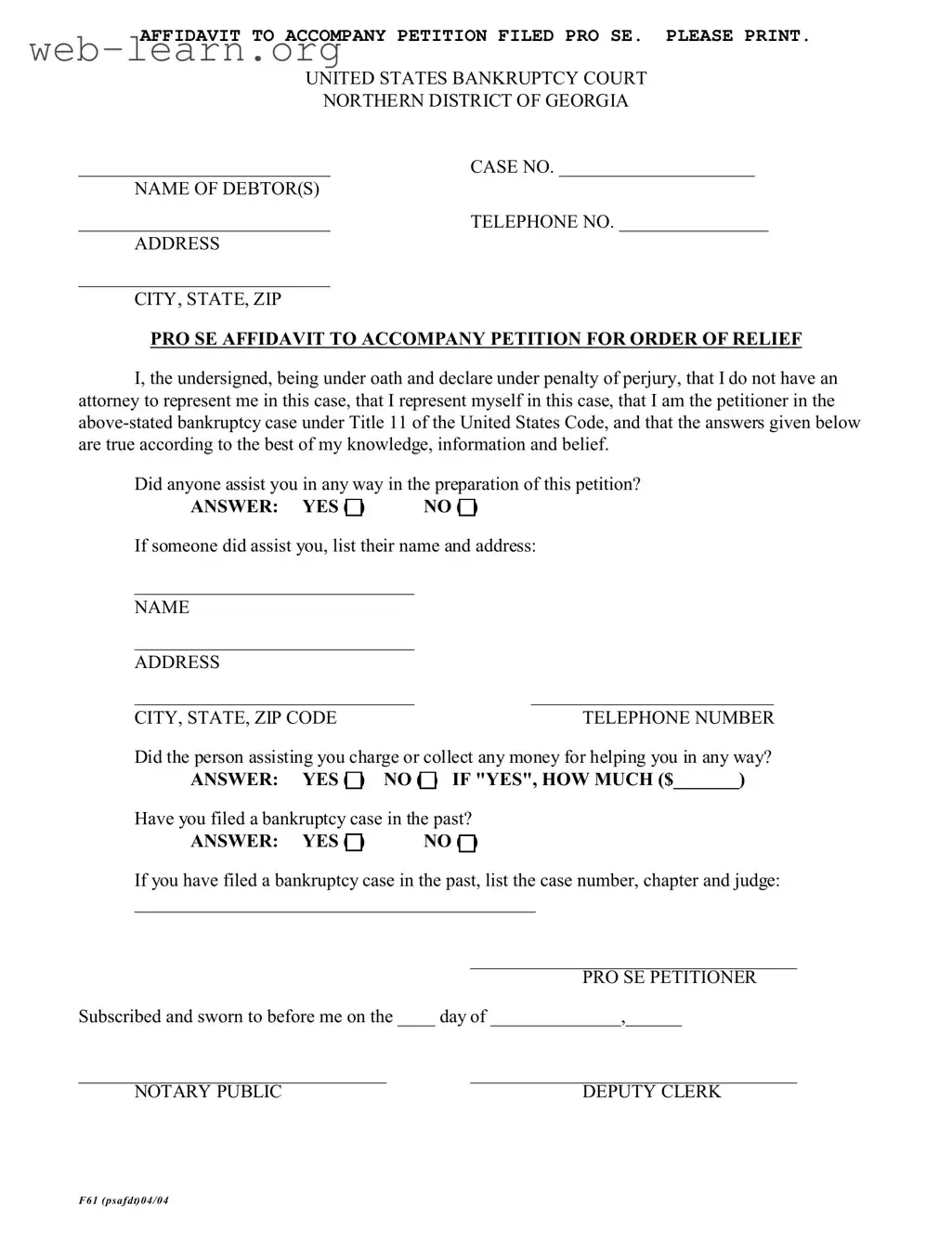
The F 61 Georgia form is a crucial document for individuals filing for bankruptcy without an attorney, known as pro se petitioners. This affidavit must accompany the bankruptcy petition and serves to affirm that the individual is representing themselves in the case. It requires the debtor to provide essential information, including their name, contact details, and the case number. Additionally, the form prompts the petitioner to disclose whether they received assistance in preparing the petition, and if so, details about the individual or entity that provided help. Importantly, it also inquires whether any fees were charged for this assistance. Furthermore, the form asks about any previous bankruptcy filings, ensuring that the court has a complete understanding of the petitioner’s financial history. The affidavit must be signed under oath, emphasizing the importance of honesty and accuracy in the information provided. This form plays a vital role in the bankruptcy process, ensuring that the court can properly assess the case and provide the necessary relief to the debtor.

Sample - F 61 Georgia Form

F61 (psafdt)04/04
AFFIDAVIT TO ACCOMPANY PETITION FILED PRO SE. PLEASE PRINT.
UNITED STATES BANKRUPTCY COURT
NORTHERN DISTRICT OF GEORGIA
___________________________ CASE NO. _____________________
NAME OF DEBTOR(S)
___________________________ TELEPHONE NO. ________________
ADDRESS
___________________________
CITY, STATE, ZIP
PRO SE AFFIDAVIT TO ACCOMPANY PETITION FOR ORDER OF RELIEF
I, the undersigned, being under oath and declare under penalty of perjury, that I do not have an
attorney to represent me in this case, that I represent myself in this case, that I am the petitioner in the
above-stated bankruptcy case under Title 11 of the United States Code, and that the answers given below
are true according to the best of my knowledge, information and belief.
Did anyone assist you in any way in the preparation of this petition?
ANSWER: YES ( ) NO ( )
If someone did assist you, list their name and address:
______________________________
NAME
______________________________
ADDRESS
______________________________ __________________________
CITY, STATE, ZIP CODE TELEPHONE NUMBER
Did the person assisting you charge or collect any money for helping you in any way?
ANSWER: YES ( ) NO ( ) IF "YES", HOW MUCH ($_______)
Have you filed a bankruptcy case in the past?
ANSWER: YES ( ) NO ( )
If you have filed a bankruptcy case in the past, list the case number, chapter and judge:
___________________________________________
___________________________________
PRO SE PETITIONER
Subscribed and sworn to before me on the ____ day of ______________,______
_________________________________ ___________________________________
NOTARY PUBLIC DEPUTY CLERK

Form Information

Fact Name Description
Purpose The F 61 Georgia form is an affidavit that accompanies a bankruptcy petition filed by an individual representing themselves, known as pro se.
Governing Law This form is governed by Title 11 of the United States Code, which outlines federal bankruptcy laws.
Assistance Disclosure Petitioners must disclose if anyone assisted them in preparing the petition and whether any fees were charged for this assistance.
Notary Requirement The form requires notarization, confirming the identity of the signer and the authenticity of the affidavit.

Detailed Guide for Filling Out F 61 Georgia

Completing the F 61 form is an important step in your bankruptcy process. This affidavit is necessary for individuals who are representing themselves in court. It requires you to provide specific information about your case and your assistance, if any, during the preparation of your petition. Follow these steps carefully to ensure that you fill out the form correctly.

  1. Obtain the Form: Download or print the F 61 form from the official website of the United States Bankruptcy Court for the Northern District of Georgia.
  2. Fill in the Case Number: In the designated space, write your case number. If you do not have one yet, leave this blank for now.
  3. Provide Your Name: Enter your full name as the debtor in the space provided.
  4. Enter Your Contact Information: Fill in your telephone number, address, city, state, and ZIP code accurately.
  5. Declare Your Status: In the statement provided, confirm that you are representing yourself in this bankruptcy case.
  6. Answer Assistance Questions: Indicate whether anyone assisted you in preparing the petition by checking "YES" or "NO." If you answered "YES," provide the name and address of the person who assisted you.
  7. Disclose Any Fees: If someone assisted you and charged a fee, indicate the amount in the space provided.
  8. Previous Bankruptcy Cases: Answer whether you have filed for bankruptcy in the past by checking "YES" or "NO." If "YES," provide the previous case number, chapter, and judge's name.
  9. Sign the Affidavit: At the bottom of the form, sign your name to declare that the information is true and correct to the best of your knowledge.
  10. Notarization: Arrange for a notary public to witness your signature and complete the notarization section.

After completing the form, review it to ensure all information is accurate. Once verified, you can submit it along with your bankruptcy petition to the court. This step is essential for moving forward in the process.

Obtain Answers on F 61 Georgia

  1. What is the purpose of the F 61 Georgia form?

    The F 61 form is an affidavit that accompanies a bankruptcy petition filed by individuals representing themselves, known as pro se petitioners. It serves to affirm that the individual does not have legal representation and provides necessary information regarding their bankruptcy case. This form helps the court understand the circumstances surrounding the filing and ensures that the petitioner is aware of their responsibilities in the process.

  2. Who should use the F 61 Georgia form?

    This form is intended for individuals who are filing for bankruptcy without an attorney. If you are representing yourself in a bankruptcy case in the Northern District of Georgia, you must complete and submit this form along with your petition. It is essential for those who need to declare their pro se status and provide relevant details about their case.

  3. What information is required on the F 61 form?

    The F 61 form requires several key pieces of information, including:

    • Your name and contact information.
    • The case number of your bankruptcy filing.
    • Details about any assistance you received in preparing the petition, including the name and address of the person who assisted you.
    • Information on whether that person charged you for their help.
    • Details about any previous bankruptcy filings, including case numbers and chapters.

    Providing accurate information is crucial, as it can impact the outcome of your bankruptcy case.

  4. What happens after I submit the F 61 form?

    Once you submit the F 61 form along with your bankruptcy petition, the court will review your documents. If everything is in order, your case will proceed through the bankruptcy process. You will be required to attend a meeting of creditors and may need to provide additional information or documentation as requested by the court. It is essential to stay informed and respond promptly to any court communications to ensure your case moves forward smoothly.

Common mistakes

Filling out the F 61 Georgia form can be a straightforward process, but there are common mistakes that individuals often make. One frequent error is failing to provide complete and accurate personal information. This includes the name of the debtor(s), telephone number, and address. Incomplete information can lead to delays in processing the petition and may even result in the dismissal of the case.

Another mistake involves neglecting to disclose assistance received during the preparation of the petition. The form explicitly asks if anyone assisted the petitioner and requires their name and address if applicable. Omitting this information can raise questions about the integrity of the filing and may lead to complications later on.

Additionally, some individuals overlook the question regarding whether the person who assisted them charged a fee. If the answer is "yes," it is crucial to specify the amount charged. Failing to answer this question or providing inaccurate information can create legal issues and affect the outcome of the bankruptcy case.

People often mistakenly believe that past bankruptcy filings do not need to be disclosed. The form requires information about any previous cases, including the case number, chapter, and judge. Not providing this information can result in significant consequences, including the potential rejection of the current petition.

Another common error is related to the signature and notarization of the form. The affidavit must be subscribed and sworn before a notary public. Some individuals forget to complete this step, which can invalidate the affidavit and delay the entire process.

Lastly, many filers fail to double-check their answers before submitting the form. Simple typographical errors or inconsistencies in the information provided can lead to confusion and may require additional clarification from the court. Taking the time to review the completed form can help prevent these issues and ensure a smoother filing process.

Documents used along the form

The F 61 form is used in the context of bankruptcy proceedings in Georgia. It serves as an affidavit for individuals representing themselves, known as pro se petitioners. Alongside the F 61 form, several other documents are commonly utilized in the bankruptcy process. Each of these documents plays a specific role in ensuring that the petition is complete and compliant with legal requirements.

  • Bankruptcy Petition (Form B1): This is the primary document that initiates a bankruptcy case. It includes basic information about the debtor, the type of bankruptcy being filed, and the names of creditors.
  • Schedules of Assets and Liabilities (Form B6): These schedules detail the debtor's assets, liabilities, income, and expenses. They provide a comprehensive view of the debtor's financial situation.
  • Statement of Financial Affairs (Form B7): This form requires the debtor to disclose financial transactions and other relevant financial information for a specified period before filing.
  • Means Test Calculation (Form 22A or 22C): This form determines eligibility for Chapter 7 or Chapter 13 bankruptcy by comparing the debtor's income to the median income for their state.
  • Credit Counseling Certificate: Before filing for bankruptcy, debtors must complete a credit counseling course and obtain a certificate. This document proves compliance with this requirement.
  • Statement of Intention: This document outlines the debtor's intentions regarding secured debts, such as whether they plan to reaffirm, redeem, or surrender the property.
  • Chapter 13 Plan (if applicable): For those filing under Chapter 13, this plan outlines how the debtor intends to repay creditors over a specified period.
  • Notice of Meeting of Creditors (341 Meeting): This notice informs creditors of the meeting where they can question the debtor about their financial situation and the bankruptcy filing.
  • Discharge of Debtor (Form B18): After completing the bankruptcy process, this document formally discharges the debtor from certain debts, providing relief from financial obligations.
  • Proof of Claim (Form B10): Creditors use this form to file a claim against the debtor's estate, asserting their right to receive payment from the bankruptcy proceedings.

Understanding these documents is crucial for individuals navigating the bankruptcy process. Each form serves a distinct purpose, contributing to the overall clarity and organization of the case. Proper completion and submission of these documents can significantly impact the outcome of a bankruptcy filing.

Similar forms

The F 61 Georgia form is similar to several other legal documents that serve various purposes in the context of self-representation in court. Below are eight documents that share similarities with the F 61 form:

  • Affidavit of Support - This document is used to affirm the financial support of an individual for another person, often in immigration cases. Like the F 61, it requires the signer to declare the truthfulness of the information provided under oath.
  • Declaration of Financial Affairs - Used in bankruptcy cases, this document outlines an individual's financial situation. Similar to the F 61, it must be completed by individuals representing themselves and requires accurate disclosures.
  • Pro Se Notice of Appearance - This form allows individuals to officially notify the court that they are representing themselves. It parallels the F 61 in that it emphasizes self-representation and the individual's responsibility in the legal process.
  • Self-Representation Form - This document is often required in family law cases. It is similar to the F 61 as it confirms that the individual is proceeding without an attorney and provides necessary information to the court.
  • Petition for Bankruptcy - This is the primary document filed to initiate a bankruptcy case. The F 61 serves as an affidavit accompanying this petition, confirming the individual's self-representation.
  • Request for Waiver of Filing Fees - Individuals may use this form to request a fee waiver when filing court documents. Like the F 61, it requires the individual to provide truthful information regarding their financial status.
  • Affidavit of Service - This document is used to confirm that legal documents have been delivered to the appropriate parties. It shares the need for an oath and verification of facts, much like the F 61.
  • Financial Disclosure Statement - This statement provides a detailed account of an individual's financial situation, similar to the information requested in the F 61. It is often required in family law cases and bankruptcy filings.

Dos and Don'ts

When filling out the F 61 Georgia form, it is essential to follow specific guidelines to ensure accuracy and compliance. Here are seven things you should and shouldn't do:

  • Do print clearly and legibly. This helps prevent misunderstandings and ensures that all information is easily readable.
  • Don't leave any required fields blank. Missing information can delay your case or lead to complications.
  • Do provide truthful answers. Honesty is crucial, as providing false information can have serious legal consequences.
  • Don't use abbreviations or shorthand. Write out full names and addresses to avoid confusion.
  • Do check your form for errors before submitting it. A thorough review can help catch mistakes that could affect your case.
  • Don't forget to sign and date the form. Your signature is a declaration of the truthfulness of your statements.
  • Do seek assistance if needed. If you have questions, consider reaching out to a legal aid organization for guidance.

Misconceptions

Here are six common misconceptions about the F 61 Georgia form:

  • It's only for those with legal representation. The F 61 form is specifically designed for individuals who are representing themselves, or "pro se," in bankruptcy cases.
  • Assistance in completing the form is not allowed. You can receive help in preparing the petition. However, if someone assists you, you must disclose their information on the form.
  • Filing this form guarantees bankruptcy relief. Completing the F 61 does not automatically result in a bankruptcy discharge. The court must review your case and make a determination.
  • Previous bankruptcy filings disqualify you from using the form. Even if you have filed for bankruptcy before, you can still use the F 61 form. You just need to provide details of your previous cases.
  • You don't need to provide any financial information. The form requires you to answer specific questions about your financial situation, including any assistance you received and prior filings.
  • The form can be filed without a notary. A notary public must witness your signature on the F 61 form to validate your affidavit.

Key takeaways

When filling out and using the F 61 form in Georgia, there are several important aspects to consider. This form is crucial for individuals representing themselves in bankruptcy proceedings. Here are some key takeaways:

  • Understand the Purpose: The F 61 form is an affidavit that accompanies a pro se petition for bankruptcy relief. It confirms that you are representing yourself and provides essential information to the court.
  • Complete All Sections: Ensure that every section of the form is filled out accurately. Missing information can delay your case or result in the court rejecting your petition.
  • Be Honest: When answering questions, especially regarding past bankruptcy filings or assistance received, provide truthful information. Misrepresentation can lead to serious legal consequences.
  • Assistance Disclosure: If someone helped you prepare the petition, you must disclose their name and address. This transparency is vital for the court's understanding of your situation.
  • Notary Requirement: The form must be signed in front of a notary public. This step is essential to validate your affidavit and ensure its acceptance by the court.
  • File Correctly: After completing the F 61 form, ensure that it is filed with the appropriate bankruptcy court. Double-check that you have included all necessary documents to avoid delays.

By keeping these points in mind, individuals can navigate the process of filing for bankruptcy more effectively and with greater confidence.