Homepage Blank Entity Annual Report Indiana Form
Outline

The Entity Annual Report Indiana form, also known as Form E-1, serves a crucial role for various organizations operating within the state. This form is essential for determining the audit requirements that apply to your entity, as outlined by Indiana Code. It must be filed within thirty days following the close of your entity's fiscal year. The report collects vital information, including the legal name of the entity, its federal ID number, and contact details. It also requires specifics about the organization’s financial activities, such as government funds received and disbursed throughout the year. Additionally, the form assesses the overall disbursements and the percentage of government funds in relation to total expenditures. Organizations must certify the accuracy of the data provided, ensuring that all information is truthful and complete. Furthermore, the report includes sections to detail the organization's purpose, governing structure, and any past audits conducted by independent public accountants. Completing this form accurately is not only a regulatory requirement but also a step towards maintaining transparency and accountability in your organization’s financial dealings.


Sample - Entity Annual Report Indiana Form

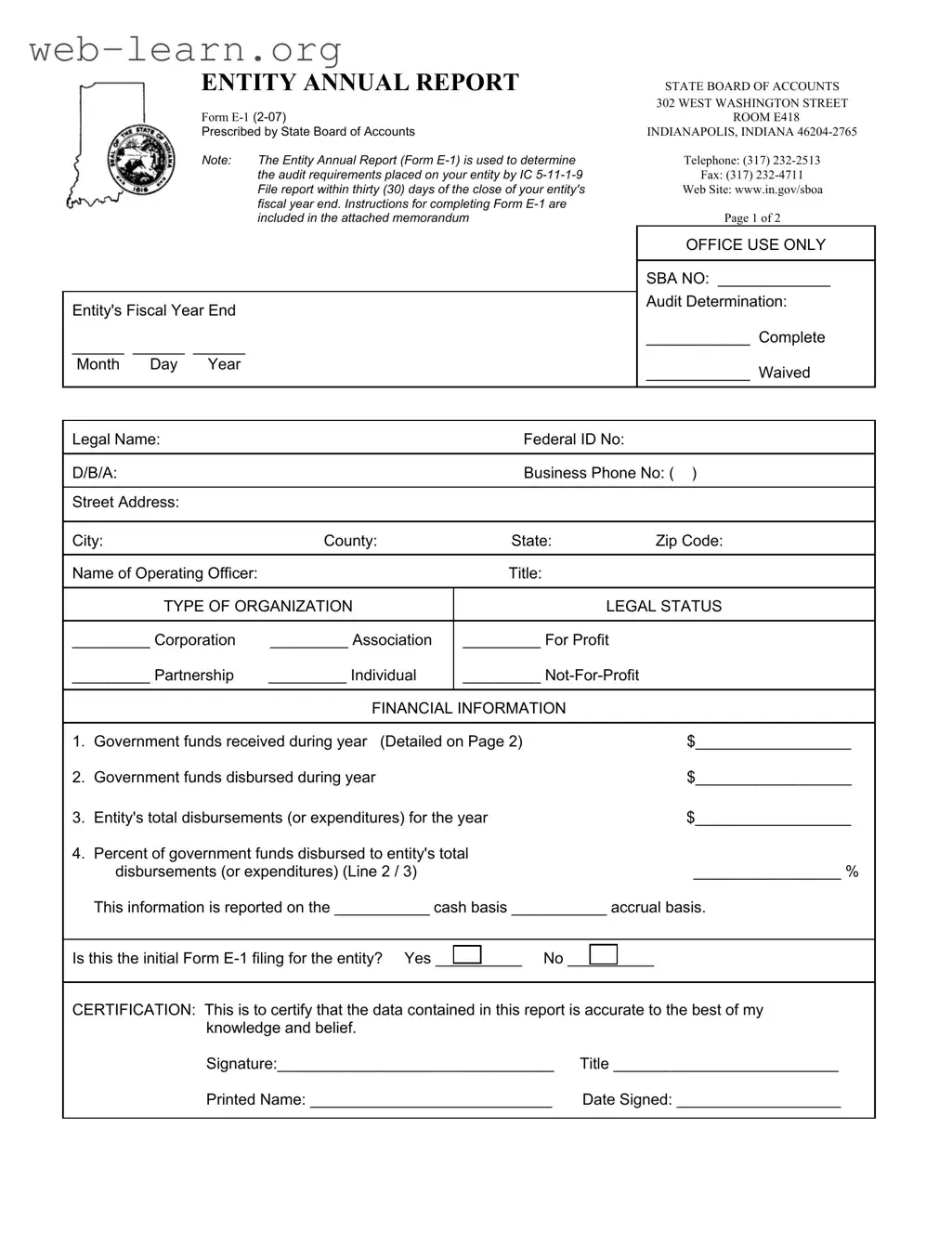
ENTITY ANNUAL REPORT STATE BOARD OF ACCOUNTS
302 WEST WASHINGTON STREET
Form E-1 (2-07) ROOM E418
Prescribed by State Board of Accounts INDIANAPOLIS, INDIANA 46204-2765
Note: The Entity Annual Report (Form E-1) is used to determine Telephone: (317) 232-2513
the audit requirements placed on your entity by IC 5-11-1-9 Fax: (317) 232-4711
File report within thirty (30) days of the close of your entity's Web Site: www.in.gov/sboa
fiscal year end. Instructions for completing Form E-1 are
included in the attached memorandum Page 1 of 2
OFFICE USE ONLY
S
BA NO: _____________
Entity's Fiscal Year End
______ ______ ______
Month Day Year
Audit Determination:
____________ Complete
____________ Waived
Legal Name: Federal ID No:
D/B/A: Business Phone No: ( )
Street Address:
City: County: State: Zip Code:
Name of Operating Officer: Title:
TYPE OF ORGANIZATION
LEGAL STATUS
_________ Corporation _________ Association
_________ Partnership _________ Individual
_________ For Profit
_________ Not-For-Profit
FINANCIAL INFORMATION
1. Government funds received during year (Detailed on Page 2) $__________________
2. Government funds disbursed during year $__________________
3. Entity's total disbursements (or expenditures) for the year $__________________
4. Percent of government funds disbursed to entity's total
disbursements (or expenditures) (Line 2 / 3) _________________ %
This information is reported on the ___________ cash basis ___________ accrual basis.
Is this the initial Form E-1 filing for the entity? Yes __________ No __________
CERTIFICATION: This is to certify that the data contained in this report is accurate to the best of my
knowledge and belief.
Signature:________________________________ Title __________________________
Printed Name: ____________________________ Date Signed: ___________________
Page 2 of 2
DETAIL OF GOVERNMENT FUNDS RECEIVED
List the government funds received during the year by agency, address, program title and amount received. Attach
additional sheets if necessary.
GOVERNMENT AGENCY ADDRESS PROGRAM TITLE AMOUNT RECEIVED
Date organization was founded: _________________________________________________________________
Describe organization's purpose:_________________________________________________________________
___________________________________________________________________________________________
Describe organizational governing structure:________________________________________________________
___________________________________________________________________________________________
Have you ever been audited by an Independent Public Accountant (IPA)? Yes ___________ No ___________
If so, what was the last fiscal year audited? ________________________________________________________
Name and address of IPA that conducted audit: _____________________________________________________
___________________________________________________________________________________________

Form Information

Fact Name Details
Form Identifier Entity Annual Report, Form E-1
Governing Body State Board of Accounts, Indiana
Filing Deadline Reports must be filed within thirty (30) days of the close of the entity's fiscal year.
Legal Reference Indiana Code IC 5-11-1-9
Purpose of the Form The form is used to determine audit requirements for the entity.
Information Required Includes financial data, entity information, and certification of accuracy.
Types of Organizations Corporation, Partnership, Association, Individual, For-Profit, Not-For-Profit
Audit History Entities must disclose if they have been audited by an Independent Public Accountant.

Detailed Guide for Filling Out Entity Annual Report Indiana

Filling out the Entity Annual Report form in Indiana is an essential task for organizations to ensure compliance with state requirements. This report must be submitted within thirty days after the close of your entity's fiscal year. Here’s how to complete the form accurately.

  1. Obtain the Entity Annual Report (Form E-1) from the State Board of Accounts website or the designated office.
  2. Fill in the fiscal year end date in the specified format (Month, Day, Year).
  3. Provide your entity's legal name and Federal ID number in the designated fields.
  4. If applicable, include the "Doing Business As" (D/B/A) name and the business phone number.
  5. Enter the street address, city, county, state, and zip code of your entity.
  6. List the name and title of the operating officer responsible for the report.
  7. Select the type of organization by marking the appropriate box (e.g., Corporation, Partnership, Not-For-Profit).
  8. Complete the financial information section:
    • Report the total government funds received during the year.
    • Indicate the total government funds disbursed during the year.
    • Provide the entity's total disbursements or expenditures for the year.
    • Calculate and enter the percentage of government funds disbursed relative to total disbursements.
  9. Specify whether the financial information is reported on a cash basis or an accrual basis.
  10. Indicate if this is the initial Form E-1 filing for your entity by checking "Yes" or "No."
  11. Sign and date the certification section, ensuring that the data is accurate to the best of your knowledge.
  12. On Page 2, detail the government funds received by listing the agency, address, program title, and amount received. Attach additional sheets if necessary.
  13. Provide the date the organization was founded and describe its purpose and governing structure.
  14. Indicate whether the organization has ever been audited by an Independent Public Accountant (IPA) and provide details if applicable.

Obtain Answers on Entity Annual Report Indiana

  1. What is the purpose of the Entity Annual Report Indiana form?

    The Entity Annual Report (Form E-1) is designed to help determine the audit requirements for your organization as mandated by Indiana Code IC 5-11-1-9. This report collects essential financial information regarding government funds received and disbursed by your entity during the fiscal year. By filing this report, entities ensure compliance with state regulations and maintain transparency in their financial activities.

  2. When is the Entity Annual Report due?

    The report must be filed within thirty (30) days following the close of your entity's fiscal year. It is crucial to adhere to this timeline to avoid potential penalties and ensure that your organization meets its legal obligations.

  3. What information is required on the form?

    Form E-1 requires various details, including:

    • Legal name and Federal ID number of the entity
    • Type of organization and legal status
    • Financial information such as government funds received and disbursed
    • Total disbursements for the year
    • Certification of accuracy signed by an authorized individual

    Additionally, the form asks for information about the entity's purpose, governing structure, and any previous audits conducted.

  4. How should the financial information be reported?

    The financial data can be reported on either a cash basis or an accrual basis, depending on the accounting method your entity uses. It is important to indicate which basis is being utilized, as this affects the interpretation of the financial figures provided.

  5. What happens if the report is not filed on time?

    Failure to file the Entity Annual Report within the specified thirty-day period may result in penalties. Additionally, not submitting the report can hinder the entity's ability to receive government funding or lead to increased scrutiny during future audits.

  6. Is this the first time my entity is filing the report?

    The form includes a question to indicate whether this is the initial filing for your entity. If it is, the information provided will be crucial for establishing the entity's audit history and requirements moving forward. If not, it is essential to provide accurate details regarding any previous audits conducted.

Common mistakes

Filling out the Entity Annual Report Indiana form can be a straightforward process, but many make common mistakes that can lead to delays or complications. One frequent error is failing to submit the report within the required thirty days after the close of the fiscal year. This oversight can result in penalties or an audit that could have been avoided.

Another common mistake involves incorrect or incomplete information in the legal name section. The legal name must match the entity's registration documents exactly. Any discrepancies can raise questions and may require additional clarification, causing unnecessary delays.

Many individuals also overlook the importance of providing a valid Federal ID number. This number is essential for the state's record-keeping and audit processes. Omitting this detail can lead to processing issues and may hinder the entity’s compliance with state regulations.

Inaccuracies in financial information are another prevalent issue. People often misreport government funds received or disbursed. It is crucial to ensure that these figures are accurate and reflect the entity's actual financial activities. Errors in this area can lead to audits and further scrutiny.

Another mistake is failing to indicate whether the report is being filed on a cash or accrual basis. This choice affects how financial information is interpreted. Not specifying this can lead to misunderstandings about the entity's financial status.

Some filers do not check whether this is the initial Form E-1 filing for the entity. Marking this incorrectly can confuse the state about the entity's history and compliance status. Clarity in this section is vital for proper record-keeping.

People often neglect to provide a detailed description of the organization’s purpose and governing structure. This information is critical for the state to understand the entity’s operations and compliance with relevant laws. Lack of detail can lead to further inquiries from the state.

Another frequent oversight is not signing the certification section. The report must be certified as accurate by an authorized individual. Failure to do so can render the entire report invalid and may lead to additional complications.

Lastly, many forget to include information about previous audits. If the organization has been audited by an Independent Public Accountant, this information is essential. Not providing it can raise red flags and lead to unnecessary follow-up questions.

By avoiding these common mistakes, entities can ensure that their Annual Report is processed smoothly and efficiently. Attention to detail in each section of the form is key to maintaining compliance and fostering a positive relationship with state authorities.

Documents used along the form

The Entity Annual Report Indiana form is a crucial document for organizations in Indiana, as it outlines financial information and compliance with state regulations. Along with this form, several other documents are often required to ensure complete transparency and adherence to legal obligations. Below is a list of related forms and documents commonly used in conjunction with the Entity Annual Report.

  • Financial Statements: These documents provide a comprehensive overview of an entity's financial performance over a specific period. They typically include the balance sheet, income statement, and cash flow statement, which help stakeholders assess the organization's financial health.
  • Audit Report: This report is prepared by an independent auditor after examining the entity's financial statements. It offers an opinion on whether the financial statements present a true and fair view of the organization's financial position and compliance with applicable laws.
  • Bylaws: Bylaws are the internal rules governing the management and operations of an organization. They outline the structure, responsibilities, and procedures for decision-making, ensuring that the entity operates within its legal framework.
  • Meeting Minutes: These are official records of the discussions and decisions made during meetings of the organization's governing body. Minutes serve as a legal record of actions taken and can be important for compliance and transparency.
  • IRS Form 990: This is an annual information return that tax-exempt organizations must file with the IRS. It provides detailed information about the organization's finances, governance, and activities, ensuring accountability and transparency to the public.
  • State Registration Documents: These include forms and certificates required for an entity to operate legally within the state. They may involve initial registration, renewals, or changes in status, ensuring that the organization complies with state laws.

Each of these documents plays a vital role in maintaining an organization’s compliance and transparency. Together with the Entity Annual Report, they contribute to a complete understanding of an entity's operations and financial standing.

Similar forms

The Entity Annual Report for Indiana serves a specific purpose in reporting financial information and audit requirements. Several other documents share similarities with this report in terms of structure and function. Here are five such documents:

  • Annual Financial Report: This document provides a comprehensive overview of an organization's financial status over a fiscal year. Like the Entity Annual Report, it includes details on revenues, expenditures, and may require certification by an officer of the organization.
  • Form 990: Non-profit organizations in the U.S. must file this form with the IRS. It outlines financial information, governance, and compliance with tax regulations. Similar to the Entity Annual Report, it requires disclosure of funds received and disbursed.
  • State Business License Renewal Application: This form is necessary for businesses to maintain their operating status within a state. It often includes updates on the entity's structure and financial standing, paralleling the annual reporting requirements of the Entity Annual Report.
  • Corporate Annual Meeting Minutes: These minutes document the discussions and decisions made during an annual meeting of a corporation. They often summarize financial performance and future plans, much like the Entity Annual Report summarizes fiscal activities.
  • Financial Statements: These include balance sheets, income statements, and cash flow statements. They provide a snapshot of an entity's financial health and are often required alongside annual reports, sharing a focus on financial transparency.

Dos and Don'ts

When filling out the Entity Annual Report Indiana form, it is essential to follow specific guidelines to ensure accuracy and compliance. Below is a list of things you should and shouldn't do during this process.

  • Do file the report within thirty (30) days of your entity's fiscal year-end.
  • Do ensure that all financial information is accurate and complete.
  • Do provide the legal name and Federal ID number of the entity.
  • Do specify the type of organization and its legal status clearly.
  • Do certify the accuracy of the report with a signature and date.
  • Don't leave any required fields blank; incomplete forms may lead to delays.
  • Don't forget to attach additional sheets if more space is needed for government funds received.
  • Don't mix up cash basis and accrual basis reporting; choose the correct method.
  • Don't submit the report without reviewing it for errors or inconsistencies.

Misconceptions

Misconceptions about the Entity Annual Report Indiana form can lead to confusion and errors in compliance. Here are eight common misconceptions:

  • The form is only for large organizations. All entities, regardless of size, must file this report if they receive government funds.
  • Filing is optional. Filing the Entity Annual Report is mandatory and must be done within thirty days of the fiscal year-end.
  • Only financial information is required. The report also requires details about the organization’s purpose and governing structure.
  • There are no penalties for late filing. Late submissions can result in penalties and may affect the entity's audit requirements.
  • Once filed, the information is not reviewed. The State Board of Accounts reviews the report to determine audit requirements.
  • Only non-profit organizations need to report. For-profit entities that receive government funds are also required to submit the report.
  • The report can be submitted in any format. The Entity Annual Report must be filed using the prescribed Form E-1.
  • Changes in the organization do not need to be reported. Any changes, such as the operating officer or legal name, must be updated in the report.

Understanding these misconceptions can help ensure compliance and avoid unnecessary complications.

Key takeaways

Filling out the Entity Annual Report Indiana form (Form E-1) is an essential process for organizations operating in Indiana. Here are key takeaways to keep in mind:

  • The report must be filed within thirty (30) days after the end of the entity's fiscal year.
  • Accurate financial information is crucial, including details on government funds received and disbursed.
  • Entities must indicate whether they report on a cash basis or an accrual basis.
  • Certification of the report is required, confirming that the data is accurate to the best of the signer's knowledge.
  • Organizations should provide a description of their purpose and governing structure within the report.
  • Previous audits by Independent Public Accountants (IPAs) should be disclosed, including the last fiscal year audited.