Homepage Attorney-Approved Employee Drug Test Consent Template
Outline

The Employee Drug Test Consent form serves as a critical document in the workplace, facilitating a clear understanding between employers and employees regarding drug testing procedures. This form typically outlines the purpose of drug testing, which often includes maintaining a safe work environment, ensuring compliance with company policies, and adhering to legal regulations. Employees are informed about the types of substances that may be tested, the testing methods used, and the potential consequences of refusing to participate or failing a test. Additionally, the form usually emphasizes the confidentiality of test results, reassuring employees that their privacy will be respected throughout the process. By signing this consent form, employees acknowledge their awareness of these aspects and agree to participate in the testing, thereby fostering a culture of transparency and accountability within the organization.

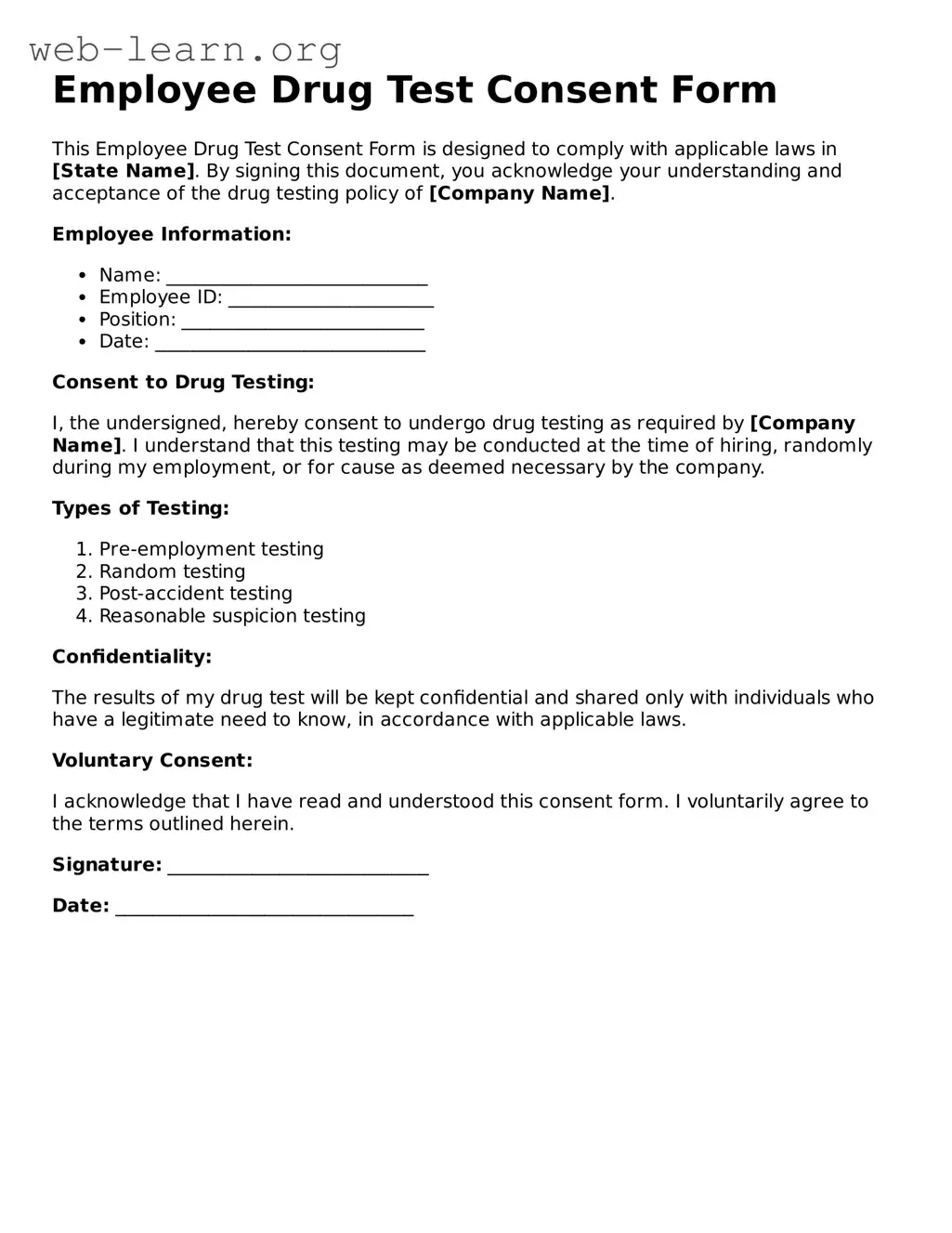
Employee Drug Test Consent Form

This Employee Drug Test Consent Form is designed to comply with applicable laws in [State Name]. By signing this document, you acknowledge your understanding and acceptance of the drug testing policy of [Company Name].

Employee Information:

  • Name: ____________________________
  • Employee ID: ______________________
  • Position: __________________________
  • Date: _____________________________

Consent to Drug Testing:

I, the undersigned, hereby consent to undergo drug testing as required by [Company Name]. I understand that this testing may be conducted at the time of hiring, randomly during my employment, or for cause as deemed necessary by the company.

Types of Testing:

  1. Pre-employment testing
  2. Random testing
  3. Post-accident testing
  4. Reasonable suspicion testing

Confidentiality:

The results of my drug test will be kept confidential and shared only with individuals who have a legitimate need to know, in accordance with applicable laws.

Voluntary Consent:

I acknowledge that I have read and understood this consent form. I voluntarily agree to the terms outlined herein.

Signature: ____________________________

Date: ________________________________

File Characteristics

Fact Name Details
Purpose The Employee Drug Test Consent form is used to obtain permission from employees to conduct drug testing as part of the hiring process or ongoing employment.
State-Specific Laws Each state may have different laws governing drug testing in the workplace. For example, in California, employers must comply with the California Fair Employment and Housing Act.
Confidentiality The form typically includes provisions to ensure that the results of the drug tests are kept confidential and only shared with authorized personnel.
Employee Rights Employees have the right to refuse drug testing, but this may result in consequences such as withdrawal of a job offer or disciplinary action.

After obtaining the Employee Drug Test Consent form, it is essential to complete it accurately to ensure compliance with company policies. Following the submission of the form, the next steps will involve scheduling the drug test and receiving further instructions from the employer.

  1. Begin by carefully reading the entire form to understand the requirements.
  2. Enter your full name in the designated section at the top of the form.
  3. Provide your job title and department as requested.
  4. Fill in your employee identification number, if applicable.
  5. Indicate the date on which you are completing the form.
  6. Review the consent statement thoroughly to ensure you agree with the terms.
  7. Sign the form in the space provided to confirm your consent.
  8. Print your name below your signature for clarity.
  9. Submit the completed form to the designated HR representative or department.
  1. What is the Employee Drug Test Consent form?

    The Employee Drug Test Consent form is a document that employees must sign to give their consent for drug testing. This form outlines the procedures for testing and informs employees of their rights and responsibilities.

  2. Why is the Employee Drug Test Consent form necessary?

    This form is necessary to ensure that employees understand the drug testing policy and agree to participate. It protects both the employer and the employee by providing clear guidelines and legal protection.

  3. When is drug testing conducted?

    Drug testing may occur at various times, including:

    • Pre-employment
    • Random testing
    • Post-accident
    • For cause (when there is reasonable suspicion of drug use)
  4. What substances are typically tested for?

    Common substances tested include:

    • Marijuana
    • Cocaine
    • Opioids
    • Amphetamines
    • Phencyclidine (PCP)
  5. What happens if an employee refuses to sign the consent form?

    If an employee refuses to sign the consent form, they may be ineligible for employment or face disciplinary action. Employers typically require consent to ensure compliance with company policies.

  6. How is confidentiality maintained during the testing process?

    Confidentiality is maintained by limiting access to test results to authorized personnel only. Results are kept secure and are not disclosed to anyone without the employee's consent, except as required by law.

  7. What rights do employees have regarding drug testing?

    Employees have several rights, including:

    • The right to know what substances are being tested.
    • The right to receive information about the testing process.
    • The right to challenge positive results.
  8. What are the consequences of a positive drug test?

    Consequences may vary by employer but can include:

    • Termination of employment
    • Mandatory participation in a rehabilitation program
    • Probationary periods with increased testing
  9. Can an employee appeal a positive drug test result?

    Yes, employees typically have the right to appeal a positive test result. They may request a retest or provide evidence to contest the findings, depending on the employer's policies.

  10. How can employees prepare for a drug test?

    Employees should:

    • Be aware of the testing schedule.
    • Avoid using prohibited substances.
    • Understand the testing procedures outlined in the consent form.

Common mistakes

Filling out an Employee Drug Test Consent form may seem straightforward, but many individuals make common mistakes that can lead to complications. One frequent error is failing to read the entire form before signing. This oversight can result in misunderstandings about the testing process, potential consequences, and the rights of the employee. Taking the time to carefully review each section ensures that individuals are fully informed.

Another mistake is neglecting to provide accurate personal information. This includes details such as name, address, and contact information. Inaccurate or incomplete information can lead to delays in processing the test results or even miscommunication with the testing facility. It is crucial to double-check all entries for accuracy.

Some individuals may also overlook the importance of understanding the implications of the consent. Signing the form implies agreement to undergo testing and to the handling of results. Without grasping these implications, employees might inadvertently waive their rights or consent to conditions they are uncomfortable with. Knowledge is key to making informed decisions.

Additionally, individuals sometimes forget to ask questions if they are unclear about certain aspects of the form. It is perfectly acceptable to seek clarification from a supervisor or HR representative before signing. This proactive approach can prevent misunderstandings and ensure that everyone is on the same page.

Lastly, individuals may fail to keep a copy of the signed consent form for their records. Having a personal copy can be beneficial for reference in case of any disputes or questions that arise later. Retaining documentation is a simple yet effective way to protect oneself and ensure transparency throughout the process.

Documents used along the form

When conducting employee drug testing, several forms and documents may accompany the Employee Drug Test Consent form. Each of these documents serves a specific purpose and helps ensure compliance with legal and organizational standards. Below is a list of commonly used forms that may be relevant in this context.

  • Employee Handbook: This document outlines the company's policies and procedures regarding drug use, testing, and the consequences of violations. It serves as a reference for employees to understand expectations.
  • Drug Testing Policy: This policy provides detailed information about the drug testing process, including the types of tests conducted, the substances tested for, and the circumstances under which testing may occur.
  • Chain of Custody Form: This form tracks the handling of the sample from collection to testing. It ensures the integrity of the sample and helps prevent tampering or contamination.
  • Medical Review Officer (MRO) Report: After testing, an MRO evaluates the results and provides a report. This document may include explanations for any positive results and recommendations for further action.
  • Refusal to Test Form: If an employee refuses to undergo testing, this form documents the refusal. It may also outline the potential consequences of not participating in the drug testing process.
  • Follow-Up Testing Consent Form: For employees who have previously tested positive or are in a rehabilitation program, this form gives consent for follow-up testing as part of their recovery process.

These documents work together to create a comprehensive framework for managing employee drug testing. They help protect both the organization and its employees by ensuring clarity, compliance, and a fair process.

Similar forms

  • Medical Release Form: This document allows healthcare providers to share a patient's medical information with employers or other parties. Like the Employee Drug Test Consent form, it requires the individual's consent and ensures that personal health information is handled appropriately.
  • Background Check Authorization Form: This form grants permission for an employer to conduct a background check on a potential employee. Similar to the drug test consent, it involves the individual’s agreement and aims to protect both parties by ensuring transparency in the hiring process.
  • Confidentiality Agreement: Often used in workplaces, this document ensures that employees agree to keep sensitive company information private. Like the drug test consent, it requires acknowledgment of the importance of confidentiality and the consequences of breaching that trust.
  • Health and Safety Acknowledgment: This form confirms that employees understand and agree to adhere to workplace health and safety policies. It parallels the drug test consent in that both documents focus on maintaining a safe work environment and require the employee's explicit consent.

Dos and Don'ts

When filling out the Employee Drug Test Consent form, it's important to follow certain guidelines to ensure accuracy and compliance. Here are ten things to keep in mind:

  • Do read the entire form carefully before signing.
  • Don't rush through the form; take your time to understand each section.
  • Do provide accurate personal information, including your full name and contact details.
  • Don't leave any required fields blank; this could delay the process.
  • Do ask questions if you are unsure about any part of the form.
  • Don't sign the form if you do not fully understand its contents.
  • Do keep a copy of the signed form for your records.
  • Don't forget to check the date before submitting the form.
  • Do ensure that you are aware of the testing procedures and consequences.
  • Don't provide false information, as this could lead to serious consequences.

Misconceptions

Misconceptions about the Employee Drug Test Consent form can lead to confusion for both employers and employees. Here are ten common misconceptions explained:

  1. All employers must conduct drug tests. Not all employers are required to conduct drug tests. It depends on the industry and company policies.
  2. Signing the consent form means you will be fired if you test positive. A positive test result does not automatically lead to termination. Employers often have policies that include rehabilitation options.
  3. Drug tests can detect all substances. Drug tests do not detect every substance. Most tests focus on specific drugs, such as marijuana, cocaine, and opiates.
  4. Employees can refuse to sign the consent form. While employees can refuse, this may result in disqualification from employment or specific job duties.
  5. Drug tests are always conducted randomly. Not all drug tests are random. Some are conducted pre-employment, post-accident, or based on reasonable suspicion.
  6. Drug test results are always confidential. While results are generally kept confidential, there are circumstances where employers may need to disclose them, such as legal requirements.
  7. Testing can occur at any time without notice. Employers must typically provide notice of testing policies, and tests are often scheduled within specific guidelines.
  8. All drug tests are the same. Different types of drug tests exist, such as urine, saliva, and hair tests, each with different detection windows and accuracy levels.
  9. Employees cannot challenge a positive result. Employees have the right to challenge a positive result, usually through a retest or appeal process.
  10. Drug testing is a violation of privacy. Drug testing is legal when conducted according to company policy and applicable laws, and employees are usually informed of the testing procedures.

Key takeaways

Filling out and using the Employee Drug Test Consent form is an important process for both employers and employees. Here are some key takeaways to keep in mind:

  • Understand the Purpose: The form serves to obtain consent from employees for drug testing, ensuring compliance with company policies and legal requirements.
  • Provide Clear Instructions: Employers should offer clear guidance on how to fill out the form, including any necessary details that need to be included.
  • Confidentiality Matters: Employee information collected through the consent form must be kept confidential and handled with care.
  • Know Your Rights: Employees should be aware of their rights regarding drug testing, including the right to refuse testing under certain circumstances.
  • Review Company Policies: Familiarity with the company's drug testing policies is essential for employees before signing the consent form.
  • Document Retention: Employers must retain signed consent forms for a specified period, as required by law or company policy.
  • Provide Contact Information: Include a contact for employees to reach out with questions or concerns about the testing process.
  • Update as Needed: The consent form should be reviewed and updated regularly to reflect any changes in laws or company policies.