Homepage Blank Employee Coaching Form
Outline

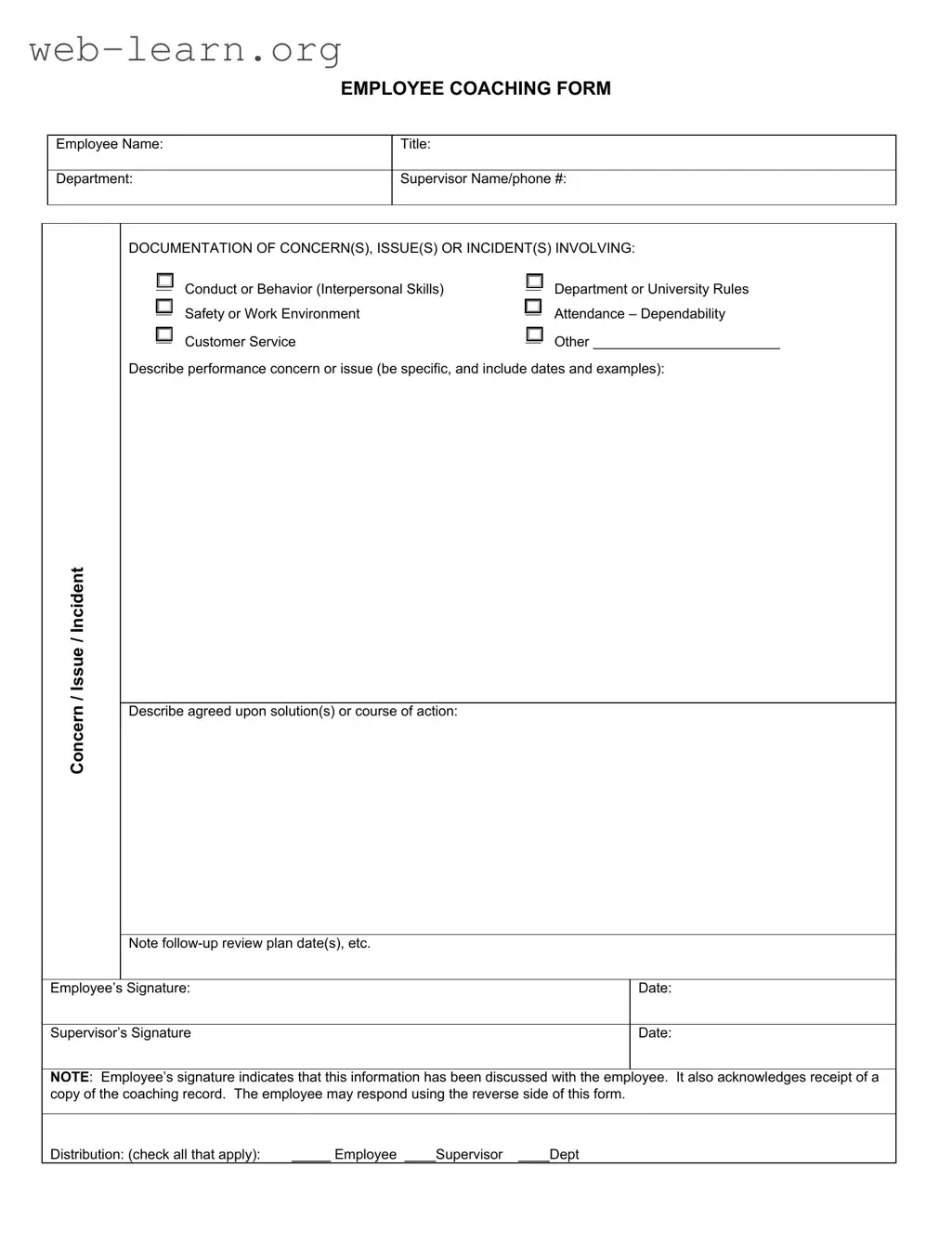
In the realm of workplace management, the Employee Coaching form serves as a vital tool for fostering communication between supervisors and employees. This form is designed to address specific concerns or issues related to an employee's conduct, behavior, or performance. Key elements of the form include the employee's name, department, title, and the supervisor's contact information, ensuring that all parties are clearly identified. It provides a structured space to document various concerns, which may range from interpersonal skills and adherence to department rules to attendance and customer service. By requiring a detailed description of the performance issue, including dates and examples, the form encourages transparency and specificity. Additionally, it outlines agreed-upon solutions and establishes a follow-up review plan, promoting accountability and continuous improvement. The inclusion of signature lines for both the employee and supervisor signifies that the issues have been discussed and that the employee has received a copy of the coaching record. Furthermore, the option for the employee to respond on the reverse side of the form underscores the importance of dialogue in the coaching process. Finally, the distribution section ensures that all relevant parties are informed, reinforcing the collaborative nature of employee development.

Sample - Employee Coaching Form

EMPLOYEE COACHING FORM
Employee Name: Title:
Department:
Supervisor Name/phone #:
DOCUMENTATION OF CONCERN(S), ISSUE(S) OR INCIDENT(S) INVOLVING:
Conduct or Behavior (Interpersonal Skills) Department or University Rules
Safety or Work Environment Attendance Dependability
Customer Service Other ________________________
Describe performance concern or issue (be specific, and include dates and examples):
Describe agreed upon solution(s) or course of action:
Note follow-up review plan date(s), etc.
Employee’s Signature: Date:
Supervisor’s Signature Date:
NOTE: Employee’s signature indicates that this information has been discussed with the employee. It also acknowledges receipt of a
copy of the coaching record. The employee may respond using the reverse side of this form.
Distribution: (check all that apply): _____ Employee ____Supervisor ____Dept
Concern / Issue / Incident

Form Information

Fact Name Description
Purpose The Employee Coaching Form is designed to document performance issues, concerns, or incidents involving an employee.
Employee Information The form requires the employee's name, department, title, and supervisor's contact information.
Documentation It includes sections for detailing the specific concern, issue, or incident, with a focus on providing dates and examples.
Areas of Concern Concerns can relate to conduct, departmental rules, safety, attendance, customer service, or other specified issues.
Agreed Solutions The form requires a description of the agreed-upon solutions or actions to address the performance issues.
Follow-up Plan A follow-up review plan must be included, specifying dates for revisiting the performance concerns.
Signatures Both the employee and supervisor must sign the form, indicating that the information was discussed.
Employee Acknowledgment The employee’s signature acknowledges receipt of a copy of the coaching record.
Response Option Employees have the option to respond to the coaching documentation on the reverse side of the form.
Distribution The form includes a section for distribution, allowing copies to be provided to the employee, supervisor, and department.

Detailed Guide for Filling Out Employee Coaching

After completing the Employee Coaching form, it will be reviewed by the supervisor and discussed with the employee. This process ensures that both parties are aware of the concerns and the agreed-upon solutions. Follow these steps to fill out the form accurately.

  1. Write the employee's full name in the designated space.
  2. Fill in the department where the employee works.
  3. Enter the employee's job title.
  4. Provide the supervisor's name and phone number.
  5. Select the relevant concern, issue, or incident from the list provided.
  6. In the space provided, describe the performance concern or issue in detail, including specific dates and examples.
  7. Outline the agreed-upon solutions or course of action to address the concern.
  8. Note the dates for follow-up reviews in the designated area.
  9. Have the employee sign the form to indicate that the information has been discussed.
  10. Obtain the supervisor's signature and date the form.
  11. Check all applicable distribution boxes to indicate who will receive a copy of the form.

Obtain Answers on Employee Coaching

  1. What is the purpose of the Employee Coaching form?

    The Employee Coaching form is designed to document performance concerns, issues, or incidents involving an employee. It serves as a tool for supervisors to communicate specific areas needing improvement, outline agreed-upon solutions, and establish a plan for follow-up. The goal is to support employee development and foster a positive work environment.

  2. What information is required on the form?

    The form requires several key pieces of information:

    • Employee Name
    • Department
    • Title
    • Supervisor Name and phone number
    • A detailed description of the concern, issue, or incident
    • Agreed-upon solutions or actions
    • Follow-up review plan dates

    Both the employee and supervisor must sign the form to acknowledge that the information has been discussed and a copy has been received.

  3. Can the employee provide their input on the form?

    Yes, the employee has the opportunity to respond to the documented concerns. They can use the reverse side of the form to provide their perspective or additional information regarding the issue. This ensures that their voice is heard in the process.

  4. Who receives a copy of the Employee Coaching form?

    Distribution of the form includes the following parties:

    • The Employee
    • The Supervisor
    • The Department

    Each party should have a copy for their records to maintain transparency and accountability.

  5. What happens if the employee disagrees with the documented concerns?

    If the employee disagrees with the concerns outlined in the form, they can express their disagreement in writing on the reverse side of the form. This response will be kept on file along with the coaching record, ensuring that their viewpoint is documented.

  6. Is the Employee Coaching form confidential?

    Yes, the information contained in the Employee Coaching form is considered confidential. It should be handled with care and only shared with those who are directly involved in the coaching process. This helps to protect the privacy of the employee while addressing performance issues.

Common mistakes

When filling out the Employee Coaching form, individuals often make several common mistakes that can lead to misunderstandings or incomplete documentation. One frequent error is failing to provide specific details about the concern or issue. Instead of vague descriptions, it is crucial to include dates and examples that illustrate the performance issue. This specificity helps in clearly communicating the problem and can aid in developing effective solutions.

Another mistake is neglecting to check all the necessary distribution boxes. The form includes options for distribution to the employee, supervisor, and department. Omitting any of these can result in a lack of communication and follow-up, which may hinder the resolution process. Ensuring that all relevant parties receive a copy is essential for accountability and transparency.

Additionally, some people overlook the importance of the follow-up review plan. It is vital to outline specific dates for follow-up reviews. Without these dates, there may be confusion about when to reassess the situation, making it difficult to track progress. Establishing a clear timeline helps both the employee and supervisor stay aligned on expectations.

Another common oversight is not including the employee's signature. The signature serves as an acknowledgment that the information has been discussed. Skipping this step can lead to disputes later on, as the employee may claim they were unaware of the concerns raised. It is important to ensure that both signatures are present before finalizing the document.

Furthermore, some individuals fail to address the "agreed upon solution(s) or course of action." This section is critical for outlining the steps that will be taken to resolve the issue. A lack of clarity here can lead to misunderstandings about what is expected moving forward. Clear communication of the action plan is essential for both the employee's improvement and the supervisor's expectations.

Lastly, people sometimes forget to use the reverse side of the form for the employee's response. This section allows employees to provide their perspective on the issue. Ignoring this opportunity can result in an incomplete picture of the situation. Encouraging employees to share their thoughts fosters a more open dialogue and can lead to more effective solutions.

Documents used along the form

The Employee Coaching form is a vital tool for addressing performance issues and facilitating constructive dialogue between employees and supervisors. Several other documents complement this form, providing a comprehensive approach to employee development and performance management.

  • Performance Improvement Plan (PIP): This document outlines specific performance deficiencies and sets measurable goals for improvement. It details the timeline for achieving these goals and the consequences of not meeting them.
  • Employee Feedback Form: This form collects feedback from peers and supervisors regarding an employee's performance. It helps to identify strengths and areas for growth, promoting a well-rounded evaluation process.
  • Meeting Notes: Notes taken during coaching sessions or performance discussions are crucial for tracking progress. They serve as a record of what was discussed and any commitments made by either party.
  • Training and Development Plan: This document outlines opportunities for professional growth tailored to the employee’s needs. It includes recommended training programs and resources to support skill enhancement.
  • Follow-Up Evaluation Form: Used to assess the effectiveness of the coaching process, this form reviews the outcomes of the agreed-upon solutions and measures progress against the established goals.

Utilizing these documents in conjunction with the Employee Coaching form ensures a structured approach to performance management. This fosters an environment of accountability and continuous improvement, benefiting both the employee and the organization.

Similar forms

The Employee Coaching form serves as a valuable tool in managing employee performance and facilitating communication between supervisors and employees. Several other documents share similarities with the Employee Coaching form in terms of purpose, structure, and content. Here are six such documents:

  • Performance Improvement Plan (PIP): Like the Employee Coaching form, a PIP outlines specific performance issues and provides a structured plan for improvement. It typically includes goals, timelines, and follow-up evaluations to ensure accountability.
  • Incident Report: This document records specific incidents involving an employee, similar to how the Employee Coaching form documents concerns or issues. Both forms require detailed descriptions of events and may involve multiple parties in the review process.
  • Employee Evaluation Form: Evaluations assess overall employee performance, akin to the coaching form's focus on specific concerns. Both documents often include sections for feedback, areas for improvement, and signatures from both the employee and supervisor.
  • Disciplinary Action Form: This form is used when an employee's behavior necessitates formal disciplinary measures. It shares similarities with the Employee Coaching form in documenting issues and outlining steps for resolution, although it typically carries more serious implications.
  • Meeting Minutes: Minutes from meetings regarding employee performance or conduct can resemble the Employee Coaching form in their documentation of discussions and agreed-upon actions. Both serve as records of communication and expectations moving forward.
  • Feedback Form: This document collects input from employees about their experiences and performance. Similar to the Employee Coaching form, it encourages dialogue and provides a structured way for employees to express concerns and solutions.

Dos and Don'ts

When filling out the Employee Coaching form, it is essential to approach the task with care and consideration. Below are some guidelines to follow and some pitfalls to avoid.

  • Do provide a clear and concise description of the performance concern or issue, including specific dates and examples.
  • Do ensure that all relevant parties, including the employee and supervisor, are involved in the discussion about the concern.
  • Do outline agreed-upon solutions or actions in detail, so that everyone understands the next steps.
  • Do set a follow-up review plan, specifying dates and expectations for future performance.
  • Do keep a copy of the completed form for your records, as it serves as a reference for future discussions.
  • Don't use vague language or generalizations that may lead to misunderstandings about the issue at hand.
  • Don't neglect to check all distribution boxes to ensure that the necessary parties receive a copy of the coaching record.

By adhering to these guidelines, you can create a constructive and effective coaching document that fosters improvement and clarity.

Misconceptions

Understanding the Employee Coaching form is essential for both supervisors and employees. However, several misconceptions can lead to confusion about its purpose and use. Here are eight common misconceptions:

  • The form is solely for disciplinary actions. Many people believe the Employee Coaching form is only used to document negative behavior or performance issues. In reality, it serves as a tool for constructive feedback, helping employees improve and grow in their roles.
  • Only supervisors can fill out the form. While supervisors typically initiate the form, employees are encouraged to participate actively. They can provide input on their performance and suggest solutions, fostering a collaborative environment.
  • Signing the form means the employee agrees with the content. An employee’s signature indicates that the discussion took place and they received a copy of the record. It does not mean they agree with everything documented; they can express their views on the reverse side of the form.
  • The form is only necessary for serious issues. Some may think that the form should only be used for significant problems. However, addressing minor concerns early can prevent them from escalating, making the form a valuable tool for ongoing performance management.
  • The coaching process is one-sided. A common belief is that the coaching process involves only the supervisor providing feedback. In truth, effective coaching requires open communication, where both parties discuss concerns and collaboratively develop solutions.
  • Once the form is filled out, the issue is resolved. Completing the form is just one step in the coaching process. Follow-up reviews are crucial to ensure that agreed-upon solutions are implemented and that progress is being made.
  • Only negative feedback is recorded. Some individuals think that the form only captures negative aspects of performance. Positive feedback and recognition of improvements can also be documented, reinforcing good practices.
  • The form is not confidential. There is a misconception that the Employee Coaching form is shared widely. In reality, it is treated as a confidential document, with distribution limited to those involved in the coaching process, ensuring privacy and respect for the employee.

By clarifying these misconceptions, both employees and supervisors can better utilize the Employee Coaching form to foster a productive and supportive work environment.

Key takeaways

Filling out and utilizing the Employee Coaching form effectively can significantly enhance workplace communication and performance management. Here are key takeaways to consider:

  • Identify the Employee: Clearly fill in the employee's name, department, title, and supervisor's contact information at the top of the form.
  • Document Concerns: Specify the nature of the concern, issue, or incident. Categories include conduct, safety, attendance, and customer service.
  • Be Specific: When describing the performance concern, include specific examples, dates, and details to provide context.
  • Outline Solutions: Clearly articulate the agreed-upon solutions or actions to address the identified issues.
  • Plan Follow-Up: Establish a follow-up review plan with specific dates to assess progress and effectiveness of the solutions.
  • Signatures Matter: Ensure both the employee and supervisor sign the form to acknowledge that the discussion took place and that the employee received a copy.
  • Employee Response: The employee has the opportunity to provide their response on the reverse side of the form, which can be important for transparency.
  • Distribution is Key: Check all relevant distribution boxes to ensure that the right parties receive the form, including the employee, supervisor, and department.
  • Maintain Confidentiality: Handle the completed form with care to protect the privacy of the employee involved.
  • Use as a Development Tool: View the coaching form not just as a record of issues but as a tool for employee development and improvement.