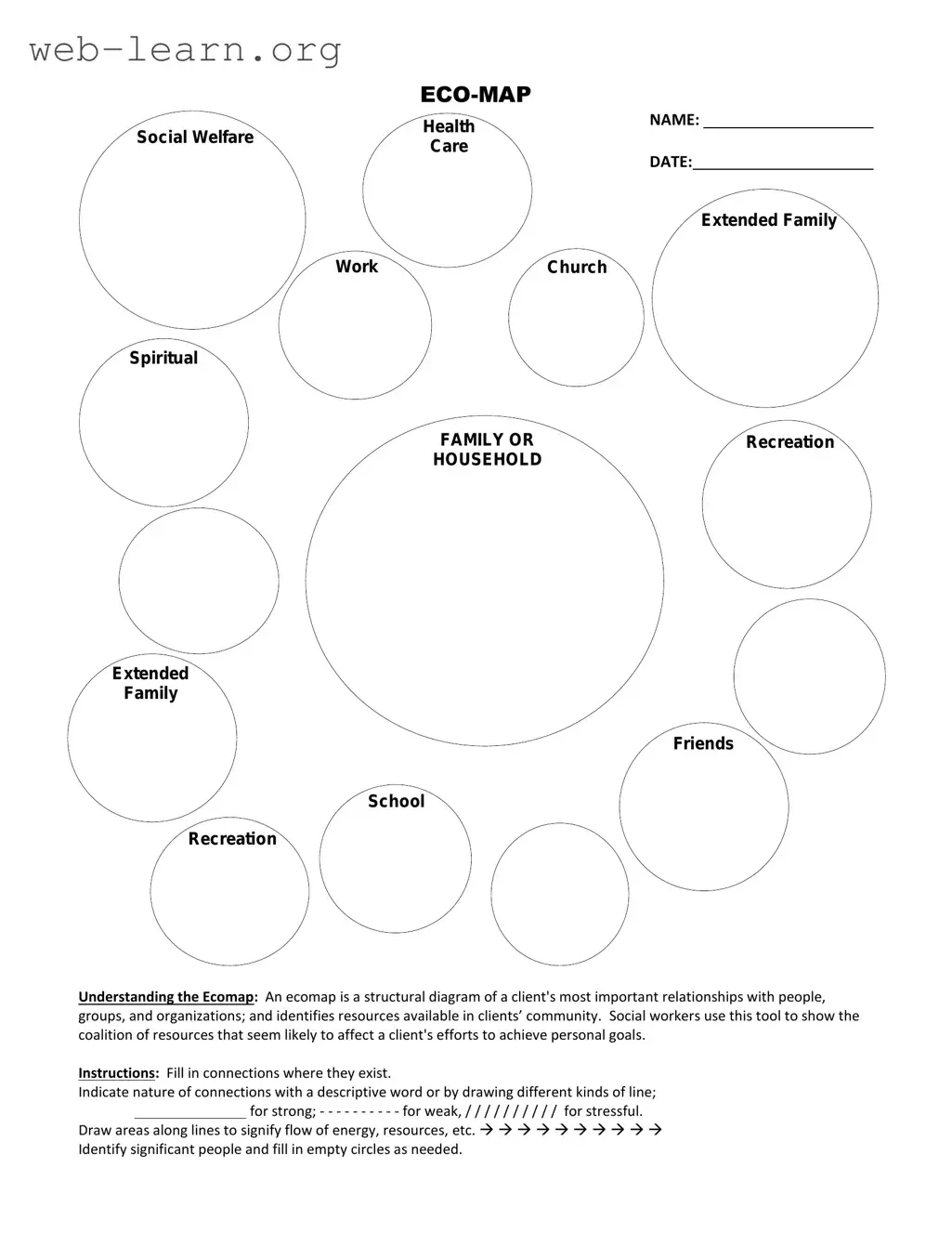
The Eco Map form serves as a vital tool for individuals and families seeking to visualize their social relationships and environmental influences. By mapping out connections with various systems, such as family, friends, and community resources, users can gain insights into their support networks and identify areas for improvement. The form encourages reflection on the quality and nature of these relationships, highlighting both strengths and potential gaps. It provides a structured way to assess interactions with educational institutions, healthcare providers, and social services. This holistic approach not only fosters a better understanding of personal dynamics but also promotes proactive engagement with available resources. Ultimately, the Eco Map form empowers users to take charge of their social environment, facilitating positive change and enhanced well-being.

| Fact Name | Description | Governing Law |
|---|---|---|
| Purpose | The Eco Map form is used to visually represent the relationships and resources available to an individual or family, particularly in the context of social services. | N/A |
| Components | It typically includes various elements such as family members, friends, community resources, and support systems. | N/A |
| Usage | Social workers and counselors often utilize the Eco Map form to assess the social environment and identify areas for support. | N/A |
| Customization | The form can be tailored to meet the specific needs of the individual or family, allowing for a personalized assessment. | N/A |
| State Variations | Some states may have specific guidelines or adaptations for the Eco Map form, which can be influenced by local laws and regulations. | Varies by state |
Filling out the Eco Map form is an important step in gathering information about your environment and resources. Follow these steps carefully to ensure that all necessary information is accurately provided.
What is an Eco Map?
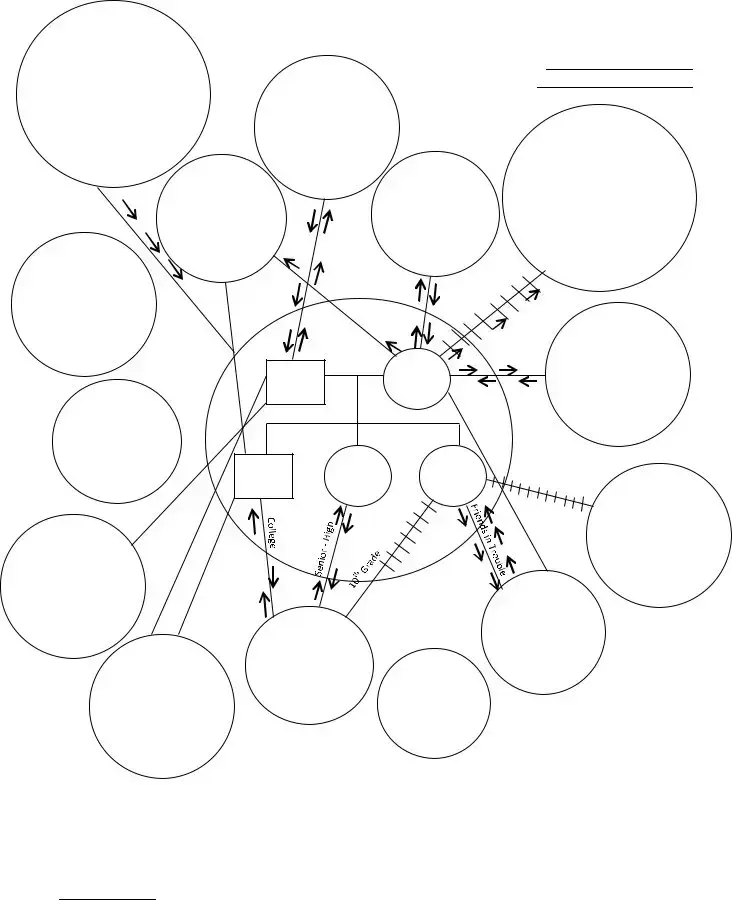
An Eco Map is a visual tool that helps individuals and families understand their social environment. It illustrates the relationships and connections between a person and their various support systems, such as family, friends, community resources, and other important entities. By mapping these connections, individuals can identify strengths and areas where additional support may be needed.
Who can benefit from using an Eco Map?
Anyone can benefit from using an Eco Map. It is particularly useful for individuals facing challenges in their lives, such as those dealing with mental health issues, family conflicts, or social isolation. Additionally, social workers, counselors, and educators often use Eco Maps to better understand the support systems of the people they serve.
How do I create an Eco Map?
Creating an Eco Map involves a few simple steps:
This visual representation can help clarify relationships and highlight areas for potential growth.
What should I include in my Eco Map?
Include all relevant support systems in your Eco Map. Think about:
Each connection should reflect the nature of the relationship and the level of support provided.
How can I use my Eco Map once it's completed?
Your Eco Map can serve as a valuable tool for self-reflection and planning. Use it to:
By actively engaging with your Eco Map, you can take steps to enhance your support network.
Can I update my Eco Map?
Yes, your Eco Map is a living document. As relationships change or new connections are formed, it is important to update your map. Regularly reviewing and revising your Eco Map allows you to stay aware of your support systems and make adjustments as needed.
Is there a specific format for an Eco Map?
There is no strict format for an Eco Map. The beauty of this tool lies in its flexibility. You can create your Eco Map on paper, use digital tools, or even draw it on a whiteboard. The goal is to make it meaningful and useful for you.
Where can I find resources to help me create an Eco Map?
Many community organizations, schools, and mental health professionals provide resources and guidance for creating Eco Maps. Online platforms also offer templates and examples. Consider reaching out to a local counselor or social worker for assistance, or explore websites dedicated to mental health and social support.
Filling out the Eco Map form can be a crucial step in understanding the various relationships and resources in a person's life. However, many individuals make common mistakes that can lead to incomplete or inaccurate representations of their social environment. Awareness of these pitfalls can enhance the effectiveness of the Eco Map.
One significant mistake is not including all relevant relationships. People often focus on immediate family or close friends, overlooking important connections like coworkers, mentors, or community members. Each relationship can provide different types of support, so it's essential to capture the full spectrum.
Another common error is failing to differentiate between supportive and non-supportive relationships. When filling out the form, individuals may list all connections without considering how each one impacts their well-being. Identifying which relationships are nurturing and which may be detrimental is vital for a clear understanding of one's support system.
Additionally, some people neglect to update their Eco Map regularly. Relationships can change over time, and so can their significance. By not revisiting the Eco Map, individuals may rely on outdated information that no longer reflects their current situation.
Another mistake is overlooking the importance of geographical context. Relationships can be affected by distance. For example, a friend who lives far away may provide less immediate support than a neighbor. Including geographical factors can provide a clearer picture of how accessible support systems are.
Some individuals also make the mistake of using vague descriptions for their relationships. Instead of simply noting “friend” or “family,” it is beneficial to specify the nature of the relationship. This specificity can help in understanding the dynamics of each connection.
In addition, there is often a tendency to ignore professional relationships. These can be just as important as personal ones. Connections with colleagues, supervisors, or professional networks can offer unique resources and support that should not be overlooked.
Another frequent error is not considering the impact of community resources. Many people focus solely on personal relationships and fail to include organizations, clubs, or services that provide support. These community resources can be vital in times of need.
Some individuals may also underestimate the role of self. It’s important to recognize one’s own strengths and resources. Including oneself in the Eco Map helps to highlight personal resilience and the ability to cope with challenges.
Furthermore, a lack of clarity in visual representation can lead to confusion. The Eco Map should be clear and easy to read. Using different colors or symbols can help distinguish between various types of relationships and their significance.
Finally, many people fail to seek feedback from trusted individuals when completing their Eco Map. Getting input from others can provide new perspectives and help identify relationships that may have been overlooked. Collaboration can enhance the overall accuracy and usefulness of the Eco Map.
The Eco Map form is a valuable tool that helps individuals visualize their relationships and interactions within their environment. However, it is often used in conjunction with other forms and documents to provide a more comprehensive understanding of a person's situation. Below are five commonly used documents that complement the Eco Map form.
Using these documents alongside the Eco Map form creates a more holistic view of an individual's situation. This comprehensive approach not only aids in understanding but also enhances the effectiveness of the support provided.
The Eco Map form is a valuable tool for understanding relationships and resources within a person's life. Several other documents share similarities with the Eco Map, each serving a unique purpose but often focusing on relationships and resources. Here’s a list of those documents:
When filling out the Eco Map form, it is important to follow certain guidelines to ensure accuracy and clarity. Below are ten recommendations for what to do and what to avoid.
Here are some common misconceptions about the Eco Map form, along with explanations to clarify them:
This is not true. While social workers often use Eco Maps, anyone involved in community services or support roles can benefit from this tool.
In reality, Eco Maps are designed to be simple and user-friendly. They visually represent relationships and resources, making them easy to interpret.
Creating an Eco Map does not require specialized training. Basic knowledge of the relationships being mapped is sufficient.
Eco Maps actually highlight both positive and negative relationships. They provide a balanced view of a person’s support system.
This is incorrect. Eco Maps can and should be updated regularly to reflect changes in relationships and resources.
Eco Maps are versatile. They can be used for families, groups, or entire communities, making them applicable in various contexts.
While they can help identify issues, Eco Maps also serve to recognize strengths and resources within a network.
This is false. Eco Maps remain a valuable tool in modern practice, helping professionals and individuals alike visualize connections and support.
When filling out and utilizing the Eco Map form, there are several important considerations to keep in mind. This tool serves to visualize the relationships and resources surrounding an individual or family, offering insights that can inform various interventions and support strategies.