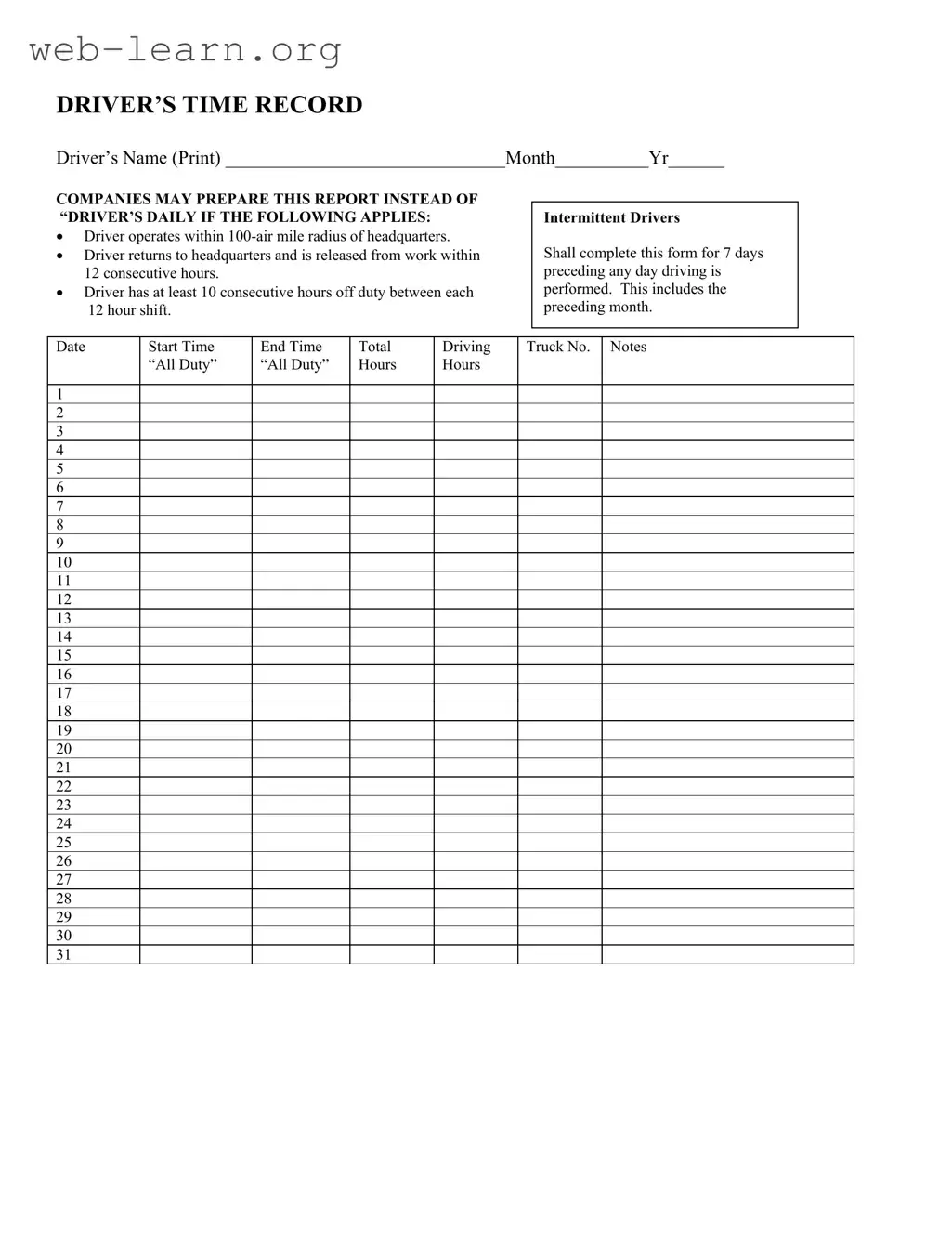
Homepage Blank Driver Time Record Form
Outline

The Driver Time Record form serves as a crucial tool for tracking the working hours of drivers, particularly those operating within a specific radius of their headquarters. It is designed to streamline the reporting process for companies, allowing them to forgo the traditional “Driver’s Daily” report under certain conditions. For instance, drivers who operate within a 100-air mile radius and return to their headquarters within 12 consecutive hours can utilize this form. Additionally, it ensures that drivers have a minimum of 10 consecutive hours off duty between each 12-hour shift, promoting safety and compliance with regulations. The form requires drivers to document their hours over a seven-day period preceding any day of driving, capturing essential details such as start and end times, total driving hours, and truck identification numbers. This comprehensive approach not only aids in maintaining accurate records but also enhances accountability within the transportation industry.

Sample - Driver Time Record Form

DRIVER’S TIME RECORD
Driver’s Name (Print) ______________________________Month__________Yr______
COMPANIES MAY PREPARE THIS REPORT INSTEAD OF
“DRIVER’S DAILY IF THE FOLLOWING APPLIES:
Driver operates within 100-air mile radius of headquarters.
Driver returns to headquarters and is released from work within
12 consecutive hours.
Driver has at least 10 consecutive hours off duty between each
12 hour shift.
Date Start Time
“All Duty”
End Time
“All Duty”
Total
Hours
Driving
Hours
Truck No. Notes
1
2
3
4
5
6
7
8
9
10
11
12
13
14
15
16
17
18
19
20
21
22
23
24
25
26
27
28
29
30
31
Intermittent Drivers
Shall complete this form for 7 days
preceding any day driving is
performed. This includes the
preceding month.

Form Information

Fact Name Description
Driver's Name Requirement The form requires the driver's name to be printed clearly at the top.
Monthly Record This form is intended to document the driver's time for a specific month and year.
Eligibility Criteria Companies may use this form instead of the Driver's Daily Log if the driver operates within a 100-air mile radius and meets other conditions.
Intermittent Drivers Intermittent drivers must complete this form for the seven days preceding any driving day, including the previous month.
Record Keeping Drivers must accurately record start and end times, total driving hours, truck number, and any relevant notes.

Detailed Guide for Filling Out Driver Time Record

Filling out the Driver Time Record form is an important task that requires attention to detail. Once completed, this form will help ensure accurate tracking of driving hours and compliance with regulations. Follow the steps below to fill out the form correctly.

  1. Print your name clearly in the space provided for the Driver’s Name.
  2. Indicate the month and year by filling in the Month and Year sections.
  3. Review the eligibility criteria to determine if your company can prepare this report instead of the Driver’s Daily Log.
  4. For intermittent drivers, ensure you have records for the 7 days preceding any driving day, including the previous month.
  5. Fill in the date for each day you drove in the designated Date column.
  6. Record the start time and end time for each driving session in the corresponding columns.
  7. Calculate total driving hours for each session and enter this information in the Total Driving Hours column.
  8. List the truck number you drove in the Truck No. column.
  9. Add any notes relevant to your driving sessions in the Notes section.

Obtain Answers on Driver Time Record

  1. What is the purpose of the Driver Time Record form?

    The Driver Time Record form is used to document the hours a driver works, including start and end times, total driving hours, and any relevant notes. It ensures compliance with regulations regarding driving hours and rest periods, especially for those operating within specific limits.

  2. Who needs to fill out this form?

    Drivers who operate within a 100-air mile radius of their headquarters and meet certain conditions must complete this form. Specifically, this includes drivers who:

    • Return to headquarters and are released from work within 12 consecutive hours.
    • Have at least 10 consecutive hours off duty between each 12-hour shift.

    Additionally, intermittent drivers must fill out the form for the 7 days preceding any day they perform driving duties.

  3. What information is required on the form?

    The Driver Time Record form requires the following details:

    • Driver’s name
    • Month and year of the record
    • Date of driving
    • Start time and end time for each driving session
    • Total driving hours
    • Truck number
    • Notes for any additional information

    Each of these elements helps provide a comprehensive overview of the driver's work hours.

  4. How should the form be completed for intermittent drivers?

    Intermittent drivers must complete the Driver Time Record form for the 7 days leading up to any driving day. This includes documenting all driving hours from the preceding month. It’s essential to ensure accuracy in recording each day’s driving activities to comply with regulations.

  5. What happens if the form is not filled out correctly?

    If the Driver Time Record form is not completed accurately, it may lead to compliance issues. Inaccurate records can result in penalties for both the driver and the employer. It is crucial to double-check all entries for correctness and ensure that the form is filled out in a timely manner.

Common mistakes

Filling out the Driver Time Record form accurately is crucial for compliance and record-keeping. One common mistake is failing to print the driver's name clearly. Illegible handwriting can lead to confusion and potential issues with identification. Ensure that the name is written in a way that can be easily read.

Another frequent error involves the month and year section. Drivers often forget to fill in these fields completely. Leaving them blank can result in difficulties when tracking driving records. It is important to enter both the month and year correctly to maintain accurate documentation.

Many drivers do not complete the date section properly. This can lead to missing or incorrect information about when driving occurred. Each date must be filled out clearly to reflect the driving schedule accurately. Incomplete dates can complicate record verification.

Start and end times are critical components of the form. A common mistake is entering these times incorrectly. Drivers should double-check that the times accurately reflect their actual driving hours. Errors in time entries can lead to misunderstandings regarding compliance with regulations.

Another issue arises with the total driving hours. Some individuals forget to calculate these hours or make errors in their calculations. It is essential to ensure that the total driving hours are correct, as this data is used for compliance checks and may impact safety regulations.

Truck numbers are sometimes omitted or entered incorrectly. This can create confusion when tracking vehicle usage. Each entry should include the correct truck number to ensure that records are complete and accurate.

Notes sections are often left blank. While it may seem unnecessary, providing notes can clarify circumstances related to driving hours or any unusual occurrences. Including relevant notes can assist in understanding the context of the driving record.

Lastly, intermittent drivers may overlook the requirement to complete the form for the preceding 7 days before any driving. This oversight can result in incomplete records. It is important for these drivers to remember to document all relevant days to ensure compliance with regulations.

Documents used along the form

When managing driver schedules and compliance, several important forms complement the Driver Time Record form. Each of these documents plays a crucial role in ensuring that drivers adhere to regulations and maintain accurate records. Here’s a brief overview of these essential forms.

  • Driver's Daily Log: This form is used by drivers to record their hours of service each day. It captures details such as driving time, rest periods, and any off-duty time. This log is vital for compliance with federal regulations regarding maximum driving hours.
  • Vehicle Inspection Report: Before and after each trip, drivers are required to complete this report to document the condition of the vehicle. It helps ensure safety and compliance by identifying any maintenance issues that need to be addressed.
  • Bill of Lading: This document serves as a receipt for the goods being transported. It outlines the details of the shipment, including the type of cargo, weight, and destination. It is crucial for both the driver and the shipping company to have a clear record of the cargo being transported.
  • Fuel Purchase Receipt: Drivers must keep track of fuel purchases to monitor expenses and ensure compliance with company policies. This receipt provides a record of fuel expenditures, which can be important for tax and reimbursement purposes.

Utilizing these forms alongside the Driver Time Record form helps streamline operations and maintain compliance with regulations. Keeping thorough and accurate records is essential for both drivers and companies in the transportation industry.

Similar forms

  • Driver’s Daily Log: This document tracks a driver's daily activities, including driving time, rest breaks, and total hours worked. Like the Driver Time Record, it ensures compliance with regulations regarding hours of service.
  • Vehicle Inspection Report: Similar in its purpose of documenting important operational details, this report outlines the condition of the vehicle before and after a trip, ensuring safety and compliance with regulations.
  • Bill of Lading: This document serves as a receipt for goods and outlines the terms of transport. It is similar in that it is essential for tracking and documenting the movement of goods, just as the Driver Time Record tracks driving hours.
  • Route Plan: A route plan details the intended path for delivery, including stops and estimated times. Like the Driver Time Record, it helps in planning and managing time effectively during a trip.
  • Fuel Purchase Receipts: These receipts document fuel purchases made during trips. They are similar in that they help track expenses and operational efficiency, much like the Driver Time Record tracks driving hours.
  • Time Card: This document records the hours worked by an employee, including start and end times. It serves a similar purpose to the Driver Time Record by providing a clear account of time spent on work-related activities.
  • Maintenance Log: A maintenance log tracks repairs and services performed on a vehicle. It is similar to the Driver Time Record in that both documents ensure proper management and compliance with safety standards.
  • Accident Report: This report details any incidents that occur while driving. It is similar to the Driver Time Record in that it documents critical information about driving activities and safety.
  • Trip Report: A trip report summarizes the details of a journey, including mileage and expenses. It shares similarities with the Driver Time Record as both documents provide insights into the operational aspects of driving.
  • Hours of Service (HOS) Compliance Record: This record ensures that drivers comply with federal regulations regarding driving hours. Like the Driver Time Record, it focuses on tracking time to maintain safety and legal standards.

Dos and Don'ts

When filling out the Driver Time Record form, it’s important to be thorough and accurate. Here are five things you should and shouldn’t do to ensure your form is completed correctly.

  • Do print your name clearly in the designated space.
  • Do fill in the month and year accurately.
  • Do ensure that all driving hours are recorded, including start and end times.
  • Don’t forget to include notes for any unusual circumstances during your driving time.
  • Don’t leave any sections blank; incomplete forms can lead to confusion and delays.

By following these guidelines, you can help ensure that your Driver Time Record form is processed smoothly and efficiently. Accuracy matters, and your attention to detail can make all the difference.

Misconceptions

Understanding the Driver Time Record form is essential for both drivers and employers. However, several misconceptions can lead to confusion. Here are seven common misunderstandings:

  1. Only long-haul drivers need to fill out this form. Many believe that only drivers who travel long distances are required to complete a Driver Time Record. In fact, even drivers operating within a 100-air mile radius must fill it out under specific conditions.
  2. Drivers can skip days without recording their time. Some may think they can omit days when they are not driving. However, intermittent drivers must complete this form for the seven days leading up to any driving day, including the previous month.
  3. All driving hours are counted as “All Duty” hours. There is a misconception that all hours logged are automatically considered “All Duty.” Drivers must accurately record their driving hours and distinguish them from off-duty hours.
  4. The form is only for company drivers. Another common belief is that only company drivers need to use this form. Independent drivers or those working for themselves also need to maintain accurate records for compliance.
  5. Returning to headquarters means you can stop recording. Some drivers think that once they return to headquarters, they no longer need to log their hours. In reality, they must still follow the guidelines for recording their time, especially if they are released from work within 12 consecutive hours.
  6. It’s acceptable to estimate driving hours. Estimating driving hours is a significant misconception. Accurate records are crucial, and drivers should log their actual driving times to ensure compliance with regulations.
  7. Filling out the form is optional. Lastly, some may believe that completing the Driver Time Record is optional. It is, in fact, a necessary requirement for compliance with federal regulations, and failure to complete it can result in penalties.

By addressing these misconceptions, drivers can ensure they are compliant and maintain accurate records, which is essential for their safety and the safety of others on the road.

Key takeaways

Filling out the Driver Time Record form accurately is essential for compliance and record-keeping. Here are key takeaways to consider:

  • The form requires the driver's name, month, and year for proper identification.
  • Companies may use this report in place of the Driver’s Daily if specific conditions are met.
  • To qualify for the alternate report, the driver must operate within a 100-air mile radius of headquarters.
  • Returning to headquarters and being released from work within 12 consecutive hours is a requirement.
  • Drivers must have at least 10 consecutive hours off duty between each 12-hour shift.
  • Intermittent drivers should complete this form for the 7 days leading up to any driving day.
  • It is important to include all relevant details, such as start time, end time, total driving hours, and truck number.

By adhering to these guidelines, drivers can ensure they maintain accurate records and comply with regulations.