Homepage Blank Dr 504 Florida Form
Outline

The DR 504 Florida form is a vital tool for nonprofit organizations seeking an ad valorem tax exemption for properties used primarily for charitable, religious, scientific, literary, or healthcare purposes. This application allows qualifying entities such as hospitals, nursing homes, and other special service homes to request exemptions as outlined in specific Florida statutes. To successfully apply, organizations must complete various sections detailing their status as a Florida not-for-profit corporation, the nature of property usage, and any rental or lease agreements in place. The form also requires supporting documents, including financial statements and tax returns, to substantiate the organization’s claims. Timeliness is crucial; applications must be submitted to the county property appraiser by March 1 of the current tax year. Understanding the requirements and preparing the necessary documentation can significantly impact an organization’s ability to reduce its tax burden and allocate more resources toward fulfilling its mission.


Sample - Dr 504 Florida Form

DR-504
R. 11/21
Rule 12D-16.002
FAC
Eff. 11/21
Page 1 of 3
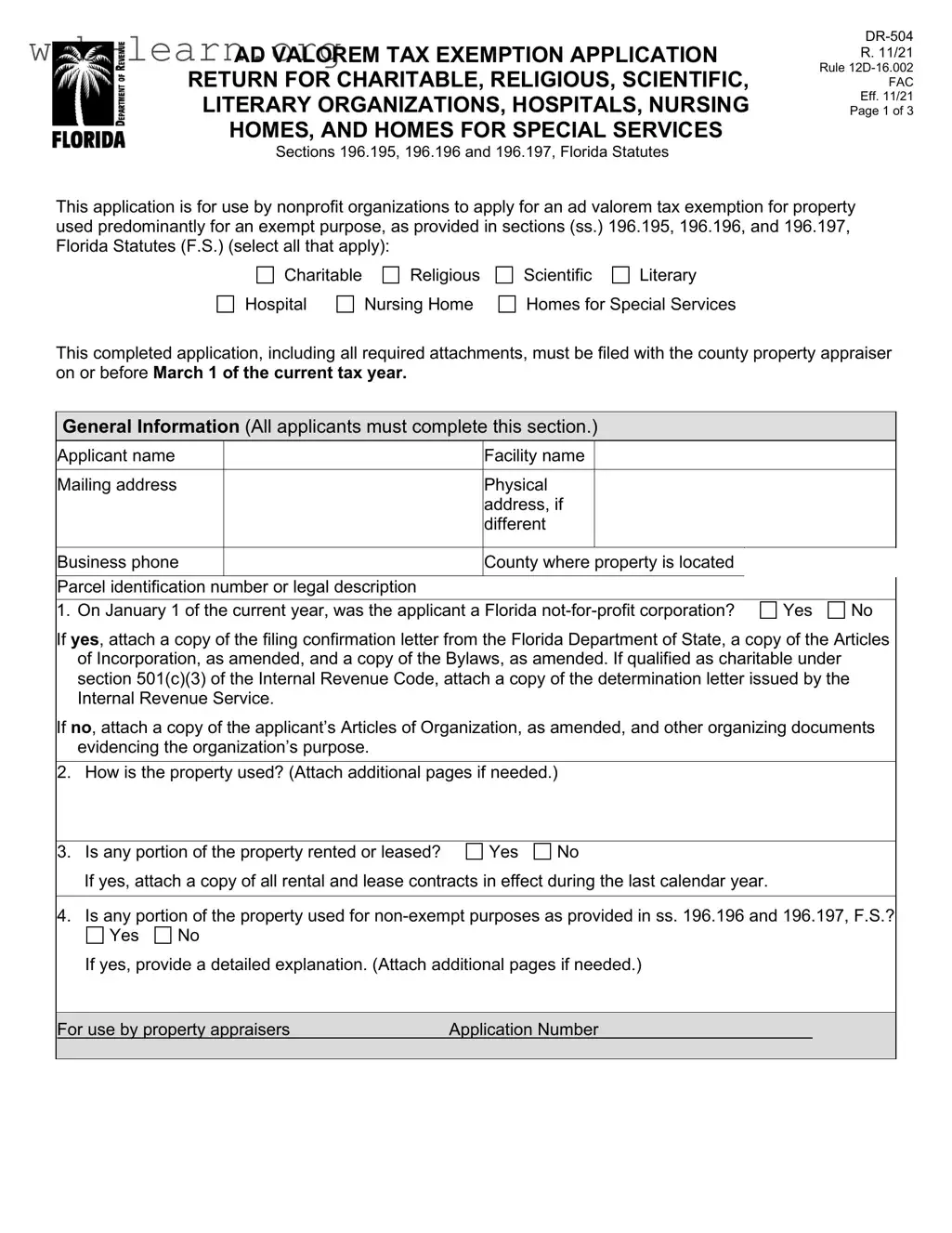
AD VALOREM TAX EXEMPTION APPLICATION
AND RETURN FOR CHARITABLE, RELIGIOUS, SCIENTIFIC,
LITERARY ORGANIZATIONS, HOSPITALS, NURSING
HOMES, AND HOMES FOR SPECIAL SERVICES
Sections 196.195, 196.196 and 196.197, Florida Statutes
This application is for use by nonprofit organizations to apply for an ad valorem tax exemption for property
used predominantly for an exempt purpose, as provided in sections (ss.) 196.195, 196.196, and 196.197,
Florida Statutes (F.S.) (select all that apply):
Charitable Religious Scientific Literary
Hospital Nursing Home Homes for Special Services
This completed application, including all required attachments, must be filed with the county property appraiser
on or before March 1 of the current tax year.
General Information (All applicants must complete this section.)
Applicant name
Facility name
Mailing address
Physical
address, if
different
Business phone
County where property is located
Parcel identification number or legal description
1. On January 1 of the current year, was the applicant a Florida not-for-profit corporation? Yes No
If
yes, attach a copy of the filing confirmation letter from the Florida Department of State, a copy of the Articles
of Incorporation, as amended, and a copy of the Bylaws, as amended. If qualified as charitable under
section 501(c)(3) of the Internal Revenue Code, attach a copy of the determination letter issued by the
Internal Revenue Service.
If
no, attach a copy of the applicant’s Articles of Organization, as amended, and other organizing documents
evidencing the organization’s purpose.
2. How is the property used? (Attach additional pages if needed.)
3. Is any portion of the property rented or leased? Yes No
If yes, attach a copy of all rental and lease contracts in effect during the last calendar year.
4.
Is any portion of the property used for non-exempt purposes
as provided in ss. 196.196 and 196.197, F.S.?
Yes No
If yes, provide a detailed explanation. (Attach additional pages if needed.)
For use by property appraisers
Application Number ______________________
DR-504
Eff. 11/21
Page 2 of 3
1.
On January 1 of the current year, was the applicant qualified as charitable under section 501(c)(3) of the
Internal Revenue Code, as determined by the Internal Revenue Service?
Yes No
If yes, attach a copy of the determination letter from the Internal Revenue Service, a copy of the Articles
of Incorporation, as amended, and a copy of the Bylaws, as amended.
2. On January 1 of the current year, did the organization hold a valid license issued by the Agency for Health Care
Administration under
Chapter 395, F.S. Hospital or Ambulatory Surgical Center
Yes No
Chapter 400, F.S. Nursing Home, Home for Special Services and Related
Health Care Facility, or
Yes No
Part I, Chapter 429, F.S. Assisted Living Facility?
Yes No
If yes, attach a copy of the license issued by the Agency for Health Care Administration.
1. Provide a copy of the organization’s most recent financial statement.
2. Provide a copy of the organization’s most recent federal tax return (if filed).
3. Provide the following fiscal and other records showing in reasonable detail the financial condition, record of
operation, and exempt and nonexempt uses of the property, where appropriate, for the immediately
preceding fiscal year:
a. A schedule of payments or advances, directly or indirectly, by way of salaries, fees, loans, gifts,
bonuses, gratuities, drawing accounts, commissions or other compensation (except reimbursements
for reasonable out-of-pocket expenses incurred on behalf of the applicant) to
any officer, director, trustee, member, or stockholder, or
any person, company, or other entity directly or indirectly controlled by the applicant.
b. An explanation for the guarantee of any loan to or obligation of any officer, director, trustee, member,
or stockholder of the applicant or any entity directly or indirectly controlled by the applicant.
c. Any contractual arrangement by the applicant or any officer, director, trustee, member, or stockholder
of the applicant regarding the
rendition of services;
provision of goods or supplies;
management of the applicant;
construction or renovation of the property;
procurement of the real, personal, or intangible property; and
other similar financial interest in the affairs of the applicant.
d. A schedule of payments or amounts for
salaries for operation;
services received;
supplies and materials;
reserves for repair, replacement, and depreciation of the property;
any mortgage, lien, and other encumbrances; and
other purposes (explain).
e. A schedule of charges for services rendered by the applicant. If the charges for services rendered
exceed the value of the services rendered, information on whether the excess is used to pay
maintenance and operational expenses furthering its exempt purpose or to provide services to persons
unable to pay for the services.
f. An affirmative statement that no part of the property, or no part of the proceeds of the sale, lease, or
other disposition of the property, will inure to the benefit of its members, directors, or officers, or to any
person or firm operating for a profit or for a nonexempt purpose.
Hospitals, Nursing Homes, and Homes for Special Services
Attachments (All applicants must attach the following information
to this application.) On each attachment,
include your name, address, and an indication that the information is an attachment to this application.
DR-504
Eff. 11/21
Page 3 of 3
Signature
(ALL applicants must complete this section.)
Florida law requires property appraisers to determine whether an organization uses the identified property for
exempt
purposes before granting an ad valorem tax exemption. Property appraisers will notify you if additional
information
or documentation is needed to determine eligibility for the exemption requested.
I certify all information on this application, including any attachment
s, is true, correct, and in effect on January
1 of the tax year.
Signature
Title
Date
Need Help?
In Florida, local governments are responsible for administering property tax. The best
resource for assistance is the property appraiser in the county where the property is
located. Find websites for county property appraisers at:
FloridaRevenue.com/Property/Pages/LocalOfficials.aspx

Form Information

Fact Name Details
Purpose The DR-504 form is used by nonprofit organizations to apply for an ad valorem tax exemption for property used predominantly for exempt purposes.
Governing Laws This form is governed by sections 196.195, 196.196, and 196.197 of the Florida Statutes.
Filing Deadline Applications must be filed with the county property appraiser by March 1 of the current tax year.
Eligibility Requirements Applicants must be a Florida not-for-profit corporation and may need to provide proof of 501(c)(3) status if applicable.
Attachments Needed Required attachments include the organization's financial statement, federal tax return, and details of property use, among others.

Detailed Guide for Filling Out Dr 504 Florida

Filling out the DR-504 Florida form is a crucial step for nonprofit organizations seeking an ad valorem tax exemption. To ensure your application is complete and submitted on time, follow these straightforward steps.

  1. Begin by entering the applicant name and facility name at the top of the form.
  2. Fill in the mailing address and, if different, the physical address of the organization.
  3. Provide a business phone number and the county where the property is located.
  4. Include the parcel identification number or legal description of the property.
  5. Answer the question regarding whether the applicant was a Florida not-for-profit corporation on January 1 of the current year. If yes, attach the required documents.
  6. Describe how the property is used. If necessary, attach additional pages for a detailed explanation.
  7. Indicate if any portion of the property is rented or leased. If yes, attach copies of all relevant contracts.
  8. Answer whether any part of the property is used for non-exempt purposes. If yes, provide a detailed explanation.
  9. If applicable, for hospitals and nursing homes, confirm whether the applicant is qualified as charitable under section 501(c)(3). Attach the necessary documents.
  10. Indicate if the organization holds a valid license from the Agency for Health Care Administration. Attach a copy of the license if applicable.
  11. Attach the organization’s most recent financial statement and federal tax return (if filed).
  12. Provide detailed fiscal records showing the financial condition and operation of the property for the previous fiscal year, including various schedules as outlined in the form.
  13. Complete the signature section, certifying that all information is accurate as of January 1 of the tax year.

After completing the form, review everything to ensure accuracy and completeness. Remember, this application must be submitted to the county property appraiser by March 1 of the current tax year. If you have questions, don't hesitate to reach out to your local property appraiser for guidance.

Obtain Answers on Dr 504 Florida

  1. What is the purpose of the DR 504 Florida form?

    The DR 504 form is designed for nonprofit organizations to apply for an ad valorem tax exemption. This exemption applies to properties used predominantly for charitable, religious, scientific, literary, or health-related purposes. Organizations such as hospitals, nursing homes, and homes for special services can benefit from this exemption, helping them to allocate more resources toward their missions.

  2. Who is eligible to apply using the DR 504 form?

    Eligible applicants include Florida not-for-profit corporations that operate in one of the exempt categories mentioned above. Specifically, organizations must demonstrate that they are primarily engaged in charitable, religious, scientific, literary, or health-related activities. Additionally, if the organization is classified as charitable under section 501(c)(3) of the Internal Revenue Code, it must provide relevant documentation to support its claim.

  3. What documents must be submitted with the application?

    Applicants must attach several key documents, including:

    • A copy of the organization’s most recent financial statement.
    • A copy of the organization’s most recent federal tax return, if filed.
    • Records detailing the financial condition and operations of the property for the previous fiscal year.
    • Documentation regarding any compensation to officers or directors, as well as any contractual arrangements.

    All attachments should include the applicant's name and address, clearly indicating they are part of the application.

  4. When is the application due?

    The completed DR 504 application must be submitted to the county property appraiser by March 1 of the current tax year. Meeting this deadline is crucial for ensuring the organization receives the tax exemption for that year.

  5. What happens if the application is incomplete?

    If the application lacks necessary information or documentation, the property appraiser will notify the applicant. It’s important to respond promptly to any requests for additional information to avoid delays in processing the application.

  6. Can the property be used for non-exempt purposes?

    Yes, but any portion of the property used for non-exempt purposes must be clearly detailed in the application. This includes providing explanations and documentation regarding how much of the property is used for exempt versus non-exempt activities.

  7. What is the significance of the applicant's status as a not-for-profit corporation?

    The applicant must be a Florida not-for-profit corporation as of January 1 of the current year. This status is essential for qualifying for the tax exemption. If the organization is not a not-for-profit, it must provide documentation to demonstrate its purpose and eligibility.

  8. Where can I find assistance with the DR 504 application?

    For help with the DR 504 application, the best resource is the local county property appraiser. Each county has specific guidelines and resources available. You can find contact information for county property appraisers at FloridaRevenue.com.

Common mistakes

Filling out the DR-504 Florida form for ad valorem tax exemption can be a straightforward process, but several common mistakes can hinder the application. One frequent error occurs when applicants fail to provide the necessary documentation. The form requires attachments such as the Articles of Incorporation and financial statements. Omitting these documents can lead to delays or outright rejection of the application.

Another mistake is related to the use of property. Applicants often do not clearly describe how the property is utilized. The form asks for details about any non-exempt uses of the property. If this section is not thoroughly completed, it may raise questions about the organization’s eligibility for tax exemption. Providing vague or incomplete answers can result in complications during the review process.

Additionally, applicants sometimes overlook the importance of deadlines. The completed form and all required attachments must be submitted to the county property appraiser by March 1 of the current tax year. Missing this deadline can disqualify the organization from receiving the tax exemption for that year, regardless of the merits of the application.

Lastly, failing to sign and date the application is a common oversight. The signature section is crucial as it certifies that all information provided is accurate and complete. Without a signature, the application may be considered invalid. It is essential for applicants to double-check that every section is filled out correctly and that all necessary signatures are included before submission.

Documents used along the form

When applying for an ad valorem tax exemption using the DR 504 Florida form, several additional documents may be required to support your application. These documents provide necessary information about your organization and its operations, ensuring a comprehensive review by the property appraiser. Below are some commonly used forms and documents that accompany the DR 504.

  • Articles of Incorporation: This document outlines the formation of the nonprofit organization. It includes details such as the organization's name, purpose, and structure. If the organization is a Florida not-for-profit corporation, a copy must be attached.
  • Bylaws: Bylaws govern the internal management of the organization. They specify the rules and procedures for meetings, elections, and other operational aspects. Updated bylaws must be included if amendments have been made.
  • IRS Determination Letter: For organizations qualifying as charitable under section 501(c)(3), this letter from the Internal Revenue Service confirms the tax-exempt status. It is crucial for demonstrating eligibility for the exemption.
  • Financial Statement: A recent financial statement provides insight into the organization's financial health. It should reflect the financial position, including assets, liabilities, and net assets.
  • Federal Tax Return: If filed, the most recent federal tax return offers additional financial information. It helps the property appraiser assess the organization’s operations and compliance with tax regulations.

Ensuring that these documents are complete and accurate will facilitate a smoother application process for the ad valorem tax exemption. It is essential to provide all required information to support your case and demonstrate your organization’s commitment to its exempt purposes.

Similar forms

The DR 504 Florida form serves as an application for ad valorem tax exemption for nonprofit organizations. Several other documents share similarities with this form, primarily in their purpose and requirements. Below is a list of documents that are comparable to the DR 504 form:

  • IRS Form 1023: This form is used by organizations to apply for federal tax-exempt status under section 501(c)(3) of the Internal Revenue Code. Like the DR 504, it requires detailed information about the organization's structure and purpose.
  • Florida Form DR-501: This is an application for property tax exemption for homesteads. It requires information about the property and the owner, similar to the property usage questions in the DR 504.
  • Florida Form DR-420: This form is used for requesting a property tax exemption for governmental property. It also requires proof of the organization's nonprofit status and the purpose of the property.
  • IRS Form 990: Nonprofits must file this annual information return to maintain their tax-exempt status. It provides financial information similar to what is required in the DR 504 regarding the organization’s finances.
  • Florida Form DR-504A: This is a renewal application for tax exemption for nonprofit organizations. It requires similar attachments and information as the initial DR 504 form.
  • Florida Form DR-501A: This is an application for additional homestead exemption for low-income seniors. It also requires verification of the applicant's status, akin to the DR 504's requirements.
  • Florida Form DR-1: This is a general application for various tax exemptions. It gathers information about the organization and its property use, paralleling the DR 504's inquiries.
  • Florida Form DR-420S: This form is for requesting an exemption for educational institutions. It requires proof of nonprofit status and details on property use, similar to the DR 504.
  • Florida Form DR-403: This is an application for a charitable organization exemption. It shares the same objective of proving the nonprofit status and the intended use of the property.

Dos and Don'ts

When filling out the DR 504 Florida form for ad valorem tax exemption, it's essential to approach the process carefully. Here’s a helpful list of things you should and shouldn’t do:

  • Do ensure all required attachments are included with your application.
  • Do provide accurate and complete information about your organization and property.
  • Do file your application by the March 1 deadline to avoid delays.
  • Do attach proof of your nonprofit status, such as the determination letter from the IRS.
  • Don't forget to sign and date the application before submission.
  • Don't leave any questions unanswered; if something doesn’t apply, indicate that clearly.

Following these guidelines can help streamline your application process and improve your chances of receiving the tax exemption you seek. Good luck!

Misconceptions

Understanding the DR-504 Florida form is essential for nonprofit organizations seeking an ad valorem tax exemption. However, several misconceptions often arise regarding its use and requirements. Below are six common misunderstandings, along with clarifications to help navigate the process more effectively.

  • Misconception 1: The DR-504 form can be submitted at any time during the year.
  • This is incorrect. The completed application must be filed with the county property appraiser by March 1 of the current tax year. Late submissions may result in a denial of the exemption.

  • Misconception 2: Only religious organizations can apply for the exemption.
  • In reality, the DR-504 form is available to a variety of nonprofit organizations, including those that are charitable, scientific, literary, and more. Hospitals and nursing homes also qualify.

  • Misconception 3: If an organization is registered as a nonprofit, it automatically qualifies for the tax exemption.
  • While being a registered nonprofit is a prerequisite, it does not guarantee exemption. The organization must use the property predominantly for exempt purposes as outlined in Florida statutes.

  • Misconception 4: The form only requires basic information about the organization.
  • This is misleading. The application requires detailed financial information, including recent financial statements and federal tax returns, to substantiate the organization's exempt status.

  • Misconception 5: The property does not need to be exclusively used for exempt purposes.
  • In fact, any portion of the property used for non-exempt purposes can jeopardize the exemption. The organization must provide a clear explanation of how the property is used.

  • Misconception 6: The property appraiser will automatically approve the application if it is submitted on time.
  • This is a common misunderstanding. The property appraiser must review the application thoroughly and may request additional information to determine eligibility for the exemption.

By dispelling these misconceptions, nonprofit organizations can better prepare their applications and increase their chances of securing the tax exemption they seek.

Key takeaways

When filling out the DR 504 Florida form for ad valorem tax exemption, keep these key takeaways in mind:

  • Submit on Time: Ensure you file the completed application, along with all required attachments, by March 1 of the current tax year.
  • Provide Accurate Information: Fill out the general information section completely. Include your organization’s name, address, and contact details to avoid delays.
  • Attach Necessary Documents: Include all required attachments, such as financial statements and tax returns. These documents are essential for verifying your organization’s eligibility.
  • Clarify Property Use: Clearly explain how the property is used. If any part of the property is rented or used for non-exempt purposes, provide detailed information and relevant contracts.
  • Certification is Key: Sign the application to certify that all information is true and correct as of January 1 of the tax year. This step is crucial for the approval process.