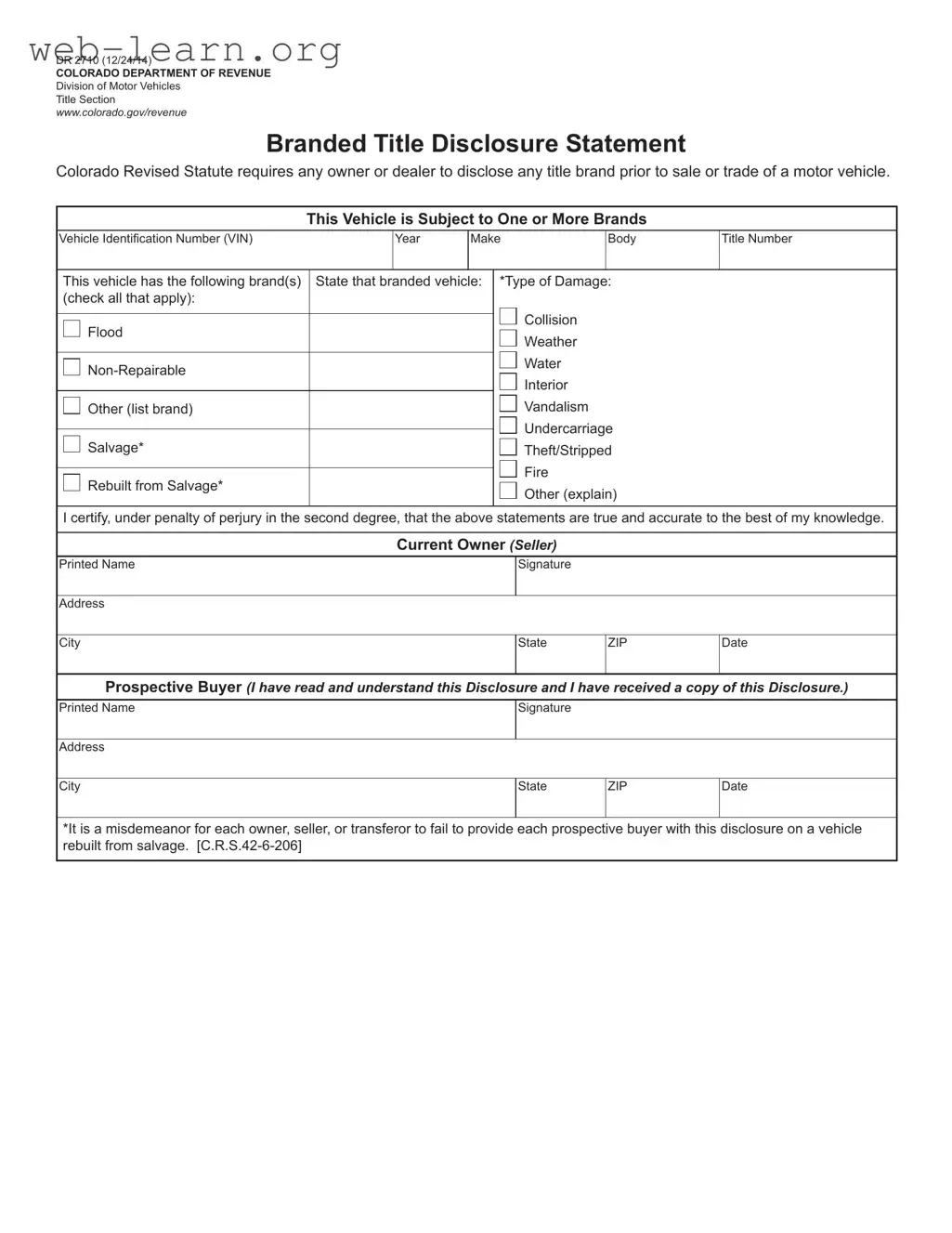
The DR 2710 form, also known as the Branded Title Disclosure Statement, plays a crucial role in the process of buying and selling motor vehicles in Colorado. Designed to promote transparency, this form requires vehicle owners and dealers to disclose any title brands associated with a vehicle before a sale or trade occurs. Title brands can indicate a variety of issues, such as collision damage, flood exposure, or salvage status, which can significantly affect a vehicle's value and safety. Each vehicle is identified by its Vehicle Identification Number (VIN), and the form prompts sellers to detail the specific brand types that apply. Additionally, the form includes a certification statement, ensuring that the seller attests to the accuracy of the information provided. Both the current owner and the prospective buyer must sign the document, acknowledging their understanding of the disclosure. Notably, failing to provide this information can lead to legal consequences, as it is considered a misdemeanor under Colorado law. By utilizing the DR 2710 form, both parties can engage in a more informed transaction, fostering trust and accountability in the marketplace.

| Fact Name | Description |
|---|---|
| Form Title | DR 2710 is known as the Branded Title Disclosure Statement. |
| Governing Law | This form is governed by Colorado Revised Statute (C.R.S.) 42-6-206. |
| Purpose | The form is used to disclose any title brands on a motor vehicle before sale or trade. |
| Required Information | Owners must provide the Vehicle Identification Number (VIN), year, make, and body type. |
| Brand Disclosure | Owners must indicate if the vehicle has one or more brands, such as salvage or flood. |
| Certification | The seller certifies the accuracy of the information under penalty of perjury. |
| Buyer Acknowledgment | The prospective buyer must acknowledge receipt of the disclosure and its contents. |
| Legal Consequence | Failure to provide this disclosure can result in misdemeanor charges for the seller. |
| Form Revision Date | The current version of the form was revised on December 24, 2014. |
Filling out the DR 2710 form is an important step in disclosing any title brands associated with a motor vehicle. This form ensures that all parties are informed about the vehicle's history before a sale or trade occurs. Follow these steps to complete the form accurately.
Once the form is filled out, ensure that both the seller and buyer keep a copy for their records. This documentation is essential for maintaining transparency in the transaction.
What is the purpose of the DR 2710 form?
The DR 2710 form, known as the Branded Title Disclosure Statement, serves a crucial role in ensuring transparency in the sale or trade of motor vehicles. Colorado law mandates that any owner or dealer must disclose any title brands associated with a vehicle before completing a sale. This form helps protect prospective buyers by providing them with essential information about the vehicle's history.
What information do I need to provide on the DR 2710 form?
When filling out the DR 2710 form, you will need to include several key pieces of information:
Who is required to complete the DR 2710 form?
Both vehicle owners and dealers are required to complete the DR 2710 form. This requirement applies to any sale or trade of a motor vehicle that has a branded title. By completing this form, sellers ensure they comply with Colorado law and provide buyers with necessary disclosures about the vehicle's condition.
What types of title brands should be disclosed?
The DR 2710 form includes various types of title brands that must be disclosed. These may include:
It is important to check all applicable boxes to ensure full disclosure.
What are the consequences of failing to provide this disclosure?
Failing to provide the DR 2710 disclosure can lead to legal repercussions. According to Colorado Revised Statutes, it is considered a misdemeanor for any owner, seller, or transferor not to disclose the necessary information about a vehicle rebuilt from salvage. This emphasizes the importance of honesty and transparency in vehicle transactions.
Can the buyer refuse to sign the DR 2710 form?
A buyer has the right to refuse to sign the DR 2710 form if they do not agree with the information provided. However, it is essential for buyers to understand that signing the form indicates they have read and understood the disclosure. If a buyer is unsure about any details, they should seek clarification before proceeding with the transaction.
How can I obtain a copy of the DR 2710 form?
The DR 2710 form can be easily accessed through the Colorado Department of Revenue's website. You can download a copy directly from the site, or you may request a physical copy from a local Division of Motor Vehicles office. Ensuring you have the correct form is vital for compliance with state regulations.
Filling out the DR 2710 form in Colorado is a crucial step in the process of disclosing a vehicle's title history. However, many individuals make common mistakes that can lead to complications. One frequent error is neglecting to provide the Vehicle Identification Number (VIN). The VIN is essential for identifying the vehicle and must be accurate. Without it, the form may be considered incomplete.
Another common mistake is failing to check all applicable boxes under the type of damage section. If a vehicle has multiple brands, it is important to indicate each one. Ignoring this can mislead potential buyers about the vehicle's condition. Additionally, some individuals mistakenly believe they only need to disclose the most severe brand. All brands must be disclosed, regardless of severity.
Many people also overlook the importance of signatures. Both the current owner and the prospective buyer must sign the form. A missing signature can invalidate the document, leading to legal issues down the line. Furthermore, it is vital to ensure that the printed names match the signatures. Discrepancies can raise questions about the authenticity of the document.
Another mistake involves incorrect or incomplete addresses. Providing accurate contact information is crucial for future correspondence. A missing ZIP code or incorrect city can create confusion and hinder communication. Similarly, failing to include the date of signing can lead to complications, especially in legal contexts.
Some individuals may not fully understand the implications of the certification statement at the bottom of the form. This statement affirms that the information provided is true and accurate. Misrepresenting information, whether intentional or accidental, can lead to serious legal consequences. It is essential to take this part of the form seriously.
In addition, people often forget to keep a copy of the completed form for their records. This is important for both the seller and the buyer. Having a copy can provide proof of disclosure and protect against potential disputes in the future. It is wise to maintain a personal record of all transactions.
Another mistake is not consulting with a knowledgeable person before filling out the form. If unsure about any part of the process, seeking advice can prevent errors. Understanding the requirements and implications can save time and trouble later on.
Some individuals might also rush through the form, leading to careless mistakes. Taking the time to read each section carefully can help ensure accuracy. A thorough review can catch errors before they become problematic.
Finally, failing to understand the legal requirements surrounding branded titles can lead to misinformation. Each state has its own laws, and knowing Colorado's specific regulations is essential. Ignorance of the law does not excuse mistakes, so being informed is key.
By avoiding these common pitfalls, individuals can ensure that their DR 2710 form is filled out correctly. This not only protects the seller but also provides transparency for the buyer. Taking the time to complete the form accurately can lead to a smoother transaction process.
The DR 2710 form is essential for disclosing any title brands on a motor vehicle in Colorado. Along with this form, several other documents are commonly required during the sale or transfer of a vehicle. Below is a list of these forms and documents, each serving a specific purpose in the transaction process.
Each of these documents plays a crucial role in the vehicle transfer process. Ensuring that all necessary forms are completed accurately can help prevent issues down the line. Proper documentation protects both the buyer and seller and facilitates a smooth transaction.
When filling out the DR 2710 form in Colorado, it’s essential to be thorough and accurate. This document is crucial for disclosing any title brands on a vehicle, which can impact its value and legality. Here are some important dos and don’ts to consider:
By following these guidelines, you can help ensure that the process of completing the DR 2710 form goes smoothly and that all parties are protected.
Here are some common misconceptions about the DR 2710 Colorado form:
When dealing with the DR 2710 Colorado form, understanding its key components is essential for both sellers and buyers of motor vehicles. Here are some important takeaways:
Filling out the DR 2710 form accurately and completely not only complies with Colorado law but also fosters trust between buyers and sellers.