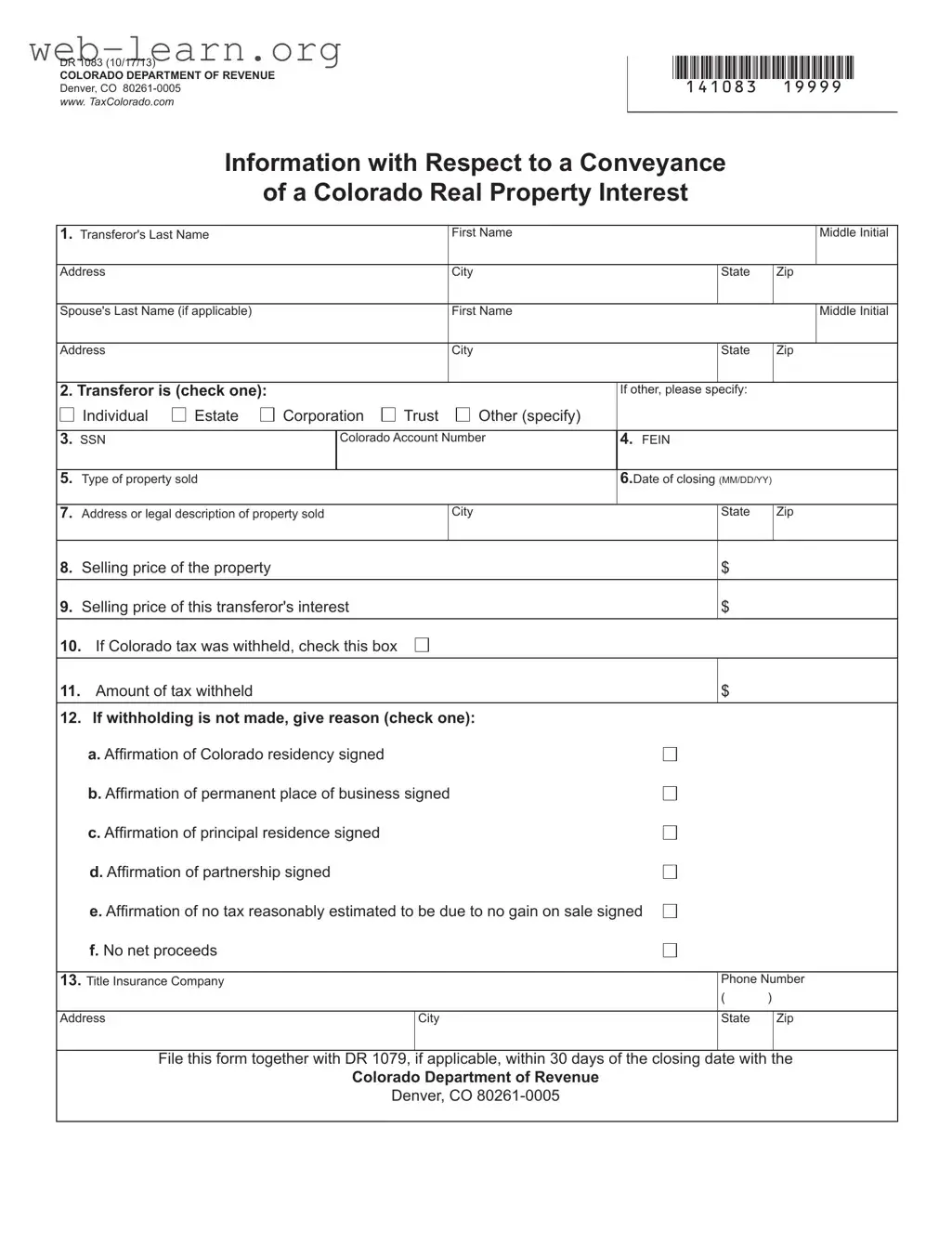
Homepage Blank Dr 1083 Colorado Form
Outline

The DR 1083 form is a crucial document for anyone involved in the sale of real property in Colorado, especially for non-residents. It serves to report the transfer of a real property interest and addresses the withholding tax that may apply to the transaction. This form requires detailed information about the transferor, including names, addresses, and whether the transferor is an individual, corporation, estate, or trust. Key aspects include the selling price of the property and the transferor's interest, as well as any Colorado tax withheld during the sale. The form also features affirmations that the transferor can sign to assert residency or business status in Colorado, which can exempt them from withholding requirements. To ensure compliance, the completed DR 1083 must be filed with the Colorado Department of Revenue within 30 days of the closing date. Understanding the specifics of this form is essential for a smooth transaction and to avoid potential penalties for failure to comply with Colorado tax regulations.

Sample - Dr 1083 Colorado Form

DR 1083 (10/17/13)
COLORADO DEPARTMENT OF REVENUE
Denver, CO 80261-0005
www. TaxColorado.com
Information with Respect to a Conveyance
of a Colorado Real Property Interest
1. Transferor's Last Name
First Name Middle Initial
Address City State Zip
Spouse's Last Name (if applicable) First Name Middle Initial
Address City State Zip
2. Transferor is (check one):
Individual Estate Corporation Trust Other (specify)
If other, please specify:
3. SSN
Colorado Account Number
4. FEIN
5. Type of property sold 6.Date of closing (MM/DD/YY)
7. Address or legal description of property sold
City State Zip
8. Selling price of the property $
9. Selling price of this transferor's interest $
10. If Colorado tax was withheld, check this box
11. Amount of tax withheld $
12. If withholding is not made, give reason (check one):
a.
b.
c.
d.
e.
f. No net proceeds
13. Title Insurance Company
Phone Number
( )
Address City State Zip
File this form together with DR 1079, if applicable, within 30 days of the closing date with the
Colorado Department of Revenue
Denver, CO 80261-0005
*141083==19999*


DR 1083 and that as of the date of closing I am (we are) or the estate or the trust is a resident of the State of Colorado.
Signed under the penalty of perjury
 Date (MM/DD/YY)
Spouse's signature (if applicable) Date (MM/DD/YY)
*141083==29999*


permanent place of business in Colorado.
Signed under the penalty of perjury.
 Date (MM/DD/YY)



of income under section 6031(a) of the Internal Revenue Code.
Signed under the penalty of perjury.
Signature of general partner Date (MM/DD/YY)


transfer it was my (our) principal residence which could qualify for the exclusion of gain provision of section 121 of the
Internal Revenue Code.
Signed under the penalty of perjury.
Signature of transferor Date (MM/DD/YY)
Spouse's signature if applicable Date (MM/DD/YY)




the transfer.


Signed under the penalty of perjury.
 Date (MM/DD/YY)
Spouse's signature if applicable Date (MM/DD/YY)
In general. With certain exceptions, sales of Colorado real
property valued of $100,000 of more, and are made by
nonresidents of Colorado, are subject to a withholding tax
in anticipation of the Colorado income tax that will be due
on the gain from the sale.
A transferor who is an individual, estate, or trust will be
subject to the withholding tax if either the federal Form


disbursement of the funds resulting from the transaction
shows a non-Colorado address for the transferor.
A corporate transferor will be subject to the withholding
tax if immediately after the transfer of the title to the
Colorado real property interest, it has no permanent place
of business in Colorado. A corporation will be deemed to
have a permanent place of business in Colorado if it is a

transact business in Colorado, or if it maintains and staffs

Amount of withholding. The withholding shall be made

or any attorney, bank, savings and loan association,
savings bank, corporation, partnership, association, joint

combination thereof acting separately or in concert that
provides closing and settlement services. The amount
to be withheld shall be the lesser of: (a) two percent of
the selling price of the property interest or, (b) the net
proceeds that would otherwise be due to the transferor as
shown on the settlement statement.
"Closing and settlement services" means providing

connection with the sale, leasing, encumbering,
mortgaging, creating a secured interest in and to the real
property, and the receipt and disbursement of money in
connection with any sale, lease, encumbrance, mortgage,
or deed of trust. [§10-11-102 (3.5), C.R.S.]
 Withholding shall not be
made when:
the selling price of the property is not more than
$100,000;
or
the transferor is an individual, estate, or trust and

disbursement of funds show a Colorado address for
the transferor;
or


and the Colorado real property is acquired in judicial
nonjudicial foreclosure or by deed in lieu of
foreclosure;
or
the transferor is a corporation incorporated under
Colorado law or currently registered with the

business in Colorado;
or
the title insurance company or the person providing
the closing and settlement services, in good faith,

transferor, certifying under the penalty of perjury
one of the following:
that the transferor, if a corporation, has a
permanent place of business in Colorado;

in section 761(a) of the Internal Revenue

of income under section 6031(a) of the Internal
Revenue Code;
that the Colorado real property being conveyed
is the principal residence of the transferor
which could qualify for the exclusion of gain
provisions of section 121 of the Internal
Revenue Code;
that the transferor will not owe Colorado
income tax reasonably estimated to be due
from the inclusion of the actual gain required

income of the transferor.
Normally Colorado tax will be due on any transaction upon

        
purposes any time the selling price of the property exceeds
the total of the taxpayer's adjusted basis in the property,
plus the expenses incurred in the sale of the property. The
taxpayer's adjusted basis of the property will normally be
the taxpayer's total investment in the property, minus any
depreciation thereon he has previously claimed for federal
income tax purposes.
Partnership as Transferor. Sales of real property interests
      
        
partnership returns of income will not be subject to the
Colorado withholding tax. This exception will not apply to
        
partnerships for federal income tax purposes. The sale of
property jointly owned by a husband and wife, for example,
is a sale by two individuals, not a sale by a partnership, and
not exempt from withholding tax.
Instructions for DR 1083
Completion of DR 1083. DR 1083 must be completed and
submitted to the Department of Revenue with respect to
sales of Colorado real property if Colorado tax was withheld
from the net proceeds from the sale, or if Colorado tax would

the transferor.
Information. Forms and additional information are available
through the Tax Information Index at www.TaxColorado.com
or call (303) 238-SERV (7378) for information.
Line 1. Enter the name and address of the transferor.
In the case of multiple transferors of the same

for each transferor except that if the transferors
are husband and wife at the time of closing who
held the property as joint tenants, tenants by the
entirety, tenants in common, or as community
property, and they are both subject to withholding
or both exempt from withholding, treat them as
a single transferor and list both of their names
on line 1. Do not list husband and wife as one
transferor if they do not choose to be listed as
one transferor. Use the same address as is used
on the federal FORM 1099-S if one is required to

available.
Line 3. If both husband and wife are listed on line 1, show
both Social Security Numbers on line 3.
Line 5. Type of property sold would be residential, rental,
commercial, unimproved land, farm, etc.
Line 6. Address or legal description would be the same
as shown on federal FORM 1099-S.
Line 7. Date of closing would be the same as shown on
Form 1099-S.
Line 8. Selling price of the property is the contract sales
price. Selling price means the sum of:
 
interest;
      
transferred or to be transferred; and
 
by the transferee to which the Colorado real
property interest is subject immediately before
and after the transfer.
Line 9. Selling price of the transferor's interest is that part
of the selling price entered on line 8 apportioned to
the ownership interest of the transferor for whom
the DR 1083 is being prepared. For example, if
the property was owned 60% by Smith and 40%
by Jones and the property was sold for $150,000,
the DR 1083 being prepared for Jones would show
$150,000 on line 8 and $60,000 on line 9. Note that
it is the amount on line 8 that determines whether
or not the $100,000 withholding tax threshold is
met, not the amount entered on line 9, but the
withholding is to be computed on the amount on
line 9 if it is smaller than the amount on line 8.
Line 10 If Colorado tax is withheld on the transaction,
check the box on line 10 and show the amount
withheld on line 11.
Line 11 If Colorado tax is being withheld on the transfer,
the title insurance company or the person providing
the closing and settlement services must complete
DR 1079 which is the form used to transmit the tax
withheld to the Colorado Department of Revenue.
Line 12. If Colorado tax is not withheld on the transaction,
check appropriate box on line 12.
Due date and penalty. The title insurance company or other
person providing the closing and settlement services must
      
withheld on the transfer, with the Colorado Department of
Revenue within 30 days of the closing date of the transaction.

required to withhold any amount pursuant to §39-22-604.5,
C.R.S. (relating to withholding on transfers of Colorado real
property interests) and fails to do so shall be liable for the


dollars.

Form Information

Fact Name Description
Form Purpose The DR 1083 form is used to report the conveyance of a real property interest in Colorado.
Governing Law This form is governed by Colorado Revised Statutes, specifically §39-22-604.5.
Transferor Information Transferors must provide their full names, addresses, and, if applicable, the names of their spouses.
Type of Transferor The form allows for various types of transferors, including individuals, estates, corporations, and trusts.
Tax Withholding Requirement Sales of Colorado real property valued at $100,000 or more by nonresidents are generally subject to tax withholding.
Exemptions from Withholding There are several exemptions, including when the selling price is below $100,000 or when the transferor has a Colorado address.
Filing Deadline The form must be filed within 30 days of the closing date of the transaction.
Signature Requirement Transferors must sign the form under penalty of perjury, affirming the accuracy of the provided information.
Tax Amount Calculation The amount withheld is the lesser of 2% of the selling price or the net proceeds due to the transferor.
Contact Information For further assistance, individuals can visit the Colorado Department of Revenue website or call their service number.

Detailed Guide for Filling Out Dr 1083 Colorado

Completing the DR 1083 form is an important step when dealing with the sale of real property in Colorado. Once you have gathered the necessary information, follow these steps to ensure that the form is filled out correctly and submitted on time.

  1. Begin by entering the transferor's last name, first name, and middle initial in the designated fields.
  2. Provide the transferor's address, city, state, and zip code.
  3. If applicable, enter the spouse's last name, first name, and middle initial along with their address, city, state, and zip code.
  4. Indicate the type of transferor by checking the appropriate box (individual, estate, corporation, trust, or other). If you select "other," specify the type.
  5. Fill in the Social Security Number (SSN) or Colorado Account Number.
  6. Enter the Federal Employer Identification Number (FEIN).
  7. Specify the type of property sold (e.g., residential, commercial, unimproved land).
  8. Provide the date of closing in MM/DD/YY format.
  9. Enter the address or legal description of the property sold, ensuring it matches any federal forms.
  10. Fill in the selling price of the property as stated in the sales contract.
  11. Indicate the selling price of the transferor's interest based on their ownership percentage.
  12. If Colorado tax was withheld, check the box and enter the amount of tax withheld.
  13. If withholding was not made, check the appropriate reason on the form.
  14. Provide the title insurance company's name and phone number, along with their address, city, state, and zip code.
  15. Sign and date the form under the penalty of perjury. If applicable, have the spouse sign and date as well.

Once you have completed the form, ensure that it is submitted to the Colorado Department of Revenue within 30 days of the closing date, along with any other required forms. This step is crucial to avoid penalties and ensure compliance with state tax regulations.

Obtain Answers on Dr 1083 Colorado

  1. What is the purpose of the DR 1083 form?

    The DR 1083 form is used to report the conveyance of a real property interest in Colorado. It is primarily intended for transactions involving properties valued at $100,000 or more, particularly when the transferor is a nonresident of Colorado. The form helps ensure that any applicable Colorado income tax withholding is properly reported and remitted to the Colorado Department of Revenue.

  2. Who needs to complete the DR 1083 form?

    Any transferor who is selling real property in Colorado must complete the DR 1083 form if Colorado tax is withheld from the sale proceeds. This includes individuals, estates, corporations, and trusts. If multiple transferors are involved, each must submit a separate DR 1083, unless they are spouses holding the property jointly and both are subject to the same withholding rules.

  3. What information is required on the DR 1083 form?

    The form requires various details, including:

    • The names and addresses of the transferor and spouse (if applicable).
    • The type of property sold (residential, commercial, etc.).
    • The selling price of the property and the transferor's interest in it.
    • Any tax withheld and the reason for withholding or lack thereof.

    Completing these sections accurately is crucial to ensure compliance with Colorado tax regulations.

  4. What happens if the DR 1083 form is not filed on time?

    If the DR 1083 form is not filed within 30 days of the closing date, the title insurance company or the individual responsible for closing may face penalties. The penalty can be either $500 or 10% of the amount that was required to be withheld, up to a maximum of $2,500. Timely submission of the form is essential to avoid these penalties and ensure compliance with state tax laws.

Common mistakes

Filling out the DR 1083 form in Colorado can be a straightforward process, but many individuals make common mistakes that can lead to complications. One frequent error is failing to provide accurate names and addresses. The form requires the transferor's full name and address, and if multiple transferors are involved, each must be listed separately unless they are spouses holding the property jointly. Omitting or miswriting this information can delay processing.

Another common mistake occurs with the selection of the transferor type. The form has specific checkboxes for individuals, estates, corporations, and trusts. Failing to check the appropriate box or incorrectly specifying "other" without clarity can lead to confusion regarding the transferor's legal status, potentially complicating the transaction.

Many people also overlook the importance of providing the correct Social Security Number (SSN) or Colorado Account Number. This information is crucial for identification purposes. If the transferor is a corporation, the Federal Employer Identification Number (FEIN) must be provided. Missing or incorrect numbers can result in delays or penalties.

Another significant error involves the property type description. The form asks for the type of property sold—residential, commercial, etc. Providing vague or inaccurate descriptions can lead to misunderstandings about the tax implications of the sale.

Additionally, mistakes often occur in the selling price section. The selling price of the property must reflect the contract sales price accurately. Some individuals mistakenly include interest or other unrelated fees, which can skew the figures and lead to incorrect tax calculations.

Completing the affirmation section also presents challenges. Transferors must select the correct affirmation type based on their residency or business status. Misunderstanding which affirmation applies can lead to incorrect withholding tax assessments.

People frequently neglect to check the box indicating whether Colorado tax was withheld. This oversight can result in complications, especially if the tax is indeed withheld but not reported correctly on the form.

Another mistake involves the submission deadline. The DR 1083 must be filed within 30 days of the closing date. Failing to meet this deadline can lead to penalties, which can be significant. Individuals often underestimate the importance of timely filing.

Lastly, individuals sometimes forget to include the necessary supporting documentation, such as the DR 1079, if applicable. This omission can result in the form being returned or delayed, causing further issues with the transaction.

By being aware of these common pitfalls and taking care to avoid them, individuals can ensure a smoother process when completing the DR 1083 form for Colorado real property transactions.

Documents used along the form

The DR 1083 form is essential for reporting the conveyance of real property interests in Colorado. When completing this form, you may also need to use several other documents to ensure compliance with state regulations. Below is a list of commonly used forms that accompany the DR 1083.

  • DR 1079 - This form is used to report the tax withheld from the sale of the property. It must be filed with the DR 1083 if Colorado tax is withheld during the transaction.
  • Form 1099-S - This federal form reports the sale of real estate. It is crucial for documenting the transaction and must be filed with the IRS.
  • Afirmation of Colorado Residency - This document affirms that the transferor is a resident of Colorado as of the closing date. It helps establish eligibility for certain tax exemptions.
  • Afirmation of Permanent Place of Business - Used by corporations, this form certifies that the transferor maintains a permanent business location in Colorado, which can affect tax withholding requirements.
  • Afirmation of Sale by Partnership - This affirmation is for partnerships selling property, confirming the sale complies with federal tax regulations.
  • Afirmation of Principal Residence - This document certifies that the property being sold was the transferor's principal residence, potentially qualifying for tax exclusions.
  • Afirmation of No Reasonably Estimated Tax to be Due - This form states that the transferor expects no Colorado income tax will be owed from the sale, which can influence withholding decisions.
  • Closing Statement - This document outlines the financial aspects of the transaction, including the selling price and any deductions, and is important for accurate reporting.

Using these forms alongside the DR 1083 helps ensure a smooth transaction and compliance with Colorado tax laws. Make sure to complete each document accurately and submit them within the required timeframes to avoid any penalties.

Similar forms

The DR 1083 form from Colorado serves a specific purpose in the context of real property transactions. Several other documents share similarities with this form, primarily in their function related to property transfers and tax implications. Below is a list of seven documents that are similar to the DR 1083 form, along with explanations of their similarities.

  • Form 1099-S: This IRS form is used to report the sale or exchange of real estate. Like the DR 1083, it requires details about the transferor, the property sold, and the selling price. Both forms aim to ensure proper reporting of real estate transactions for tax purposes.
  • DR 1079: This form is used to report the amount of tax withheld on the sale of Colorado real property. It is often filed alongside the DR 1083 when tax is withheld, reflecting a similar goal of compliance with tax obligations related to property transfers.
  • Form 1040, Schedule D: This form is used for reporting capital gains and losses. Both the Schedule D and the DR 1083 involve reporting gains from the sale of property, ensuring that any tax liabilities are accurately calculated and reported.
  • Form 8824: This form is used for like-kind exchanges of real property. It shares similarities with the DR 1083 in that both forms deal with property transactions and their tax implications, although the specifics of the transactions differ.
  • Colorado Real Estate Transfer Declaration (RETD): This document is required for all real estate transactions in Colorado. Similar to the DR 1083, it collects information about the property, the parties involved, and the sale price, serving as a record for tax assessment purposes.
  • Form 990-T: This form is used by tax-exempt organizations to report unrelated business income. It is similar to the DR 1083 in that both forms involve the reporting of income generated from property transactions, although they apply to different types of entities.
  • Form 706: This form is used for estate tax purposes and is relevant when real property is part of an estate. Both the Form 706 and the DR 1083 require detailed information about property ownership and value, particularly when tax liabilities are involved.

Dos and Don'ts

When filling out the DR 1083 form for Colorado, it’s essential to follow specific guidelines to ensure accuracy and compliance. Here’s a list of things you should and shouldn’t do:

  • Do provide complete and accurate information for all required fields.
  • Do double-check the selling price and the transferor's interest to ensure they are correctly calculated.
  • Do file the form within 30 days of the closing date to avoid penalties.
  • Do ensure that the signatures on the form are from the correct individuals, including spouses if applicable.
  • Don’t leave any fields blank; if a question does not apply, indicate that clearly.
  • Don’t use outdated information; always refer to the most current address and details for the transferor.
  • Don’t forget to check the appropriate boxes regarding tax withholding and provide the necessary details if applicable.

Misconceptions

Here are five common misconceptions about the DR 1083 Colorado form:

  • Misconception 1: The DR 1083 form is only for Colorado residents.
  • This is not true. While the form is often used by Colorado residents, it is also required for nonresidents who sell real property in Colorado. Nonresidents may still be subject to Colorado income tax on gains from the sale.

  • Misconception 2: You only need to file the DR 1083 if tax is withheld.
  • Many believe that the form is only necessary when tax is withheld. However, it must be filed whenever Colorado tax would have been withheld, even if an affirmation is signed that exempts the transferor from withholding.

  • Misconception 3: The DR 1083 can be submitted at any time after closing.
  • Some people think there's no rush to file. In reality, the DR 1083 must be submitted within 30 days of the closing date. Missing this deadline can lead to penalties.

  • Misconception 4: Only individuals need to worry about the DR 1083.
  • This is a common misunderstanding. Corporations, estates, and trusts also need to complete this form if they are involved in the sale of Colorado real estate.

  • Misconception 5: The DR 1083 is the only form needed for real estate transactions.
  • Many assume that the DR 1083 is standalone. However, it often needs to be filed alongside the DR 1079 form, especially when tax is withheld. Both forms work together to ensure compliance.

Key takeaways

Filling out the DR 1083 form is an important step when transferring real property in Colorado. Here are some key takeaways to help you navigate the process:

  • Who Needs to File: The transferor, which can be an individual, estate, corporation, or trust, must complete the form.
  • Information Required: You will need to provide personal details such as names, addresses, and Social Security numbers.
  • Property Details: Clearly describe the property being sold, including its legal address and type.
  • Closing Date: Indicate the date of closing, formatted as MM/DD/YY.
  • Tax Withholding: If Colorado tax is withheld, check the appropriate box and specify the amount on the form.
  • Affirmations: Depending on your situation, you may need to sign affirmations regarding residency or business status.
  • Submission Deadline: Submit the DR 1083 within 30 days of the closing date to avoid penalties.
  • Withholding Exceptions: Understand the exceptions to withholding, such as sales under $100,000 or certain types of transferors.
  • Multiple Transferors: If there are multiple transferors, each must file a separate DR 1083 unless they are married and choose to file jointly.
  • Seek Assistance: If you have questions, resources are available through the Colorado Department of Revenue's website or by phone.

By following these guidelines, you can ensure that you fill out the DR 1083 form accurately and comply with Colorado regulations.