The Do Not Resuscitate (DNR) Order form plays a crucial role in healthcare decisions, particularly for individuals facing serious illnesses or end-of-life situations. This document empowers patients to communicate their wishes regarding resuscitation efforts in the event of cardiac arrest or respiratory failure. It outlines specific instructions that guide medical professionals on whether or not to perform life-saving measures, such as CPR or advanced cardiac life support. Understanding the nuances of the DNR form is essential for patients, families, and healthcare providers alike. It ensures that the patient's preferences are respected, providing clarity during emotionally charged moments. Additionally, the DNR form often requires a physician's signature, affirming that the decision aligns with the patient's medical condition and prognosis. By engaging in conversations about the DNR, individuals can take charge of their healthcare journey, ensuring their values and desires are honored when it matters most.
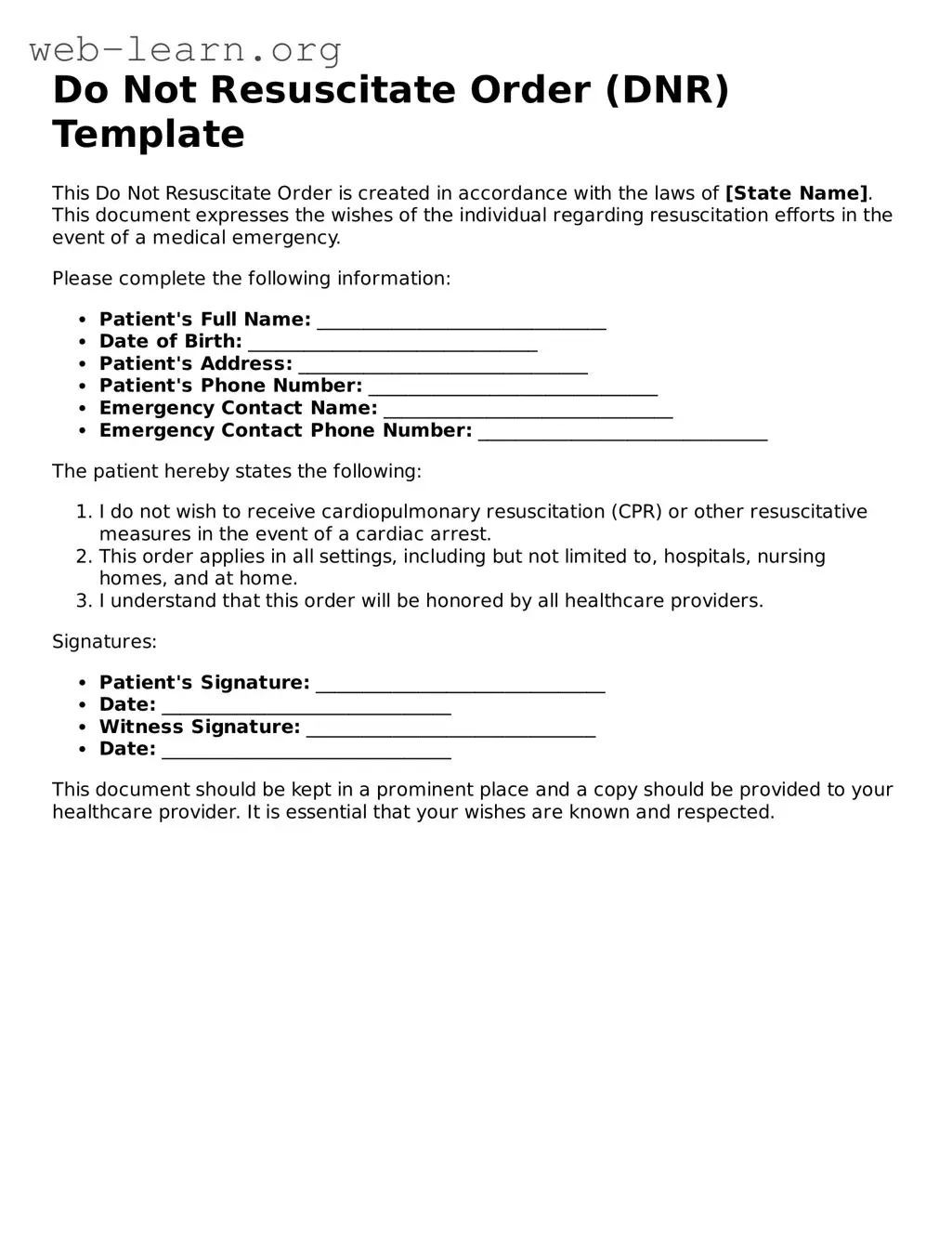
Do Not Resuscitate Order (DNR) Template
This Do Not Resuscitate Order is created in accordance with the laws of [State Name]. This document expresses the wishes of the individual regarding resuscitation efforts in the event of a medical emergency.
Please complete the following information:
The patient hereby states the following:
Signatures:
This document should be kept in a prominent place and a copy should be provided to your healthcare provider. It is essential that your wishes are known and respected.
| Fact Name | Description |
|---|---|
| Definition | A Do Not Resuscitate (DNR) Order is a legal document that instructs medical personnel not to perform cardiopulmonary resuscitation (CPR) if a person's heart stops beating or they stop breathing. |
| Purpose | The primary purpose of a DNR Order is to respect a patient's wishes regarding end-of-life care and to avoid unnecessary suffering. |
| State-Specific Forms | Each state has its own DNR Order form, which must be completed and signed by a physician to be valid. |
| Governing Laws | In California, for instance, the DNR Order is governed by the California Health and Safety Code Section 7180. |
| Patient Autonomy | A DNR Order empowers patients to make decisions about their medical treatment based on their personal values and preferences. |
| Revocation | Patients can revoke a DNR Order at any time, verbally or in writing, and medical personnel must honor this change. |
| Emergency Services | Emergency medical services (EMS) personnel must be informed of a DNR Order and are required to follow it unless they have reason to believe it is not valid. |
| Documentation | It is important to keep the DNR Order accessible, such as on the refrigerator or with medical records, to ensure it can be easily located in an emergency. |
Filling out a Do Not Resuscitate (DNR) Order form is an important step in expressing your medical preferences. After completing the form, it’s essential to ensure that it is properly documented and accessible to your healthcare providers. This will help ensure your wishes are respected in a medical emergency.
A Do Not Resuscitate Order is a legal document that allows an individual to refuse specific medical interventions, particularly cardiopulmonary resuscitation (CPR), in the event of a medical emergency. This order is typically used by individuals with serious health conditions or those who wish to avoid aggressive medical treatment at the end of life.
Generally, a DNR Order can be requested by a patient who is of sound mind and understands the implications of the decision. If the patient is unable to communicate their wishes, a legally authorized representative, such as a family member or healthcare proxy, may be able to request the order on their behalf. It is important that the individual’s healthcare provider is involved in this process to ensure that the order is properly documented and understood.
Once a DNR Order is signed by the patient and their physician, it must be placed in the patient’s medical records. Healthcare providers are required to follow the instructions outlined in the DNR Order. It is advisable for patients to carry a copy of the order with them at all times, especially when visiting hospitals or other healthcare facilities, to ensure that their wishes are respected.
Yes, a DNR Order can be revoked at any time by the patient or their legal representative. To revoke the order, the individual should inform their healthcare provider and destroy any copies of the DNR document. It is essential to communicate any changes in wishes clearly to ensure that all healthcare personnel are aware of the updated instructions.
Filling out a Do Not Resuscitate (DNR) Order form is a significant decision that requires careful consideration. However, many individuals make common mistakes that can lead to confusion or unintended consequences. Understanding these pitfalls can help ensure that the form accurately reflects one’s wishes regarding medical treatment.
One frequent mistake occurs when individuals fail to discuss their decision with family members or healthcare providers. A DNR order is not just a personal choice; it affects the people around you. Open conversations can clarify intentions and ensure that everyone understands the reasons behind the decision. Without this dialogue, loved ones may be left in a difficult position during a medical emergency.
Another common error is neglecting to sign and date the form. A DNR order is only valid if it is properly executed. Without a signature, medical professionals may not recognize the document as legitimate, leading to unwanted resuscitation efforts. Always ensure that the form is signed, dated, and witnessed if required by state law.
People often overlook the importance of keeping the DNR order accessible. After filling out the form, it should be placed in a location where medical personnel can easily find it, such as on the refrigerator or in a medical file. If the order is not readily available during an emergency, the wishes expressed in the document may not be honored.
Additionally, individuals sometimes fail to update their DNR orders as their health status or personal wishes change. Life circumstances can evolve, and what may have been a suitable decision at one point might no longer reflect a person’s desires. Regularly reviewing and, if necessary, revising the DNR order ensures that it continues to align with current wishes.
Lastly, misunderstanding the implications of a DNR order can lead to mistakes. Some individuals may believe that a DNR order means no medical treatment at all, which is not the case. A DNR order specifically relates to resuscitation efforts. Other forms of medical care, including pain management and comfort measures, can still be provided. Clarifying this distinction is crucial for ensuring that the order is understood and respected.
A Do Not Resuscitate (DNR) Order is a crucial document that communicates a person's wishes regarding resuscitation efforts in the event of a medical emergency. However, it is often accompanied by other important forms and documents that help clarify medical preferences and ensure that healthcare providers understand the individual’s desires. Below is a list of other forms that are commonly used alongside a DNR Order.
Each of these documents plays a vital role in ensuring that a person’s healthcare preferences are honored. By having these forms in place, individuals can communicate their wishes clearly, providing peace of mind for both themselves and their loved ones during difficult times.
The Do Not Resuscitate Order (DNR) form is a critical document in healthcare, guiding medical professionals on a patient's wishes regarding resuscitation efforts. Here are five documents that are similar to the DNR form:
When filling out a Do Not Resuscitate (DNR) Order form, it’s crucial to approach the task with care. Here are some important dos and don'ts to keep in mind:
Taking these steps can help ensure that your wishes are respected. It’s important to act with intention and clarity.
Understanding the Do Not Resuscitate (DNR) Order can be challenging, and many misconceptions surround this important document. Below are some common misunderstandings that people may have about DNR orders, along with clarifications to help provide a clearer perspective.
Understanding these misconceptions can help individuals make informed decisions about their healthcare preferences and ensure that their wishes are respected in critical situations.
Filling out a Do Not Resuscitate (DNR) Order form is an important step for individuals who wish to express their preferences regarding medical interventions in emergencies. Here are some key takeaways to consider: