Homepage Blank Dmv 65 Mcp Form
Outline

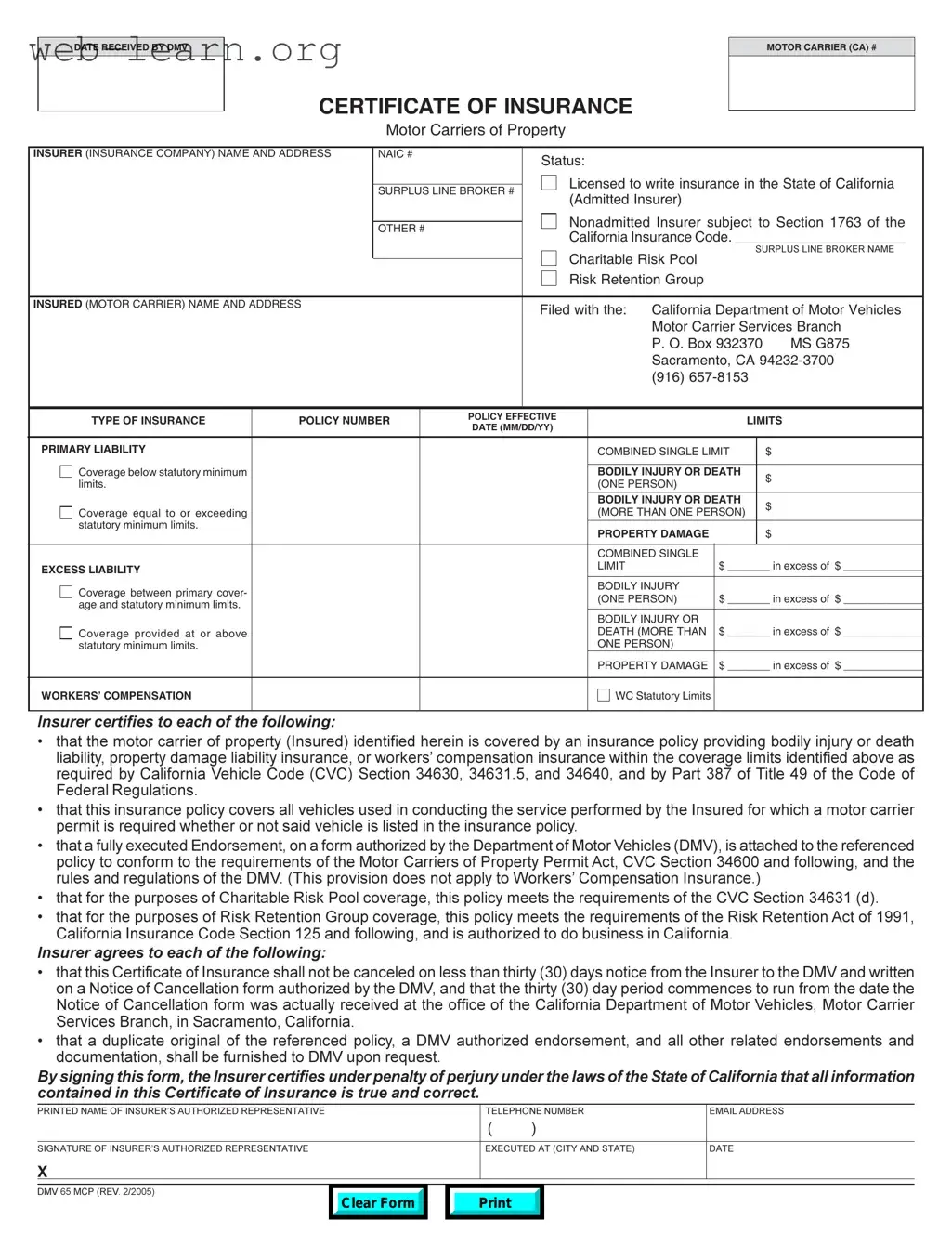
The DMV 65 MCP form plays a critical role in ensuring compliance for motor carriers operating within California. This certificate of insurance serves as a formal declaration from insurers, affirming that the motor carrier is adequately covered by various types of insurance, including bodily injury, property damage, and workers' compensation. It outlines essential details such as the motor carrier's name and address, the insurer's information, and the policy's effective limits. Compliance with California Vehicle Code sections is paramount, as the form confirms that the insurance policy meets statutory minimums and covers all vehicles utilized in the carrier's operations. Moreover, it mandates that a fully executed endorsement be attached to the policy, ensuring adherence to the Motor Carriers of Property Permit Act. The form also highlights the insurer's obligations, including the requirement for a thirty-day notice before any cancellation of the insurance coverage. By signing this document, the insurer certifies the accuracy of the information provided, reinforcing the importance of transparency and accountability in the insurance process for motor carriers.

Sample - Dmv 65 Mcp Form

Insurer certifies to each of the following:
that the motor carrier of property (Insured) identified herein is covered by an insurance policy providing bodily injury or death
liability, property damage liability insurance, or workers compensation insurance within the coverage limits identified above as
required by California Vehicle Code (CVC) Section 34630, 34631.5, and 34640, and by Part 387 of Title 49 of the Code of
Federal Regulations.
that this insurance policy covers all vehicles used in conducting the service performed by the Insured for which a motor carrier
permit is required whether or not said vehicle is listed in the insurance policy.
that a fully executed Endorsement, on a form authorized by the Department of Motor Vehicles (DMV), is attached to the referenced
policy to conform to the requirements of the Motor Carriers of Property Permit Act, CVC Section 34600 and following, and the
rules and regulations of the DMV. (This provision does not apply to Workers Compensation Insurance.)
that for the purposes of Charitable Risk Pool coverage, this policy meets the requirements of the CVC Section 34631 (d).
that for the purposes of Risk Retention Group coverage, this policy meets the requirements of the Risk Retention Act of 1991,
California Insurance Code Section 125 and following, and is authorized to do business in California.
Insurer agrees to each of the following:
that this Certificate of Insurance shall not be canceled on less than thirty (30) days notice from the Insurer to the DMV and written
on a Notice of Cancellation form authorized by the DMV, and that the thirty (30) day period commences to run from the date the
Notice of Cancellation form was actually received at the office of the California Department of Motor Vehicles, Motor Carrier
Services Branch, in Sacramento, California.
that a duplicate original of the referenced policy, a DMV authorized endorsement, and all other related endorsements and
documentation, shall be furnished to DMV upon request.
By signing this form, the Insurer certifies under penalty of perjury under the laws of the State of California that all information
contained in this Certificate of Insurance is true and correct.
COMBINED SINGLE LIMIT $
BODILY INJURY OR DEATH
$
(ONE PERSON)
BODILY INJURY OR DEATH
$
(MORE THAN ONE PERSON)
PROPERTY DAMAGE $
COMBINED SINGLE
LIMIT $ _______ in excess of $ _____________
BODILY INJURY
(ONE PERSON) $ _______ in excess of $ _____________
BODILY INJURY OR
DEATH (MORE THAN $ _______ in excess of $ _____________
ONE PERSON)
PROPERTY DAMAGE $ _______ in excess of $ _____________
WC Statutory Limits
CERTIFICATE OF INSURANCE
Motor Carriers of Property
DMV 65 MCP (REV. 2/2005)
PRIMARY LIABILITY
Coverage below statutory minimum
limits.
Coverage equal to or exceeding
statutory minimum limits.
EXCESS LIABILITY
Coverage between primary cover-
age and statutory minimum limits.
Coverage provided at or above
statutory minimum limits.
WORKERS’ COMPENSATION
TYPE OF INSURANCE POLICY NUMBER
POLICY EFFECTIVE
LIMITS
DATE (MM/DD/YY)
INSURER (INSURANCE COMPANY) NAME AND ADDRESS
INSURED (MOTOR CARRIER) NAME AND ADDRESS
Status:
Licensed to write insurance in the State of California
(Admitted Insurer)
Nonadmitted Insurer subject to Section 1763 of the
California Insurance Code. ______________________
Charitable Risk Pool
Risk Retention Group
Filed with the: California Department of Motor Vehicles
Motor Carrier Services Branch
P. O. Box 932370 MS G875
Sacramento, CA 94232-3700
(916) 657-8153
PRINTED NAME OF INSURERS AUTHORIZED REPRESENTATIVE TELEPHONE NUMBER EMAIL ADDRESS
SIGNATURE OF INSURERS AUTHORIZED REPRESENTATIVE EXECUTED AT (CITY AND STATE) DATE
X
MOTOR CARRIER (CA) #DATE RECEIVED BY DMV
NAIC #
SURPLUS LINE BROKER #
OTHER #
SURPLUS LINE BROKER NAME
( )
Clear Form
Print

Form Information

Fact Name Details
Date Received The DMV 65 MCP form must indicate the date it was received by the Department of Motor Vehicles.
Insurance Coverage This form certifies that the motor carrier has the necessary insurance coverage for bodily injury, property damage, and workers' compensation as required by California law.
Governing Laws The form is governed by California Vehicle Code Sections 34630, 34631.5, and 34640, as well as federal regulations under Title 49.
Cancellation Notice Insurers must provide at least thirty (30) days' notice to the DMV before canceling the insurance policy.
Endorsement Requirement A fully executed endorsement must accompany the insurance policy to meet the requirements set forth by the DMV.
Certification of Truth The insurer certifies under penalty of perjury that all information provided in the DMV 65 MCP form is accurate and truthful.

Detailed Guide for Filling Out Dmv 65 Mcp

Filling out the DMV 65 MCP form is an important step in ensuring that your motor carrier is properly insured. Follow these steps carefully to complete the form accurately.

  1. Start by entering the date when the form is received by the DMV.
  2. Fill in the Motor Carrier (CA) # for your business.
  3. Provide the insurer's name and address as well as the NAIC #.
  4. Indicate the status of the insurer (Licensed, Nonadmitted, etc.).
  5. If applicable, enter the Surplus Line Broker # and the name of the broker.
  6. In the insured section, fill out the name and address of the motor carrier.
  7. Write the type of insurance policy you are using.
  8. Fill in the policy number and the policy effective date in MM/DD/YY format.
  9. Enter the coverage limits for primary liability, including combined single limit and bodily injury or death limits.
  10. If applicable, provide limits for combined single excess liability and any other coverage types.
  11. Complete the workers’ compensation section, indicating if it meets statutory limits.
  12. Ensure that the insurer certifies all required statements regarding the coverage.
  13. Have the authorized representative print their name, provide their telephone number, and email address.
  14. Finally, the authorized representative must sign the form, indicating the city and state where the form is executed and the date.

Obtain Answers on Dmv 65 Mcp

  1. What is the DMV 65 MCP form?

    The DMV 65 MCP form is a Certificate of Insurance specifically designed for Motor Carriers of Property in California. It certifies that a motor carrier has the required insurance coverage as mandated by California law. This form must be filed with the California Department of Motor Vehicles (DMV) to ensure compliance with vehicle code regulations.

  2. Who needs to file the DMV 65 MCP form?

    Any motor carrier operating in California that requires a motor carrier permit must file the DMV 65 MCP form. This includes businesses that transport goods for hire, ensuring they meet the insurance requirements set forth by the California Vehicle Code.

  3. What information is required on the DMV 65 MCP form?

    The form requires several key pieces of information, including:

    • Motor Carrier name and address
    • Insurance company name and address
    • Policy number and effective dates
    • Coverage limits for bodily injury, property damage, and workers’ compensation

    Accurate and complete information is crucial for the DMV to process the form efficiently.

  4. How does the insurance coverage work?

    The insurance policy must provide coverage for bodily injury, property damage, and workers’ compensation as required by California law. The policy must cover all vehicles used by the motor carrier, regardless of whether they are specifically listed in the policy. This ensures comprehensive protection while operating under the motor carrier permit.

  5. What happens if the insurance policy is canceled?

    If the insurance policy is canceled, the insurer must provide at least thirty (30) days' notice to the DMV. This notice must be submitted using an authorized Notice of Cancellation form. The DMV will not accept cancellations without this formal notification.

  6. Is there a penalty for providing false information on the DMV 65 MCP form?

    Yes, providing false information on this form can lead to serious consequences. The insurer certifies the accuracy of the information under penalty of perjury. This means that if the information is found to be incorrect, it could result in legal penalties and loss of the motor carrier permit.

  7. Where should the DMV 65 MCP form be submitted?

    The completed DMV 65 MCP form should be submitted to the California Department of Motor Vehicles, Motor Carrier Services Branch, at the following address:

    P.O. Box 932370 MS G875
    Sacramento, CA 94232-3700

    It's advisable to keep a copy of the submitted form for your records.

  8. How can I contact the DMV for more information?

    If you have further questions or need assistance regarding the DMV 65 MCP form, you can contact the DMV Motor Carrier Services Branch at (916) 657-8153. They can provide guidance and clarify any uncertainties you may have about the filing process or insurance requirements.

Common mistakes

Filling out the DMV 65 MCP form can be straightforward, but mistakes often occur. One common error is failing to provide the correct motor carrier number. This number is essential for identifying the motor carrier and ensuring that the insurance is properly linked to the right entity.

Another mistake is not including the insurance policy number. This number verifies that the policy is valid and active. Without it, the DMV cannot confirm coverage, which may lead to delays or denials of the permit.

People sometimes neglect to check the policy effective date. This date indicates when the insurance coverage begins. If this date is incorrect or missing, it can raise questions about the validity of the insurance.

Additionally, some individuals fail to provide the limits of coverage accurately. Each type of insurance coverage, such as bodily injury or property damage, has specific limits that must be filled out. Incomplete or incorrect entries can cause complications with the application process.

Another frequent oversight is not including the insurer's name and address. This information is necessary for the DMV to contact the insurance provider if needed. Omitting this detail can lead to processing issues.

Some applicants forget to attach the required endorsement form. This form is crucial for confirming that the insurance meets DMV requirements. Without it, the application may be rejected.

People also sometimes misinterpret the type of insurance required. It's important to ensure that the insurance policy covers all necessary aspects of operation, including liability and workers' compensation, as outlined by the law.

Another mistake is not providing the contact information for the insurer's authorized representative. This detail is important for communication purposes. Missing this information can lead to delays in processing.

Lastly, some applicants forget to sign the form. A signature is a critical component, as it certifies that the information provided is accurate and true. Without a signature, the form is not valid.

Documents used along the form

The DMV 65 MCP form is crucial for motor carriers in California, ensuring compliance with insurance requirements. However, several other documents are often needed alongside this form to provide a comprehensive understanding of insurance coverage and compliance. Below are four commonly used documents.

  • Certificate of Insurance: This document serves as proof that the motor carrier has the necessary insurance coverage. It details the types of coverage, limits, and the insurer's information, ensuring compliance with state regulations.
  • Endorsement Form: An endorsement form is attached to the insurance policy to modify its terms. It may specify coverage for additional vehicles or services, ensuring that all operational aspects are covered under the policy.
  • Notice of Cancellation Form: If an insurer decides to cancel the insurance policy, this form must be submitted to the DMV. It ensures that the DMV is notified in advance, adhering to the required notice period.
  • Workers' Compensation Insurance Policy: This policy provides coverage for employees in case of work-related injuries. It is essential for motor carriers to maintain this insurance to comply with California law and protect their workforce.

Having these documents ready can streamline the process of obtaining and maintaining the necessary permits and insurance for motor carriers. Ensure all information is accurate and up-to-date to avoid complications with compliance and coverage.

Similar forms

The DMV 65 MCP form is a critical document for motor carriers in California, particularly concerning insurance coverage. Several other documents share similarities with the DMV 65 MCP form in terms of purpose and required information. Here are four such documents:

  • Certificate of Liability Insurance: This document provides proof of liability coverage for businesses. Like the DMV 65 MCP, it details the insurer, coverage limits, and the insured entity, ensuring compliance with state regulations.
  • Commercial Auto Insurance Policy: This policy outlines coverage for vehicles used for business purposes. Similar to the DMV 65 MCP, it specifies coverage types, limits, and the vehicles included, ensuring legal compliance for commercial operations.
  • Workers' Compensation Insurance Certificate: This certificate verifies that a business has workers' compensation coverage. It aligns with the DMV 65 MCP by confirming coverage for employees, which is essential for motor carriers operating in California.
  • Endorsement Forms: These forms modify existing insurance policies to meet specific requirements. They are similar to the DMV 65 MCP in that they must be filed with the DMV to confirm compliance with the Motor Carriers of Property Permit Act.

Dos and Don'ts

When filling out the DMV 65 MCP form, there are important guidelines to follow. Here’s a list of things you should and shouldn't do:

  • Do ensure all information is accurate and complete.
  • Do provide a valid Certificate of Insurance from an authorized insurer.
  • Do attach any required endorsements as specified by the DMV.
  • Do sign the form where indicated to certify the information.
  • Don't leave any sections blank; incomplete forms may be rejected.
  • Don't forget to check the policy limits to ensure they meet statutory requirements.

Misconceptions

Here are ten common misconceptions about the DMV 65 MCP form, which is important for motor carriers in California:

  1. It's only for large companies. Many believe that only big businesses need this form. In reality, any motor carrier operating in California must complete it, regardless of size.
  2. It covers all types of insurance. Some think the DMV 65 MCP form covers every kind of insurance. However, it specifically pertains to bodily injury, property damage, and workers' compensation insurance.
  3. Once submitted, it never needs updates. Many assume that the form is a one-time requirement. In fact, it must be updated whenever there are changes to the insurance policy or the motor carrier's details.
  4. It’s only necessary for new permits. Some believe it’s only needed when applying for a new motor carrier permit. However, it is also required for renewals and changes in coverage.
  5. Any insurance policy will suffice. There's a misconception that any insurance policy meets the requirements. The policy must specifically comply with California Vehicle Code regulations.
  6. It can be canceled without notice. Some think insurers can cancel the coverage at any time. In reality, insurers must provide a 30-day notice to the DMV before cancellation.
  7. Filing it is optional. Many people believe that submitting the DMV 65 MCP form is optional. This is incorrect; it is a mandatory requirement for motor carriers.
  8. It's only for commercial vehicles. Some think this form only applies to commercial trucks. However, it applies to all motor carriers, including those using passenger vehicles for business purposes.
  9. The DMV handles everything once it's submitted. There’s a belief that once the form is submitted, the DMV will manage all insurance-related issues. However, it’s the responsibility of the motor carrier to ensure ongoing compliance.
  10. It's a complicated process. Many feel overwhelmed by the form. In truth, while it requires attention to detail, the process is straightforward if you follow the guidelines provided.

Understanding these misconceptions can help motor carriers navigate their insurance requirements more effectively.

Key takeaways

Filling out the DMV 65 MCP form is an important step for motor carriers in California. Here are some key takeaways to ensure a smooth process:

  • The form serves as a Certificate of Insurance for motor carriers of property.
  • Make sure to include the Motor Carrier (CA) number and the insurer's details accurately.
  • Insurance coverage must meet the requirements set forth in the California Vehicle Code.
  • All vehicles used for the service must be covered, even if they are not listed in the insurance policy.
  • Attach a fully executed endorsement to the policy to comply with the Motor Carriers of Property Permit Act.
  • Cancellation of the insurance policy requires a 30-day notice to the DMV.
  • Provide a duplicate original of the insurance policy and any related documentation upon request from the DMV.
  • Ensure that the insurer's authorized representative signs the form, certifying the accuracy of the information.
  • Keep copies of the completed form and all related documents for your records.