Homepage Blank Dj Le 330 Form
Outline

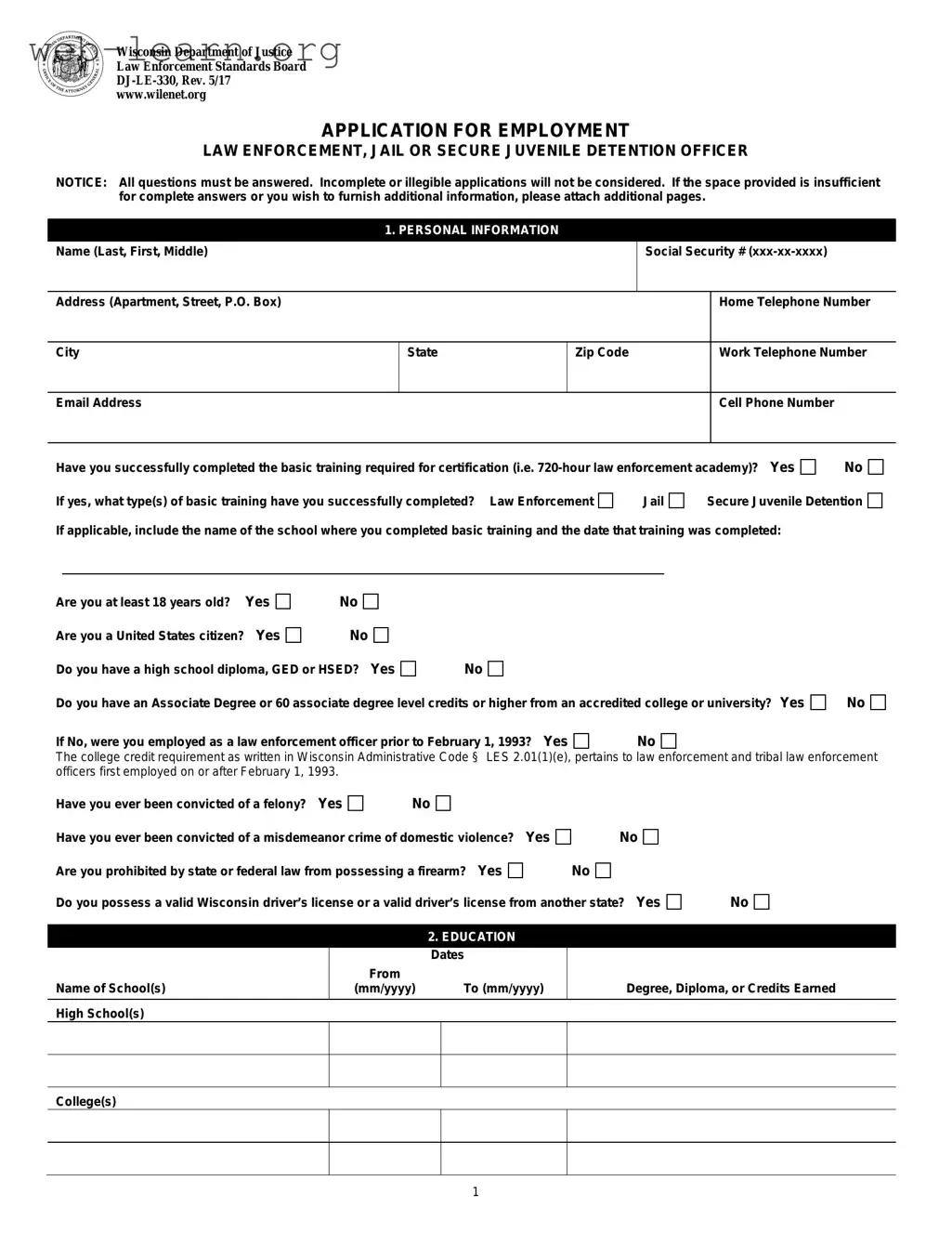
The DJ-LE-330 form is an essential document for individuals seeking employment as law enforcement officers, jail personnel, or secure juvenile detention officers in Wisconsin. This application requires candidates to provide comprehensive personal information, including their educational background, work history, and military service, if applicable. Applicants must confirm their eligibility by answering questions related to their age, citizenship, and criminal history. The form also emphasizes the importance of completing all sections accurately, as any omissions or inaccuracies could lead to disqualification. Furthermore, candidates are asked to provide references and discuss their motivations for applying, as well as their ability to work with diverse populations. Understanding the requirements and structure of the DJ-LE-330 form is crucial for prospective applicants to ensure a smooth application process and enhance their chances of securing a position in law enforcement.

Sample - Dj Le 330 Form

1
Wisconsin Department of Justice
Law Enforcement Standards Board
DJ-LE-330, Rev. 5/17
www.wilenet.org
APPLICATION FOR EMPLOYMENT
LAW ENFORCEMENT, JAIL OR SECURE JUVENILE DETENTION OFFICER
NOTICE: All questions must be answered. Incomplete or illegible applications will not be considered. If the space provided is insufficient
for complete answers or you wish to furnish additional information, please attach additional pages.
1. PERSONAL INFORMATION
Name (Last, First, Middle)
Social Security # (xxx-xx-xxxx)
Address (Apartment, Street, P.O. Box)
Home Telephone Number
City
State
Zip Code
Work Telephone Number
Email Address
Cell Phone Number
Have you successfully completed the basic training required for certification (i.e. 720-hour law enforcement academy)?
Yes No
If yes, what type(s) of basic training have you successfully completed? Law Enforcement Jail Secure Juvenile Detention
If applicable, include the name of the school where you completed basic training and the date that training was completed:
Are you at least 18 years old?
Yes
No
Are you a United States citizen?
Yes
No
Do you have a high school diploma, GED or HSED?
Yes
No
Do you have an Associate Degree or 60 associate degree level credits or higher from an accredited college or university?
Yes No
If No, were you employed as a law enforcement officer prior to February 1, 1993?
Yes
No
The college credit requirement as written in Wisconsin Administrative Code § LES 2.01(1)(e), pertains to law enforcement and tribal law enforcement
officers first employed on or after February 1, 1993.
Have you ever been convicted of a felony?
Yes
No
Have you ever been convicted of a misdemeanor crime of domestic violence?
Yes
No
Are you prohibited by state or federal law from possessing a firearm?
Yes
No
Do you possess a valid Wisconsin driver’s license or a valid driver’s license from another state?
Yes
No
2. EDUCATION
Dates
Name of School(s)
From
(mm/yyyy)
To (mm/yyyy) Degree, Diploma, or Credits Earned
High School(s)
College(s)
2
3. EMPLOYMENT
Begin with current or most recent employer. List chronologically all employment, including summer and part-time employment while
attending school. To furnish additional employment information, attach sheets of the same size and format as this application.
Name and Address of Employer
Dates of Employment
From (mm/yyyy) To (mm/yyyy)
Name of Employer:
Address:
Full-Time Part-Time
Annual Salary/Wages:
City:
State:
Zip Code:
Supervisor’s Name / Telephone Number:
May we contact the employer / supervisor?
Yes
No
Position and kind of work:
Reason for Leaving:
Name and Address of Employer
Dates of Employment
From (mm/yyyy) To (mm/yyyy)
Name of Employer:
Address:
Full-Time Part-Time
Annual Salary/Wages:
City:
State:
Zip Code:
Supervisor’s Name / Telephone Number:
May we contact the employer / supervisor?
Yes
No
Position and kind of work:
Reason for Leaving:
Name and Address of Employer
Dates of Employment
From (mm/yyyy) To (mm/yyyy)
Name of Employer:
Address:
Full-Time Part-Time
Annual Salary/Wages:
City
State:
Zip Code:
Supervisor’s Name / Telephone Number:
May we contact the employer / supervisor?
Yes
No
Position and kind of work:
Reason for Leaving:
3
4. MILITARY SERVICE
Branch of Service
From
(mm/yyyy)
To
(mm/yyyy)
Active Duty or
Reserve Highest Grade
Skill Specialty or Primary Duty
Honorably Discharged from Military Service? Yes
No
Not Applicable
5. REFERENCES
Give three references (not relatives, or present employer; avoid listing members of the clergy).
Name:
Position/Title/Profession:
Number of Years Acquainted:
Address:
City/State/Zip:
Telephone Number:
Name:
Position/Title/Profession:
Number of Years Acquainted:
Address:
City/State/Zip:
Telephone Number:
Name:
Position/Title/Profession:
Number of Years Acquainted:
Address:
City/State/Zip:
Telephone Number:
6. GENERAL
COMPLETE IF INSTRUCTED TO DO SO BY EMPLOYING AGENCY.
Attach no more than one additional page for each answer.
A. Why have you chosen to apply for this position?
B. Discuss things you have done which have contributed to your life experience. Be sure to include information regarding
volunteer work with civic, school, or professional organizations. Be specific about names and dates.
C. Why do you believe you could relate to and/or work with people of different races, genders, cultures, ages, socio-economic
groups, and educational levels?
4
APPLICANT PLEASE READ CAREFULLY AND SIGN BELOW
Information provided and statements made as part of this application may be grounds for not employing you or for
dismissing you after you begin work. All information and statements made are subject to verification.
CERTIFICATION
ALL INFORMATION PROVIDED AND STATEMENTS MADE BY ME AS PART OF THIS APPLICATION, OR AS PART
OF ANY ADDITIONAL INFORMATION PROVIDED IN SUPPORT OF THIS APPLICATION, ARE COMPLETE,
CORRECT, AND TRUE TO THE BEST OF MY KNOWLEDGE.
I UNDERSTAND THAT IF I AM EMPLOYED, FALSE INFORMATION PROVIDED OR FALSE STATEMENTS MADE AS
PART OF THIS APPLICATION MAY BE CONSIDERED AS CAUSE FOR DISMISSAL.
Applicants Signature
Date Signed
Under the provisions of § 19.36, Wis. Stats., I request that my identity as an applicant for this position
not be revealed without my
consent or until required under law.
Applicants Signature
Date Signed
APPLICANT: COMPLETE QUESTIONS A – C IN SECTION SIX
5
CERTIFICATION
CONFIDENTIAL INFORMATION RELEASE AUTHORIZATION
INDIVIDUAL WHO IS SUBJECT OF RECORD
INFORMATION RELEASED TO
Name
_
Address
_
City, State, Zip
_
Price County
Human Resources Department
Price County Courthouse
126 Cherry Street
Phillips, WI 54555
SPECIFIC RECORDS AUTHORIZED FOR RELEASE
1.
Present employer(s)
2.
Former employer(s)
3.
Any school, college, university, or other educational institution
4.
Personal references
PURPOSE OR NEED FOR RELEASE OF INFORMATION
As evidence of my desire to obtain a position with Price County, I hereby authorize any official
representative of Price County, bearing this release, to obtain information and records pertaining to me and my
qualifications whether such information is public, private, or confidential in nature from any or all of the above
sources. I understand that the above information is necessary for determining my eligibility or suitability to
obtain employment with Price County. I hereby release any individual or institution, including its officers,
employers, or related personnel, both individually or collectively, from any and all liability from damages of
whatever kind, which may at any time result to me, because of compliance with this authorization and
request to release information or any attempt to comply with it. A photocopy of this release will be valid as an
original thereof.
As evidenced by my signature below, I hereby authorize disclosure of records to the person(s) or agency(s) as
specified above.
Signature of individual who is subject of record
Date signed
klb H:\.APPLICATION FORM.doc
I certify that the information given by me on this application is true and correct without omissions to the
best of my knowledge. I understand and agree that any misrepresentations or deliberate omissions of
fact during the application/hiring process may result
in
a rejection of my application, or if employed, a
termination from employment.
I further understand that the County will make a thorough investigation of my entire work history and
may verify all data given
in
my application for employment, related papers, or oral interviews. I consent
to and authorize information requested by the County or its agents and I release from liability any
person giving or receiving any such information.
I understand that due to business needs, it may be necessary at times for management to mandate
overtime. I understand this is within management's rights as dictated by the needs of the County.
I further understand that Price County has adopted a Drug Free Work Environment that requires that
all candidates for employment undergo a drug
-
screening test prior to appointment.
Signature
Date

Form Information

Fact Name Fact Description
Governing Law The DJ-LE-330 form is governed by Wisconsin Administrative Code § LES 2.01(1)(e).
Purpose This form is used for applying to positions as a law enforcement, jail, or secure juvenile detention officer in Wisconsin.
Eligibility Requirements Applicants must be at least 18 years old, possess a valid driver's license, and meet educational qualifications.
Application Completeness Incomplete or illegible applications will not be considered for employment.

Detailed Guide for Filling Out Dj Le 330

Completing the DJ-LE-330 form is an important step in the application process for a law enforcement, jail, or secure juvenile detention officer position. It requires careful attention to detail, as all questions must be answered fully. Once the form is completed, it will be submitted for review as part of your application.

  1. Start by filling in your personal information. Include your full name, social security number, address, telephone numbers, and email address.
  2. Indicate whether you have completed the required basic training for certification, and if so, specify the type and name of the school.
  3. Answer questions regarding your age, citizenship, educational background, and any prior law enforcement experience.
  4. Provide details about your employment history. List your employers chronologically, starting with your most recent job. Include the name, address, dates of employment, salary, and reasons for leaving.
  5. If applicable, fill in your military service information. Include your branch of service, dates of service, and whether you were honorably discharged.
  6. List three references who are not relatives or current employers. Provide their names, professions, how long you have known them, and their contact information.
  7. Complete the general questions section if instructed. This may involve discussing your motivations for applying and your ability to work with diverse groups.
  8. Read the certification statement carefully. Sign and date the application to confirm that all information is accurate and complete.
  9. Ensure that the form is free of any errors or omissions before submitting it.

Obtain Answers on Dj Le 330

  1. What is the DJ-LE-330 form?

    The DJ-LE-330 form is an application for employment specifically designed for positions in law enforcement, jails, or secure juvenile detention facilities in Wisconsin. It collects personal information, educational background, employment history, military service details, and references from applicants.

  2. Who needs to fill out the DJ-LE-330 form?

    Individuals seeking employment as law enforcement officers, jail officers, or secure juvenile detention officers in Wisconsin must complete this form. It is essential for anyone applying to these positions to provide accurate and complete information as required by the form.

  3. What personal information is required on the form?

    Applicants must provide their full name, social security number, address, contact numbers, and email address. Additionally, questions regarding age, citizenship, educational qualifications, and criminal history are included to assess eligibility for employment.

  4. Are there any educational requirements for applicants?

    Yes, applicants must demonstrate educational qualifications such as having a high school diploma, GED, or HSED. Furthermore, an associate degree or at least 60 college credits from an accredited institution is required unless the applicant was previously employed as a law enforcement officer before February 1, 1993.

  5. What happens if I leave a question blank or provide incomplete information?

    Incomplete or illegible applications will not be considered. It is crucial to answer all questions fully. If more space is needed, applicants are encouraged to attach additional pages to provide complete answers.

  6. Is there a background check involved in the hiring process?

    Yes, a thorough background check will be conducted. This includes verifying employment history, educational qualifications, and any criminal history. Applicants must authorize the release of information from previous employers and educational institutions.

  7. What if I have a criminal history?

    Applicants must disclose any felony convictions or misdemeanor crimes of domestic violence. Depending on the nature of the offenses, this may affect eligibility for employment in law enforcement roles.

  8. Do I need to provide references?

    Yes, the form requires applicants to provide three references who are not relatives or current employers. These references should be individuals who can vouch for the applicant's character and qualifications.

  9. What is the certification section at the end of the form?

    The certification section requires applicants to affirm that all information provided is accurate and complete. It also warns that false information can lead to disqualification or termination if hired. Signing this section indicates understanding and agreement with the application’s terms.

Common mistakes

Filling out the DJ-LE-330 form can be a straightforward process, but many applicants make common mistakes that can lead to delays or disqualification. One frequent error is leaving sections blank. Each question on the form must be answered. If a question does not apply, it is important to indicate that clearly. Incomplete applications will not be considered, which can be frustrating for applicants who may have otherwise qualified.

Another mistake involves providing incorrect or inconsistent information. For instance, if the applicant states they have a high school diploma but later indicates they have not completed the necessary education, it raises red flags. It is essential to ensure that all information is accurate and consistent throughout the application. Mismatched details can lead to questions about the applicant's honesty and reliability.

Many people also overlook the importance of formatting when listing employment history. The form requires a chronological listing of all employment, including summer and part-time jobs. Failing to follow this format can confuse reviewers. Applicants should pay attention to the structure and ensure that dates and job titles are clearly presented.

Providing insufficient references is another common pitfall. The form requests three references who are not relatives or current employers. Applicants sometimes list individuals who do not know them well enough to provide meaningful insights. It is advisable to choose references who can speak positively about the applicant's character and work ethic.

Some applicants neglect to check the contact information for their references. Outdated phone numbers or addresses can hinder the verification process. It is crucial to confirm that all contact details are current and accurate to facilitate smooth communication.

In addition, applicants often forget to sign and date the application. This step is vital, as it certifies that the information provided is true and complete. An unsigned application may be dismissed outright, regardless of the quality of the content.

Another mistake involves not adhering to the page limits for additional information. The form allows for one additional page for each answer in Section Six. If an applicant exceeds this limit, it may lead to rejection. Keeping responses concise and relevant is essential.

Some applicants fail to provide their Social Security number or other personal information as requested. This omission can result in delays during the background check process. Providing complete and accurate personal information is crucial for timely processing.

Finally, applicants sometimes ignore the instructions regarding the drug screening policy. Understanding and acknowledging this requirement is important, as it reflects the applicant's willingness to comply with the employer's policies. Ignoring such details can be viewed unfavorably.

By avoiding these common mistakes, applicants can improve their chances of success when filling out the DJ-LE-330 form. Careful attention to detail and thoroughness in providing information will help ensure a smoother application process.

Documents used along the form

The DJ-LE-330 form is essential for individuals applying for positions in law enforcement, jails, or secure juvenile detention facilities in Wisconsin. Along with this application, several other forms and documents are commonly used to support the application process. Below is a list of these important documents.

  • Background Check Authorization Form: This form allows the employer to conduct a thorough background check on the applicant. It typically requires the applicant to provide personal information and consent for the release of their criminal history.
  • Employment Verification Form: This document is used to confirm the applicant's previous employment history. It may require the applicant to list past employers and provide contact information for verification purposes.
  • Training Certification Documentation: Applicants must provide proof of any completed training relevant to the position. This may include certificates from law enforcement academies or specialized training programs.
  • Medical Examination Release Form: This form grants permission for the employer to request medical records or require a medical examination to ensure the applicant is fit for duty.
  • Drug Screening Consent Form: Many law enforcement agencies require applicants to undergo drug testing. This form allows the agency to conduct the necessary tests and outlines the procedures involved.

Each of these documents plays a critical role in the hiring process. Ensure that all forms are completed accurately and submitted on time to avoid delays in your application. Take this process seriously, as it can significantly impact your chances of securing a position in law enforcement.

Similar forms

The DJ-LE-330 form is similar to several other employment-related documents. Each of these documents serves to gather personal, educational, and professional information from applicants. Below is a list of documents that share similarities with the DJ-LE-330 form:

  • Job Application Form: Like the DJ-LE-330, a standard job application form collects personal details, work history, and educational background from candidates seeking employment.
  • Resume: A resume summarizes an applicant’s work experience and education. Both documents aim to present the qualifications of the applicant to potential employers.
  • Background Check Authorization Form: This form allows employers to obtain information about an applicant’s criminal history, similar to the DJ-LE-330's inquiries about felony or misdemeanor convictions.
  • Employment Verification Form: This document is used to confirm the employment history provided by the applicant, paralleling the employment section of the DJ-LE-330.
  • Reference Check Form: This form gathers information from references about an applicant’s character and qualifications, akin to the references section in the DJ-LE-330.
  • Military Service Record Form: This form collects details about an applicant's military background, similar to the military service section in the DJ-LE-330.
  • Equal Employment Opportunity (EEO) Form: This form collects demographic information to ensure compliance with equal opportunity laws, just as the DJ-LE-330 seeks to understand the applicant's background and qualifications.

Dos and Don'ts

When filling out the DJ-LE-330 form, it is essential to follow certain guidelines to ensure your application is complete and accurate. Here is a list of things you should and shouldn't do:

  • Do: Provide complete and accurate answers to all questions.
  • Do: Double-check all dates and names for accuracy.
  • Do: Attach additional pages if the provided space is insufficient for your answers.
  • Do: Sign and date the application to certify the information is correct.
  • Do: List references who are not relatives or current employers.
  • Don't: Leave any questions unanswered or provide incomplete information.
  • Don't: Use abbreviations or shorthand that may confuse the reader.
  • Don't: Include personal information that is not requested, such as your Social Security number in the wrong section.
  • Don't: Forget to check your application for legibility before submission.
  • Don't: List clergy members as references.

Misconceptions

Misconceptions about the DJ-LE-330 form can lead to confusion and errors during the application process. Here are nine common misconceptions explained:

  • All questions are optional. Many applicants believe they can skip questions on the form. In reality, all questions must be answered for the application to be considered complete.
  • Only law enforcement experience is relevant. Some think that only previous law enforcement jobs matter. However, all work experience, including part-time and summer jobs, should be included.
  • Education requirements are the same for everyone. It is a misconception that all applicants need the same educational background. The requirements differ based on when the applicant was first employed as a law enforcement officer.
  • Military service is not relevant. Some applicants may believe their military experience does not count. In fact, military service can enhance an application and is considered in the hiring process.
  • References can be family members. Many applicants think they can list relatives as references. The form specifically states that references should not be family members or current employers.
  • Criminal history does not need to be disclosed. Some individuals may think they can omit past convictions. However, all felony and misdemeanor convictions must be disclosed on the application.
  • Submitting an incomplete application is acceptable. Applicants often believe that they can submit an incomplete application and provide additional information later. This is not true; incomplete applications will not be considered.
  • Personal information is not confidential. Some may think that their information will not be protected. The form includes provisions to keep applicant identities confidential until required by law.
  • Once submitted, the application cannot be changed. Many applicants assume they cannot make changes after submission. In reality, if additional information is needed, applicants can attach extra pages to clarify or expand on their answers.

Key takeaways

When filling out the DJ-LE-330 form, there are several important considerations to keep in mind to ensure a smooth application process. Here are some key takeaways:

  • Complete All Sections: Every question on the form must be answered. If any section is left incomplete or is difficult to read, it may lead to your application being disregarded.
  • Provide Accurate Information: Ensure that all personal details, employment history, and educational background are accurate and truthful. Misrepresentations can lead to disqualification or termination if hired.
  • Include Additional Pages if Necessary: If there is not enough space to provide complete answers, you are encouraged to attach additional pages. This allows you to elaborate on your qualifications and experiences.
  • Understand the Background Check: Be aware that your entire work history may be investigated. This includes verification of previous employment, education, and personal references.

By keeping these points in mind, applicants can enhance their chances of a successful submission and avoid common pitfalls in the application process.