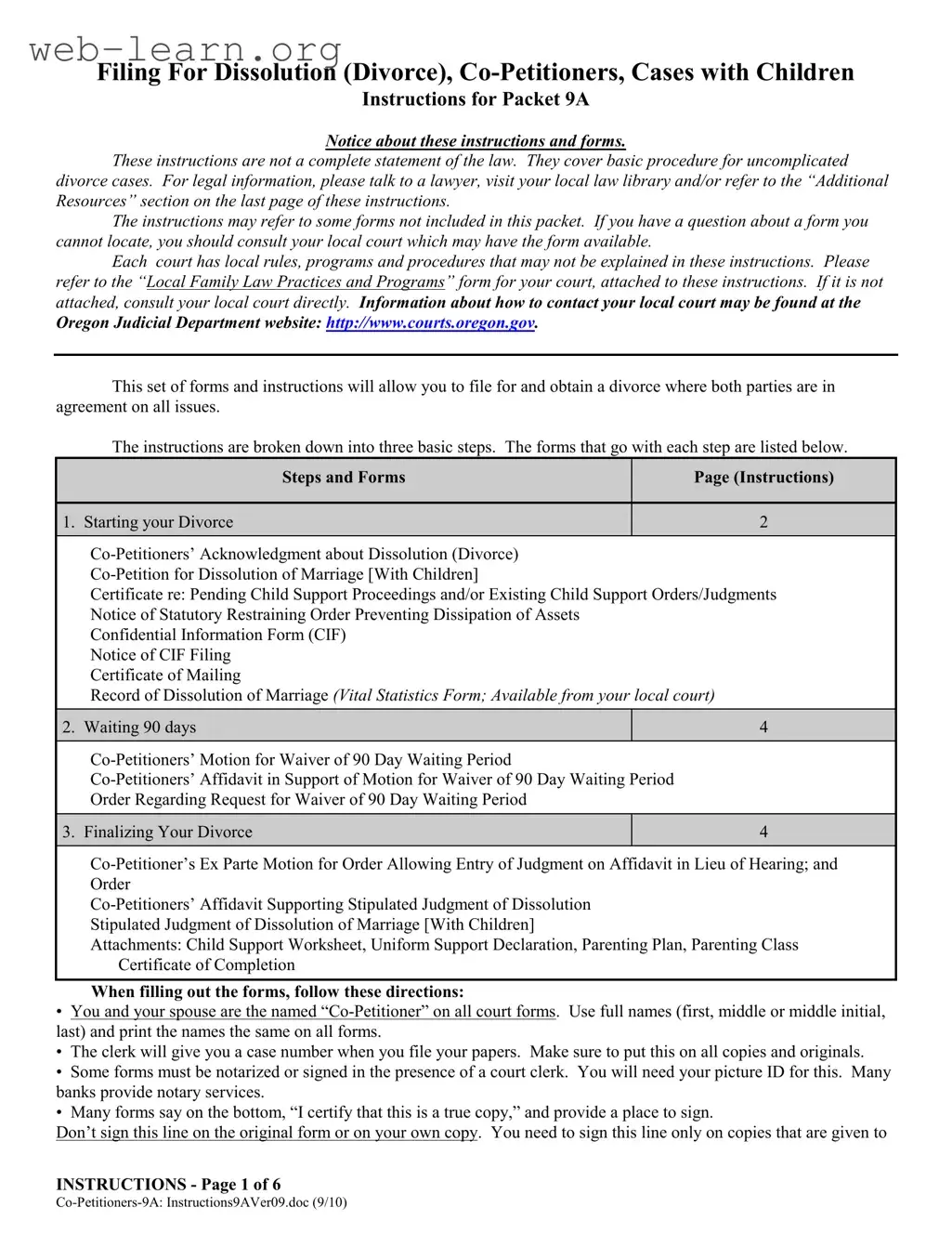
When navigating the complexities of divorce in Oregon, the Divorce Papers Oregon form serves as a crucial tool for couples seeking a mutually agreed-upon dissolution of marriage. This set of forms is specifically designed for cases where both parties, referred to as "Co-Petitioners," are in agreement on all significant issues. The process is organized into three main steps: starting your divorce, waiting for the mandated 90-day period, and finalizing the divorce. Each step requires specific forms, such as the Co-Petition for Dissolution of Marriage, which outlines the terms both parties wish to include in the final judgment. For those with children, additional documentation, including a parenting plan and child support worksheets, is necessary to ensure the well-being of minors involved. It is important to note that while these instructions provide a basic framework, they do not encompass all legal nuances. Therefore, consulting a lawyer or accessing local legal resources is advisable for comprehensive guidance. Understanding the requirements, including notarization of certain documents and the need for confidentiality in sensitive information, is essential for a smooth process. Overall, the Divorce Papers Oregon form aims to facilitate a respectful and efficient resolution to marital dissolution, allowing both parties to move forward with clarity and support.





| Fact Name | Details |
|---|---|
| Purpose of the Form | The Divorce Papers Oregon form is designed to facilitate the filing for dissolution of marriage when both parties agree on all issues. |
| Governing Law | Oregon divorce laws are primarily governed by ORS 107.005 to 107.175, which outline the procedures and requirements for divorce. |
| Co-Petitioners | Both spouses act as “Co-Petitioners” on all forms, indicating mutual agreement on the dissolution process. |
| Waiting Period | Oregon law mandates a 90-day waiting period after filing the petition before a final hearing can occur (ORS 107.065). |
| Child Custody | A parenting plan is required for cases involving minor children, detailing custody arrangements and visitation schedules. |
| Child Support Certificate | The petitioning party must submit a certificate regarding any pending child support proceedings or existing orders. |
| Notarization Requirements | Some forms must be notarized or signed in the presence of a court clerk, necessitating a valid photo ID. |
| Confidential Information | Personal information, such as Social Security numbers, must be included only in the Confidential Information Form (CIF). |
| Spousal Support | Oregon law recognizes three types of spousal support: transitional, compensatory, and spousal maintenance, depending on individual circumstances. |
| Local Court Rules | Each court may have specific local rules and procedures that are not detailed in the general instructions, necessitating direct consultation with the local court. |
Completing the Divorce Papers in Oregon involves several important steps to ensure that everything is properly filed and documented. Following these instructions carefully will help streamline the process and keep it organized. After you fill out the necessary forms, you will need to file them with the court and may have to wait for a specified period before finalizing your divorce.
To begin the divorce process, both parties must fill out and file several forms with the court clerk. The essential forms include:
Make sure to check with your local court for any specific forms or requirements they may have.
Oregon law mandates a 90-day waiting period from the time you file your petition until the court can finalize the divorce. If both parties agree to the terms, they may request a waiver of this waiting period by submitting the appropriate forms.
If minor children are part of the divorce, a parenting plan is required. This plan outlines the custody arrangement and visitation schedule. It may also include provisions for the child's safety if there are concerns about domestic violence or substance abuse.
Child support is intended to ensure that the child's financial needs are met after the divorce. Oregon law requires that a certificate indicating any existing child support orders be submitted with the divorce petition. The court typically determines the amount of support based on guidelines and worksheets provided by the state.
To finalize the divorce, you will need to submit several forms, including:
Additional documents may be necessary based on your specific circumstances, such as child support worksheets or a parenting plan.
If you have safety concerns, you can use a contact address instead of your residential address on court forms. The court will send all notices to this contact address. In some cases, you may also be eligible for a non-disclosure order.
If you are unable to pay the filing fee, you can request a waiver or deferral. This may involve filling out specific forms, which you can obtain from your local court. If approved, you will not have to pay the fee or can defer payment to a later date.
If one spouse fails to comply with the terms of the divorce judgment, the other spouse can ask the court to enforce the judgment. This may require personal service of notice to the non-compliant spouse, and a waiver of personal service can be filed if confidentiality is needed.
For further details, you may consult the Oregon Judicial Department website or visit your local law library. Additionally, legal aid organizations and courthouse facilitators can provide assistance and answer questions regarding the divorce process.
Filling out divorce papers can be a daunting task, and many people make mistakes that can complicate the process. One common error is failing to use full names consistently. When filling out the Divorce Papers Oregon form, both parties must be identified as “Co-Petitioner” using their full names—first, middle (if applicable), and last. Inconsistent naming can lead to confusion and delays in processing your case.
Another mistake often made is neglecting to include the case number on all documents. Once you file your papers, the court clerk assigns a case number. It’s crucial to write this number on every original and copy of the forms. Forgetting to do this could result in important documents being misplaced or not being linked to your case.
People also frequently overlook the requirement for notarization. Certain forms need to be signed in the presence of a notary or a court clerk. This step is essential for ensuring that your documents are legally valid. Bring a picture ID when you go to get your forms notarized. Missing this step could delay your divorce process significantly.
Lastly, many individuals mistakenly sign the certification line on the original form instead of just on the copies. This certification states, “I certify that this is a true copy.” You should only sign this line on the copies that are given to your spouse or sent with the Certificate of Mailing. Signing the original can lead to complications and confusion down the line.
When navigating the divorce process in Oregon, several forms and documents may be necessary alongside the Divorce Papers. Each of these documents serves a specific purpose and helps ensure that all legal requirements are met. Understanding these forms can simplify the process and provide clarity as you move forward.
Each of these forms plays a crucial role in the divorce process. It is important to carefully complete and file them as required. If you have questions or need assistance, consider consulting with a legal professional who can guide you through the process and ensure that your rights are protected.
When filling out the Divorce Papers Oregon form, it is essential to follow certain guidelines to ensure a smooth process. Below is a list of things you should and should not do.
This form can be used by couples without children as well. It accommodates both situations, allowing for a smooth process regardless of parental status.
While consulting an attorney can be beneficial, it is not mandatory. Individuals can represent themselves and use the provided forms to navigate the process.
Forms can be submitted in stages. You start with the initial forms, and additional documents can be filed as needed throughout the process.
The 90-day waiting period is a legal requirement in Oregon. However, couples who agree on terms can request a waiver of this period.
Once filed, you can still make changes or withdraw your petition. Communication with the court is essential for any adjustments.
Child support must be specifically requested and documented. It is not automatically applied unless there are children involved and support is necessary.
If safety is a concern, you can request a non-disclosure order to keep your address private. This is especially important in sensitive situations.
Filling out and using the Divorce Papers Oregon form can be a straightforward process if you follow these key takeaways: