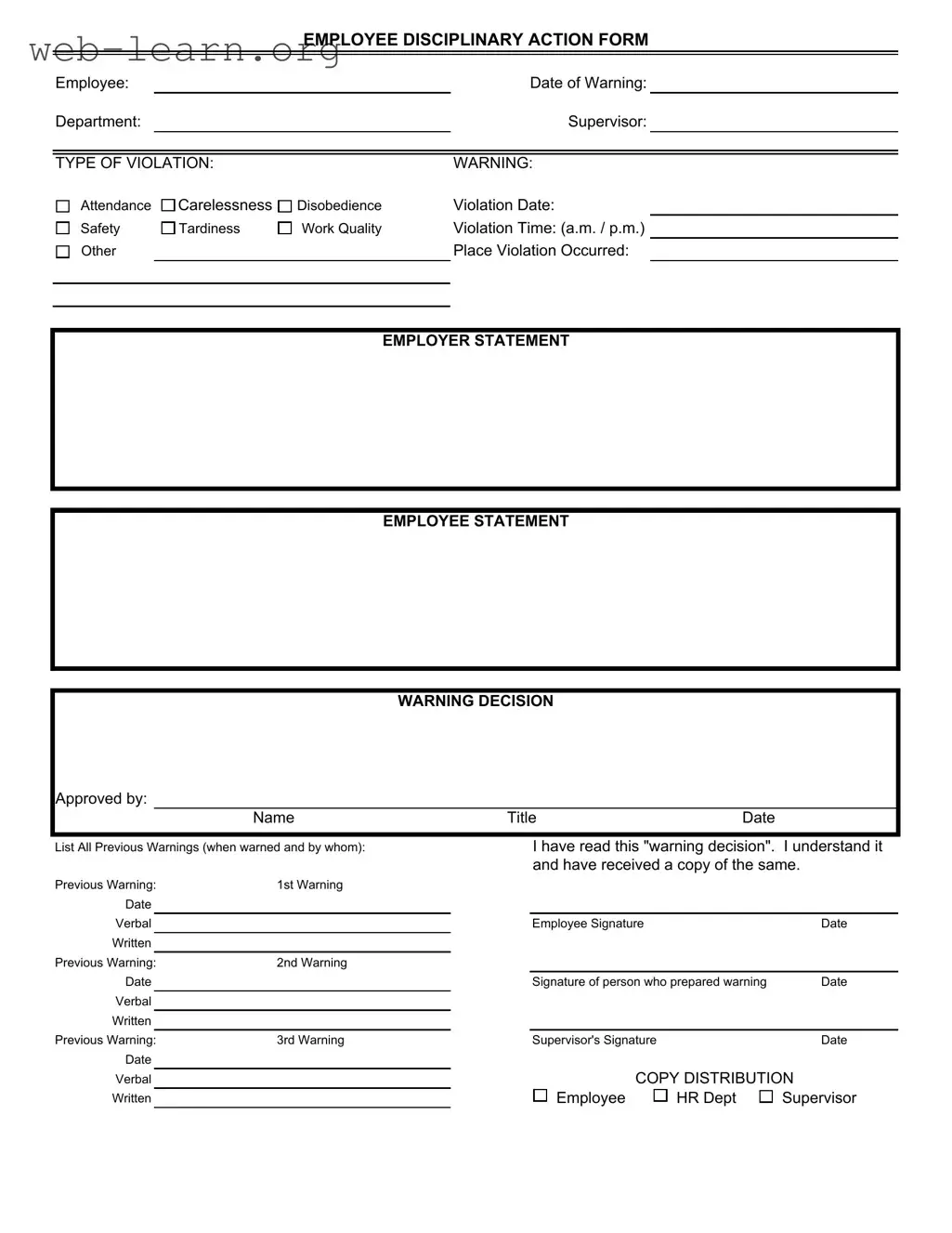
The Disciplinary Action form serves as a crucial tool for employers to document employee violations and the subsequent actions taken. This form includes essential information such as the employee's name, the date of the warning, and the department involved. It categorizes the type of violation, which can range from attendance issues and carelessness to safety concerns and tardiness. Additionally, it records specific details about the violation, including the date, time, and location where the incident occurred. Both the employer and employee have sections to provide their statements, ensuring that each party's perspective is captured. The form also includes a space for listing previous warnings, allowing for a comprehensive view of the employee's disciplinary history. This transparency is vital for both parties, as it helps to clarify the warning decision, which must be approved by a supervisor. Finally, the form emphasizes the importance of acknowledgment, requiring the employee's signature to confirm understanding and receipt of the warning. Proper distribution of the completed form is essential, as copies are provided to the employee, the HR department, and the supervisor, creating a clear record of the disciplinary process.
| Fact Name | Details |
|---|---|
| Purpose | The Disciplinary Action Form is used to document employee violations and the corresponding disciplinary actions taken by the employer. |
| Types of Violations | Common violations include attendance issues, carelessness, safety violations, tardiness, and other misconduct. |
| Employee Acknowledgment | Employees must sign the form to acknowledge receipt of the warning and their understanding of its contents. |
| State-Specific Regulations | In states like California, the governing law includes the California Labor Code, which outlines employer responsibilities in disciplinary actions. |
After completing the Disciplinary Action form, it will be necessary to review the information provided and ensure that all parties involved understand the implications of the warning. The completed form will serve as an official record of the disciplinary action taken.
After completing the form, ensure that copies are distributed appropriately to the employee, the HR department, and the supervisor.
What is the purpose of the Disciplinary Action form?
The Disciplinary Action form serves as a formal record of any violations of workplace policies by an employee. It outlines the specific type of violation, details the circumstances surrounding the incident, and documents any prior warnings. This form is essential for ensuring that disciplinary actions are consistent, fair, and well-documented.
What types of violations can be recorded on this form?
The form allows for various types of violations to be recorded, including:
Clearly identifying the type of violation helps in assessing the severity and determining the appropriate response.
How is the warning decision documented?
The warning decision is documented by having the supervisor or authorized personnel complete the form, including their name, title, and the date of the decision. This ensures accountability and provides a clear record of who made the decision and when it was made.
What should be included in the 'List All Previous Warnings' section?
This section should include a detailed account of any prior warnings given to the employee. Each entry should specify:
Documenting previous warnings is crucial for establishing a pattern of behavior and ensuring that the employee is aware of their past infractions.
What does the employee's signature indicate?
The employee's signature on the form indicates that they have read the warning decision, understand its contents, and have received a copy of the document. It does not imply agreement with the decision but confirms that the employee is aware of the situation.
How is the form distributed after completion?
Once the Disciplinary Action form is completed, copies are distributed to several parties to ensure transparency and proper record-keeping. The distribution typically includes:
This distribution helps maintain clear communication among all parties involved.
What are the consequences of not addressing violations documented on this form?
Failure to address documented violations can lead to several negative outcomes. These may include ongoing issues with employee performance, decreased morale among staff, and potential legal ramifications for the organization. It is crucial to take disciplinary actions seriously and follow through with appropriate measures.
Filling out a Disciplinary Action form can be a straightforward process, but many individuals make common mistakes that can complicate matters. One frequent error is failing to provide complete information about the employee. This includes neglecting to fill in all required fields such as the employee's name, department, and the date of the warning. Incomplete information can lead to confusion and may hinder the effectiveness of the disciplinary process.
Another mistake often seen is the lack of specificity regarding the type of violation. The form provides categories such as attendance, carelessness, and safety. However, individuals sometimes select a broad category without clearly detailing the incident. For example, stating "attendance" without specifying whether it was due to tardiness or unexcused absences can leave room for interpretation and may not accurately reflect the situation.
Additionally, many people overlook the importance of documenting the time and place of the violation. This information is crucial as it provides context for the warning. Without it, the disciplinary action may appear unfounded or arbitrary. Including precise details helps to create a clear record of events, which is beneficial for both the employee and the employer.
Another common oversight is not listing all previous warnings accurately. The section that asks for previous warnings should be filled out thoroughly. Omitting past warnings can give the impression that the employee’s behavior is being treated lightly or inconsistently. It is essential to provide a complete history to support the current disciplinary action.
Finally, signatures are often neglected. After the employee reads the warning decision, their signature is required to confirm receipt and understanding. Failing to obtain this signature can lead to disputes later on. Moreover, the signature of the supervisor who prepared the warning is equally important. It validates the process and ensures accountability. Properly completing the Disciplinary Action form helps maintain a fair and transparent workplace environment.
When addressing employee behavior and performance issues, various forms and documents often accompany the Disciplinary Action form. Each document serves a specific purpose in ensuring that the process is clear, fair, and well-documented. Below is a list of commonly used forms that help maintain a consistent approach to disciplinary actions.
These documents work together to create a comprehensive record of the disciplinary process. By using them, employers can ensure that all actions taken are justified, transparent, and in line with company policies.
The Disciplinary Action form shares similarities with several other documents commonly used in workplace settings. Each document serves a specific purpose in documenting employee behavior and organizational responses. Below are six documents that are similar to the Disciplinary Action form:
When filling out the Disciplinary Action form, there are important dos and don'ts to keep in mind. Following these guidelines can help ensure clarity and fairness in the process.
Misconceptions about the Disciplinary Action form can lead to misunderstandings in the workplace. Here are six common misconceptions and clarifications for each:
In reality, the Disciplinary Action form can be used for a range of violations, including minor issues such as tardiness and carelessness. It serves as a tool for documenting any behavior that does not meet company standards.
Employees have the right to provide their statement on the form. This allows them to express their perspective on the situation, which can be considered in future discussions.
Warnings may not necessarily impact future employment. Companies often have policies in place that allow for the removal of warnings after a certain period, provided that the employee demonstrates improved behavior.
The Disciplinary Action form serves as a historical record. It can be referenced in future evaluations or when assessing an employee's overall performance and growth.
While supervisors typically initiate the form, employees can also contribute by providing their statements. This collaboration ensures a more comprehensive understanding of the incident.
Follow-up is crucial. The form includes sections to list previous warnings, allowing for a cumulative assessment of an employee's performance over time. Regular reviews can help track progress and reinforce expectations.
When utilizing the Disciplinary Action form, it is crucial to approach the process with clarity and precision. This form serves as a formal record of employee violations and the corresponding disciplinary measures taken. Here are several key takeaways to keep in mind: