Homepage Blank Dhs 38 Form
Outline

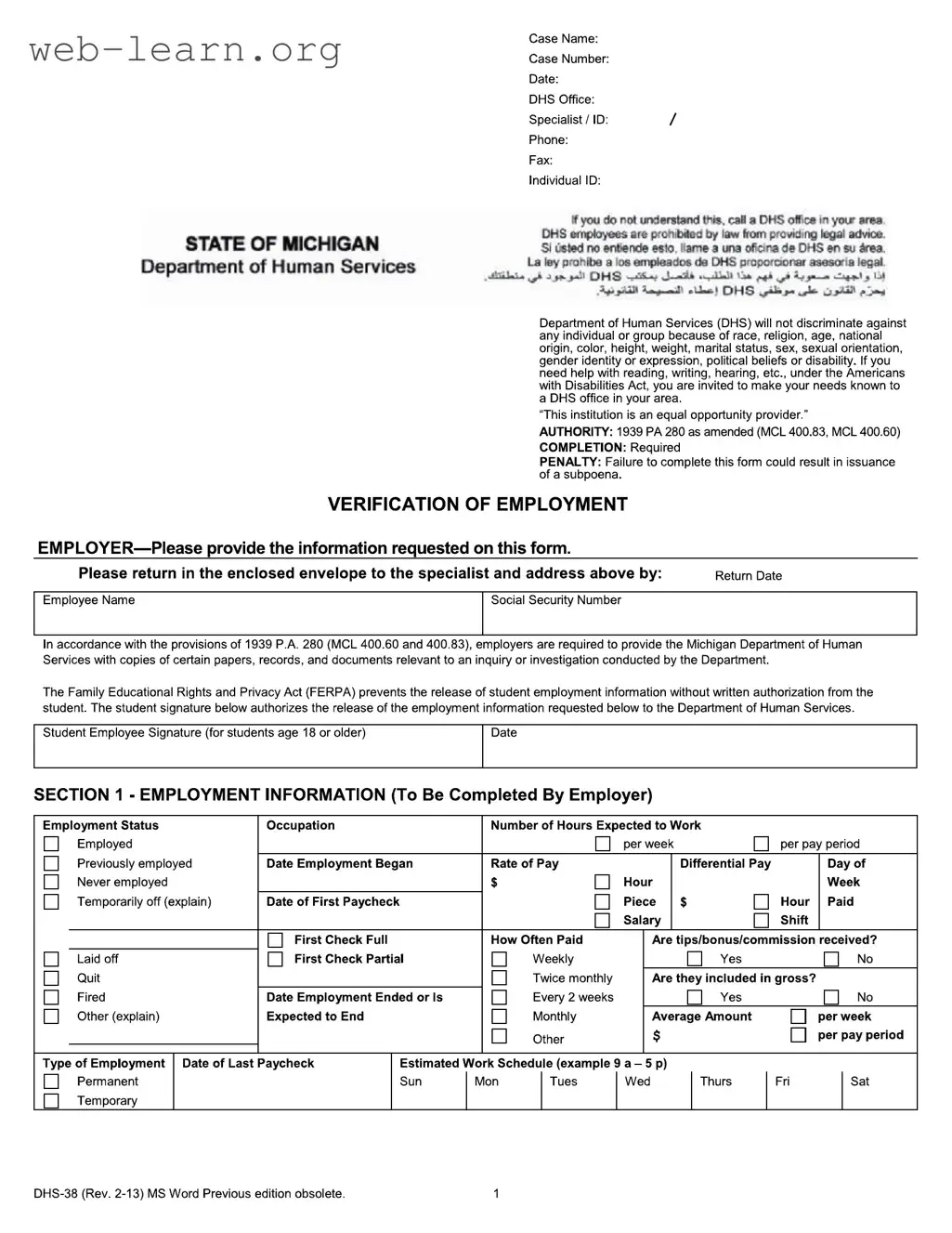
The DHS 38 form plays a crucial role in the operations of the Michigan Department of Human Services (DHS), facilitating the collection of essential information related to employment and income verification. This form is utilized primarily by employers to provide detailed employment data about their employees, including job status, hours worked, and compensation. It ensures that the DHS can accurately assess eligibility for various assistance programs while maintaining compliance with legal requirements. Additionally, the form emphasizes the importance of equal opportunity and non-discrimination, inviting individuals with disabilities to request necessary accommodations. Employers must complete several sections, detailing not only employment information but also insurance and retirement benefits, which are vital for a comprehensive understanding of an employee's financial situation. The form also includes sections for reporting disability or workers' compensation information, reinforcing its multifaceted purpose. Failure to complete the DHS 38 form can lead to serious consequences, including the issuance of a subpoena, highlighting its significance in the administrative process. Overall, the DHS 38 form serves as a key instrument in ensuring that the DHS can fulfill its mandate to provide support while upholding the rights and dignity of all individuals involved.

Sample - Dhs 38 Form

Form Information

Fact Name Description
Form Title The form is known as DHS-38 and is used by the Michigan Department of Human Services.
Governing Law This form is governed by 1939 PA 280, specifically MCL 400.60 and MCL 400.83.
Completion Requirement It is mandatory to complete this form to avoid penalties.
Penalties Failure to complete the form may lead to the issuance of a subpoena.
Equal Opportunity The Department of Human Services ensures no discrimination based on various factors including race, gender, and disability.
Americans with Disabilities Act Individuals needing assistance under the ADA are encouraged to communicate their needs to their local DHS office.
Employer Responsibility Employers must provide specific employment-related documents to the DHS when requested.
Student Employment Information Under FERPA, student employment information cannot be released without written consent from the student.
Sections of the Form The form includes sections for employment information, insurance/retirement details, income information, and additional comments.
False Statements Providing false information to obtain assistance can lead to serious legal penalties, including felony charges.

Detailed Guide for Filling Out Dhs 38

Completing the DHS 38 form is an essential step in ensuring that the necessary information is accurately provided to the Michigan Department of Human Services. Once you have filled out the form, it should be returned to the designated specialist by the specified return date. This process helps facilitate the verification of employment and related information, which is crucial for the services being requested.

  1. Begin by entering the Case Name and Case Number at the top of the form.
  2. Fill in the Date, DHS Office, Specialist/ID, Phone, and Fax fields.
  3. Provide the Individual ID if applicable.
  4. In the Verification of Employment section, enter the Employer information as requested.
  5. Write the Employee Name and Social Security Number.
  6. Indicate the Employment Status by checking the appropriate box (Employed, Previously employed, etc.).
  7. Complete the Occupation, Date Employment Began, and Date of First Paycheck fields.
  8. Fill in the Date Employment Ended or Is Expected to End and the Number of Hours Expected to Work per week.
  9. Provide the Rate of Pay and indicate how often the employee is paid (Weekly, Monthly, etc.).
  10. Answer whether tips, bonuses, or commissions are received and if they are included in gross income.
  11. Complete the Type of Employment section by checking Permanent or Temporary.
  12. In Section 2, provide information regarding Insurance / Retirement including health plan availability and enrollment status.
  13. Fill out Section 3 with income information for each pay received during the specified period.
  14. In Section 4, indicate if any medical or disability benefits or worker’s compensation were paid during the specified period.
  15. Complete Section 5 with any additional information or comments.
  16. In Section 6, provide the Business Name, Business Address, and the name and title of the person completing the form.
  17. Ensure the Signature of the person completing the form is included along with the Date Signed.

Obtain Answers on Dhs 38

  1. What is the purpose of the DHS 38 form?

    The DHS 38 form is designed for employers to provide necessary employment information to the Michigan Department of Human Services (DHS). This information is essential for DHS inquiries or investigations related to assistance programs. Employers must complete the form accurately and return it by the specified deadline to avoid potential legal consequences.

  2. Who is required to complete the DHS 38 form?

    Employers are required to complete the DHS 38 form when requested by the DHS. This applies to all employers who have employees involved in any assistance program inquiries. The form gathers critical information about the employee's employment status, income, and benefits, which aids DHS in determining eligibility for assistance.

  3. What happens if the DHS 38 form is not completed?

    Failure to complete the DHS 38 form can lead to serious consequences. Specifically, the DHS may issue a subpoena to compel compliance. It is crucial for employers to respond promptly to avoid legal repercussions and ensure that the assistance process is not delayed.

  4. Can I get help with the DHS 38 form if I have a disability?

    Yes, individuals with disabilities are encouraged to seek assistance. Under the Americans with Disabilities Act, you can inform your local DHS office about your needs for help with reading, writing, or any other assistance required to complete the form. DHS is committed to providing equal opportunity and support to all individuals.

Common mistakes

Completing the DHS 38 form can be a straightforward process, but several common mistakes may lead to delays or complications in the application. Understanding these pitfalls can help ensure a smoother experience for everyone involved.

One frequent mistake is not providing complete information. Each section of the form requires specific details, such as employment status, income information, and insurance details. Omitting even a small piece of information can result in the form being returned for corrections. It is essential to double-check all entries to confirm that every required field is filled out accurately.

Another common error is failing to sign the form. The signature of the person completing the form is necessary to validate the information provided. Without this signature, the form may not be processed, leading to unnecessary delays. Remember, the signature is a confirmation of the truthfulness of the information submitted.

Additionally, individuals often overlook the importance of using the correct date format. Dates should be clearly indicated, as the form may require specific timelines for employment and benefits. Misinterpreting the date format could lead to confusion and might affect the processing of the application.

Some people mistakenly assume that all sections of the form must be filled out by the applicant. In reality, certain sections are designated for the employer to complete. Understanding which parts require employer input can prevent unnecessary errors and streamline the process.

Another mistake is not following the submission instructions. The form must be returned to the designated specialist by a specific date. Failing to adhere to these guidelines may result in the application being considered incomplete. It is vital to pay attention to submission deadlines and ensure that the form is sent to the correct address.

Lastly, individuals may not realize the importance of reviewing the entire form before submission. Taking the time to read through the completed form can help catch any errors or omissions that may have been overlooked initially. A thorough review can make a significant difference in the application process.

Documents used along the form

The DHS 38 form is a critical document used by the Michigan Department of Human Services for various employment and income verification processes. Along with this form, several other documents may be required to ensure a comprehensive understanding of an individual's situation. Below is a list of these forms and documents, each serving a specific purpose in the verification process.

  • Verification of Income Form: This document is used to provide detailed information about an individual's income sources, including wages, bonuses, and any other earnings. It helps determine eligibility for assistance programs.
  • Employment Verification Letter: Employers provide this letter to confirm an employee's job status, salary, and duration of employment. It serves as an official record for the DHS.
  • Tax Returns: Recent tax returns can be requested to verify an individual's total income for the year. They provide a complete picture of an individual's financial situation.
  • Pay Stubs: Recent pay stubs are often required to verify current income levels. They detail the employee's earnings, deductions, and net pay for each pay period.
  • Social Security Administration (SSA) Benefits Statement: This document outlines any benefits received from the SSA, which can affect eligibility for state assistance programs.
  • Disability Verification Form: For individuals receiving disability benefits, this form confirms the type and amount of benefits received, which is crucial for income assessments.
  • Health Insurance Verification: This document confirms whether an individual has health insurance coverage, which may impact their eligibility for certain services.
  • Retirement Account Statements: Statements from retirement accounts provide information about any funds available to an individual, which can influence their financial assessment.

Each of these documents plays a vital role in the overall assessment process. They help the Department of Human Services ensure that individuals receive the appropriate assistance based on their unique circumstances. Proper documentation is essential for a smooth application process and to avoid any delays or issues with eligibility determinations.

Similar forms

The DHS 38 form serves a specific purpose in gathering information related to employment and benefits. There are several other documents that share similar functions or objectives. Below is a list of seven such documents, each highlighting how they relate to the DHS 38 form.

  • W-2 Form: This document is used by employers to report an employee's annual wages and the taxes withheld. Like the DHS 38, it provides critical employment information that may be required for benefit eligibility assessments.
  • 1040 Form: The U.S. Individual Income Tax Return collects information about an individual's income. It parallels the DHS 38 in that it requires detailed reporting of earnings, which can affect eligibility for various assistance programs.
  • Employment Verification Letter: This letter, often requested by employees, confirms their employment status and income. Similar to the DHS 38, it serves as proof of employment for various applications, including housing and financial aid.
  • Pay Stubs: These documents provide a breakdown of an employee's earnings and deductions for each pay period. They are akin to the DHS 38 in that they detail income information necessary for determining eligibility for assistance programs.
  • Form I-9: This form verifies the identity and employment authorization of individuals hired for employment in the U.S. Like the DHS 38, it is essential for confirming employment status, which can impact benefit eligibility.
  • Social Security Administration (SSA) Benefit Verification Letter: This letter outlines the benefits an individual receives from Social Security. It shares similarities with the DHS 38 as it provides necessary income information for assessing eligibility for state assistance programs.
  • Health Insurance Marketplace Application: This application collects information about household income and employment to determine eligibility for health coverage. It is similar to the DHS 38 in that it requires comprehensive income details to assess eligibility for benefits.

Dos and Don'ts

When filling out the DHS 38 form, there are important steps to follow to ensure accuracy and compliance. Here’s a list of what you should and shouldn’t do:

  • Do read all instructions carefully before starting.
  • Do provide accurate and complete information for all sections.
  • Do double-check your entries for any errors or omissions.
  • Do submit the form by the specified return date.
  • Do keep a copy of the completed form for your records.
  • Don’t leave any sections blank unless instructed to do so.
  • Don’t provide false information or omit details.
  • Don’t forget to sign and date the form where required.
  • Don’t submit the form without reviewing it thoroughly.
  • Don’t hesitate to contact a DHS office if you have questions.

Misconceptions

There are several misconceptions about the DHS 38 form that can lead to confusion. Understanding these can help ensure that the form is completed correctly and submitted on time.

  • It is only for employed individuals. Many believe that the DHS 38 form is only applicable to those who are currently employed. However, it also applies to individuals who have been previously employed or have never been employed, as indicated in the form.
  • Employers can provide legal advice regarding the form. Some people think that employers can assist with legal questions about the DHS 38 form. In reality, employers are prohibited from providing legal advice. It is important to seek help from a qualified legal professional if needed.
  • Failure to complete the form has no consequences. Many assume that not completing the form is not a big deal. In fact, failing to complete it can lead to serious repercussions, including the issuance of a subpoena.
  • Only students need to sign the form. Some believe that only students must sign the DHS 38 form. However, any employee over the age of 18 must provide their signature to authorize the release of employment information.
  • The form is only about employment status. While employment status is a significant part of the DHS 38 form, it also covers insurance and retirement information, income details, and any disability or workers' compensation benefits.
  • Information provided is not confidential. A common misconception is that the information on the DHS 38 form is not protected. In fact, the form requires careful handling of personal information, and confidentiality is maintained as per applicable laws.

Understanding these misconceptions can help ensure that individuals complete the DHS 38 form accurately and in compliance with the requirements. If there are any uncertainties, reaching out to a local DHS office for clarification is always a good step.

Key takeaways

Filling out the DHS-38 form can be straightforward if you keep a few key points in mind. Here are some essential takeaways:

  • Understand the Purpose: The DHS-38 form is primarily used to verify employment and income information for individuals applying for assistance.
  • Complete All Sections: Ensure that every section of the form is filled out accurately. Missing information can lead to delays or issues with your application.
  • Employer's Responsibility: Employers must provide the requested information. They are legally required to comply with this request.
  • Submission Deadline: Pay attention to the return date specified on the form. Timely submission is crucial to avoid complications.
  • Confidentiality Matters: The form includes provisions to protect personal information, ensuring it is only used for the intended purpose.
  • Legal Consequences: Be aware that providing false information can lead to legal penalties. Always provide truthful and accurate data.

By following these guidelines, you can navigate the DHS-38 form process more effectively.