When it comes to transferring ownership of property, a Deed form plays a crucial role in ensuring that the transaction is legally binding and recognized by the state. This document serves as a formal written agreement that outlines the specifics of the property being transferred, including its legal description, the names of the parties involved, and any conditions or restrictions that may apply. Understanding the various types of Deeds, such as warranty deeds and quitclaim deeds, is essential for anyone involved in real estate transactions. Each type offers different levels of protection and assurances regarding the title. Additionally, the Deed form must be executed properly, which typically involves signatures from both the grantor and grantee, and often requires notarization. By grasping the key elements and requirements of the Deed form, individuals can navigate property transfers with greater confidence and clarity.
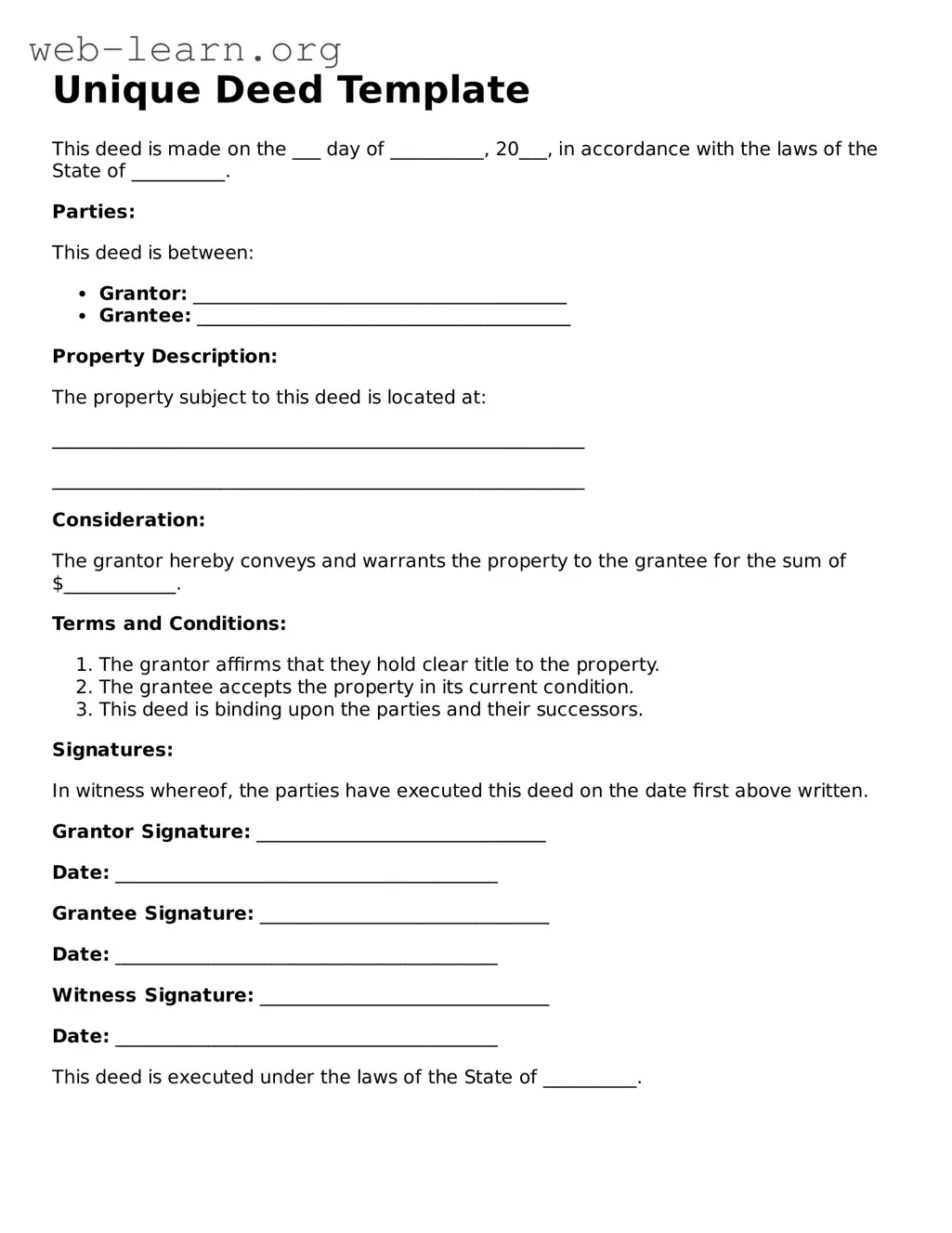
Unique Deed Template
This deed is made on the ___ day of __________, 20___, in accordance with the laws of the State of __________.
Parties:
This deed is between:
Property Description:
The property subject to this deed is located at:
_________________________________________________________
_________________________________________________________
Consideration:
The grantor hereby conveys and warrants the property to the grantee for the sum of $____________.
Terms and Conditions:
Signatures:
In witness whereof, the parties have executed this deed on the date first above written.
Grantor Signature: _______________________________
Date: _________________________________________
Grantee Signature: _______________________________
Date: _________________________________________
Witness Signature: _______________________________
Date: _________________________________________
This deed is executed under the laws of the State of __________.
| Fact Name | Description |
|---|---|
| Definition | A deed is a legal document that signifies the transfer of property ownership from one party to another. |
| Types of Deeds | Common types include warranty deeds, quitclaim deeds, and special purpose deeds. |
| Governing Law | Deeds are governed by state laws, which can vary significantly across jurisdictions. |
| Execution Requirements | Most states require the deed to be signed by the grantor, and some may require notarization. |
| Recording | Recording the deed with the county clerk or recorder's office is often necessary to provide public notice of the transfer. |
| Consideration | While many deeds require consideration (something of value exchanged), quitclaim deeds may not. |
| Legal Capacity | Both parties involved in the deed must have the legal capacity to enter into a contract. |
| State-Specific Forms | Each state has its own specific forms and requirements for deeds; for example, California requires a preliminary change of ownership report. |
| Revocation | Generally, once a deed is executed and delivered, it cannot be revoked unless specific conditions apply. |
Filling out a Deed form is a straightforward process. Once completed, this document will need to be submitted to the appropriate authority for recording. Ensure all information is accurate to avoid delays in processing.
What is a Deed?
A deed is a legal document that conveys an interest in real property from one party to another. It serves as proof of ownership and can be used to transfer property rights, such as selling a home or gifting land. The deed must be signed, witnessed, and often notarized to be valid.
What types of Deeds are there?
There are several types of deeds, including:
Do I need a lawyer to create a Deed?
While it is not legally required to have a lawyer draft a deed, it is highly recommended. A legal professional can ensure that the deed complies with state laws and accurately reflects the intentions of the parties involved.
How do I execute a Deed?
To execute a deed, follow these steps:
What information is required in a Deed?
A deed typically requires the following information:
Can a Deed be revoked or changed?
Once a deed is executed and recorded, it generally cannot be revoked or changed unilaterally. However, the parties involved can create a new deed to amend the terms or transfer ownership again. Legal advice is recommended for this process.
What happens if a Deed is not recorded?
If a deed is not recorded, it may still be valid between the parties involved, but it may not provide legal protection against claims from third parties. Recording a deed is essential for establishing public notice of ownership and can prevent disputes over property rights.
Are there any fees associated with recording a Deed?
Yes, there are typically fees for recording a deed, which can vary by county or state. These fees cover the administrative costs of maintaining public records. It’s important to check with your local recorder’s office for the specific fee structure.
Filling out a Deed form can be a straightforward process, but many individuals make common mistakes that can lead to complications. One significant error is failing to include all necessary parties. A Deed must clearly identify the grantor (the person transferring the property) and the grantee (the person receiving the property). Omitting one of these parties can render the Deed invalid.
Another frequent mistake involves incorrect property descriptions. The Deed must contain a precise legal description of the property being transferred. Relying on informal descriptions or vague language can create confusion and disputes in the future. It is essential to use the legal description found in the property’s title or previous Deed.
People often overlook the need for signatures. A Deed must be signed by the grantor, and in some cases, the grantee as well. Not obtaining the necessary signatures can lead to the Deed being challenged or considered unenforceable. Additionally, if the grantor is married, both spouses may need to sign the Deed, depending on state laws.
Another mistake is neglecting to have the Deed notarized. Many states require that a Deed be notarized to be legally binding. Without notarization, the document may not be recognized by the county recorder's office, which can prevent the transfer of property ownership.
Individuals sometimes fail to record the Deed after it is executed. Recording the Deed with the appropriate county office protects the new owner’s rights and provides public notice of the ownership transfer. Not recording can lead to issues if the property is sold again or if disputes arise regarding ownership.
People may also use outdated forms. Laws and requirements can change, and using an old version of the Deed form may lead to compliance issues. It is crucial to ensure that the most current form is being used to avoid any legal complications.
Another common error is not including the date of the transaction. The date is essential for establishing when the transfer of ownership takes place. Omitting the date can lead to confusion regarding the effective date of the Deed.
Some individuals forget to check for any liens or encumbrances on the property before completing the Deed. It is vital to ensure that the property is free of any legal claims that could affect the transfer. Failure to address this can lead to financial liabilities for the new owner.
Lastly, many people do not seek legal advice or assistance when completing a Deed form. While it is possible to fill out the form independently, consulting with a professional can help avoid mistakes and ensure that all legal requirements are met. Seeking guidance can save time and prevent future disputes.
When completing a property transaction, several documents may accompany the Deed form to ensure all legal requirements are met and to provide necessary information about the property. Below is a list of commonly used forms and documents in conjunction with a Deed.
These documents play a crucial role in the property transfer process, providing transparency and protecting the interests of both parties involved. Ensuring that all necessary forms are completed and reviewed can help facilitate a smooth transaction.
The Deed form shares similarities with several other legal documents. Each document serves a specific purpose in property transactions or legal agreements. Below are seven documents that are comparable to the Deed form:
When filling out a Deed form, attention to detail is crucial. Here are some important dos and don'ts to keep in mind:
Following these guidelines can help prevent delays or complications in the processing of your Deed form. Be diligent and thorough in your approach.
Understanding the Deed form can be challenging. Here are ten common misconceptions that often arise:
By understanding these misconceptions, you can navigate the complexities of property transfers more effectively.
When filling out and using a Deed form, keep these key takeaways in mind: