The Deed in Lieu of Foreclosure form is a crucial document for homeowners facing financial difficulties and potential foreclosure. This form allows a homeowner to voluntarily transfer their property to the lender in exchange for the cancellation of the mortgage debt. It serves as an alternative to the lengthy and often stressful foreclosure process, providing a more straightforward resolution for both parties involved. By executing this deed, the homeowner can avoid the negative consequences of foreclosure on their credit report, while the lender can quickly take possession of the property and reduce their losses. Key aspects of the form include the identification of the property, the parties involved, and the terms of the transfer. Additionally, the form may outline any agreements regarding the homeowner's remaining obligations, if applicable. Understanding the implications and requirements of this form is essential for anyone considering this option as a means to navigate their financial challenges.
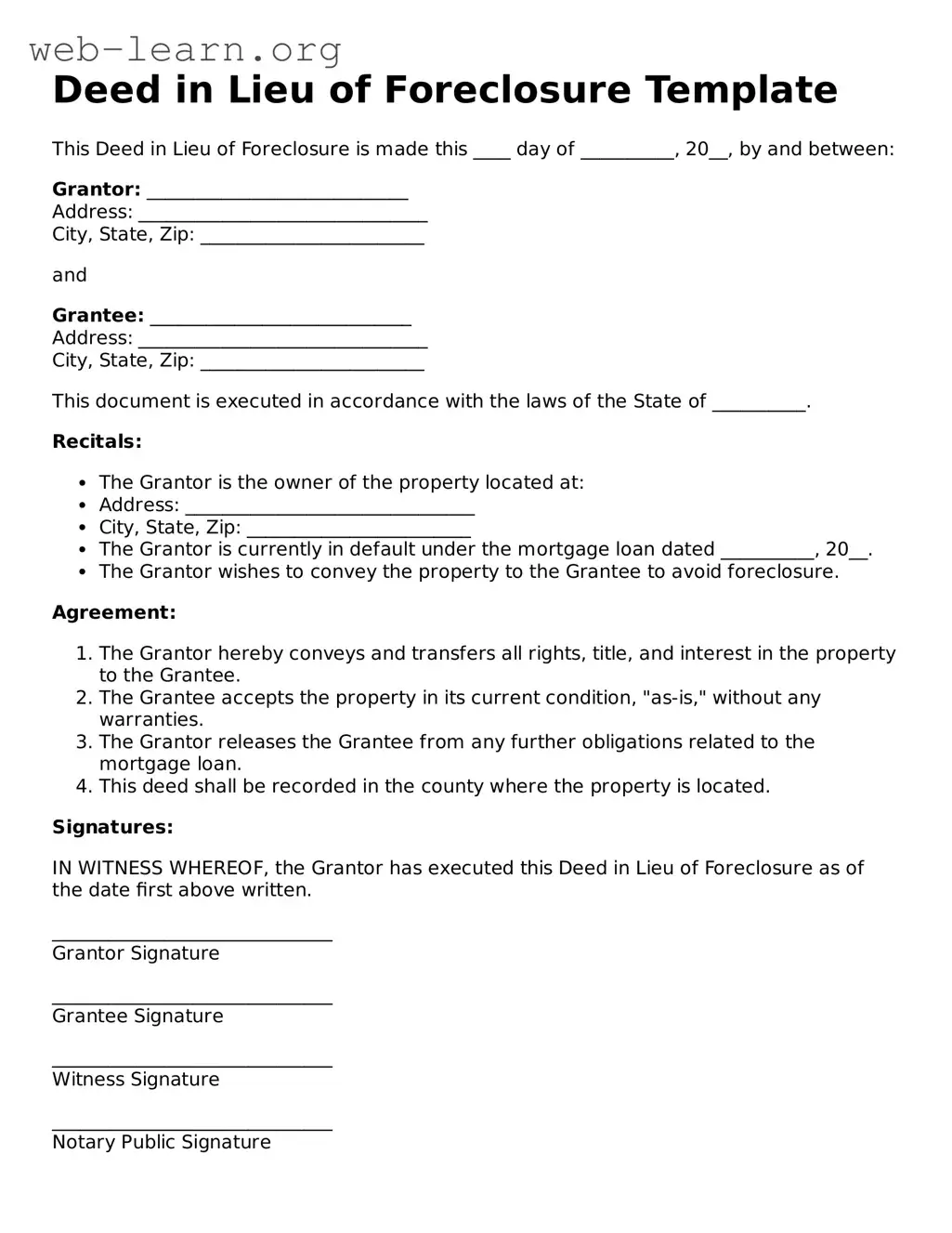
Deed in Lieu of Foreclosure Template
This Deed in Lieu of Foreclosure is made this ____ day of __________, 20__, by and between:
Grantor: ____________________________
Address: _______________________________
City, State, Zip: ________________________
and
Grantee: ____________________________
Address: _______________________________
City, State, Zip: ________________________
This document is executed in accordance with the laws of the State of __________.
Recitals:
Agreement:
Signatures:
IN WITNESS WHEREOF, the Grantor has executed this Deed in Lieu of Foreclosure as of the date first above written.
______________________________
Grantor Signature
______________________________
Grantee Signature
______________________________
Witness Signature
______________________________
Notary Public Signature
| Fact Name | Description |
|---|---|
| Definition | A deed in lieu of foreclosure is a legal agreement where a borrower voluntarily transfers the title of their property to the lender to avoid foreclosure proceedings. |
| Purpose | This process helps borrowers escape the negative impact of foreclosure on their credit scores while allowing lenders to take possession of the property more efficiently. |
| Eligibility | Homeowners facing financial hardship may qualify, but they must demonstrate an inability to continue making mortgage payments. |
| Governing Law | Each state has its own laws governing deeds in lieu of foreclosure. For example, in California, the relevant law is the California Civil Code Section 2943. |
| Process | The borrower must submit a request to the lender, providing necessary documentation to support their financial situation. |
| Benefits for Borrowers | Borrowers can avoid the lengthy foreclosure process and may be able to negotiate the forgiveness of remaining mortgage debt. |
| Impact on Credit | A deed in lieu of foreclosure may still impact credit scores, but typically less severely than a foreclosure. |
| Tax Implications | Borrowers may face tax consequences, as the IRS considers forgiven debt as taxable income in some situations. |
| Alternatives | Other options include loan modification, short sale, or bankruptcy, which may be more suitable depending on individual circumstances. |
Once you have the Deed in Lieu of Foreclosure form ready, it's important to carefully complete it to ensure all necessary information is provided. This process can help facilitate a smoother transition for all parties involved.
After submitting the form, your lender will review it and may reach out for any additional information or clarification. It is essential to stay in communication with them during this time to ensure a smooth process.
What is a Deed in Lieu of Foreclosure?
A Deed in Lieu of Foreclosure is a legal agreement where a homeowner voluntarily transfers ownership of their property to the lender to avoid foreclosure. This option can be beneficial for both parties: the homeowner can escape the lengthy and stressful foreclosure process, while the lender can quickly take possession of the property and potentially minimize losses.
What are the benefits of choosing a Deed in Lieu of Foreclosure?
Opting for a Deed in Lieu of Foreclosure can provide several advantages:
Are there any drawbacks to a Deed in Lieu of Foreclosure?
While there are benefits, it’s important to consider potential drawbacks:
How does the process work?
The process typically involves several steps:
Will I be responsible for any debts after the deed is transferred?
This can vary depending on the agreement you reach with your lender. Some lenders may agree to forgive any remaining mortgage debt, while others might not. It’s crucial to clarify this point during negotiations to ensure you understand your financial obligations moving forward.
What should I do if I’m considering a Deed in Lieu of Foreclosure?
If you are contemplating this option, consider the following steps:
Taking these steps can help you make an informed decision that aligns with your circumstances.
Filling out a Deed in Lieu of Foreclosure form can be a complex process. Many people make mistakes that can lead to complications later. One common error is failing to provide accurate property information. It's essential to include the correct legal description of the property, as any inaccuracies can delay the process or cause legal issues.
Another mistake involves not understanding the implications of the deed. Some individuals sign the form without fully grasping that they are voluntarily transferring ownership of the property to the lender. This action can have long-term effects on their credit and financial situation.
Many people overlook the need for signatures from all parties involved. If there are co-owners or a spouse, their signatures may be required. Missing a signature can render the document invalid, leading to further complications.
Failing to include a date on the form is another frequent oversight. A date is crucial for establishing when the transfer of ownership takes place. Without it, the timeline for any potential legal actions may become unclear.
Some individuals do not attach supporting documents that may be necessary. This can include proof of hardship or other financial information. Lenders often require this information to process the deed effectively.
Another mistake is neglecting to check local laws and regulations. Requirements can vary significantly by state. Not adhering to these laws can result in the deed being challenged or rejected.
People sometimes forget to keep copies of the completed form. Having a record is important for future reference. If disputes arise, having documentation can be invaluable.
In addition, some individuals fail to seek legal advice. Consulting with a professional can provide clarity and help avoid potential pitfalls. Many people underestimate the benefits of having guidance during this process.
Another common error is not considering the tax implications of the deed. Transferring property can have tax consequences that may affect financial stability. It is wise to be informed about these aspects before proceeding.
Lastly, many individuals rush through the process. Taking time to review the form thoroughly can prevent mistakes. Rushing can lead to errors that might be costly in the long run.
A Deed in Lieu of Foreclosure can be a helpful option for homeowners facing financial difficulties. However, it often goes hand-in-hand with several other important documents that facilitate the process. Here’s a list of common forms and documents that you might encounter alongside a Deed in Lieu of Foreclosure.
Understanding these documents is crucial for anyone considering a Deed in Lieu of Foreclosure. Each plays a significant role in protecting both the homeowner and the lender, ensuring a smoother transition during a challenging time.
The Deed in Lieu of Foreclosure is a document that allows a homeowner to transfer ownership of their property back to the lender to avoid foreclosure. Several other documents serve similar purposes in real estate and financial transactions. Here are seven documents that share similarities with the Deed in Lieu of Foreclosure:
When filling out the Deed in Lieu of Foreclosure form, it is crucial to approach the process with care. This document can have significant implications for both the homeowner and the lender. Here are six important dos and don'ts to consider:
Understanding a Deed in Lieu of Foreclosure can be challenging, and there are several misconceptions that often arise. Here are eight common misunderstandings, along with clarifications to help you navigate this process.
Many believe that signing a Deed in Lieu of Foreclosure will wipe out all debts. However, this is not always the case. If there are any additional liens on the property, those may still remain, and the borrower could be held responsible for them.
While a Deed in Lieu of Foreclosure can be faster than a traditional foreclosure process, it still requires time and effort. The lender must review the request, and both parties need to agree on the terms.
Many assume that a Deed in Lieu of Foreclosure has no impact on credit. In reality, it can still negatively affect your credit score, though it may be less damaging than a full foreclosure.
Not all homeowners qualify for a Deed in Lieu of Foreclosure. Lenders often have specific criteria that must be met, including the homeowner's financial situation and the property's condition.
Signing a Deed in Lieu of Foreclosure does not necessarily mean you will be free from all future liability. Depending on the state laws and the terms agreed upon, you might still face certain responsibilities.
Some people confuse a Deed in Lieu of Foreclosure with a short sale. In a short sale, the property is sold for less than the amount owed on the mortgage, while in a Deed in Lieu, the homeowner voluntarily transfers ownership to the lender without a sale.
While many homeowners facing financial difficulties consider this option, it is not limited to them. Homeowners who may have other reasons for wanting to avoid foreclosure can also explore this route.
Some believe that once they sign the Deed in Lieu of Foreclosure, they cannot change their mind. However, there may be options to negotiate or withdraw, depending on the circumstances and lender policies.
By addressing these misconceptions, homeowners can make more informed decisions regarding their options in the face of financial difficulties. It is essential to seek guidance and fully understand the implications before proceeding.
When considering a Deed in Lieu of Foreclosure, it's important to understand the implications and processes involved. Here are some key takeaways to keep in mind:
Correction Deed California - The Corrective Deed may need to be notarized before recording.
Quit Claim Deed Form Iowa - This deed is often used in divorce settlements to transfer property rights.
Transfer on Death Deed California Common Questions - It is a valuable option for anyone looking to simplify the process of transferring real estate.