Homepage Blank Dd Form
Outline

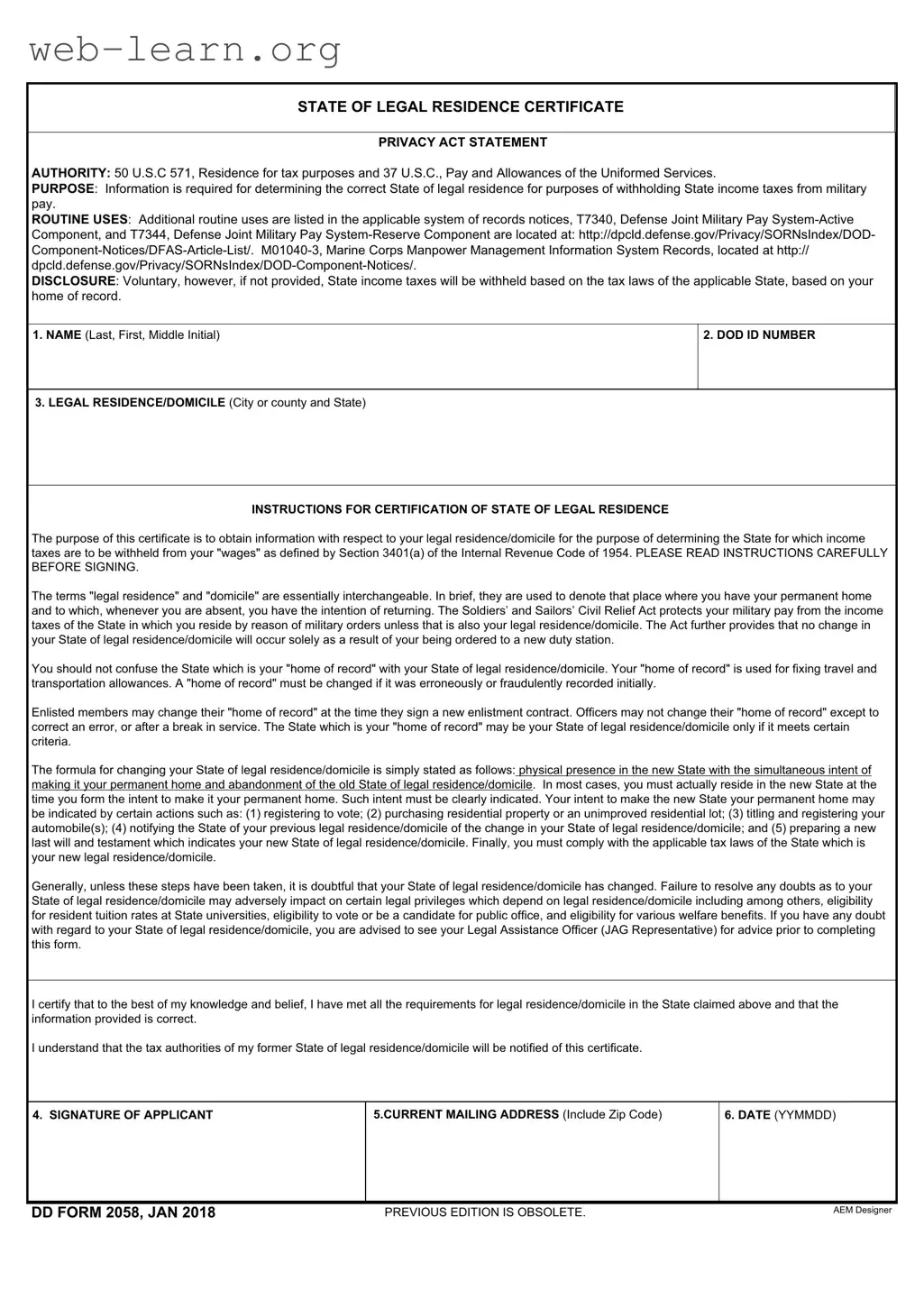
The DD Form 2058, also known as the State of Legal Residence Certificate, plays a crucial role for military personnel in determining their state of legal residence for tax purposes. This form is essential for ensuring that the correct amount of state income tax is withheld from military pay, aligning with the legal requirements set forth in U.S. law. The form collects key information, including the individual’s name, Department of Defense ID number, and their legal residence or domicile. Understanding the distinction between legal residence and home of record is vital; the home of record is primarily used for travel and transportation allowances, while legal residence affects tax obligations. The Soldiers’ and Sailors’ Civil Relief Act offers protections regarding state income taxes, emphasizing that military orders alone do not change one’s legal residence. To successfully establish a new state of legal residence, a service member must demonstrate physical presence and intent to make that state their permanent home. This can be evidenced through actions such as registering to vote or purchasing property. It’s important to navigate this process carefully, as any uncertainties about legal residence can impact various legal privileges, including voting rights and eligibility for state benefits. Therefore, it is advisable for military personnel to consult with a Legal Assistance Officer if they have questions before completing the form.

Sample - Dd Form

DD FORM 2058, JAN 2018
PREVIOUS EDITION IS OBSOLETE.
AEM Designer
STATE OF LEGAL RESIDENCE CERTIFICATE
PRIVACY ACT STATEMENT
AUTHORITY: 50 U.S.C 571, Residence for tax purposes and 37 U.S.C., Pay and Allowances of the Uniformed Services.
PURPOSE: Information is required for determining the correct State of legal residence for purposes of withholding State income taxes from military
pay.
ROUTINE USES: Additional routine uses are listed in the applicable system of records notices, T7340, Defense Joint Military Pay System-Active
Component, and T7344, Defense Joint Military Pay System-Reserve Component are located at: http://dpcld.defense.gov/Privacy/SORNsIndex/DOD-
Component-Notices/DFAS-Article-List/. M01040-3, Marine Corps Manpower Management Information System Records, located at http://
dpcld.defense.gov/Privacy/SORNsIndex/DOD-Component-Notices/.
DISCLOSURE: Voluntary, however, if not provided, State income taxes will be withheld based on the tax laws of the applicable State, based on your
home of record.
1. NAME (Last, First, Middle Initial)
2. DOD ID NUMBER
3. LEGAL RESIDENCE/DOMICILE (City or county and State)
I certify that to the best of my knowledge and belief, I have met all the requirements for legal residence/domicile in the State claimed above and that the
information provided is correct.
I understand that the tax authorities of my former State of legal residence/domicile will be notified of this certificate.
4. SIGNATURE OF APPLICANT
5.CURRENT MAILING ADDRESS (Include Zip Code)
6. DATE (YYMMDD)

Form Information

Fact Name Fact Details
Governing Law 50 U.S.C. 571 and 37 U.S.C. govern the legal residence certificate.
Purpose This form determines the correct state of legal residence for withholding state income taxes from military pay.
Voluntary Disclosure Providing information is voluntary. However, not submitting it may lead to state income taxes being withheld based on the home of record.
Legal Terms "Legal residence" and "domicile" are interchangeable and refer to the place intended as a permanent home.
Military Protection The Soldiers’ and Sailors’ Civil Relief Act protects military pay from state income taxes in certain situations.
Change of Residence Changing legal residence requires physical presence in a new state and intent to make it a permanent home.
Actions Indicating Intent Actions such as registering to vote or purchasing property can indicate intent to change legal residence.
Legal Assistance Consulting a Legal Assistance Officer is advised if there are doubts regarding legal residence/domicile.

Detailed Guide for Filling Out Dd

Completing the DD Form 2058 is an important step in establishing your state of legal residence for tax purposes. Follow these steps to ensure that you accurately fill out the form.

  1. Begin by entering your name in the format of Last, First, Middle Initial in the designated field.
  2. Provide your DOD ID number in the next section.
  3. Indicate your legal residence/domicile by specifying the city or county and state.
  4. Sign the form in the signature of applicant section to certify the information provided is correct.
  5. Fill in your current mailing address, ensuring to include the zip code.
  6. Record the date in the format YYMMDD at the bottom of the form.

Obtain Answers on Dd

  1. What is the purpose of the DD Form 2058?

    The DD Form 2058 is used to establish your legal residence or domicile for tax purposes. It helps determine the correct state for withholding state income taxes from military pay. This form is particularly important for service members who may have moved to a new state due to military orders.

  2. How does the Soldiers’ and Sailors’ Civil Relief Act affect my state income tax?

    This Act protects your military pay from being taxed by the state where you are stationed, as long as that state is not also your legal residence or domicile. Your legal residence is where you intend to return after your military service. If you are ordered to a new duty station, your legal residence does not automatically change.

  3. What actions can indicate a change in my legal residence?

    To change your legal residence, you must show physical presence in the new state and the intent to make it your permanent home. This can be demonstrated through various actions, such as:

    • Registering to vote in the new state
    • Purchasing property or a residential lot
    • Titling and registering your vehicle(s) in the new state
    • Notifying your previous state of your change in residence
    • Creating a new will that reflects your new legal residence
  4. What should I do if I am unsure about my legal residence?

    If you have doubts about your legal residence or domicile, it is advisable to consult a Legal Assistance Officer or a JAG Representative. They can provide guidance based on your specific circumstances, ensuring you understand the implications of your residency status.

  5. What happens if I do not provide this information?

    Filling out the DD Form 2058 is voluntary. However, if you choose not to provide the information, state income taxes will be withheld based on the laws of your home of record. This could result in a higher tax burden than if you had established your legal residence correctly.

Common mistakes

Filling out the DD Form can be a straightforward process, but many individuals make common mistakes that can lead to complications down the road. One significant error is failing to provide accurate personal information. When entering your name, DOD ID number, and current mailing address, it’s crucial to double-check for any typos or inaccuracies. A small mistake in your name or ID number can cause delays in processing your form and may even lead to incorrect tax withholding.

Another frequent mistake involves misunderstanding the concept of legal residence versus home of record. Many people confuse these terms, thinking they are interchangeable. However, your legal residence is where you intend to return, while your home of record is where you are officially registered. This misunderstanding can lead to incorrect filings and potential tax issues. It’s essential to clearly identify your legal residence based on your current situation and intentions.

Some individuals neglect to sign the form, which is a critical step in the submission process. Without a signature, the form is considered incomplete and will not be processed. Always remember to sign and date the form before submitting it. Additionally, ensure that the date is formatted correctly, as errors here can also cause delays.

Another common oversight is not seeking guidance when unsure about the legal residence requirements. The form provides instructions and encourages individuals to consult a Legal Assistance Officer if there are any doubts. Ignoring this advice can lead to incorrect submissions, which may affect your tax status and eligibility for various benefits. Taking the time to ask questions can save you from future complications.

Finally, individuals often forget to keep a copy of the completed form for their records. Retaining a copy can be invaluable for future reference, especially if questions arise regarding your legal residence or tax status. It’s a simple step that can provide peace of mind and clarity in case of discrepancies.

Documents used along the form

The DD Form is crucial for military personnel to establish their legal residence for tax purposes. However, several other forms and documents are often used alongside it to ensure compliance with various regulations and requirements. Below is a list of these documents, each serving a specific purpose.

  • DD Form 4: This is the enlistment contract for military service. It outlines the terms of service and is essential for establishing the member's commitment to the military.
  • DD Form 214: This form provides a summary of a service member's military service. It is often required for veterans to access benefits and services after discharge.
  • W-4 Form: This IRS form is used to determine the amount of federal income tax to withhold from an employee's paycheck. It is important for ensuring accurate tax withholding.
  • State Tax Withholding Form: Each state has its own form for withholding state income tax. This document is necessary to ensure compliance with state tax laws.
  • VA Form 22-1990: This application is for veterans seeking education benefits. It is crucial for service members transitioning to civilian life and pursuing further education.
  • DD Form 1172: This is the application for a uniformed services identification card. It is essential for accessing various military benefits and services.
  • SF 86: This is the Standard Form for background investigations. It is required for individuals seeking security clearances within the military and government sectors.
  • DD Form 1506: This form is used to document the service member's military service for various benefits. It is important for establishing eligibility for certain programs.
  • Form 1099: This IRS form reports income other than wages, salaries, and tips. It is necessary for reporting additional income that may affect tax obligations.
  • Power of Attorney: This document allows a service member to designate someone to make decisions on their behalf. It is essential for managing personal affairs while deployed.

Each of these documents plays a vital role in the military and tax processes. It is important to complete and submit them accurately to avoid complications and ensure compliance with all applicable laws and regulations.

Similar forms

  • Form W-4: Similar to the DD form, the W-4 is used to determine the correct amount of federal income tax withholding from an employee's paycheck based on their legal residence and personal circumstances.
  • Form 1040: This is the standard individual income tax return form. It requires information about the taxpayer's legal residence, which is crucial for determining tax obligations.
  • Form 8862: This form is used to claim the Earned Income Tax Credit after it was previously disallowed. It requires proof of legal residence to ensure eligibility for the credit.
  • Form 8822: This is a change of address form that notifies the IRS of a taxpayer's new legal residence. It helps maintain accurate tax records in line with the taxpayer's current domicile.
  • State Income Tax Forms: Each state has its own income tax form that often requires information similar to the DD form to determine state tax obligations based on legal residence.
  • Form DD-214: This document is used by veterans to prove military service and often contains information about the service member's legal residence at the time of discharge.
  • VA Form 22-1990: This application for education benefits requires proof of legal residence to determine eligibility for benefits based on the applicant's domicile.
  • Form I-9: Used for employment eligibility verification, the I-9 requires proof of identity and legal residence to ensure compliance with employment laws.
  • Driver’s License Application: When applying for a driver's license, individuals must provide proof of legal residence, similar to the requirements outlined in the DD form.
  • Voter Registration Forms: These forms require individuals to declare their legal residence to ensure they are registered in the correct jurisdiction for voting purposes.

Dos and Don'ts

When filling out the DD Form, consider the following guidelines to ensure accuracy and compliance:

  • Do read the instructions carefully before signing the form.
  • Do provide your current legal residence/domicile accurately, including city or county and state.
  • Do ensure that your intent to change your legal residence is clearly indicated through appropriate actions.
  • Do consult a Legal Assistance Officer if you have any doubts about your legal residence/domicile.
  • Do sign and date the form to certify the information provided is correct.
  • Don't confuse your home of record with your legal residence/domicile.
  • Don't leave any sections of the form incomplete.
  • Don't assume your legal residence has changed without taking the necessary actions.
  • Don't provide false or misleading information on the form.
  • Don't forget to include your current mailing address, including the zip code.

Misconceptions

Understanding the DD Form 2058, the State of Legal Residence Certificate, is crucial for military personnel. However, there are several misconceptions surrounding this form that can lead to confusion. Here are seven common misconceptions:

  • It’s mandatory to fill out the form. While it’s recommended to submit the DD Form 2058 to ensure correct state income tax withholding, providing this information is voluntary. If you choose not to submit it, your state taxes will be withheld based on your home of record.
  • Your home of record is the same as your legal residence. This is a common misunderstanding. Your home of record is where you were initially recorded, while your legal residence is where you intend to make your permanent home.
  • Changing your duty station automatically changes your legal residence. The Soldiers’ and Sailors’ Civil Relief Act protects you from state income taxes in your duty station state unless that state is also your legal residence. A change in duty station does not automatically alter your legal residence.
  • Only officers can change their home of record. While officers have restrictions on changing their home of record, enlisted members can change theirs when they sign a new enlistment contract. This distinction is often overlooked.
  • Physical presence in a new state is not necessary to change legal residence. To change your legal residence, you must physically reside in the new state and intend to make it your permanent home. This misconception can lead to complications with tax obligations.
  • Intent to change residence can be implied. Intent must be clearly demonstrated through specific actions, such as registering to vote or purchasing property. Simply moving to a new location without these actions may not suffice.
  • Once you declare a new legal residence, it cannot be changed. You can change your legal residence again if you meet the necessary criteria. However, it requires clear intent and action, as outlined in the form’s instructions.

Being aware of these misconceptions can help military personnel navigate the complexities of legal residence and tax obligations more effectively. If there are any uncertainties, consulting a Legal Assistance Officer is a wise step before completing the form.

Key takeaways

Filling out the DD Form 2058, the State of Legal Residence Certificate, is an important task for military personnel. Here are some key takeaways to keep in mind:

  • Purpose of the Form: The DD Form 2058 is used to determine your legal residence for state income tax withholding from military pay.
  • Voluntary Disclosure: While providing information is voluntary, not completing the form may lead to state income taxes being withheld based on your home of record.
  • Legal Residence vs. Home of Record: Your legal residence is where you intend to return as your permanent home, while your home of record is used for travel allowances and may differ.
  • Criteria for Changing Residence: To change your legal residence, you must physically reside in the new state and intend to make it your permanent home, abandoning the old state.
  • Indications of Intent: Actions such as registering to vote or purchasing property can indicate your intent to change your legal residence.
  • Seek Assistance: If you are unsure about your legal residence, consult a Legal Assistance Officer (JAG Representative) for guidance before completing the form.

Understanding these points can help ensure that your tax situation is handled correctly and that you are aware of your rights and responsibilities regarding legal residence.