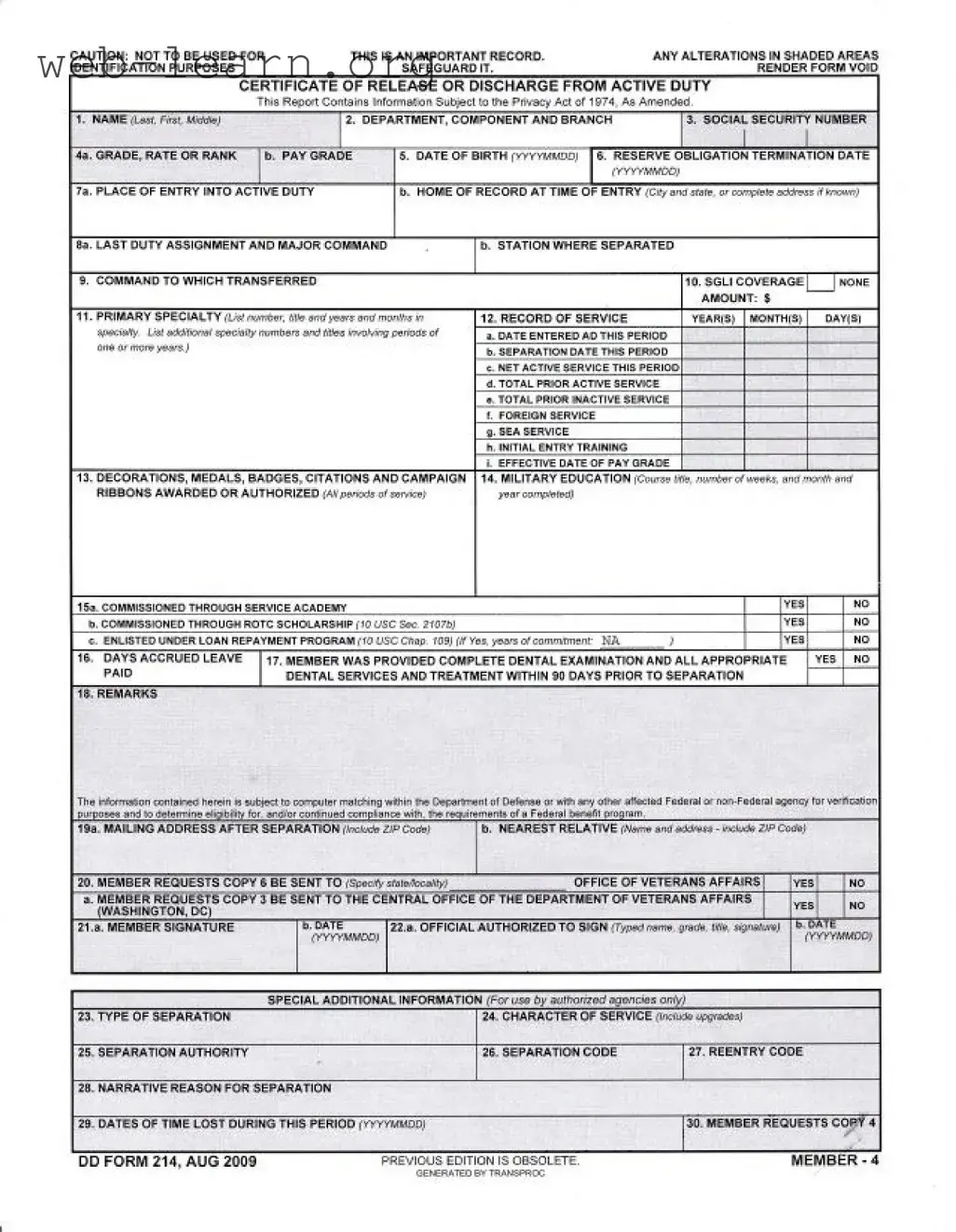
The DD Form 214, officially known as the Certificate of Release or Discharge from Active Duty, serves as a crucial document for military personnel transitioning to civilian life. It encapsulates a variety of essential information that validates a service member's time in the military. This form includes details such as the individual's name, social security number, and rank, as well as the dates of service and the character of discharge. Notably, it records any decorations, medals, or citations awarded during service, which can be vital for benefits and recognition. The DD 214 also outlines the member's military education and training, providing a comprehensive overview of their qualifications. Importantly, it is not merely a formality; it is a protected document under the Privacy Act of 1974, requiring careful handling to maintain its integrity. Given its significance, the DD Form 214 plays a pivotal role in accessing veterans' benefits, employment opportunities, and various other essential services. Understanding its components and implications can greatly assist veterans in navigating their post-service journey.
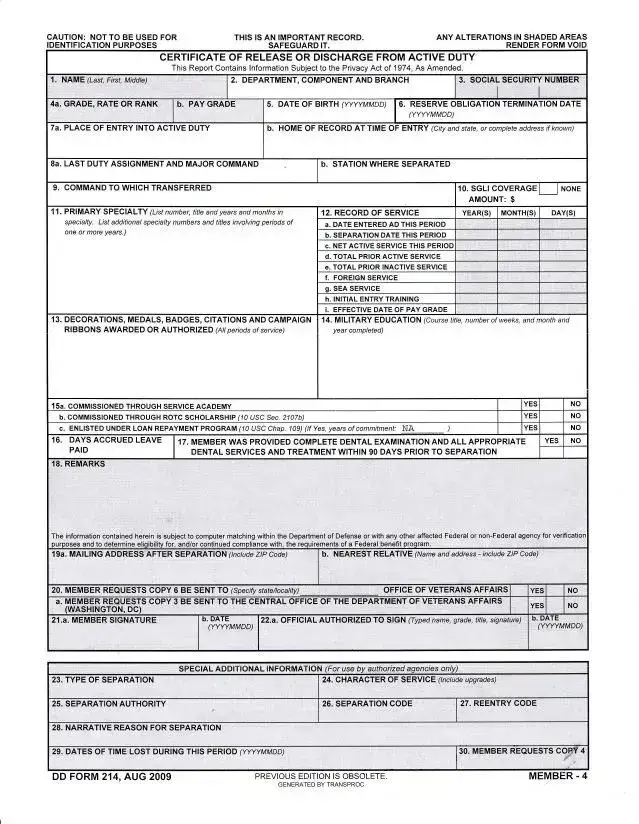
| Fact Name | Description |
|---|---|
| Purpose | The DD Form 214 serves as an official record of a service member's time in the military, documenting their discharge or release from active duty. |
| Privacy Act | This form contains personal information protected under the Privacy Act of 1974, ensuring that it is safeguarded from unauthorized access. |
| Identification | It is important to note that the DD Form 214 is not to be used for identification purposes, despite containing sensitive information. |
| Alterations | Any alterations made in the shaded areas of the form will render it void, emphasizing the need for accuracy and integrity. |
| Separation Codes | The form includes separation codes that categorize the type of discharge, which can affect eligibility for benefits. |
| State-Specific Forms | Some states may have additional forms or requirements related to the DD Form 214, governed by local laws such as California's Military and Veterans Code. |
| Record of Service | The DD Form 214 provides a detailed record of a service member's active duty, including dates of service and any foreign or sea service. |
| Requesting Copies | Members can request copies of their DD Form 214 to be sent to various offices, ensuring they have access to their records after separation. |
| Military Education | The form also documents military education, which can be important for future employment or educational opportunities. |
Filling out the DD 214 form is an important step for service members transitioning from active duty. This form captures key information about your military service. It is crucial to complete it accurately to ensure that your records are correct and that you receive any benefits you may be entitled to.
What is the DD Form 214?
The DD Form 214, also known as the Certificate of Release or Discharge from Active Duty, is an important document issued to military personnel upon their separation from active duty. It provides a summary of a service member's military career, including details such as service dates, rank, and decorations received.
Why is the DD Form 214 important?
This form serves multiple purposes. It is often required for veterans to access benefits such as healthcare, education, and employment. It is also used for identification purposes, although it should not be used solely for that. Safeguarding this document is crucial, as any alterations can render it void.
What information is included on the DD Form 214?
The form includes several key pieces of information, such as:
How do I obtain a copy of my DD Form 214?
Veterans can request a copy through the National Archives website or by contacting their branch of service. It may require providing personal information and proof of identity. There may also be options to request copies through the Department of Veterans Affairs.
Can I make changes to my DD Form 214?
Changes can be made, but it is important to follow the proper procedures. Any alterations in shaded areas will void the form. If corrections are necessary, veterans should contact their branch of service for guidance on how to proceed.
What should I do if my DD Form 214 is lost or damaged?
If the DD Form 214 is lost or damaged, it is essential to request a replacement as soon as possible. This can be done through the National Archives or the appropriate military branch. Be prepared to provide identification and other relevant information.
How does the DD Form 214 affect my eligibility for veterans' benefits?
The DD Form 214 is often required to verify service for various veterans' benefits, including healthcare, education, and housing assistance. It is critical to ensure that the form accurately reflects service details to avoid complications when applying for these benefits.
What does the character of service mean on the DD Form 214?
The character of service indicates the nature of a service member's discharge. It can range from "Honorable" to "Other Than Honorable." This designation can impact eligibility for benefits and future employment opportunities.
Is the DD Form 214 the same for all branches of service?
While the DD Form 214 is standardized across all branches of the military, there may be slight variations in formatting or specific information included. Each branch ensures that the form meets its unique requirements while adhering to federal guidelines.
Can I use my DD Form 214 for identification purposes?
The DD Form 214 is not intended for identification purposes. However, it can serve as a supporting document when applying for other forms of identification or benefits. Always safeguard this document to prevent unauthorized use.
Filling out the DD Form 214 can be a daunting task, and mistakes can lead to significant issues down the line. One common error occurs when individuals fail to provide their correct Social Security number. This number is critical for identification and benefits processing. A simple typographical error can result in delays or complications in obtaining necessary services.
Another frequent mistake is neglecting to accurately list the dates of service. It is essential to include the exact dates of entry into and separation from active duty. Omitting this information or providing incorrect dates can affect eligibility for various veteran benefits and services.
Many individuals also overlook the importance of including their correct mailing address after separation. This address is vital for receiving important documents and communications from the Department of Veterans Affairs. An outdated or incorrect address can lead to missed notifications or benefits.
Additionally, some people may fail to check the boxes regarding the request for copies of the form to be sent to relevant offices. This oversight can result in a lack of documentation for future reference, which may hinder access to benefits or services.
Another common error involves not signing the form or dating it appropriately. The signature and date are crucial for validating the document. Without these, the form may be considered incomplete and could be rejected by the processing office.
Lastly, individuals sometimes forget to review the remarks section for any additional information that may be required. This section can provide context or clarify specific circumstances related to the service member’s separation. Failing to complete this area can lead to misunderstandings or delays in processing the form.
The DD Form 214 is a crucial document for military service members, providing a summary of their service. However, several other forms and documents are often used in conjunction with the DD 214 to ensure a smooth transition from military to civilian life. Below are five important documents that may accompany the DD 214.
These documents, along with the DD 214, play a vital role in helping veterans access the benefits and services they have earned. Understanding and properly utilizing these forms can significantly ease the transition process and ensure that veterans receive the support they need.
The DD Form 214 is a vital document for military service members, detailing their service history and discharge status. Several other documents serve similar purposes in different contexts. Here are seven documents that share characteristics with the DD Form 214:
Each of these documents plays a crucial role in documenting a service member's military history and benefits eligibility, just as the DD Form 214 does.
When filling out the DD 214 form, there are several important guidelines to follow. Below is a list of things you should and shouldn't do.
The DD Form 214, officially known as the Certificate of Release or Discharge from Active Duty, is a crucial document for military personnel. However, several misconceptions surround its purpose and usage. Here are seven common misunderstandings:
Understanding these misconceptions can help service members and veterans navigate their rights and responsibilities more effectively. The DD 214 is an important document, and knowing its true purpose can facilitate better access to benefits and services.
Here are some key takeaways about filling out and using the DD 214 form: