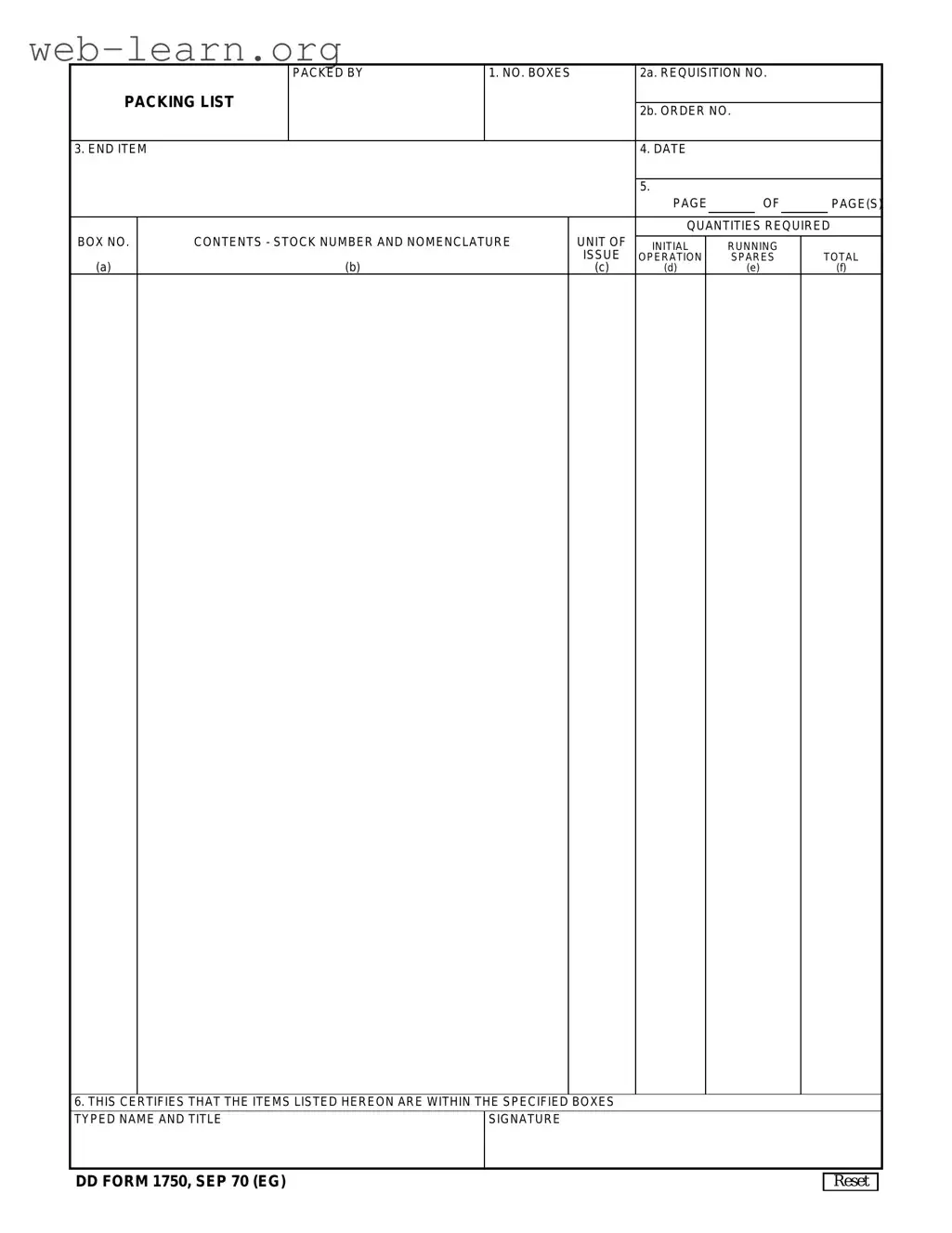
The DD Form 1750 serves as a crucial packing list utilized within the Department of Defense, primarily for the shipment and inventory of military equipment and supplies. This form details essential information, including the number of boxes in a shipment, requisition and order numbers, and the end item being shipped. It requires the date of preparation and provides a breakdown of contents per box, listing stock numbers and nomenclature for each item. The form also distinguishes between items necessary for initial operation and those designated as running spares. Notably, it includes a certification statement, affirming that the items listed are contained within the specified boxes. Additionally, the reverse side of the form offers guidance for consignees, outlining how to interpret the entries and manage the documentation effectively. Understanding the DD Form 1750 is vital for ensuring accurate inventory management and compliance with military logistics standards.

|
|
PACKED BY |
1. NO. BOXES |
|
2a. REQUISITION NO. |
|
|
||
PACKING LIST |
|
|
|
|
|
|
|
|
|
|
|
|
2b. ORDER NO. |
|
|
||||
|
|
|
|
|
|
|
|||
|
|
|
|
|
|
|
|
|
|
3. END ITEM |
|
|
|
|
4. DATE |
|
|
|
|
|
|
|
|
|
|
|
|
|
|
|
|
|
|
|
5. |
|
|
|
|
|
|
|
|
|
PAGE |
|
OF |
|
PAGE(S) |
|
|
|
|
|
|
|
|
|
|
BOX NO. |
CONTENTS - STOCK NUMBER AND NOMENCLATURE |
UNIT OF |
QUANTITIES REQUIRED |
||||||
INITIAL |
RUNNING |
TOTAL |
|||||||
(a) |
|
(b) |
|
ISSUE |
OPERATION |
SPARES |
|||
|
|
(c) |
(d) |
(e) |
|
(f) |
|||
6. THIS CERTIFIES THAT THE ITEMS LISTED HEREON ARE WITHIN THE SPECIFIED BOXES
TYPED NAME AND TITLE |
SIGNATURE |
DD FORM 1750, SEP 70 (EG)
Reset

NOTES TO CONSIGNEE
The listing shown on the reverse side, together with pertinent notations relative to each item included, is furnished for your information and guidance only. In the case of lists covering equipment sets, one copy may be retained for reference and used as a supporting document to property books and the other copy retained with the equipment as a component parts listing. For the purpose of clarification, explanations of the various entries on this Packing List are furnished.
ITEM 1. The number of boxes in a set.
ITEMS 2a. & b. The requisition number appearing on the DD Form
ITEM 3. The stock number, nomenclature, type number (when available), and the directive under which the end item was assembled. Not applicable to shipments consisting only of miscellaneous repair parts and accessories for the assembly, set or unit in which case this entry will contain such a notation in lieu of the information cited above (See 5.3.1.1).
ITEM 4. Date of preparation.
ITEM 5.
Column a. This column will be used when two or more boxes are required for the equipment. It will indicate the number of the container in which the items are packed.
Column b. This space contains a listing of items contained within the box, which are identified by stock number and nomenclature. When an FSN is not
applicable, the manufacturer's code (See 5.2.2.10) and part number shall be used.
NOTE: As required, due to out of stock position within the DOD supply system, a component parts shortage which will not hinder operational functions may be waived by higher authority and will be so indicated to the right of the nomenclature. Waivers noted thereon should be requisitioned through normal supply channels.
Column c.
Column d. "Initial Operation" - Items which are required for operation of the equipment.
Column e. "Running Spares" - Those items shipped concurrently with the equipment as spare parts and accessories.
NOTE: Columns d and e will be used on an optional basis.
"Total" -
ITEM 6.
DD FORM 1750 Reverse, SEP 70
| Fact Name | Fact Description |
|---|---|
| Form Purpose | The DD Form 1750 is used as a packing list for military shipments. |
| Form Sections | The form includes sections for box numbers, requisition numbers, and item descriptions. |
| Item Certification | It certifies that the items listed are packed in the specified boxes. |
| Preparation Date | The date of preparation is recorded on the form for tracking purposes. |
| Box Numbering | Each box in a set is numbered for easy identification. |
| Stock Number | Items are identified by stock number and nomenclature for clarity. |
| Operation Items | Columns are provided to indicate items required for initial operation. |
| Running Spares | Running spares can be listed, which are shipped as spare parts. |
| Reference Notes | Notes on the reverse side provide guidance on using the form effectively. |
| Governing Law | This form is governed by Department of Defense regulations. |
Filling out the DD 1750 form is a straightforward process that ensures your items are properly documented for shipment. Once you complete this form, it will serve as a packing list, detailing the contents of your shipment and providing essential information for the consignee. Follow these steps carefully to ensure accuracy.
After completing the form, ensure all entries are clear and legible. This will facilitate a smooth shipping process and help avoid any potential issues with your shipment.
The DD Form 1750 serves as a packing list for items being shipped within the Department of Defense (DoD) supply system. It provides detailed information about the contents of boxes, including stock numbers and nomenclature, which helps ensure that all necessary items are accounted for during transportation and receipt.
The form requires several key pieces of information, including:
Contents should be listed by stock number and nomenclature in the appropriate columns. Each box's number should also be indicated. If a Federal Stock Number (FSN) is not applicable, the manufacturer's code and part number should be used instead. This ensures clarity and accuracy in identifying the items.
The columns serve specific purposes:
If there is a component parts shortage that does not hinder operational functions, a waiver may be granted by higher authority. This waiver should be noted next to the nomenclature on the form and requisitioned through normal supply channels.
The date on the form should be clearly indicated and formatted in a way that is easily understood. While the form does not specify a particular format, it is generally advisable to use the standard month/day/year format to avoid confusion.
The notes to the consignee provide important guidance regarding the use of the DD Form 1750. They clarify that the information on the reverse side is for reference and should be used to support property books and equipment listings. This ensures that all parties involved in the shipment understand the purpose and use of the form.
The responsibility for completing the DD Form 1750 typically falls on the personnel preparing the shipment. This may include logistics specialists or supply personnel who are knowledgeable about the items being shipped. Their accuracy is crucial for the successful tracking and receipt of the shipment.
Completing the DD Form 1750 accurately is crucial for ensuring proper documentation and shipment of military items. However, several common mistakes can lead to complications. Understanding these pitfalls can help individuals avoid errors.
One frequent mistake is failing to include the requisition number and order number in Items 2a and 2b. These numbers are essential for tracking and referencing shipments. Omitting them can lead to delays and confusion in processing orders.
Another common error involves not providing sufficient details in Item 3. This section requires the stock number, nomenclature, and type number of the end item. Incomplete information can hinder the identification of items, potentially causing issues during receipt or inventory checks.
Many individuals also neglect to fill in the date of preparation in Item 4. This date is important for record-keeping and helps establish a timeline for the shipment. Without it, tracking the shipment's history becomes more challenging.
In Item 5, errors often arise in the listing of box contents. Some people may forget to include the stock number and nomenclature for each item, while others might mistakenly list items that are not in the box. Accurate itemization is critical for ensuring that the correct materials are received.
Another mistake is related to the columns for initial operation and running spares. In Items 5d and 5e, individuals sometimes fail to differentiate between these categories. Properly identifying whether items are for immediate operation or spare parts is vital for inventory management and operational readiness.
Additionally, individuals may overlook the necessity of indicating waivers for component parts shortages. If items are missing but authorized for shipment, this should be noted to prevent misunderstandings upon receipt.
Lastly, many people forget to sign the form in Item 6. The signature certifies that the information provided is accurate and complete. Without it, the form may be considered invalid, leading to further complications.
By being aware of these common mistakes, individuals can ensure that the DD Form 1750 is filled out correctly, facilitating smoother operations and reducing the likelihood of issues during the shipping process.
The DD Form 1750 is a packing list used primarily by the Department of Defense to document the contents of boxes being shipped. It serves as an essential tool for tracking items and ensuring that everything is accounted for during the shipping process. Alongside this form, several other documents may be utilized to provide additional information and support. Here are five commonly used forms and documents that often accompany the DD Form 1750:
Each of these documents plays a vital role in the shipping and logistics process within the Department of Defense. By using them in conjunction with the DD Form 1750, individuals can ensure a smooth and efficient operation, minimizing the risk of errors or misunderstandings. Proper documentation is key to maintaining accountability and transparency throughout the shipping process.
The DD 1750 form serves as a packing list for military shipments, detailing the contents of boxes and their associated requisition numbers. Several other documents share similar functions, helping to ensure accurate tracking and organization of military supplies. Here are four documents that are comparable to the DD 1750:
When filling out the DD 1750 form, attention to detail is crucial. Here are five things you should and shouldn't do to ensure accuracy and compliance.
By following these guidelines, individuals can facilitate a smoother process and reduce the likelihood of errors. Careful attention to the DD 1750 form not only aids in compliance but also supports operational efficiency.
The DD Form 1750 is an important document used in the military for packing lists. However, there are several misconceptions about its purpose and use. Here are six common misunderstandings:
Many believe this form is only necessary for extensive shipments. In reality, it can be used for any size shipment, ensuring that all items are accounted for, regardless of quantity.
Some people think the DD Form 1750 is optional. However, it is a required document for packing lists in military logistics, providing essential information for tracking and accountability.
While primarily used by military personnel, contractors and civilians involved in military logistics also utilize the DD Form 1750 for packing and shipping items.
It is a common belief that only one copy suffices. In fact, multiple copies are often necessary—one for the consignee and another to accompany the equipment.
Some assume that no signature is needed on the form. However, a signature is required to certify that the listed items are accurate and packed correctly.
Although the DD Form 1750 has been in use for many years, it remains relevant and essential in today's military logistics operations, ensuring consistency and accuracy.
Here are some key takeaways about filling out and using the DD Form 1750:
Filling out the DD Form 1750 correctly is essential for smooth logistics operations. Proper documentation ensures that all parties involved have a clear understanding of the shipment's contents and requirements.