Homepage Blank Da 5988 E Form
Outline

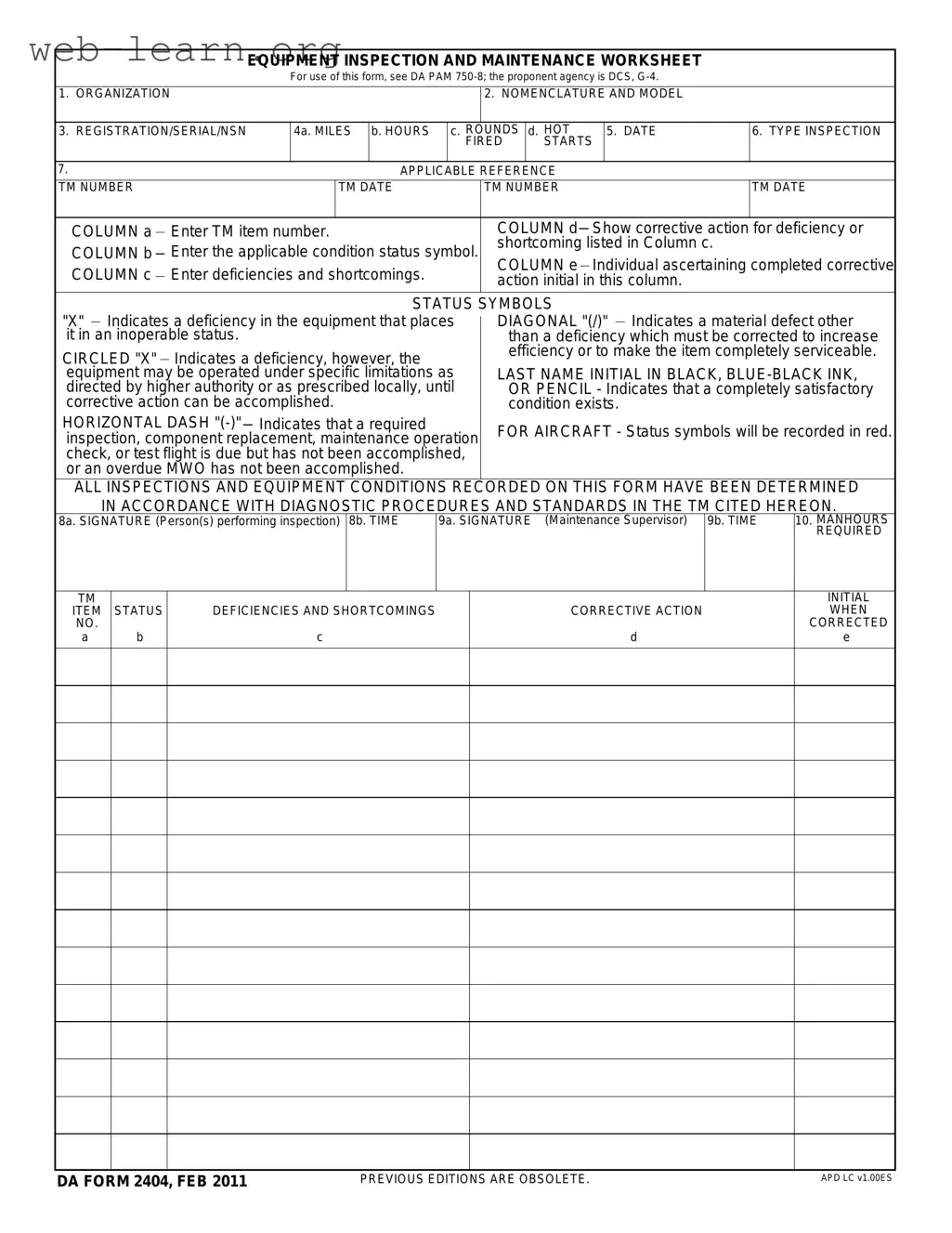
The DA 5988 E form serves as a crucial tool in the management of aircraft maintenance and inspection processes within the military. This form is specifically designed to document the status and condition of equipment, ensuring that all necessary inspections and corrective actions are meticulously recorded. When filling out the DA 5988 E, users must note various important details, including the organization responsible for the equipment, its nomenclature and model, and specific registration or serial numbers. The form also requires the input of vital operational metrics such as miles traveled, hours logged, and fired rounds. Status symbols, which are recorded in red, provide immediate visual cues regarding the equipment's operability and any deficiencies that may exist. For instance, an "X" indicates a deficiency that renders the equipment inoperable, while a circled "X" signifies that the equipment can still operate under certain limitations. This structured approach not only enhances accountability but also streamlines the maintenance process, allowing for timely corrective actions. Ultimately, the DA 5988 E form is an indispensable resource for maintaining the safety and efficiency of military aircraft, ensuring that all inspections and maintenance activities align with established diagnostic procedures and standards.
Sample - Da 5988 E Form

ALL INSPECTIONS AND EQUIPMENT CONDITIONS RECORDED ON THIS FORM HAVE BEEN DETERMINED
IN ACCORDANCE WITH DIAGNOSTIC PROCEDURES AND STANDARDS IN THE TM CITED HEREON.
EQUIPMENT INSPECTION AND MAINTENANCE WORKSHEET
For use of this form, see DA PAM 750-8; the proponent agency is DCS, G-4.
HOT
STARTS
d.
b. HOURS
ROUNDS
FIRED
c.
10.
9a. SIGNATURE
3. REGISTRATION/SERIAL/NSN
1. ORGANIZATION
2. NOMENCLATURE AND MODEL
5. DATE 6. TYPE INSPECTION
APPLICABLE REFERENCE
7.
TM NUMBER TM DATE TM NUMBER TM DATE
COLUMN a
COLUMN b
COLUMN c
Enter TM item number.
Enter the applicable condition status symbol.
Enter deficiencies and shortcomings.
COLUMN d
shortcoming listed in Column c.
Show corrective action for deficiency or
STATUS SYMBOLS
COLUMN e
action initial in this column.
Individual ascertaining completed corrective
Indicates a deficiency in the equipment that places"X"
it in an inoperable status.
Indicates a deficiency, however, the CIRCLED "X"
Indicates that a required
HORIZONTAL DASH "(-)"
Indicates a material defect otherDIAGONAL "(/)"
LAST NAME INITIAL IN BLACK, BLUE-BLACK INK,
FOR AIRCRAFT - Status symbols will be recorded in red.
(Maintenance Supervisor)
MANHOURS
REQUIRED
TM
ITEM
NO.
a
STATUS
b
DEFICIENCIES AND SHORTCOMINGS
c
INITIAL
WHEN
CORRECTED
e
CORRECTIVE ACTION
d
DA FORM 2404, FEB 2011
PREVIOUS EDITIONS ARE OBSOLETE.
APD LC v1.00ES
4a. MILES
8b. TIME 9b. TIME
8a. SIGNATURE (Person(s) performing inspection)
equipment may be operated under specific limitations as
directed by higher authority or as prescribed locally, until
corrective action can be accomplished.
inspection, component replacement, maintenance operation
check, or test flight is due but has not been accomplished,
or an overdue MWO has not been accomplished.
OR PENCIL - Indicates that a completely satisfactory
condition exists.
than a deficiency which must be corrected to increase
efficiency or to make the item completely serviceable.
DEFICIENCIES AND SHORTCOMINGS
TM
ITEM
NO.
a
STATUS
b c
INITIAL
WHEN
CORRECTED
e
CORRECTIVE ACTION
d
DA FORM 2404, FEB 2011
APD LC v1.00ES

Form Information

Fact Name Description
Purpose The DA 5988 E form is used for documenting equipment inspection and maintenance of aircraft.
Status Symbols Status symbols are recorded in red to indicate the condition of the equipment.
Governing Document The form is governed by DA PAM 750-8, which outlines its use and requirements.
Inspection Types Different types of inspections can be recorded, including routine checks and corrective actions.
Condition Codes Condition status symbols include "X," diagonal "(/)," and circled "X," each indicating different operational statuses.
Signature Requirements The form requires signatures from both the person performing the inspection and the maintenance supervisor.
Manhours Tracking It tracks manhours required for maintenance, ensuring accountability and resource management.
Corrective Action Documentation Corrective actions for deficiencies must be documented, along with the initials of the person completing them.
Inspection Records All inspections and equipment conditions recorded are based on diagnostic procedures outlined in the referenced TM.
Obsolescence Notice The form states that previous editions are obsolete, emphasizing the need for using the latest version.

Detailed Guide for Filling Out Da 5988 E

Filling out the DA 5988 E form requires attention to detail and accuracy. This form is essential for documenting the status and maintenance of equipment. Follow these steps to ensure the form is completed correctly.

  1. Organization: Enter the name of your organization in the first section.
  2. Nomenclature and Model: Fill in the specific name and model of the equipment.
  3. Registration/Serial/NSN: Provide the registration number, serial number, or National Stock Number.
  4. Miles, Hours, Fired Rounds, Start Shot: Record the relevant data in the respective columns (4a-d).
  5. Date: Enter the date when the inspection is performed.
  6. Type Inspection: Specify the type of inspection conducted.
  7. Applicable Reference TM Number: Input the TM item number and its corresponding date in the provided columns.
  8. Condition Status Symbol: Enter the applicable status symbol for the equipment condition in the appropriate column.
  9. Deficiencies and Shortcomings: List any deficiencies or shortcomings identified during the inspection.
  10. Corrective Action: Describe the corrective actions taken for each deficiency listed.
  11. Initials: The person performing the inspection should initial in the designated column after corrective actions are completed.
  12. Signatures: Obtain signatures from the person performing the inspection and the maintenance supervisor, along with the respective times.
  13. Manhours Required: Document the total manhours required for the maintenance activities.

Obtain Answers on Da 5988 E

  1. What is the DA 5988 E form used for?

    The DA 5988 E form is an Equipment Inspection and Maintenance Worksheet. It serves as a record for the status of aircraft and other equipment, detailing inspections, deficiencies, and corrective actions taken. This form is essential for maintaining operational readiness and ensuring safety standards are met.

  2. What information is required on the DA 5988 E form?

    The form requires several key pieces of information:

    • Organization
    • Nomenclature and model of the equipment
    • Registration, serial, or NSN number
    • Miles, hours, fired rounds, and start shots
    • Date of inspection
    • Type of inspection performed
    • Applicable reference TM number and date

    Additionally, it includes sections for documenting deficiencies, corrective actions, and signatures of the personnel involved in the inspection.

  3. What do the status symbols on the form indicate?

    Status symbols are used to convey the condition of the equipment:

    • "X" indicates a deficiency that renders the equipment inoperable.
    • Diagonal "(/)" signifies a material defect that needs correction to enhance efficiency.
    • Circled "X" shows a deficiency that allows for operation under specific limitations.
    • Horizontal dash "(-)" denotes overdue inspections or maintenance operations that have not been completed.
  4. How should deficiencies and corrective actions be recorded?

    Deficiencies and shortcomings should be entered in Column c of the form. For each deficiency, the corrective action taken must be documented in Column d. Once the corrective action is completed, the individual responsible should initial in Column e to confirm the correction.

  5. Who is responsible for signing the DA 5988 E form?

    Two signatures are required on the form. The person performing the inspection must sign in Section 8a, while the maintenance supervisor must sign in Section 9a. Both signatures validate the inspection and the subsequent actions taken.

  6. What should be done if a deficiency is identified?

    If a deficiency is identified, it must be recorded on the form. The appropriate corrective actions should be determined and documented. The equipment may be operated under specific limitations if indicated by a circled "X," but it is essential to address the deficiency as soon as possible to ensure safety and operational readiness.

  7. Where can I find more information about the DA 5988 E form?

    For more detailed guidance on the use of the DA 5988 E form, refer to DA PAM 750-8. This document provides comprehensive instructions and standards related to equipment maintenance and inspections.

Common mistakes

Completing the DA 5988 E form can be a straightforward process, but several common mistakes can lead to complications. One frequent error is failing to provide the correct organization information in the designated section. This detail is crucial for tracking and accountability. If the organization name is misspelled or omitted, it can cause confusion and delays in processing the form.

Another mistake often made involves the nomenclature and model entry. It’s essential to ensure that the correct terminology and model numbers are used. Incorrect entries can lead to misidentification of equipment, which may result in improper maintenance or inspections. Always double-check these details against official records.

People also tend to overlook the registration or serial number. This number is vital for tracking the specific piece of equipment. Omitting or incorrectly entering this information can complicate the maintenance history and future inspections. Ensuring accuracy in this section is paramount.

Additionally, the condition status symbol is often filled out incorrectly. Each symbol has a specific meaning, and using the wrong one can misrepresent the equipment's state. For instance, marking an "X" instead of a diagonal line can suggest a different level of urgency regarding repairs. Understanding the symbols and their implications is essential for effective communication.

Another common oversight is in the deficiencies and shortcomings section. Individuals sometimes fail to list all relevant issues or provide vague descriptions. This lack of detail can hinder maintenance efforts, as technicians may not fully understand the problems that need addressing. Clear and specific entries are necessary for effective corrective action.

Moreover, the corrective action column is sometimes left blank or inadequately filled out. This section is crucial for documenting what has been done to resolve the identified issues. If it is not completed properly, it can lead to further misunderstandings and delays in maintenance processes.

Finally, signatures and initials are often a source of confusion. Some individuals neglect to sign or initial in the appropriate areas, which can lead to questions about accountability and the validity of the inspection. Ensuring that all required signatures are obtained and that they are written in the correct ink color is vital to maintaining the form's integrity.

Documents used along the form

The DA 5988 E form, also known as the Equipment Inspection and Maintenance Worksheet, is essential for documenting the status and maintenance of aircraft. Alongside this form, several other documents are frequently utilized to ensure comprehensive tracking and management of equipment maintenance and inspections. Below is a list of five such forms, each serving a specific purpose in the maintenance process.

  • DA Form 2404: This form is used for recording equipment inspection and maintenance actions. It captures deficiencies, corrective actions taken, and the overall status of the equipment. By providing a clear record, it helps maintain accountability and ensures that all necessary repairs are documented.
  • DA Form 2406: Known as the Maintenance Request Form, this document is utilized to request maintenance services for equipment. It outlines the specific issues that need addressing, allowing maintenance personnel to prioritize and manage their workload effectively.
  • DA Form 314: This form is the Equipment Transfer and Acceptance Document. It is used when equipment is transferred between units or organizations. It ensures that all parties involved acknowledge the condition of the equipment at the time of transfer, which is crucial for maintaining accountability.
  • DA Form 5987-E: This is the Vehicle Inspection and Maintenance Record. It serves a similar purpose as the DA 5988 E but is specifically tailored for vehicles. It documents inspections, maintenance actions, and any deficiencies found during the process, ensuring that vehicles are safe and operational.
  • DA Form 2407: This form is the Maintenance Request and Work Order. It is used to initiate maintenance actions and track the progress of repairs. This document helps streamline the maintenance process by providing a formal request and record of actions taken.

These forms collectively enhance the efficiency and effectiveness of maintenance operations. By using them in conjunction with the DA 5988 E, personnel can ensure that all equipment remains in optimal condition, thereby supporting mission readiness and safety.

Similar forms

The DA 5988 E form serves as an essential tool for documenting the status and maintenance of equipment, particularly aircraft. Several other forms share similarities in purpose and structure. Here are ten documents that are comparable to the DA 5988 E form:

  • DA Form 2404: This form is used for equipment inspection and maintenance. Like the DA 5988 E, it records deficiencies, corrective actions, and inspection results. Both forms help ensure that equipment is safe and operational.
  • DA Form 2407: This document is utilized for requesting maintenance. Similar to the DA 5988 E, it captures the status of equipment and any issues that need addressing, facilitating effective communication between operators and maintenance personnel.
  • DA Form 5988-E: This is essentially the electronic version of the DA 5988 E form. It maintains the same structure and purpose, allowing for digital record-keeping while ensuring compliance with maintenance standards.
  • DA Form 3151: Known as the Equipment Transfer Document, it tracks the transfer of equipment between units. It shares the focus on equipment status, ensuring that all parties are aware of any existing deficiencies before the transfer occurs.
  • DA Form 2406: This form is used for documenting equipment condition and maintenance actions. Like the DA 5988 E, it emphasizes the importance of recording deficiencies and the actions taken to resolve them.
  • DA Form 2028: This document is used for submitting a request for a change to an existing publication. It is similar in that it addresses the need for updates based on equipment condition and maintenance findings, ensuring that all records are accurate and current.
  • DA Form 7382: This form is used for equipment status reporting. It provides a summary of the equipment's operational condition, much like the DA 5988 E, focusing on deficiencies and necessary actions to maintain readiness.
  • DA Form 2405: The Maintenance Request form is used to report issues with equipment. It serves a similar purpose to the DA 5988 E by documenting deficiencies and facilitating corrective actions through maintenance requests.
  • DA Form 4137: This document is for the transfer of property. It parallels the DA 5988 E in that it ensures all equipment status is recorded accurately, particularly concerning any deficiencies before the property changes hands.
  • DA Form 3266: This form is used for tracking equipment maintenance history. It shares the goal of ensuring that all maintenance actions are documented, similar to the DA 5988 E, helping maintain a comprehensive record of equipment status.

Each of these forms plays a crucial role in the maintenance and inspection process, ensuring that equipment remains safe and functional. Understanding their similarities can help streamline the documentation process and enhance operational readiness.

Dos and Don'ts

When filling out the DA 5988 E form, it is essential to follow specific guidelines to ensure accuracy and compliance. Here are four key things to do and avoid:

  • Do use black or blue-black ink when signing the form. This ensures clarity and professionalism.
  • Do accurately record all deficiencies and shortcomings in Column c. This information is crucial for proper maintenance and inspection.
  • Don't leave any columns blank. Each section of the form must be completed to provide a comprehensive overview of the equipment's status.
  • Don't use red ink or pencil for signatures. This can lead to confusion and may not be accepted as valid documentation.

Misconceptions

Misconceptions about the DA 5988 E form can lead to confusion regarding its purpose and usage. Here are six common misconceptions:

  • The DA 5988 E form is only for aircraft. Many believe this form is exclusive to aircraft inspections. In reality, it is used for various types of equipment, not just aircraft.
  • Status symbols are optional. Some think that recording status symbols is not necessary. However, these symbols are crucial for indicating the condition of the equipment and ensuring proper maintenance.
  • Any ink can be used for signatures. It is often assumed that any type of ink is acceptable. In fact, signatures must be made in black, blue-black ink, or pencil to ensure clarity and consistency.
  • Deficiencies can be ignored if they are not critical. There is a misconception that non-critical deficiencies can be overlooked. All deficiencies should be addressed to maintain equipment safety and performance.
  • The form does not require a maintenance supervisor's signature. Some users believe that only the inspector's signature is needed. However, the form requires a signature from both the inspector and the maintenance supervisor for accountability.
  • The DA 5988 E form is only for reporting issues. Many think the form is solely for documenting problems. It also serves as a record of completed inspections and corrective actions taken.

Key takeaways

Filling out and using the DA 5988 E form is essential for effective equipment inspection and maintenance. Here are key takeaways to ensure accurate and efficient use of the form:

  • Organization Information: Always start by accurately entering your organization details in the designated section.
  • Nomenclature and Model: Clearly specify the equipment’s nomenclature and model to avoid confusion.
  • Registration Details: Include the registration, serial number, or National Stock Number (NSN) for precise identification.
  • Status Symbols: Use red ink to record status symbols, which indicate the operational condition of the equipment.
  • Inspection Types: Document the type of inspection being performed to provide context for the findings.
  • Deficiencies and Shortcomings: Clearly list all deficiencies and shortcomings in the appropriate column for transparency.
  • Corrective Actions: Note the corrective actions taken to address any deficiencies, ensuring that all steps are documented.
  • Initials for Verification: The individual performing the inspection should initial the form to confirm that corrective actions have been completed.
  • Signature Requirements: Both the person performing the inspection and the maintenance supervisor must sign and date the form to validate the findings.
  • Manhours Tracking: Record the manhours required for maintenance tasks to aid in future planning and resource allocation.

By following these guidelines, you can ensure that the DA 5988 E form is filled out correctly and used effectively, contributing to the overall safety and efficiency of equipment operations.