Homepage Blank Da 5790 R Form
Outline

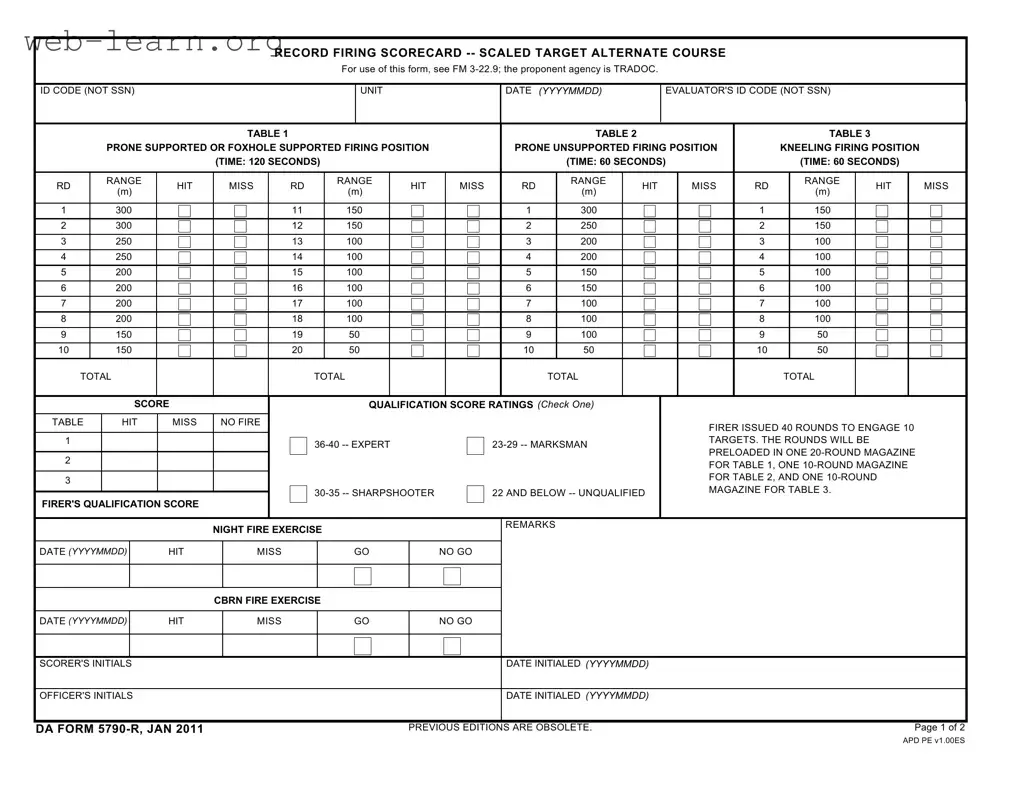
The DA Form 5790-R, known as the Record Firing Scorecard for the Scaled Target Alternate Course, serves a crucial role in the evaluation of marksmanship skills for military personnel. Designed to be utilized when standard record fire and known distance ranges are unavailable, this form allows evaluators to assess a firer's performance under alternative conditions. It is essential for tracking scores across various firing positions, including prone supported, prone unsupported, and kneeling. Each position has specific time limits and scoring criteria, ensuring that the evaluation process is both structured and fair. The form captures essential data such as the number of hits and misses, total scores, and qualification ratings, which range from unqualified to expert. Furthermore, it includes provisions for additional exercises like night fire and CBRN fire, ensuring comprehensive assessment capabilities. By adhering to the guidelines outlined in the form, evaluators can provide a detailed account of each firer's capabilities, contributing to their overall training and readiness.
Sample - Da 5790 R Form

RECORD FIRING SCORECARD -- SCALED TARGET ALTERNATE COURSE
For use of this form, see FM 3-22.9; the proponent agency is TRADOC.
DA FORM 5790-R, JAN 2011
PREVIOUS EDITIONS ARE OBSOLETE.
ID CODE (NOT SSN) UNIT DATE
(YYYYMMDD)
EVALUATOR'S ID CODE (NOT SSN)
APD PE v1.00ES
Page 1 of 2
SCORE
1
2
3
1
2
3
4
5
6
7
8
9
10
300
250
200
200
150
150
100
100
100
50
150
150
100
100
100
100
100
100
50
50
300
300
250
250
200
200
200
200
150
150
1
2
3
4
5
6
7
8
9
10
1
2
3
4
5
6
7
8
9
10
150
150
100
100
100
100
100
100
50
50
11
12
13
14
15
16
17
18
19
20
FIRER'S QUALIFICATION SCORE
REMARKS
DATE INITIALED
(YYYYMMDD)
SCORER'S INITIALS
DATE INITIALED
(YYYYMMDD)
OFFICER'S INITIALS
PRONE SUPPORTED OR FOXHOLE SUPPORTED FIRING POSITION
TABLE 1 TABLE 2
RD
RANGE
(m)
HIT MISS RD
RANGE
(m)
HIT MISS RD
RANGE
(m)
HIT MISS RD
RANGE
(m)
HIT MISS
TOTAL TOTAL TOTAL TOTAL
TABLE HIT MISS NO FIRE
QUALIFICATION SCORE RATINGS
(Check One)
FIRER ISSUED 40 ROUNDS TO ENGAGE 10
TARGETS. THE ROUNDS WILL BE
PRELOADED IN ONE 20-ROUND MAGAZINE
FOR TABLE 1, ONE 10-ROUND MAGAZINE
FOR TABLE 2, AND ONE 10-ROUND
MAGAZINE FOR TABLE 3.
(YYYYMMDD)
DATE HIT MISS GO NO GO
HIT MISS GO NO GO
NIGHT FIRE EXERCISE
(YYYYMMDD)
DATE
CBRN FIRE EXERCISE
(TIME: 120 SECONDS) (TIME: 60 SECONDS)
PRONE UNSUPPORTED FIRING POSITION
TABLE 3
(TIME: 60 SECONDS)
KNEELING FIRING POSITION
36-40 -- EXPERT
30-35 -- SHARPSHOOTER
23-29 -- MARKSMAN
22 AND BELOW -- UNQUALIFIED
NOTE
:
If zeroing/grouping exercises are not performed on the day of record fire, six rounds of training/sustainment ammunition will be fired for 25-meter zero confirmation prior to conducting the qualification course.
CONDUCT OF FIRE
(1) Table 1-- Prone Supported Firing Position or (at the unit
commander's discretion) Foxhole Supported Firing Position.
The firer is given one 20-round magazine to engage 10 silhouettes on
the same target sheet. Table 1 includes 2 rounds for each silhouette.
Firing must be completed in 120 seconds. No more than 2 hits are
scored for each silhouette.
(2) Table 2 -- Prone Unsupported Firing Position.
(3) Table 3 -- Kneeling Firing Position.
The firer is given one 10-round magazine to engage 10 silhouettes on
the target sheet. Table 3 includes 2 rounds for each silhouette
positioned at 50 and 100 meters and 1 round for each silhouette
positioned at 150 meters. Firing must be completed in 60 seconds. No
more than 2 hits are scored for the 50- and 100-meter silhouettes, and
1 hit is scored for each 150-meter silhouette.
A
lternate course qualification firers will have one 20-round magazine
and two 10-round magazines. To ensure that firers do not forget which
targets they engaged and shoot a given target more than the
prescribed number of times, firers should adhere to the following
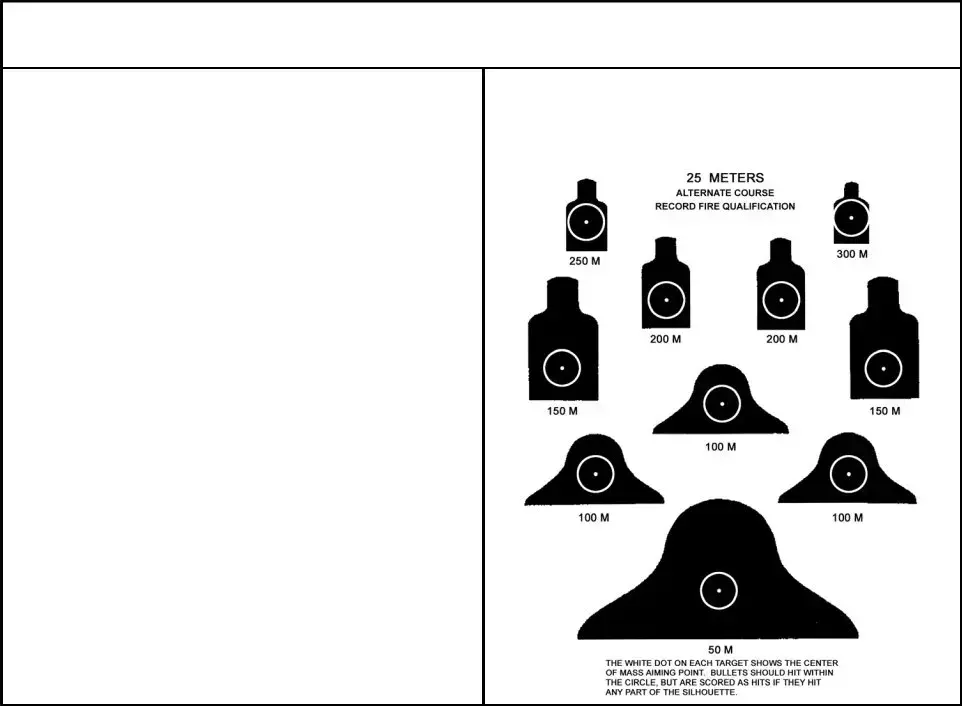
guideline: Engage targets on the sheet from left to right and nearest to
farthest. Engagement should follow this order: 50m, 100m left, 100m
center, 100m right, 150m left, 150m right, 200m left, 200m right,
250m, and 300m.
SCORING
This scorecard is used to score alternate course record fire qualification when the 25-meter scaled silhouette target (NSN 6920-01-167-1398) is used. The alternate course is used only
when standard record fire and known distance ranges are unavailable.
The firer is given one 10-round magazine to engage 10 silhouettes on
the same target sheet. Table 2 includes 1 round for each silhouette.
Firing must be completed in 60 seconds. No more than 1 hit is scored
for each silhouette.
Though the time between each firing position is not specified, enough
time should be allotted to allow the firer to clear his weapon, quickly
change firing positions, and reload before beginning the next firing
table. The range RSO ensures that enough time is given between each
change in firing position to facilitate the timely flow of the record fire
qualification table.
The same target sheet is used for every 40-round qualification table
that a firer completes. One hit is awarded for each round that strikes
within or touches some part of the silhouette. A maximum of 40 hits
is comprised of 3 hits per target at 200, 250, and 300 meters; 4 hits
per target at 150 meters; and 5 hits per target at 50 and 100 meters.
DA FORM 5790-R, JAN 2011
A
PD PE v1.00ES
Page 2 of 2

Form Information

Fact Name Details
Form Title RECORD FIRING SCORECARD -- SCALED TARGET ALTERNATE COURSE
Proponent Agency TRADOC
Governing Laws FM 3-22.9
Qualification Requirements Firer engages targets using three tables with varying positions and time limits.
Scoring Method Hits are counted based on rounds striking or touching the silhouette targets.
Previous Editions Previous editions of the form are considered obsolete.

Detailed Guide for Filling Out Da 5790 R

The DA 5790 R form is essential for recording firing scores during qualification exercises. Properly filling out this form ensures accurate tracking of performance and adherence to military standards. Follow the steps outlined below to complete the form correctly.

  1. Obtain the Form: Ensure you have the most recent version of the DA 5790 R form.
  2. Fill in Personal Information: Enter your ID code (not your Social Security Number), unit, and the date in the format YYYYMMDD.
  3. Evaluator's Information: Provide the evaluator's ID code (also not a Social Security Number).
  4. Record Firing Positions: For each firing position in Tables 1, 2, and 3, enter the range and record hits and misses. Use the provided table structure to organize this information.
  5. Total Scores: Calculate and enter the total hits for each table and the overall qualification score.
  6. Qualification Ratings: Check the appropriate box that corresponds to your qualification rating based on the total score achieved.
  7. Record Night Fire and CBRN Exercises: Fill in the dates and scores for any night fire or CBRN fire exercises, indicating whether the result was a hit or miss.
  8. Scorer's and Officer's Initials: Obtain the initials of the scorer and the officer, along with the respective dates in YYYYMMDD format.

After completing these steps, review the form for accuracy. Submit it according to your unit's procedures to ensure proper documentation of your firing qualification results.

Obtain Answers on Da 5790 R

  1. What is the purpose of the DA 5790 R form?

    The DA 5790 R form, also known as the Record Firing Scorecard, is used to document the qualification scores of individuals during alternate course record fire exercises. This form is specifically designed for situations where standard record fire and known distance ranges are not available. It allows evaluators to track performance across various firing positions and distances.

  2. What are the different tables included in the DA 5790 R form?

    The form consists of three main tables that assess different firing positions:

    • Table 1: Prone Supported or Foxhole Supported Firing Position. This table allows the firer to engage 10 silhouettes using a 20-round magazine within 120 seconds.
    • Table 2: Prone Unsupported Firing Position. In this table, the firer uses a 10-round magazine to engage 10 silhouettes in 60 seconds.
    • Table 3: Kneeling Firing Position. This table requires the firer to engage 10 silhouettes with a 10-round magazine, also within 60 seconds.
  3. How is scoring conducted on the DA 5790 R form?

    Scoring on the DA 5790 R form is based on the number of hits achieved on the target silhouettes. Each silhouette hit counts as one point. The maximum score for the qualification is 40 hits, which can be achieved by hitting the targets according to specific guidelines based on distance. For example, firers can score up to 5 hits per target at 50 and 100 meters, while fewer hits are allowed at greater distances.

  4. What should be done if zeroing/grouping exercises are not performed on the day of record fire?

    If zeroing or grouping exercises are not completed on the day of record fire, it is essential to fire six rounds of training or sustainment ammunition for zero confirmation at a 25-meter range before proceeding with the qualification course. This step ensures that the firer's aim is accurate before engaging in the qualification exercises.

Common mistakes

When filling out the DA 5790 R form, individuals often make several common mistakes that can affect the accuracy of the information recorded. One significant error is failing to provide the correct ID code. Instead of entering a Social Security Number, the form specifically requests an ID code. This mistake can lead to delays in processing and potential issues with record keeping.

Another frequent oversight involves the date format. The form requires dates to be entered in the YYYYMMDD format. Some people may enter dates in a different format, such as MM/DD/YYYY, which can create confusion and result in incorrect data entry.

Many individuals also neglect to double-check the total scores calculated for each table. Each table has specific scoring rules, and incorrect tallies can lead to inaccurate qualification ratings. This is particularly important since qualification scores determine a firer's status and future training requirements.

In addition, errors can occur in marking the hit and miss columns. It is essential to accurately record each shot's result. Miscounting hits or misses can skew the final score and affect the qualification outcome.

Some users might overlook the requirement to initial the scorer's and officer's sections. These initials confirm that the scores have been verified and approved. Failing to include these initials can lead to questions about the legitimacy of the scores submitted.

Another common mistake is not following the prescribed order of target engagement. The instructions recommend engaging targets from left to right and from nearest to farthest. Ignoring this guideline can result in unnecessary confusion during the qualification process.

Additionally, individuals may forget to account for the time constraints for each firing table. Each table has specific time limits, and not adhering to these can lead to disqualification or an incomplete score.

People sometimes fail to consider the ammunition distribution across the magazines. Each table requires a specific number of rounds, and not loading the magazines correctly can disrupt the flow of firing and affect the overall qualification.

Lastly, individuals may not pay attention to the notes regarding zeroing/grouping exercises. If these exercises are not performed on the day of record fire, it is crucial to fire six rounds for zero confirmation. Neglecting this step can impact the accuracy of the qualification attempt.

Documents used along the form

The DA Form 5790-R is an essential document for scoring alternate course record fire qualifications. It is often used alongside several other forms and documents that assist in the qualification process. Below is a list of these commonly associated forms, each serving a specific purpose in the overall evaluation and documentation of firearm proficiency.

  • DA Form 705 - This is the Army Physical Fitness Test Scorecard. It records the results of physical fitness tests, which may be relevant for overall soldier readiness and capabilities.
  • DA Form 5500 - This form is used for body fat content worksheets. It helps ensure that soldiers meet Army standards for body composition, which can affect eligibility for certain qualifications.
  • DA Form 31 - The Request and Authority for Leave form is crucial for documenting any leave taken by soldiers during training or qualification periods, ensuring proper records are maintained.
  • DA Form 2-1 - This is the Personnel Qualification Record. It provides a comprehensive overview of a soldier’s training, qualifications, and assignments, including marksmanship scores.
  • DA Form 4187 - The Personnel Action form is used to document various personnel actions, such as promotions or reassignments, which may impact a soldier's training opportunities.
  • DA Form 600-9 - This is the Army Weight Control Program form. It is used to track soldiers' compliance with weight standards, which can influence their ability to participate in qualification exercises.
  • DA Form 3508 - This form is for the Military Occupational Specialty (MOS) Qualification. It ensures that soldiers are qualified for their specific job roles, which can include weapon handling and marksmanship.
  • DA Form 2404 - This is the Equipment Inspection and Maintenance Worksheet. It documents the condition of weapons and equipment, ensuring that all gear is operational and ready for qualification exercises.

Each of these forms plays a vital role in the qualification process and helps maintain accurate records for soldiers. Together, they ensure that all necessary information is captured and that soldiers meet the required standards for marksmanship and overall readiness.

Similar forms

  • DA Form 5791: This form is also a record firing scorecard but is used for standard qualification courses. It focuses on different firing positions and distances, similar to the DA Form 5790 R, but does not utilize the alternate course when standard ranges are available.
  • DA Form 5792: Like the DA Form 5790 R, this document serves as a qualification scorecard for night firing exercises. It includes sections for recording hits and misses, but it is specifically tailored for low-light conditions, ensuring that night firing qualifications are accurately assessed.
  • DA Form 4980: This form is used for documenting weapon qualification scores for individual soldiers. It is similar in that it tracks performance and scores, but it covers a broader range of weapons and training exercises, rather than focusing solely on the scaled target alternate course.
  • DA Form 3500: This document is a training and evaluation record that includes firing scores among other training elements. It is similar to the DA Form 5790 R in that it assesses soldier performance, but it encompasses a wider array of training activities beyond just firing qualifications.

Dos and Don'ts

When filling out the DA 5790 R form, there are some important guidelines to follow. Here’s a list of what you should and shouldn’t do:

  • Do use the correct ID code, ensuring it is not your Social Security Number (SSN).
  • Do fill in the date in the specified format (YYYYMMDD) for clarity.
  • Do accurately record the number of hits and misses for each firing position.
  • Do ensure that the total scores are calculated correctly for each table.
  • Don't forget to initial and date the scorer's and officer's sections after completing the form.
  • Don't leave any sections blank; every part of the form must be filled out completely.

Following these tips will help ensure that the form is completed accurately and efficiently. Properly filling out the DA 5790 R form is crucial for record-keeping and qualification purposes.

Misconceptions

Understanding the DA 5790 R form is crucial for anyone involved in military training and qualifications. However, several misconceptions can lead to confusion. Here are five common misconceptions about this form:

  • The DA 5790 R form is only for expert marksmen. This is not true. The form is used for all levels of qualification, including unqualified, marksman, sharpshooter, and expert ratings. It serves as a standardized way to assess shooting performance regardless of skill level.
  • Only one type of firing position is allowed on the DA 5790 R form. This is a misconception. The form includes multiple firing positions such as prone supported, prone unsupported, and kneeling. Each position has specific scoring criteria, allowing for a comprehensive evaluation of a firer's abilities.
  • The DA 5790 R form is only applicable in ideal range conditions. This is misleading. The form is specifically designed for use when standard record fire and known distance ranges are unavailable. It provides an alternate course to ensure that training continues effectively under various circumstances.
  • Firing must be completed in a single session. This is incorrect. While the qualification tables have time limits for each firing position, the overall qualification process can include preparation and practice sessions. However, the actual scoring must occur within the specified time frames outlined in the form.
  • Scoring is solely based on the number of hits. This is a misunderstanding. While hits are important, the scoring system also considers the position and distance of the targets. Different targets have different scoring weights, which means that a single hit can be more valuable depending on the target's distance.

Addressing these misconceptions is essential for effective training and qualification. Understanding the DA 5790 R form can lead to improved performance and better preparedness for military engagements.

Key takeaways

When filling out and using the DA Form 5790 R, there are several important points to keep in mind:

  • The form is specifically designed for scoring alternate course record fire qualifications, particularly when standard ranges are not available.
  • Ensure that you use the correct identification codes. Do not use Social Security Numbers; instead, provide the appropriate ID code for both the firer and evaluator.
  • Follow the engagement guidelines carefully. Engage targets from left to right and from nearest to farthest to avoid confusion during the qualification process.
  • Be mindful of the time limits for each table. For example, Table 1 allows 120 seconds, while Tables 2 and 3 each allow 60 seconds for completion.
  • Scoring is based on hits that touch or strike the silhouette. Keep track of the maximum hits allowed per target to ensure accurate scoring.

These takeaways will help ensure that the DA Form 5790 R is filled out correctly and used effectively during qualification exercises.