Homepage Blank D 1 Statement Organization Illinois Form
Outline

The D1 Statement Organization form in Illinois serves as a crucial document for political committees, ensuring transparency and accountability in campaign financing. This form requires committees to provide essential information, including their full name, mailing address, and email contact. Additionally, it mandates the disclosure of the committee's creation date and the initial amount of funds available. Political committees must identify their designation, whether they are a candidate committee, political action committee, or another type, and specify their area of activity and party affiliation. The form also prompts committees to outline their purpose, including any candidates they support or oppose. Furthermore, it mandates the listing of committee officers, custodians of financial records, and financial institutions holding committee funds. In the event of dissolution, the form stipulates how residual funds should be handled. Timely filing is imperative; new committees must submit the form within ten days of creation, or within two days if established within thirty days before an election. Amendments must also be filed promptly to reflect any changes. Overall, the D1 Statement Organization form is a foundational tool for maintaining the integrity of the electoral process in Illinois.
Sample - D 1 Statement Organization Illinois Form

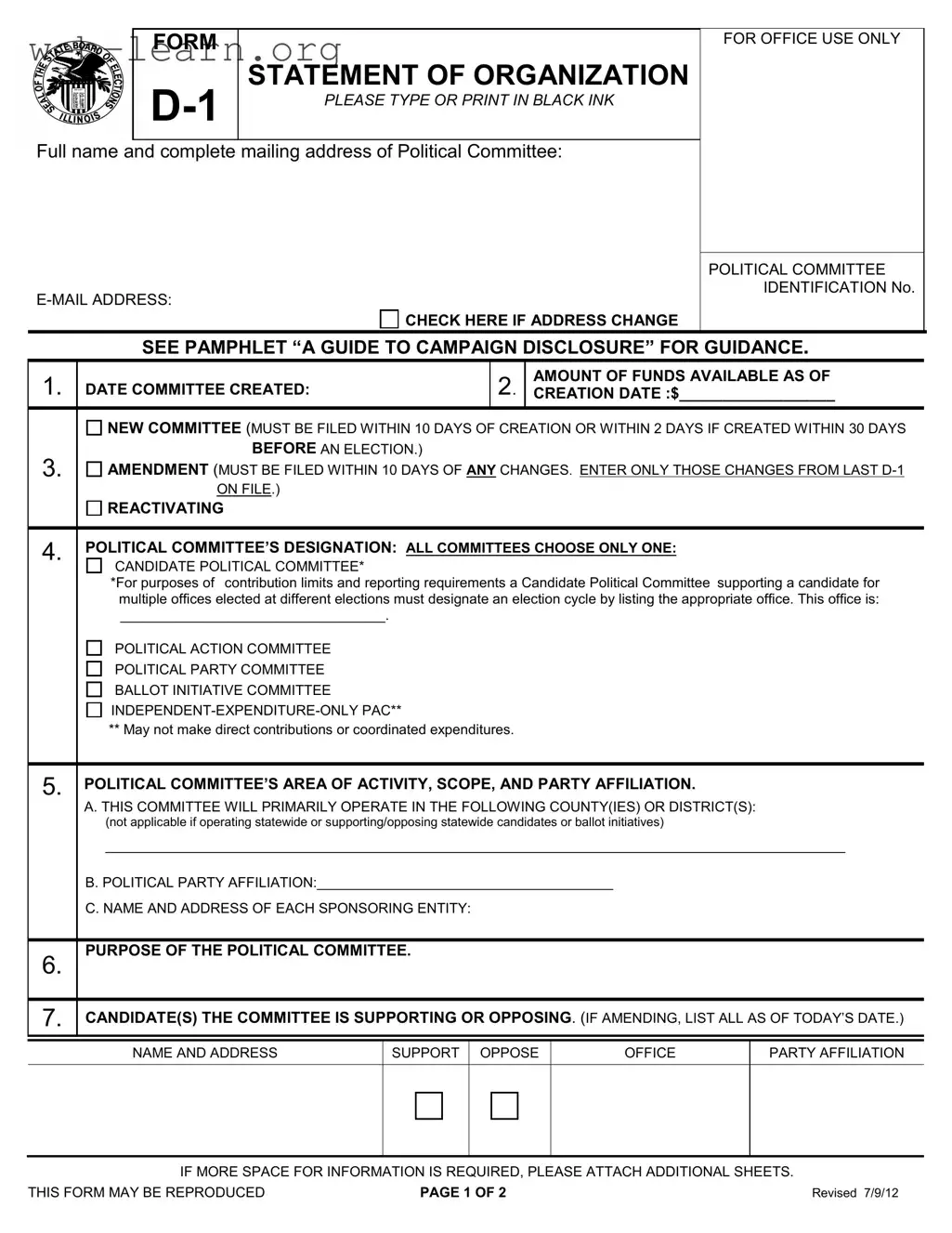
FORM
D-1
STATEMENT OF ORGANIZATION
PLEASE TYPE OR PRINT IN BLACK INK
FOR OFFICE USE ONLY
Full name and complete mailing address of Political Committee:
E-MAIL ADDRESS:
CHECK HERE IF ADDRESS CHANGE
POLITICAL COMMITTEE
IDENTIFICATION No.
SEE PAMPHLET “A GUIDE TO CAMPAIGN DISCLOSURE” FOR GUIDANCE.
1.
DATE COMMITTEE CREATED:
2.
AMOUNT OF FUNDS AVAILABLE AS OF
CREATION DATE :$__________________
3.
NEW COMMITTEE (MUST BE FILED WITHIN 10 DAYS OF CREATION OR WITHIN 2 DAYS IF CREATED WITHIN 30 DAYS
BEFORE
AN ELECTION.)
AMENDMENT (MUST BE FILED WITHIN 10 DAYS OF ANY CHANGES. ENTER ONLY THOSE CHANGES FROM LAST D-1
ON FILE
.)
REACTIVATING
4.
POLITICAL COMMITTEE’S DESIGNATION: ALL COMMITTEES CHOOSE ONLY ONE:
CANDIDATE POLITICAL COMMITTEE*
*For purposes of contribution limits and reporting requirements a Candidate Political Committee supporting a candidate for
multiple offices elected at different elections must designate an election cycle by listing the appropriate office. This office is:
__________________________________.
POLITICAL ACTION COMMITTEE
POLITICAL PARTY COMMITTEE
BALLOT INITIATIVE COMMITTEE
INDEPENDENT-EXPENDITURE-ONLY PAC**
** May not make direct contributions or coordinated expenditures.
5.
POLITICAL COMMITTEE’S AREA OF ACTIVITY, SCOPE, AND PARTY AFFILIATION.
A. THIS COMMITTEE WILL PRIMARILY OPERATE IN THE FOLLOWING COUNTY(IES) OR DISTRICT(S):
(not applicable if operating statewide or supporting/opposing statewide candidates or ballot initiatives)
_______________________________________________________________________________________________
B. POLITICAL PARTY AFFILIATION:______________________________________
C. NAME AND ADDRESS OF EACH SPONSORING ENTITY:
6.
PURPOSE OF THE POLITICAL COMMITTEE.
7.
CANDIDATE(S) THE COMMITTEE IS SUPPORTING OR OPPOSING. (IF AMENDING, LIST ALL AS OF TODAY’S DATE.)
NAME AND ADDRESS SUPPORT OPPOSE OFFICE PARTY AFFILIATION
IF MORE SPACE FOR INFORMATION IS REQUIRED, PLEASE ATTACH ADDITIONAL SHEETS.
THIS FORM MAY BE REPRODUCED
PAGE 1 OF 2 Revised 7/9/12
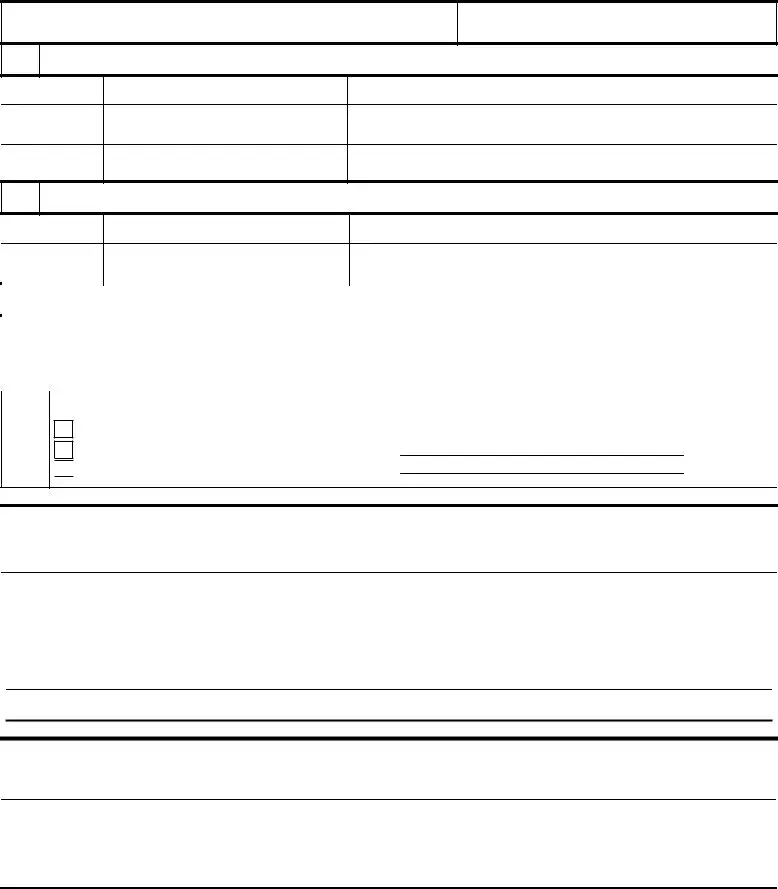
COMMITTEE NAME: POLITICAL COMMITTEE IDENTIFICATION No.:
8.
REQUIRED COMMITTEE OFFICERS.
POSITION NAME
MAILING ADDRESS, DAYTIME PHONE NUMBER, AND E-MAIL ADDRESS
CHAIRMAN
TREASURER
9.
POSITION, NAME & MAILING ADDRESS OF EACH CUSTODIAN OF THE COMMITTEES BOOKS AND ACCOUNTS.
POSITION NAME
MAILING ADDRESS, DAYTIME PHONE NUMBER, AND E-MAIL ADDRESS
10.
LIST OF ALL FINANCIAL INSTITUTIONS AND OTHER REPOSITORIES OF THE COMMITTEE FUNDS.
(IF AMENDING, LIST ALL AS OF TODAY’S DATE.)
NAME MAILING ADDRESS AND PHONE NUMBER
11.
DISPOSITION OF RESIDUAL FUNDS IN THE EVENT OF DISSOLUTION OR TERMINATION OF THE COMMITTEE:
RETURN TO CONTRIBUTORS IN AMOUNTS NOT TO EXCEED THEIR INDIVIDUAL CONTRIBUTIONS.
TRANSFER TO ANOTHER POLITICAL COMMITTEE:
TRANSFER TO A CHARITABLE ORGANIZATION:
IF MORE SPACE FOR INFORMATION IS REQUIRED, PLEASE ATTACH ADDITIONAL SHEETS.
VERIFICATION- BALLOT INITIATIVE COMMITTEES ONLY
I DECLARE THAT THIS BALLOT INITIATIVE COMMITTEE
IS FORMED FOR THE PURPOSE OF SUPPORTING OR OPPOSING A QUESTION OF PUBLIC POLICY, ALL CONTRIBUTIONS AND
EXPENDITURES OF THE COMMITTEE WILL BE USED FOR THE PURPOSE DESCRIBED IN THIS STATEMENT OF ORGANIZATION, THE COMMITTEE MAY ACCEPT UNLIMITED CONTRIBUTIONS FROM
ANY SOURCE, PROVIDED THAT THIS BALLOT INITIATIVE COMMITTEE DOES NOT MAKE CONTRIBUTIONS OR EXPENDITURES IN SUPPORT OF OR OPPOSITION TO A CANDIDATE OR CANDIDATES
FOR NOMINATION FOR ELECTION, ELECTION, OR RETENTION, AND FAILURE TO ABIDE BY THESE REQUIREMENTS SHALL DEEM THIS COMMITTEE IN VIOLATION OF THIS ARTICLE. (10 ILCS 5/9)
PRINTED AND WRITTEN SIGNATURE OF COMMITTEE CHAIRPERSON DATE
VERIFICATION: INDEPENDENT EXPENDITURE
COMMITTEES ONLY
I DECLARE THAT ( i) THIS INDEPENDENT EXPENDITURE COMMITTEE IS FORMED FOR THE EXCLUSIVE PURPOSE OF MAKING INDEPENDENT EXPEN DITURES, ( ii) ALL CONTRIBUTIONS AND
EXPENDITURES O F THE COMMITTEE WILL BE USED FOR T HE PU RPOSE D ESCRIBED I N T HE ST ATEMENT O F O RGANIZATION, ( iii) T HE C OMMITTEE M AY A CCEPT UNL IMITED CO NTRIBUTIONS
FROM ANY SOURCE, PROVIDED THAT THE INDEPENDENT EXPENDITURE COMMITTEE DOES NOT MAKE CONTRIBUTIONS TO ANY CANDIDATE POLITICAL COMMITTEE, POLITICAL PARTY COMMITTEE,
OR POLITICAL ACTION COMMITTEE, AND (iv) FAILURE TO ABIDE BY THESE REQUIREMENTS SHALL DEEM THE COMMITTEE IN VIOLATION OF THIS ARTICLE.
PRINTED AND WRITTEN SIGNATURE OF COMMITTEE CHAIRPERSON DATE
VERIFICATION: ALL POLITICAL COMMITTEES
I DECLARE THAT THIS STATEMENT OF ORGANIZATION (INCLUDING ANY ACCOMPANYING SCHEDULES AND STATEMENTS) HAS BEEN EXAMINED BY ME AND, TO THE BEST OF MY KNOWLEDGE
AND BELIEF, IS A TRUE, CORRECT, AND COMPLETE STATEMENT OF ORGANIZATION AS REQUIRED BY ARTICLE 9 OF THE ELECTION CODE. I UNDERSTAND THAT WILLFULLY FILING A FALSE OR
INCOMPLETE STATEMENT IS SUBJECT TO A CIVIL PENALTY OF AT LEAST $1001 AND UP TO $5000.
PRINTED AND WRITTEN SIGNATURE OF TREASURER OR CANDIDATE DATE
THE ILLINOIS STATE BOARD OF ELECTIONS REQUIRES THE DISCLOSURE OF INFORMATION THAT IS NECESSARY IF YOU QUALIFY AS A POLITICAL COMMITTEE AS
OUTLINED UNDER PUBLIC ACT 78-1183. WILLFUL FAILURE TO FILE OR WILLFUL FILING OF FALSE OR INCOMPLETE INFORMATION REQUIRED BY THIS ARTICLE SHALL
CONSTITUTE A BUSINESS OFFENSE SUBJECT TO A FINE OF UP TO $5000. THIS FORM IS IN COMPLIANCE WITH THE FORMS MANAGEMENT PROGRAM ACT.
ALL POLITICAL COMMITTEES RETURN TO:
STATE BOARD OF ELECTIONS
2329 S MACARTHUR BLVD
SPRINGFIELD, IL 62704-4503
fax: 217-557-5630
e-mail:
D1@ELECTIONS.IL.GOV(D-1s ONLY)
STATE BOARD OF ELECTIONS
JAMES R. THOMPSON CENTER
100 W RANDOLPH ST, STE 14-100
CHICAGO, IL. 60601-3232
fax: 312-814-6485
e-mail:
D1@ELECTIONS.IL.GOV(D-1s ONLY)
www.elections.il.gov PAGE 2 OF 2

Form Information

Fact Name Details
Form Title Form D-1 Statement of Organization
Governing Law Illinois Election Code, Article 9 (10 ILCS 5/9)
Filing Deadline for New Committees Must be filed within 10 days of creation, or within 2 days if created within 30 days before an election.
Amendment Filing Must be filed within 10 days of any changes to the committee information.
Committee Types Options include Candidate Political Committee, Political Action Committee, Political Party Committee, Ballot Initiative Committee, and Independent-Expenditure-Only PAC.
Purpose of the Committee The form requires a clear statement of the committee's purpose and the candidates it supports or opposes.
Required Officers Committees must list the names and contact information of the chairman and treasurer.
Residual Funds In the event of dissolution, funds may be returned to contributors, transferred to another political committee, or donated to a charitable organization.

Detailed Guide for Filling Out D 1 Statement Organization Illinois

Completing the D-1 Statement of Organization form is an important step for political committees in Illinois. This process ensures that your committee is properly registered and compliant with state regulations. Follow these steps carefully to fill out the form accurately.

  1. Provide Committee Information: Type or print the full name and complete mailing address of your political committee at the top of the form. Include an email address and check the box if there is a change of address.
  2. Fill in the Political Committee Identification Number: Leave this blank if you are filing for the first time.
  3. Enter the Date of Committee Creation: Write the date your committee was created.
  4. Indicate Available Funds: Write the amount of funds available as of the creation date.
  5. Select Committee Type: Choose one designation from the options provided: Candidate Political Committee, Political Action Committee, Political Party Committee, Ballot Initiative Committee, or Independent-Expenditure-Only PAC.
  6. Describe Area of Activity: Specify the counties or districts where the committee will primarily operate. If applicable, include the political party affiliation and the name and address of each sponsoring entity.
  7. State the Purpose: Clearly outline the purpose of your political committee.
  8. List Candidates Supported or Opposed: Provide the names and addresses of candidates your committee is supporting or opposing. If you need more space, attach additional sheets.
  9. Identify Committee Officers: List the names, mailing addresses, daytime phone numbers, and email addresses of the chairman and treasurer.
  10. Custodian Information: Provide the position, name, and mailing address of each custodian of the committee’s books and accounts.
  11. Financial Institutions: List all financial institutions and repositories of the committee’s funds, including their addresses and phone numbers.
  12. Residual Funds Disposition: Indicate how residual funds will be handled in the event of dissolution or termination of the committee.
  13. Verification Signature: The committee chairperson must sign and date the form, confirming that all information is true and complete.

After completing the form, ensure that all required signatures are obtained. Submit the form to the appropriate address provided in the instructions. This step is crucial for maintaining compliance with state election laws.

Obtain Answers on D 1 Statement Organization Illinois

  1. What is the D-1 Statement of Organization form?

    The D-1 Statement of Organization form is a document required by the Illinois State Board of Elections. It is used by political committees to officially register and disclose essential information about their organization. This includes the committee's name, purpose, officers, and financial details. Filing this form is crucial for compliance with campaign finance laws in Illinois.

  2. Who needs to file the D-1 form?

    Any political committee operating in Illinois must file the D-1 form. This includes candidate political committees, political action committees, political party committees, ballot initiative committees, and independent expenditure-only PACs. If a committee is created within 30 days before an election, it must file the form within 2 days of its creation.

  3. What information is required on the D-1 form?

    The D-1 form requires several key pieces of information:

    • The full name and mailing address of the committee.
    • The date the committee was created and the amount of funds available at that time.
    • The designation of the committee (e.g., candidate political committee, political action committee).
    • The area of activity, political party affiliation, and purpose of the committee.
    • Details about committee officers and custodians of the committee’s books.
    • Information about financial institutions holding committee funds.
  4. When must the D-1 form be filed?

    The D-1 form must be filed within 10 days of the committee's creation. If the committee is established within 30 days of an election, the form must be submitted within 2 days. Additionally, any amendments to the original form must be filed within 10 days of any changes to the committee's information.

  5. What are the consequences of failing to file the D-1 form?

    Failure to file the D-1 form or submitting false information can result in significant penalties. A civil penalty can range from $1,001 to $5,000. Willful failure to comply with filing requirements may also constitute a business offense, which can lead to additional fines. It is essential for committees to adhere to these regulations to avoid legal repercussions.

Common mistakes

Filling out the D-1 Statement Organization form in Illinois can be a straightforward process if done correctly. However, many individuals encounter common mistakes that can lead to delays or complications. One frequent error is failing to provide the full name and complete mailing address of the political committee. This information is crucial for identification and communication purposes. Incomplete or incorrect addresses can result in important documents not reaching the committee.

Another common mistake is neglecting to check the box for an address change when applicable. If the committee's mailing address has changed since the last filing, this must be indicated clearly. Omitting this step can cause confusion and miscommunication with the State Board of Elections.

Many people also forget to include the date the committee was created. This date is essential for tracking the committee's establishment and determining compliance deadlines. Without this information, the filing may be considered incomplete.

In addition, some individuals inaccurately report the amount of funds available as of the creation date. This figure should reflect the actual funds on hand at that time. Incorrect reporting can lead to financial discrepancies that could raise questions during audits.

Another mistake occurs when committees do not clearly indicate their designation. Selecting the appropriate category—whether it be a candidate political committee, political action committee, or another type—is vital for compliance with specific regulations. Failure to do so can result in misclassification and potential penalties.

Additionally, when detailing the committee's area of activity, some filers may leave sections blank or fail to provide adequate descriptions. This information helps clarify the committee's focus and scope of operations. Lack of detail can hinder the understanding of the committee's purpose and objectives.

Another frequent oversight is not listing all required committee officers. Each officer's position, name, mailing address, and contact information must be included. Incomplete information can lead to complications in communication and accountability.

Lastly, individuals sometimes neglect to specify the disposition of residual funds in the event of the committee's dissolution. This section is important for legal compliance and transparency. Omitting this information can lead to misunderstandings regarding the handling of leftover funds.

By being aware of these common mistakes, individuals can improve their accuracy when completing the D-1 Statement Organization form, ensuring a smoother filing process and compliance with Illinois election laws.

Documents used along the form

The D-1 Statement of Organization form is essential for political committees in Illinois. However, several other documents and forms are often required in conjunction with this form to ensure compliance with state regulations. Below is a list of these documents, along with a brief description of each.

  • Campaign Finance Disclosure Statement: This document provides detailed information about the financial activities of a political committee, including contributions received and expenditures made. It must be filed periodically throughout the election cycle.
  • Independent Expenditure Report: Required for committees making independent expenditures, this report details spending that supports or opposes a candidate without coordination with their campaign.
  • Political Committee Registration Form: This form registers the political committee with the state and provides essential details such as the committee's name, purpose, and officers.
  • Contribution Limit Statement: This document outlines the contribution limits applicable to the committee, ensuring compliance with state laws regarding financial contributions to candidates or parties.
  • Amendment Form: If there are changes to the information provided in the D-1 Statement, this form must be filed to update the state records within a specified timeframe.
  • Termination Statement: When a political committee ceases operations, this form is necessary to officially dissolve the committee and report on the final disposition of funds.
  • Campaign Fundraiser Notice: This notice informs the state about upcoming fundraising events, including details such as the date, location, and expected contributions.
  • Endorsement Form: Used when a political committee endorses a candidate or initiative, this form communicates the committee's support and outlines any associated financial commitments.
  • Statement of Organization for Ballot Initiative Committees: Specifically for committees focused on ballot initiatives, this form outlines the purpose and structure of the committee, similar to the D-1 but tailored for initiative efforts.

Understanding these documents is crucial for compliance with Illinois election laws. Properly completing and submitting the D-1 Statement of Organization along with the necessary accompanying forms helps ensure transparency and adherence to legal requirements in political campaigning.

Similar forms

The D-1 Statement Organization form in Illinois serves as a foundational document for political committees. Several other documents share similar purposes and structures. Here’s a list of nine such documents, each with a brief explanation of how they relate to the D-1 form:

  • Form D-2: Statement of Organization Amendment - Like the D-1, this form is used to update information about a political committee. It must be filed within a specific timeframe after any changes occur, ensuring that the committee’s records remain accurate.
  • Form D-3: Campaign Finance Disclosure Statement - This document details the financial activities of a political committee. It complements the D-1 by providing transparency about contributions and expenditures, which is crucial for accountability.
  • Form D-4: Independent Expenditure Statement - Similar to the D-1, this form is specifically for committees that make independent expenditures. It outlines the purpose and funding sources, ensuring compliance with election laws.
  • Form D-5: Termination of Political Committee - When a political committee is dissolved, this form is used to formally terminate its status. It shares the D-1's focus on official committee status but marks the end rather than the beginning.
  • Form D-6: Contribution Disclosure Statement - This document tracks contributions received by a committee. Like the D-1, it emphasizes the importance of transparency and accountability in political financing.
  • Form D-7: Expenditure Disclosure Statement - Similar to the D-6, this form details the expenditures made by a committee. It ensures that all financial activities are reported, much like the D-1 does for committee organization.
  • Form D-8: Ballot Initiative Committee Statement - This form is specifically for committees formed to support or oppose ballot initiatives. It shares the D-1's purpose of establishing a committee but focuses on public policy questions.
  • Form D-9: Political Party Committee Statement - Like the D-1, this document is used by political parties to register their committees. It highlights the organizational structure and purpose, similar to the D-1’s requirements.
  • Form D-10: Political Action Committee Statement - This form is for political action committees that advocate for specific issues or candidates. It shares the D-1's intent to inform about the committee's formation and activities.

Each of these documents plays a vital role in maintaining the integrity of the political process in Illinois, ensuring that all committees operate transparently and in compliance with state laws.

Dos and Don'ts

When filling out the D-1 Statement of Organization form in Illinois, it is important to follow certain guidelines to ensure accuracy and compliance. Below are six recommendations on what to do and what to avoid.

  • Do use black ink or type your responses clearly to enhance readability.
  • Do provide complete and accurate information for all required fields, including the political committee’s name and mailing address.
  • Do check for any address changes and mark the appropriate box if applicable.
  • Do submit the form within the specified time frames: within 10 days of creation or 2 days if created within 30 days before an election.
  • Don’t leave any fields blank; if a section does not apply, indicate that clearly.
  • Don’t forget to sign and date the form before submission, as an unsigned form may be considered incomplete.

Misconceptions

Understanding the D-1 Statement Organization form in Illinois is crucial for anyone involved in political committees. However, several misconceptions can lead to confusion. Here are ten common misconceptions, clarified:

  1. All political committees must file a D-1 form. Not every group needs to file. Only those meeting specific criteria as defined by the Illinois Election Code are required to submit this form.
  2. The form must be filed immediately after creation. A new committee must file within 10 days of its creation, or within 2 days if created within 30 days before an election.
  3. Amendments are optional. Amendments are mandatory within 10 days of any changes to the committee’s information. Failing to do so can lead to penalties.
  4. Only candidates can form political committees. Political action committees, political party committees, and ballot initiative committees can also file D-1 forms.
  5. There are no limits on contributions. While some committees can accept unlimited contributions, others, like candidate political committees, have specific limits that must be adhered to.
  6. The D-1 form is only about financial information. The form requires details about the committee’s purpose, area of activity, and the candidates it supports or opposes, in addition to financial data.
  7. Once filed, the information is permanent. Information can change, and committees are required to update their D-1 form to reflect any changes in their structure or activities.
  8. All forms are submitted to the same location. Different submission addresses exist for various types of committees. Ensure you send your form to the correct location.
  9. Filing late has no consequences. Late filings can result in civil penalties. It's essential to meet deadlines to avoid fines.
  10. The D-1 form can be filled out casually. Accuracy is critical. Willfully filing false or incomplete information can lead to significant penalties, including fines up to $5,000.

Being aware of these misconceptions can help ensure compliance with Illinois election laws and promote transparency in political activities.

Key takeaways

  • Complete Information: Ensure that the full name and complete mailing address of the political committee are accurately provided on the form.
  • Timely Submission: New committees must file the D 1 Statement within 10 days of creation, or within 2 days if created within 30 days before an election.
  • Amendments: Any changes to the committee must be filed within 10 days. Only the changes from the last D 1 Statement need to be reported.
  • Committee Designation: Select only one designation for the political committee, such as Candidate Political Committee or Political Action Committee.
  • Area of Activity: Clearly indicate the primary county or district where the committee will operate, unless it is statewide.
  • Purpose and Candidates: Specify the purpose of the political committee and list any candidates the committee supports or opposes.
  • Committee Officers: List the required officers, including the chairman and treasurer, along with their contact information.
  • Financial Institutions: Provide a list of all financial institutions where the committee's funds are held, including contact details.