Homepage Blank Ct Resale Certificate Form
Outline

The Connecticut Resale Certificate form serves as a vital tool for businesses engaged in the sale of goods, allowing them to make tax-exempt purchases for resale. Designed for wholesalers, retailers, manufacturers, and lessors, this form streamlines the process of acquiring products without incurring sales tax upfront. When a buyer submits this certificate to a seller, they affirm that the items purchased are intended for resale, or as components of a new product that will eventually be sold, leased, or rented. The form requires the buyer to provide essential information, including their business name, address, and relevant state registration numbers, ensuring that all transactions are properly documented. It also emphasizes the buyer's responsibility to pay any applicable sales or use tax if the purchased items are used in a manner that does not qualify for tax exemption. Valid until canceled or revoked, this certificate becomes part of each order, making it a crucial element of compliance in Connecticut's sales tax framework. By signing the form, an authorized individual confirms the accuracy of the information provided, reinforcing the importance of honesty in tax matters.
Sample - Ct Resale Certificate Form

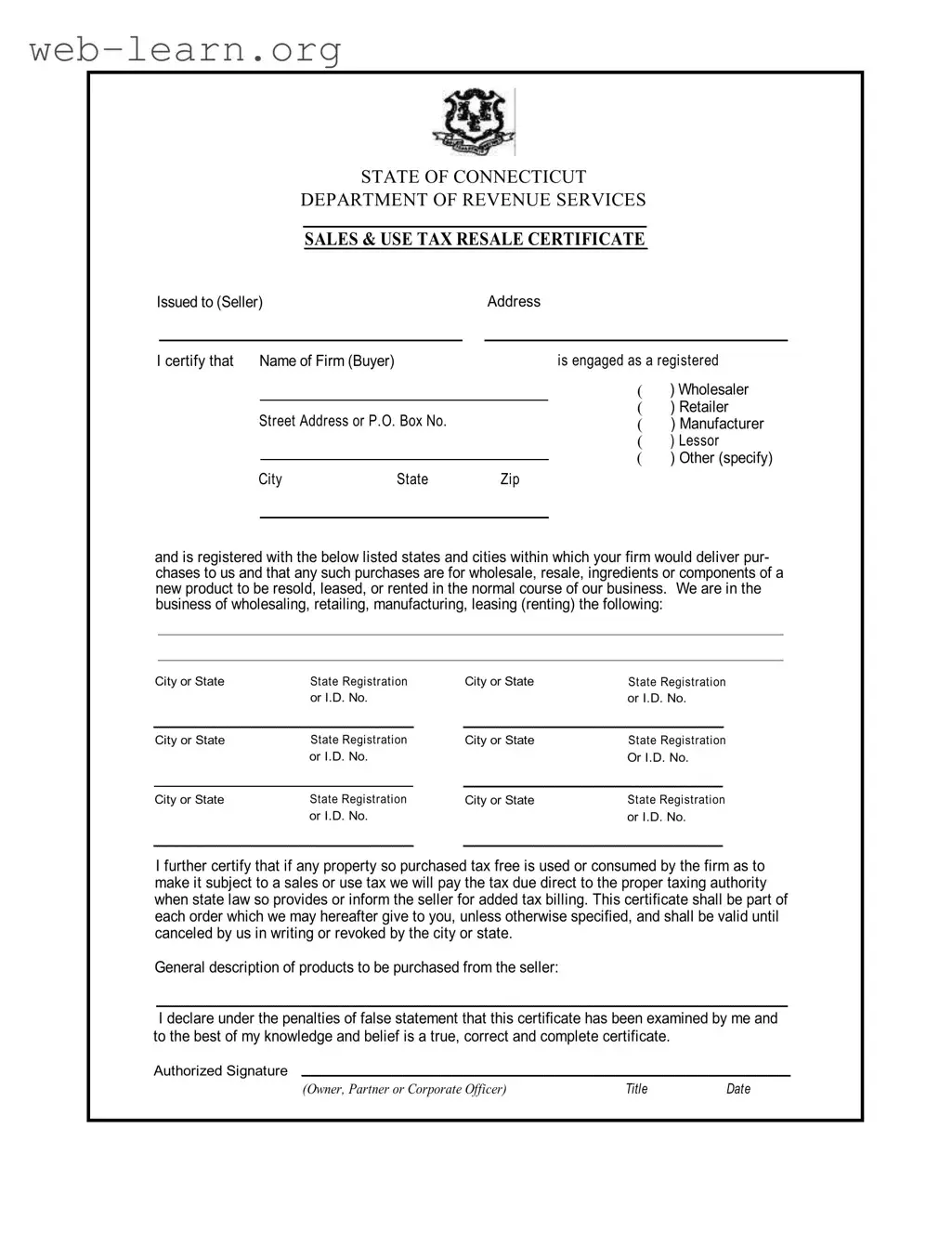
STATE OF CONNECTICUT
DEPARTMENT OF REVENUE SERVICES
SALES & USE TAX RESALE CERTIFICATE
Address
Issued to (Seller)
is engaged as a registered
Name of Firm (Buyer)I certify that
) Wholesaler
(
(
(
(
(
) Retailer
Street Address or P.O. Box No.
) Manufacturer
) Lessor
) Other (specify)
State
City Zip
and is registered with the below listed states and cities within which your firm would deliver pur-
chases to us and that any such purchases are for wholesale, resale, ingredients or components of a
new product to be resold, leased, or rented in the normal course of our business. We are in the
business of wholesaling, retailing, manufacturing, leasing (renting) the following:
State Registration
City or State
City or State
State Registration
or I.D. No.
or I.D. No.
State Registration
City or State
City or State
State Registration
or I.D. No.
Or I.D. No.
State Registration
City or State
State Registration
or I.D. No.
or I.D. No.
I further certify that if any property so purchased tax free is used or consumed by the firm as to
make it subject to a sales or use tax we will pay the tax due direct to the proper taxing authority
when state law so provides or inform the seller for added tax billing. This certificate shall be part of
each order which we may hereafter give to you, unless otherwise specified, and shall be valid until
canceled by us in writing or revoked by the city or state.
General description of products to be purchased from the seller:
I declare under the penalties of false statement that this certificate has been examined by me and
to the best of my knowledge and belief is a true, correct and complete certificate.
Authorized Signature
Date
Title
(Owner, Partner or Corporate Officer)
City or State

Form Information

Fact Name Details
Purpose The Connecticut Resale Certificate is used to purchase items tax-free for resale.
Eligibility Buyers must be registered wholesalers, retailers, manufacturers, or lessors to use this certificate.
Registration Requirement Buyers must provide their state registration or identification number.
Usage This certificate is valid for purchases made in the normal course of business.
Tax Responsibility If items are used instead of resold, the buyer must pay the applicable sales or use tax.
Validity The certificate remains valid until the buyer cancels it in writing or it is revoked by the state.
General Description Buyers must include a description of the products they intend to purchase.
Signature Requirement An authorized signature from the buyer's owner, partner, or corporate officer is required.
Governing Law This form is governed by Connecticut sales and use tax laws.

Detailed Guide for Filling Out Ct Resale Certificate

Filling out the Connecticut Resale Certificate form is a straightforward process that ensures your business can make tax-exempt purchases. Once you complete the form, you can present it to your seller, allowing you to buy goods intended for resale without paying sales tax. Here’s how to fill it out step by step.

  1. Begin by entering the seller's name in the "Issued to (Seller)" section.
  2. Provide the seller's address, including street address, city, state, and zip code.
  3. In the "Name of Firm (Buyer)" section, write the name of your business.
  4. Fill in your business address, including street address or P.O. Box, city, state, and zip code.
  5. Select your business type by checking the appropriate box: Wholesaler, Retailer, Manufacturer, Lessor, or Other. If you select "Other," specify your business type.
  6. List the states and cities where your business is registered. Include the state and city name along with the corresponding registration or ID number for each location.
  7. Provide a general description of the products you intend to purchase from the seller.
  8. Have an authorized individual sign the form. This could be the owner, a partner, or a corporate officer. Include their title and the date of signing.

Obtain Answers on Ct Resale Certificate

  1. What is the purpose of the Connecticut Resale Certificate?

    The Connecticut Resale Certificate is used by businesses to purchase goods without paying sales tax. This form certifies that the buyer intends to resell the purchased items in the normal course of their business. It is essential for wholesalers, retailers, manufacturers, and lessors who need to buy products for resale or as components of new products.

  2. Who can use the Connecticut Resale Certificate?

    This certificate can be utilized by various types of businesses, including:

    • Wholesalers
    • Retailers
    • Manufacturers
    • Lessors
    • Other specified entities

    Each business must be registered with the appropriate state and local authorities to qualify for tax-exempt purchases using this certificate.

  3. How long is the Connecticut Resale Certificate valid?

    The certificate remains valid until it is canceled in writing by the buyer or revoked by the state or city. It is important for the buyer to keep the certificate updated and ensure it is included with every order unless specified otherwise.

  4. What information is required on the Connecticut Resale Certificate?

    The certificate requires several key pieces of information, including:

    • The name and address of the seller
    • The name of the buyer's firm and its address
    • The type of business (wholesaler, retailer, etc.)
    • State registration or identification numbers
    • A general description of the products to be purchased

    Completing this information accurately is crucial for the certificate to be valid.

  5. What happens if the purchased items are used for personal use?

    If any property purchased tax-free is later used or consumed in a manner that subjects it to sales or use tax, the buyer is responsible for paying the tax directly to the appropriate taxing authority. The seller should also be informed for any necessary tax billing adjustments.

  6. How can one obtain a Connecticut Resale Certificate?

    The Connecticut Resale Certificate can typically be obtained from the Connecticut Department of Revenue Services or through various business resources online. Businesses should ensure they are registered properly before using the certificate for tax-exempt purchases.

Common mistakes

Filling out the Connecticut Resale Certificate form can be straightforward, but mistakes can lead to complications. One common error is failing to provide complete information about the seller. Ensure that the seller's name and address are filled out accurately. Missing or incorrect details can delay transactions and create confusion.

Another frequent mistake involves not selecting the correct classification of the buyer's business. The options include wholesaler, retailer, manufacturer, and others. Choosing the wrong category can result in improper tax exemptions, which may lead to unexpected tax liabilities.

Many individuals overlook the requirement to list the state registration or identification numbers. Each state where the buyer is registered should be included. Omitting this information can invalidate the certificate and cause issues during audits.

It's also important to provide a clear description of the products being purchased. Vague descriptions can lead to misunderstandings about what items are covered under the resale certificate. Specify the types of products to avoid any potential disputes with the seller.

Another mistake is failing to sign and date the certificate. An unsigned or undated form is not valid and may be rejected by the seller. Always ensure that an authorized person completes this step to maintain the certificate's legitimacy.

Additionally, some people neglect to inform the seller if they intend to use the purchased items for personal use rather than resale. This can lead to tax complications and potential penalties. Transparency is crucial to avoid any legal issues.

Lastly, not keeping a copy of the completed certificate for personal records can be a significant oversight. Having a copy on hand is essential for future reference and can assist in resolving any disputes that may arise. Always maintain thorough documentation to support your transactions.

Documents used along the form

The Connecticut Resale Certificate form is an important document used in the state for tax-exempt purchases. When engaging in transactions that involve resale, several other forms and documents may also be necessary to ensure compliance with state regulations. Below is a list of commonly used forms and documents that may accompany the Connecticut Resale Certificate.

  • Sales Tax Permit: This document proves that a business is registered to collect sales tax. It is often required for retailers and wholesalers to operate legally.
  • Exempt Use Certificate: Used by buyers to claim exemption from sales tax on certain purchases, this certificate is typically applicable for goods that will not be resold.
  • Purchase Order: A written agreement between a buyer and a seller detailing the items to be purchased, including quantities and prices. This document serves as a formal request for goods or services.
  • Invoice: This document provides a detailed list of goods or services provided by the seller, along with the total amount due. It serves as a record of the transaction.
  • Shipping Document: Often required for the transportation of goods, this document outlines the details of the shipment, including the sender, recipient, and items being shipped.
  • Business License: A legal authorization for a business to operate within a certain jurisdiction. It verifies that the business complies with local regulations.
  • Tax Exemption Certificate: This form allows certain organizations, such as non-profits, to make tax-exempt purchases. It must be presented to the seller at the time of purchase.
  • Supplier Agreement: A contract between a buyer and supplier outlining the terms of the relationship, including pricing, delivery schedules, and payment terms.
  • W-9 Form: This form is used to provide a Taxpayer Identification Number (TIN) to a business that will be paying for services. It is important for tax reporting purposes.
  • Resale Certificate from Other States: If a business operates in multiple states, it may need to provide resale certificates from those states to ensure compliance with varying tax laws.

Each of these documents plays a vital role in the purchasing process and helps ensure that businesses remain compliant with tax regulations. Proper documentation not only facilitates smooth transactions but also protects both buyers and sellers in the event of an audit or inquiry.

Similar forms

The Connecticut Resale Certificate form is a key document for businesses engaging in wholesale and retail transactions. It certifies that the buyer is authorized to purchase goods without paying sales tax, provided those goods are intended for resale. Several other documents serve similar purposes in different contexts. Below is a list of six documents that share similarities with the Connecticut Resale Certificate:

  • Sales Tax Exemption Certificate: This document allows businesses to purchase goods without paying sales tax, similar to the resale certificate. It is often used by non-profit organizations and government entities that are exempt from sales tax.
  • Wholesale License: A wholesale license permits businesses to buy products in bulk without paying sales tax. This document is essential for wholesalers who sell goods to retailers, paralleling the resale certificate's function.
  • Purchase Order: A purchase order is a formal request to a supplier for goods or services. While it does not exempt tax, it is often accompanied by a resale certificate to indicate that the purchase is intended for resale.
  • Manufacturer’s Certificate of Exemption: This certificate is used by manufacturers to purchase raw materials without paying sales tax. Like the resale certificate, it confirms that the items purchased will be used in the production of goods for resale.
  • Tax-Exempt Form: This form is used by eligible organizations to make tax-exempt purchases. It is similar to the resale certificate but is specifically for entities that qualify for tax exemption under state laws.
  • Vendor’s Certificate: A vendor’s certificate allows a seller to collect sales tax on behalf of the state. It serves as proof that the seller is authorized to collect tax, which complements the buyer's resale certificate in transactions.

Dos and Don'ts

When filling out the Connecticut Resale Certificate form, it is crucial to follow specific guidelines to ensure compliance and accuracy. Here are nine important dos and don’ts to consider:

  • Do provide the full legal name of your business in the designated section.
  • Do include the complete address, including city and zip code, for accurate identification.
  • Do specify your business type accurately, selecting from wholesaler, retailer, manufacturer, or lessor.
  • Do list all relevant state registrations or identification numbers where applicable.
  • Do clearly describe the general types of products you intend to purchase from the seller.
  • Don't leave any sections blank; incomplete forms may lead to delays or denials.
  • Don't use outdated or incorrect business names or addresses that do not match your registrations.
  • Don't forget to sign the form; an unsigned certificate is not valid.
  • Don't misrepresent the nature of your business or the intended use of the purchased items.

Adhering to these guidelines can facilitate smoother transactions and ensure compliance with state regulations.

Misconceptions

Misconceptions about the Connecticut Resale Certificate form can lead to confusion for both buyers and sellers. Here are six common misunderstandings:

  • The Resale Certificate is only for retailers. Many believe that only retailers can use this form. In reality, wholesalers, manufacturers, and lessors can also utilize the certificate to purchase items tax-free for resale or use in their business operations.
  • It is a one-time form. Some think the Resale Certificate is a one-time document. However, it remains valid until canceled in writing by the buyer or revoked by the state. It can be used for multiple purchases.
  • All purchases are exempt from tax. There is a misconception that all purchases made with the Resale Certificate are tax-exempt. This is not true. If the purchased items are used or consumed in a way that makes them subject to sales tax, the buyer must pay that tax directly to the appropriate authority.
  • Only specific products can be purchased tax-free. Some individuals believe that only certain products qualify for tax-free purchases. In fact, the certificate can be used for a wide range of items intended for resale, as long as they fall within the business's operations.
  • Buyers do not need to provide their registration information. Another common misunderstanding is that buyers can use the Resale Certificate without providing their state registration or ID number. Buyers must include this information to validate their tax-exempt status.
  • The seller has no responsibilities regarding the certificate. It is often thought that once the seller receives the Resale Certificate, they have no further obligations. Sellers must keep the certificate on file and ensure it is valid to avoid potential tax liabilities.

Understanding these misconceptions can help businesses navigate the use of the Connecticut Resale Certificate more effectively, ensuring compliance and avoiding unnecessary tax issues.

Key takeaways

When filling out and using the Connecticut Resale Certificate form, there are several important points to keep in mind. Here are key takeaways to ensure proper usage:

  • Identify the Buyer: Clearly state the name of the firm (buyer) and provide accurate contact information, including the address. This ensures that the seller can verify your business.
  • Specify Business Type: Indicate whether your business operates as a wholesaler, retailer, manufacturer, lessor, or another category. This classification is crucial for tax purposes.
  • List Registration Information: Include all relevant state and city registration or identification numbers. This information verifies your business's legitimacy and tax-exempt status.
  • Understand Tax Responsibilities: Acknowledge that if any purchased items are used in a manner that subjects them to sales or use tax, you are responsible for paying that tax to the appropriate authority.
  • Keep the Certificate Updated: The resale certificate remains valid until you cancel it in writing or it is revoked by the state or city. Ensure you keep track of any changes in your business status.
  • Signature Requirement: The certificate must be signed by an authorized individual, such as an owner, partner, or corporate officer. This adds a layer of authenticity to the document.

By following these guidelines, businesses can effectively utilize the Connecticut Resale Certificate form while ensuring compliance with tax regulations.