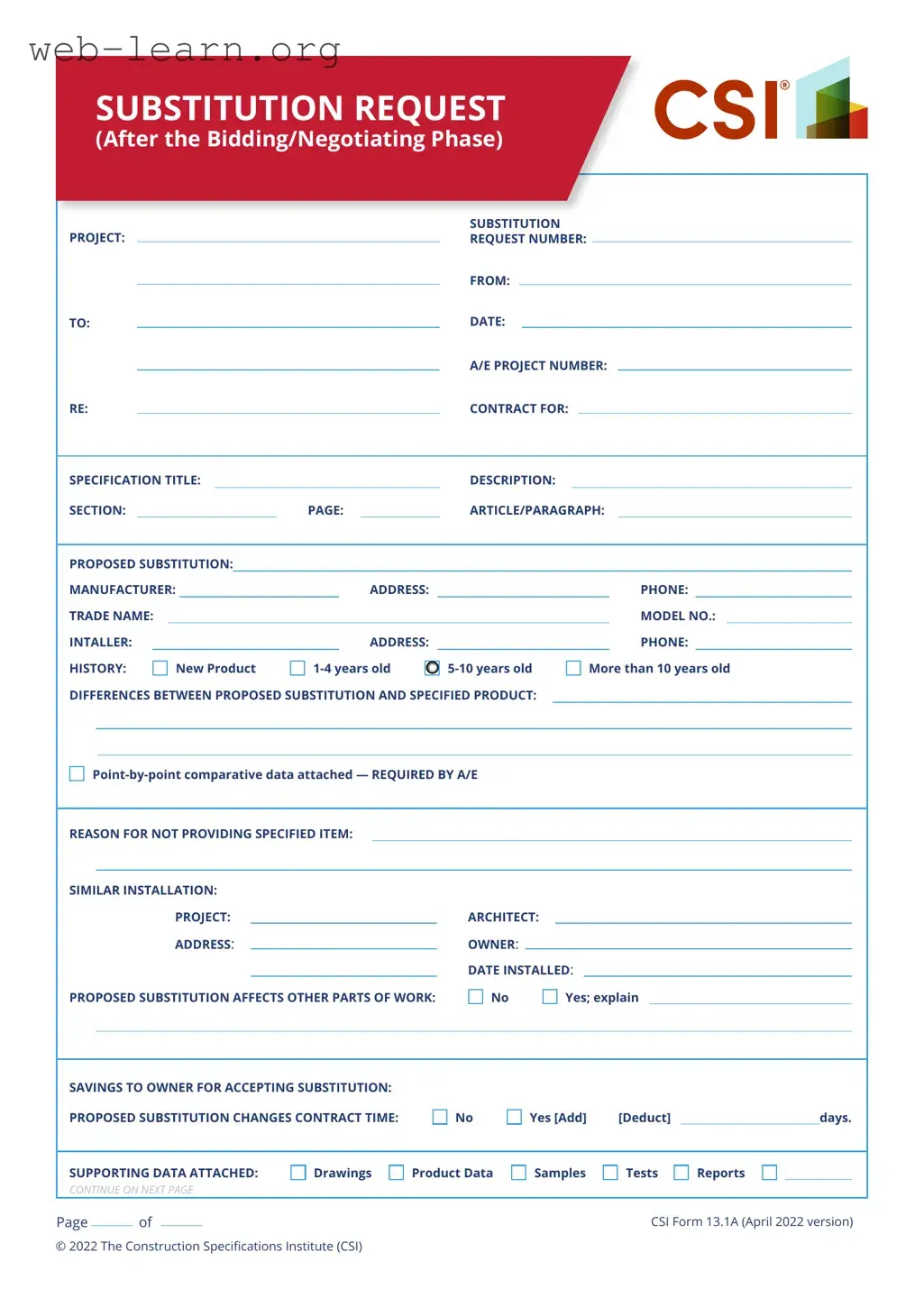
Homepage Blank Csi 13 1A Form
Outline

The CSI 13 1A form serves as a crucial tool in the construction industry, specifically designed for submitting requests for substitutions after the bidding or negotiating phase of a project. This form allows contractors to propose alternative products or materials that differ from those originally specified in the contract. Key components of the form include details about the project, such as the project name, the substitution request number, and the architect or engineer's project number. It also requires information about the proposed substitution, including the manufacturer, trade name, and model number. A section is dedicated to outlining the history of the product, indicating whether it is new or has been in use for several years. Importantly, the form prompts the contractor to provide a point-by-point comparison between the proposed substitution and the specified product, along with reasons for the substitution. Additionally, it addresses potential impacts on other parts of the work, any savings to the owner, and changes to the contract timeline. Supporting data, such as drawings or product data, can also be attached to strengthen the request. Overall, the CSI 13 1A form streamlines the process of evaluating substitutions while ensuring that all necessary information is clearly communicated.

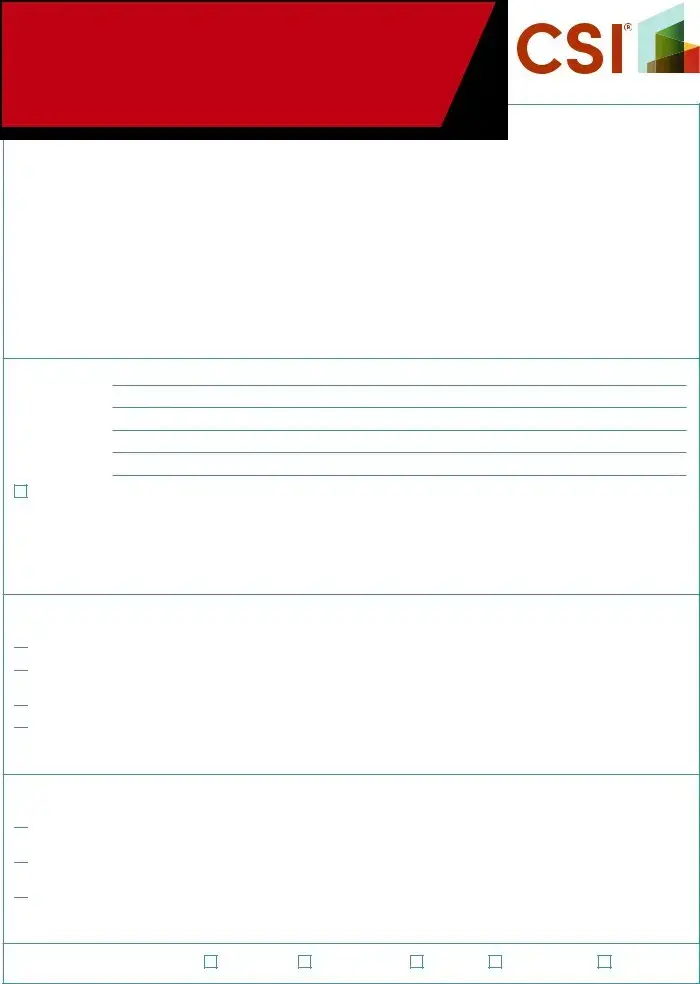
Sample - Csi 13 1A Form

SUBSTITUTION REQUEST
(After the Bidding/Negotiating Phase)
SPECIFICATION TITLE:
PHONE:
MODEL NO.:
SECTION: PAGE:
ADDRESS:
PHONE:ADDRESS:
ARTICLE/PARAGRAPH:
DESCRIPTION:
SIMILAR INSTALLATION:
PROPOSED SUBSTITUTION:
PROJECT: ARCHITECT:
MANUFACTURER:
ADDRESS
: OWNER:
DATE INSTALLED:
TRADE NAME:
HISTORY:
INTALLER:
REASON FOR NOT PROVIDING SPECIFIED ITEM:
New Product 1-4 years old 5-10 years old More than 10 years old
DIFFERENCES BETWEEN PROPOSED SUBSTITUTION AND SPECIFIED PRODUCT:
SAVINGS TO OWNER FOR ACCEPTING SUBSTITUTION:
PROPOSED SUBSTITUTION CHANGES CONTRACT TIME:
SUPPORTING DATA ATTACHED:
PROPOSED SUBSTITUTION AFFECTS OTHER PARTS OF WORK: No Yes; explain
Point-by-point comparative data attached — REQUIRED BY A/E
PROJECT:
SUBSTITUTION
REQUEST NUMBER:
TO:
RE: CONTRACT FOR:
DATE:
A/E PROJECT NUMBER:
FROM:
No Yes [Add] [Deduct] days.
Drawings Product Data Samples Tests Reports
CONTINUE ON NEXT PAGE
CSI Form 13.1A (April 2022 version)
Page of
© 2022 The Construction Specifications Institute (CSI)
SUBSTITUTION REQUEST
(After the Bidding/Negotiating Phase—
Continued)
ADDITIONAL COMMENTS: Contractor Subcontractor Supplier Manufacturer A/E
The Undersigned certies:
· Proposed substitution has been fully investigated and determined to be equal or superior in all respects to
specied product.
· Same warranty will be furnished for proposed substitution as for specied product.
· Same maintenance service and source of replacement parts, as applicable, is available.
· Proposed substitution will have no adverse eect on other trades and will not aect or delay progress schedule.
· Cost data as stated above is complete. Claims for additional costs related to accepted substitution which may
subsequently become apparent are to be waived.
· Proposed substitution does not aect dimensions and functional clearances.
· Payment will be made for changes to building design, including A/E design, detailing, and construction costs caused by
the substitution.
· Coordination, installation, and changes in the Work as necessary for accepted substitution will be complete in
all respects.
SUBMITTED BY:
SIGNED BY:
FIRM:
ADDRESS:
TELEPHONE:
CSI Form 13.1A (April 2022 version)
Attachments
A/E’s REVIEW AND RECOMMENDATION:
Approve Substitution—Make submittals in accordance with Specication Section 01 33 00 Submittal Procedures.
Approve Substitution as noted—Make submittals in accordance with Specication Section 01 33 00 Submittal
Procedures.
Reject Substitution—Use specied materials.
Substitution Request received too late—Use specied materials.
OWNER’S REVIEW AND ACTION:
Substitution approved—Make submittals in accordance with Specication Section 01 33 00 Submittal Procedures.
Prepare Change Order
Substitution approved as noted—Make submittals in accordance with Specication Section 01 33 00 Submittal
Procedures. Prepare Change Order.
Substitution rejected—Use specied materials.
SIGNED BY: DATE:
SIGNED BY: DATE:
Page of
© 2022 The Construction Specifications Institute (CSI)

Form Information

Fact Name Details
Form Purpose This form is used to request a substitution for a specified product after the bidding or negotiating phase of a project.
Project Information It requires details about the project, including the project name, substitution request number, and the architect/engineer project number.
Manufacturer Details Information about the proposed substitution includes the manufacturer’s name, address, phone number, trade name, and model number.
Age of Product The form asks for the history of the proposed substitution, allowing options for age ranging from new to over ten years old.
Impact on Contract It addresses whether the proposed substitution affects other parts of the work, changes the contract time, or provides savings to the owner.
Supporting Data Users must attach supporting data, such as drawings, product data, samples, tests, and reports, to substantiate the request.

Detailed Guide for Filling Out Csi 13 1A

Filling out the Csi 13 1A form is an important step in the substitution request process. After completing the form, you will submit it for review. The next steps will depend on the response from the architect or engineer regarding your request.

  1. Begin by entering the Project name at the top of the form.
  2. Fill in the Substitution Request Number assigned to this request.
  3. In the From section, write your name or the name of your company.
  4. In the To section, indicate the name of the architect or engineer.
  5. Write the Date you are submitting the form.
  6. Provide the A/E Project Number if applicable.
  7. In the Re section, specify the contract for which you are requesting a substitution.
  8. Fill in the Specification Title relevant to the substitution.
  9. Describe the Section and Page where the specification is found.
  10. Indicate the Article/Paragraph related to the substitution.
  11. Describe the Proposed Substitution clearly.
  12. Provide the Manufacturer name and Address.
  13. Include the Phone number of the manufacturer.
  14. State the Trade Name and Model No. of the proposed substitution.
  15. Fill in the Installer name and Address.
  16. Provide the Phone number for the installer.
  17. Check the box for the History of the product: New product, 1-4 years old, 5-10 years old, or more than 10 years old.
  18. Attach point-by-point comparative data to explain differences between the proposed substitution and the specified product.
  19. Explain the Reason for not providing specified item.
  20. In the Similar Installation section, provide details about the project, architect, address, and date installed.
  21. Indicate if the proposed substitution affects other parts of the work by checking No or Yes and explaining if necessary.
  22. State the Savings to Owner for accepting the substitution in dollars.
  23. Indicate if the proposed substitution changes Contract Time by checking No or Yes and specify whether it adds or deducts days.
  24. Check all Supporting Data Attached such as drawings, product data, samples, tests, or reports.

Obtain Answers on Csi 13 1A

  1. What is the purpose of the CSI 13 1A form?

    The CSI 13 1A form is a Substitution Request used during the construction process, specifically after the bidding or negotiating phase. It allows contractors to propose an alternative product or method that differs from what was originally specified in the contract documents. This form ensures that all parties involved are informed about the proposed changes and can evaluate their impact on the project.

  2. What information do I need to provide on the form?

    When filling out the CSI 13 1A form, you will need to include several key details:

    • The project name and the substitution request number.
    • Information about the original product, including its specifications, title, and relevant sections.
    • Details about the proposed substitution, including the manufacturer, trade name, and model number.
    • A history of the proposed product, indicating its age and any comparative data.
    • Any potential impacts on the project, such as changes to contract time or cost savings for the owner.
  3. What should I include in the supporting data?

    Supporting data is crucial for a thorough evaluation of the proposed substitution. You should attach:

    • Drawings that illustrate how the substitution will fit into the project.
    • Product data sheets that provide specifications and features of the proposed item.
    • Samples, if applicable, to allow for a physical comparison.
    • Test results or reports that demonstrate the performance and reliability of the proposed substitution.
  4. How does the substitution affect contract time and costs?

    When submitting the CSI 13 1A form, it’s important to address whether the proposed substitution will affect the contract time. You must indicate if it will add or deduct days from the project timeline. Additionally, if there are cost savings for the owner due to the substitution, you should clearly state the amount. This information helps the architect and owner make informed decisions.

  5. What happens after I submit the form?

    Once you submit the CSI 13 1A form, the architect or engineer will review the request. They will evaluate the proposed substitution against the specified product, considering factors like performance, compatibility, and cost. The architect will then communicate their decision, which could be an approval, a request for more information, or a denial. It’s important to follow up and ensure that all necessary information is provided for a timely review.

Common mistakes

Filling out the CSI 13 1A form can be a straightforward process, but many individuals make common mistakes that can lead to delays or complications. One frequent error is not providing all the required information. Each section of the form is designed to gather specific details about the substitution request. Missing even one piece of information, such as the project name or the proposed substitution details, can result in the form being returned for correction.

Another common mistake involves the selection of the product's age in the history section. It is crucial to accurately indicate whether the proposed product is new or falls within one of the specified age ranges. Misclassifying the product can lead to misunderstandings about its reliability and suitability for the project.

Additionally, some individuals fail to include the necessary comparative data. The form requires a point-by-point comparison between the proposed substitution and the specified product. This data is essential for the Architect/Engineer (A/E) to assess the validity of the substitution. Without this information, the request may be deemed incomplete.

People also often overlook the explanation for not providing the specified item. This section is critical as it helps clarify the reasoning behind the substitution request. A vague or missing explanation can raise red flags and may lead to rejection of the request.

Another mistake is not addressing how the proposed substitution may affect other parts of the work. If the substitution does impact other areas, it’s important to clearly explain this on the form. Failing to do so can create confusion and may hinder project progress.

When it comes to savings for the owner, many forget to provide a specific dollar amount. This section is an opportunity to highlight the financial benefits of accepting the substitution. A lack of clarity or omission here can diminish the perceived value of the proposed change.

In terms of contract time, individuals sometimes neglect to indicate whether the substitution will change the contract duration. If it does, it’s important to specify whether it will add or deduct days. This oversight can lead to scheduling conflicts and misunderstandings later in the project.

Lastly, failing to attach supporting data can be a critical error. The form lists several types of supporting documents, such as drawings and product data, that should accompany the request. Omitting these documents can result in the form being incomplete, further delaying the approval process.

Documents used along the form

The Csi 13 1A form is a crucial document used in construction projects to request the substitution of specified products after the bidding phase. It is often accompanied by several other forms and documents that facilitate the review and approval process. Below is a list of commonly used documents that support the substitution request.

  • Product Data Sheets: These sheets provide detailed information about the proposed substitution, including specifications, performance data, and compliance with relevant standards. They help the architect or engineer assess whether the new product meets project requirements.
  • Samples: Physical samples of the proposed substitution may be submitted to allow for a visual and tactile evaluation. This can be crucial in determining if the substitution aligns with the aesthetic and functional goals of the project.
  • Test Reports: These reports document the performance and safety tests conducted on the proposed substitution. They offer evidence that the product meets industry standards and can be safely integrated into the project.
  • Comparative Analysis: A detailed analysis comparing the proposed substitution with the originally specified product can be included. This document outlines the differences and advantages of the substitution, providing a clear rationale for the change.

Each of these documents plays a significant role in the evaluation process of the substitution request. By providing thorough and accurate information, they help ensure that all parties involved can make informed decisions regarding the proposed changes to the project specifications.

Similar forms

The CSI 13 1A form is a document used to request the substitution of specified products in construction projects. It serves a specific purpose in the construction industry, and several other documents share similarities in function and structure. Below is a list of six documents that are similar to the CSI 13 1A form:

  • Change Order Form: This document is used to request changes to the original contract. It outlines modifications in scope, cost, or time, similar to how the CSI 13 1A form addresses substitutions in specified products.
  • Request for Information (RFI): An RFI seeks clarification on project specifications or drawings. Like the CSI 13 1A form, it is a formal request that helps ensure all parties are aligned on project requirements.
  • Submittal Form: This document is used to submit product data, samples, or shop drawings for approval. It parallels the CSI 13 1A form by providing a structured way to present alternatives to specified items.
  • Proposal Request Form: This form is utilized to request pricing for additional work or changes. It shares similarities with the CSI 13 1A form in its role of facilitating communication regarding project adjustments.
  • Field Order Form: A field order is used for minor changes that do not affect the contract price or time. Like the CSI 13 1A form, it allows for adjustments to be made without extensive documentation.
  • Notice of Change Form: This document notifies stakeholders of changes in project scope or specifications. It serves a similar purpose as the CSI 13 1A form in keeping all parties informed about product substitutions.

Dos and Don'ts

When filling out the Csi 13 1A form, attention to detail is crucial. Here’s a helpful list of dos and don’ts to ensure your submission is clear and complete.

  • Do provide accurate project details, including the project name and substitution request number.
  • Do specify the proposed substitution clearly, including the manufacturer, trade name, and model number.
  • Do attach point-by-point comparative data as required by the architect/engineer (A/E).
  • Do explain the reasons for not providing the specified item in detail.
  • Do indicate if the proposed substitution affects other parts of the work.
  • Don't leave any sections blank. Every part of the form needs to be filled out completely.
  • Don't forget to include supporting data, such as drawings or product data, as this can strengthen your request.
  • Don't provide vague explanations. Be specific about the differences between the proposed substitution and the specified product.
  • Don't assume the A/E knows your project details. Provide all relevant information clearly.
  • Don't overlook the importance of signatures. Ensure all necessary parties have signed the form before submission.

By following these guidelines, you can enhance the clarity and effectiveness of your substitution request, making it easier for the A/E to review and approve your submission.

Misconceptions

Understanding the CSi 13 1A form can be crucial for those involved in construction projects. However, several misconceptions often arise regarding its purpose and usage. Here are nine common misunderstandings:

  • Misconception 1: The form is only for new products.
  • This is not true. While the form can be used for new products, it also accommodates substitutions that are several years old. Users must indicate the age of the product in the designated section.

  • Misconception 2: Only the contractor can submit a substitution request.
  • In reality, any party involved in the project, including subcontractors or suppliers, can submit the form. It is essential for anyone proposing a substitution to have proper documentation and justification.

  • Misconception 3: The architect must automatically approve all substitution requests.
  • Approval is not guaranteed. The architect evaluates each request based on its merits, including how well it meets the project specifications and requirements.

  • Misconception 4: The form is optional if the substitution is minor.
  • Regardless of the perceived significance of the substitution, completing the CSi 13 1A form is mandatory. This ensures that all changes are documented and assessed properly.

  • Misconception 5: The form does not require supporting data.
  • Supporting data is a critical component of the submission. The form explicitly states that comparative data and other relevant documentation must be attached for the architect's review.

  • Misconception 6: There is no need to explain the reason for not providing the specified item.
  • Providing a reason is essential. The form includes a section dedicated to explaining why the proposed substitution is necessary, which helps the architect understand the context of the request.

  • Misconception 7: The substitution request will not affect the project timeline.
  • This is misleading. The form includes a section to indicate whether the proposed substitution will change the contract time, and it is crucial to address this aspect to avoid delays.

  • Misconception 8: Only financial savings need to be documented.
  • While documenting savings is important, the form also requires consideration of how the substitution may impact other parts of the work. This holistic view is necessary for informed decision-making.

  • Misconception 9: The CSi 13 1A form is only relevant during the bidding phase.
  • The form is specifically designed for use after the bidding or negotiating phase. It serves as a formal request for substitutions that arise during the execution of the project.

By addressing these misconceptions, stakeholders can better navigate the complexities of the CSi 13 1A form and ensure compliance with project requirements.

Key takeaways

When filling out the CSI 13.1A form, keep these key takeaways in mind:

  • Project Details Matter: Clearly state the project name and include the substitution request number. This helps keep everything organized.
  • Specificity is Key: Fill in all relevant fields such as the A/E project number, contract details, and specification title. Incomplete information can lead to delays.
  • Proposed Substitution Information: Provide detailed information about the proposed substitution, including the manufacturer, trade name, and model number.
  • Installation History: Indicate the age of the product. This gives context to the reliability and suitability of the proposed substitution.
  • Comparative Data is Required: Attach point-by-point comparative data. This is essential for the architect/engineer to evaluate the substitution.
  • Impact on Contract: Clearly state if the proposed substitution will affect the contract time or savings to the owner. Transparency here is crucial.
  • Supporting Documents: Ensure all necessary supporting data is attached, such as drawings or product data. This strengthens your request.