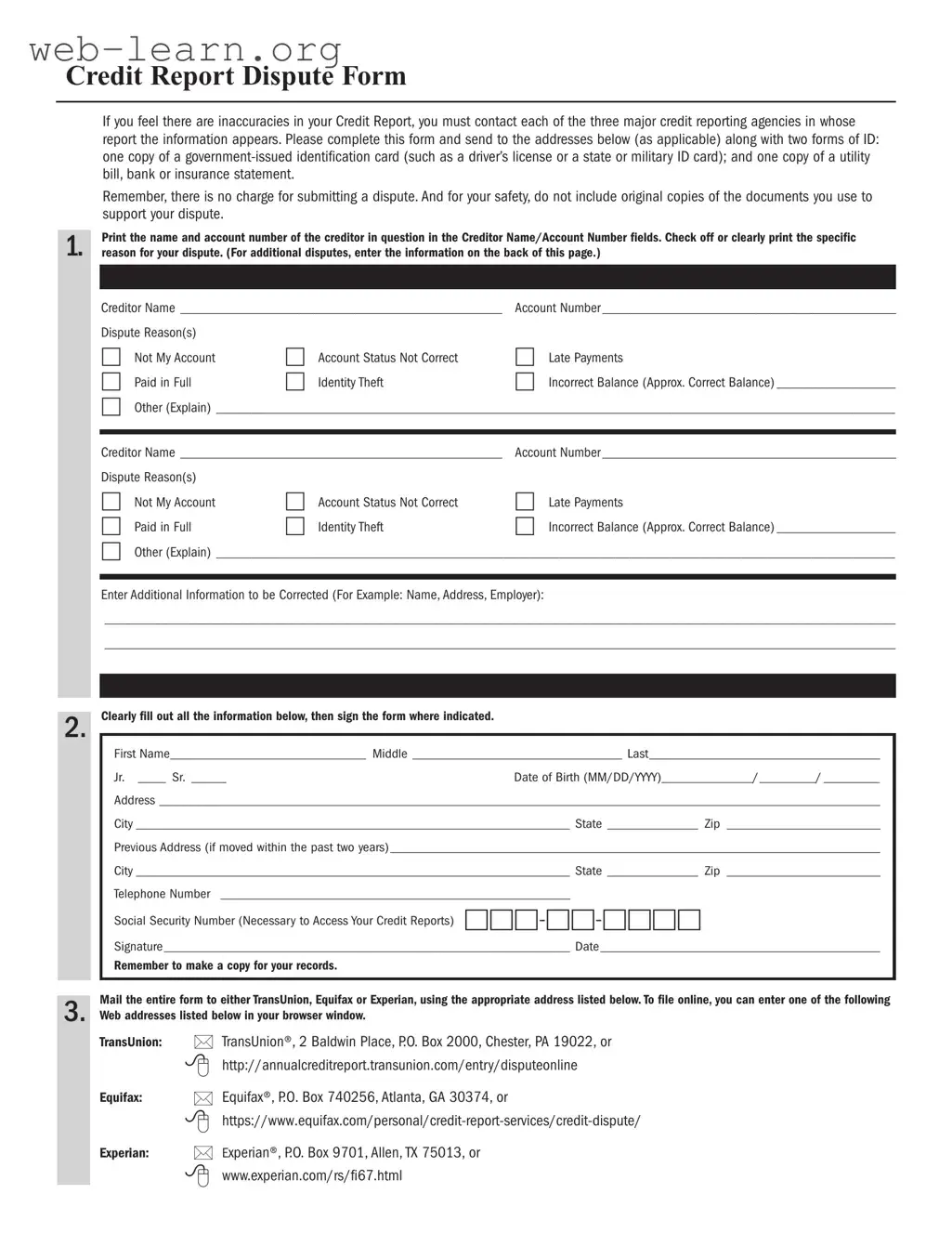
Homepage Blank Credit Report Dispute Form
Outline

When reviewing your credit report, you may find inaccuracies that could negatively impact your credit score. The Credit Report Dispute form is an essential tool for addressing these discrepancies. This form allows you to formally challenge any incorrect information, whether it pertains to personal details, account statuses, or payment histories. By submitting this form, you initiate a process that requires credit reporting agencies to investigate your claims. It's important to include specific details about the inaccuracies, supporting documentation, and any relevant personal information. Completing the form accurately can help ensure that your dispute is taken seriously and resolved in a timely manner. Understanding how to effectively use the Credit Report Dispute form empowers you to take control of your financial future and protect your credit standing.

Sample - Credit Report Dispute Form

_________________________________________________________________________________________________________________
_________________________________________________________________________________________________________________
Credit Report Dispute Form
If you feel there are inaccuracies in your Credit Report, you must contact each of the three major credit reporting agencies in whose
report the information appears. Please complete this form and send to the addresses below (as applicable) along with two forms of ID:
one copy of a government-issued identification card (such as a driver’s license or a state or military ID card); and one copy of a utility
bill, bank or insurance statement.
Remember, there is no charge for submitting a dispute. And for your safety, do not include original copies of the documents you use to
support your dispute.
1.
Print the name and account number of the creditor in question in the Creditor Name/Account Number fields. Check off or clearly print the specific
reason for your dispute. (For additional disputes, enter the information on the back of this page.)
Creditor Name ______________________________________________ Account Number __________________________________________
Dispute Reason(s)
Not My Account Account Status Not Correct Late Payments
Paid in Full Identity Theft Incorrect Balance (Approx. Correct Balance) _________________
Other (Explain) _________________________________________________________________________________________________
Creditor Name ______________________________________________ Account Number __________________________________________
Dispute Reason(s)
Not My Account Account Status Not Correct Late Payments
Paid in Full Identity Theft Incorrect Balance (Approx. Correct Balance) _________________
Other (Explain) _________________________________________________________________________________________________
Enter Additional Information to be Corrected (For Example: Name, Address, Employer):
Clearly fill out all the information below, then sign the form where indicated.
2.
First Name____________________________ Middle ______________________________ Last_________________________________
Jr. ____ Sr. _____ Date of Birth (MM/DD/YYYY)_____________/________/ ________
Address _______________________________________________________________________________________________________
City ______________________________________________________________ State _____________ Zip ______________________
Previous Address (if moved within the past two years)______________________________________________________________________
City ______________________________________________________________ State _____________ Zip ______________________
Telephone Number __________________________________________________
Social Security Number (Necessary to Access Your Credit Reports)
□□□-□□-□□□□
Signature__________________________________________________________ Date________________________________________
Remember to make a copy for your records.
Mail the entire form to either TransUnion, Equifax or Experian, using the appropriate address listed below. To file online, you can enter one of the following
3.
Web addresses listed below in your browser window.
TransUnion:
TransUnion®, 2 Baldwin Place, P.O. Box 2000, Chester, PA 19022, or
http://annualcreditreport.transunion.com/entry/disputeonline
Equifax:
Equifax®, P.O. Box 740256, Atlanta, GA 30374, or
https://www.equifax.com/personal/credit-report-services/credit-dispute/
Experian:
Experian®, P.O. Box 9701, Allen, TX 75013, or
www.experian.com/rs/fi67.html
Creditor Name ________________________________________________ Account Number_______________________________________________
Dispute Reason(s)
Not My Account Account Status Not Correct Late Payments
Paid in Full Identity Theft Incorrect Balance (Approx. Correct Balance) ______________________
Other (Explain)________________________________________________________________________________________________________
Creditor Name ________________________________________________ Account Number_______________________________________________
Dispute Reason(s)
Not My Account Account Status Not Correct Late Payments
Paid in Full Identity Theft Incorrect Balance (Approx. Correct Balance) ______________________
Other (Explain)________________________________________________________________________________________________________
Creditor Name ________________________________________________ Account Number_______________________________________________
Dispute Reason(s)
Not My Account Account Status Not Correct Late Payments
Paid in Full Identity Theft Incorrect Balance (Approx. Correct Balance) ______________________
Other (Explain)________________________________________________________________________________________________________
Creditor Name ________________________________________________ Account Number_______________________________________________
Dispute Reason(s)
Not My Account Account Status Not Correct Late Payments
Paid in Full Identity Theft Incorrect Balance (Approx. Correct Balance) ______________________
Other (Explain)________________________________________________________________________________________________________
Creditor Name ________________________________________________ Account Number_______________________________________________
Dispute Reason(s)
Not My Account Account Status Not Correct Late Payments
Paid in Full Identity Theft Incorrect Balance (Approx. Correct Balance) ______________________
Other (Explain)________________________________________________________________________________________________________
Creditor Name ________________________________________________ Account Number_______________________________________________
Dispute Reason(s)
Not My Account Account Status Not Correct Late Payments
Paid in Full Identity Theft Incorrect Balance (Approx. Correct Balance) ______________________
Other (Explain)________________________________________________________________________________________________________
Creditor Name ________________________________________________ Account Number_______________________________________________
Dispute Reason(s)
Not My Account Account Status Not Correct Late Payments
Paid in Full Identity Theft Incorrect Balance (Approx. Correct Balance) ______________________
Other (Explain)________________________________________________________________________________________________________

Form Information

Fact Name Description
Purpose The Credit Report Dispute form is used to challenge inaccuracies in a consumer's credit report.
Consumer Rights Under the Fair Credit Reporting Act (FCRA), consumers have the right to dispute incorrect information.
Submission Process Consumers can submit the dispute form online, by mail, or by phone, depending on the credit reporting agency.
Timeframe for Response Credit reporting agencies must investigate disputes within 30 days of receiving the form.
Supporting Documentation Consumers should include any supporting documents that substantiate their claims when submitting the form.
State-Specific Forms Some states may have their own specific dispute forms, governed by state laws such as California's Consumer Credit Reporting Agencies Act.
Impact on Credit Score Disputing an item does not directly affect a consumer's credit score, but the resolution may.
Multiple Agencies Disputes must be filed with each credit reporting agency that contains the inaccurate information.
Follow-Up Consumers should follow up with the credit reporting agency if they do not receive a response within the required timeframe.
Outcome Notification After the investigation, consumers will receive a summary of the findings and any changes made to their credit report.

Detailed Guide for Filling Out Credit Report Dispute

Once you have the Credit Report Dispute form in hand, it’s time to start filling it out. This process is straightforward and can help you address any inaccuracies on your credit report. Take your time and ensure that all the information is accurate before submitting the form.

  1. Begin by entering your personal information at the top of the form. This includes your full name, address, and contact information.
  2. Next, provide your Social Security number. This helps identify your credit report accurately.
  3. In the section for the credit reporting agency, indicate which agency you are disputing the report with. You may be dealing with one of the three major agencies: Experian, Equifax, or TransUnion.
  4. Clearly describe the item you are disputing. Include details such as the account number and the nature of the inaccuracy.
  5. Attach any supporting documents that substantiate your claim. This might include bank statements, letters, or any other relevant paperwork.
  6. Review the form for any errors or omissions. It’s essential to ensure that all information is correct.
  7. Finally, sign and date the form to confirm that the information provided is accurate to the best of your knowledge.

After completing the form, make a copy for your records before sending it to the appropriate credit reporting agency. Keep an eye on your mailbox or email for any updates regarding your dispute.

Obtain Answers on Credit Report Dispute

  1. What is a Credit Report Dispute Form?

    A Credit Report Dispute Form is a document that allows you to formally challenge inaccuracies or errors on your credit report. When you notice something that doesn’t seem right—like incorrect personal information, accounts that don’t belong to you, or wrong payment histories—you can use this form to notify the credit reporting agency. This process helps ensure that your credit report accurately reflects your financial history.

  2. How do I fill out the Credit Report Dispute Form?

    Filling out the Credit Report Dispute Form is straightforward. Start by providing your personal information, including your name, address, and Social Security number. Next, identify the specific items you wish to dispute. Clearly explain why you believe the information is incorrect. Attach any supporting documents, such as bank statements or payment receipts, to strengthen your case. Make sure to review the form for accuracy before submitting it.

  3. What happens after I submit my dispute?

    Once you submit your dispute, the credit reporting agency will investigate the claim. They typically have 30 days to respond. During this time, they will reach out to the creditor or lender involved to verify the information. If they find that your claim is valid, they will correct the error and send you an updated credit report. If the dispute is not resolved in your favor, you can ask for a statement of your dispute to be added to your credit report.

  4. Can I dispute my credit report online?

    Yes, many credit reporting agencies offer online dispute options. This can be a quicker way to submit your dispute compared to mailing a physical form. To do this, visit the agency's website, navigate to the dispute section, and follow the instructions provided. You will need to create an account or log in to submit your dispute online. Just remember to keep copies of any correspondence for your records.

Common mistakes

Filling out a Credit Report Dispute form can be straightforward, but many people make common mistakes that can hinder their efforts. One frequent error is providing incomplete information. When personal details, such as name, address, or Social Security number, are missing, it can delay the dispute process.

Another mistake is failing to specify the items being disputed. It is essential to clearly identify the accounts or entries that are incorrect. Without this clarity, the credit bureau may not understand which items need to be investigated.

Some individuals neglect to include supporting documentation. Evidence such as payment receipts or correspondence with creditors can strengthen a dispute. Without these documents, the credit bureau may not have enough information to resolve the issue.

Additionally, people often overlook the importance of checking their credit report thoroughly before filing a dispute. Errors may be overlooked, leading to disputes that could have been avoided. A careful review helps ensure that only legitimate errors are challenged.

Another common oversight is not keeping a copy of the dispute form. Retaining a copy for personal records is crucial. This documentation can be useful if follow-up is needed or if the dispute is not resolved satisfactorily.

Some filers fail to provide a clear explanation of why they believe the information is incorrect. A concise and specific statement can guide the credit bureau in their investigation. A vague explanation may result in a lack of action.

People also sometimes forget to sign and date the form. An unsigned form can lead to automatic rejection. Ensuring that all required fields are filled out and signed is a vital step in the process.

Lastly, individuals often miss the deadline for submitting disputes. Credit bureaus have specific timelines for handling disputes. It is important to submit the form promptly to ensure that it is addressed in a timely manner.

Documents used along the form

When disputing information on your credit report, several other forms and documents may be helpful to support your case. These documents can provide additional context or evidence that can strengthen your dispute. Here’s a list of commonly used forms and documents that often accompany a Credit Report Dispute form:

  • Credit Report: This is the main document you are disputing. It contains your credit history, including accounts, payment history, and inquiries.
  • Identity Theft Report: If your dispute is related to identity theft, this report can help prove that the accounts in question are not yours.
  • Proof of Payment: Receipts or bank statements showing that you have made payments on accounts can help clarify any discrepancies.
  • Correspondence with Creditors: Any letters or emails exchanged with creditors regarding the disputed account can provide context and support your claim.
  • Affidavit of Identity Theft: This sworn statement can be used to declare that you are a victim of identity theft, further supporting your dispute.
  • Consumer Complaint Form: If you have filed a complaint with a consumer protection agency, this form can show that you are taking formal steps to resolve the issue.
  • Credit Monitoring Reports: Reports from credit monitoring services can help track changes to your credit report and highlight inaccuracies.
  • Supporting Documentation: This can include any other relevant documents, such as court records or contracts, that may support your dispute.

Gathering these documents can help ensure that your dispute is well-supported and increases the chances of a successful resolution. Always keep copies of everything you submit for your records.

Similar forms

The Credit Report Dispute form is important for addressing inaccuracies in your credit report. Here are ten other documents that are similar to it, along with their similarities:

  • Identity Theft Report: Like the Credit Report Dispute form, this document helps consumers report inaccuracies caused by identity theft. It serves as proof to creditors that the consumer is a victim.
  • Credit Freeze Request: This form allows individuals to restrict access to their credit report. Similar to the dispute form, it aims to protect consumers from fraudulent activities.
  • Fraud Alert Request: When a consumer places a fraud alert, it notifies creditors to take extra steps to verify identity. This is akin to disputing inaccuracies, as both seek to safeguard credit integrity.
  • Consumer Credit File Request: This document allows individuals to request a copy of their credit file. It’s similar because reviewing the file can lead to discovering errors that need disputing.
  • Debt Validation Letter: This letter requests verification of a debt. It shares similarities with the dispute form by prompting creditors to confirm the accuracy of the information they have.
  • Bankruptcy Filing: Filing for bankruptcy can affect credit reports. Like the dispute form, it requires accurate reporting of financial history to ensure fair treatment.
  • Loan Application: When applying for a loan, consumers provide information that impacts their credit. Similar to the dispute form, accuracy is crucial for obtaining fair loan terms.
  • Credit Counseling Agreement: This document outlines the terms of credit counseling services. It is similar because it addresses credit issues and aims to improve financial health.
  • Payment Arrangement Letter: This letter sets up a payment plan with creditors. Like the dispute form, it addresses financial discrepancies and seeks a resolution.
  • Credit Monitoring Service Agreement: This agreement allows consumers to monitor their credit reports regularly. It relates to the dispute form by helping individuals catch inaccuracies early.

Dos and Don'ts

When filling out a Credit Report Dispute form, it is essential to approach the process carefully. Here is a list of things you should and shouldn't do to ensure your dispute is handled effectively.

  • Do provide accurate information. Ensure that all details, such as your name, address, and account numbers, are correct.
  • Do include supporting documentation. Attach any relevant documents that support your dispute, such as payment receipts or correspondence with creditors.
  • Do keep a copy of your dispute. Retain a copy of the completed form and any attachments for your records.
  • Do follow up. After submitting your dispute, check back to see if it has been resolved or if additional information is needed.
  • Don't submit multiple disputes for the same issue. This can confuse the credit reporting agency and delay the resolution process.
  • Don't use vague language. Clearly state the reason for your dispute and what you believe is inaccurate.
  • Don't forget to sign the form. A signature is often required to validate your dispute.
  • Don't ignore deadlines. Be aware of any time limits for submitting disputes to ensure your case is considered.
  • Don't provide unnecessary personal information. Only include information relevant to the dispute to protect your privacy.

By following these guidelines, you can improve the chances of a successful resolution to your credit report dispute.

Misconceptions

Understanding the Credit Report Dispute form is crucial for anyone looking to correct inaccuracies in their credit report. However, several misconceptions can lead to confusion. Here are nine common misunderstandings:

  1. Disputes must be submitted in writing. Many people believe that a dispute can only be filed through a written letter. In reality, most credit reporting agencies allow disputes to be submitted online or via phone as well.
  2. Disputing an item guarantees its removal. Some individuals think that filing a dispute will automatically lead to the removal of negative information. However, the credit bureau will investigate and only remove items if they are proven to be inaccurate.
  3. All disputes are resolved quickly. While some disputes may be resolved within a few days, others can take up to 30 days or more. The timeline often depends on the complexity of the dispute and the response from the creditor.
  4. You can only dispute items once. Many believe that if a dispute is denied, they cannot challenge the item again. In fact, you can dispute the same item multiple times, especially if new evidence arises.
  5. Disputing a debt affects your credit score. A common myth is that filing a dispute will negatively impact your credit score. Disputing an item itself does not affect your score; however, the outcome of the dispute may.
  6. Only negative items can be disputed. Some think they can only dispute negative information. In truth, you can dispute any incorrect information, including outdated positive items that may be affecting your credit history.
  7. You must hire a professional to dispute. Many feel that they need to hire a credit repair service to handle disputes. However, individuals can file disputes on their own without incurring additional costs.
  8. Disputes are only for credit reports. Some people believe disputes are exclusive to credit reports. In fact, disputes can also be filed regarding other financial documents, such as loan statements or billing errors.
  9. Once resolved, disputes cannot be reopened. It is a misconception that once a dispute is resolved, it cannot be revisited. If new information comes to light or if the item reappears, you can reopen the dispute process.

By clarifying these misconceptions, individuals can better navigate the process of disputing inaccuracies in their credit reports and take control of their financial health.

Key takeaways

When filling out and using the Credit Report Dispute form, it is essential to follow certain guidelines to ensure an effective process. Below are key takeaways to consider:

  • Accuracy is crucial: Ensure that all information provided on the form is accurate and complete. Double-check personal details, account numbers, and dispute reasons.
  • Identify specific errors: Clearly identify the specific items on your credit report that you believe are inaccurate or incomplete.
  • Provide supporting documentation: Include any relevant documents that support your dispute, such as payment records or correspondence with creditors.
  • Use clear language: Write your dispute in clear and concise language. Avoid jargon or overly complex terms that may confuse the reader.
  • Submit to the correct agency: Ensure that the dispute form is sent to the correct credit reporting agency. Each agency may have different submission processes.
  • Keep copies: Retain copies of the completed dispute form and any supporting documents for your records.
  • Monitor your dispute: After submission, monitor the status of your dispute. Credit reporting agencies typically have a timeframe for investigating disputes.
  • Review the results: Once the investigation is complete, review the results carefully. The agency will provide a summary of their findings.
  • Follow up if necessary: If the dispute is not resolved to your satisfaction, you may need to follow up or escalate the issue with additional documentation.