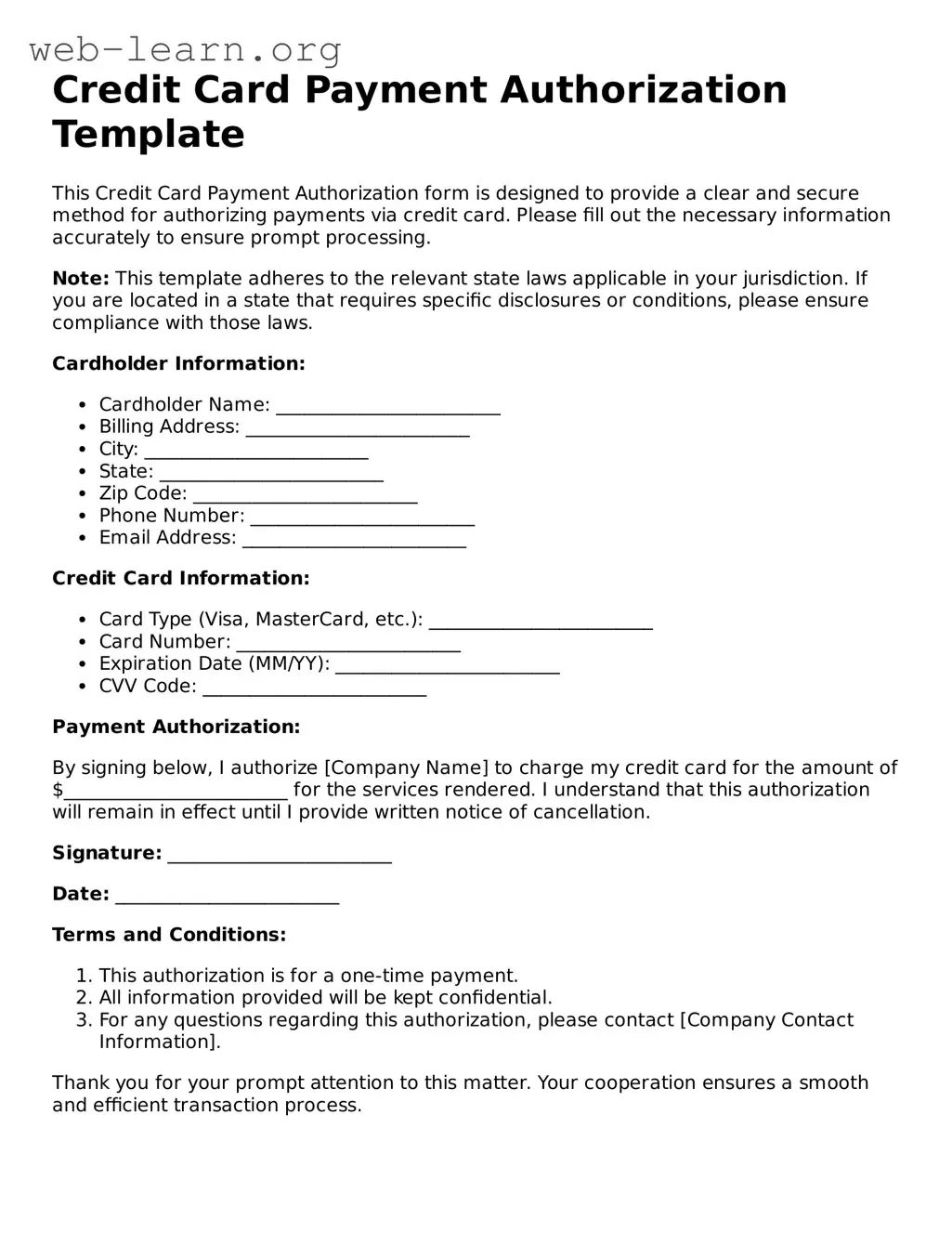
The Credit Card Payment Authorization form plays a crucial role in facilitating secure transactions between consumers and businesses. This form is designed to ensure that the cardholder provides explicit permission for a specified amount to be charged to their credit card. Key elements of the form typically include the cardholder's name, card number, expiration date, and the amount to be charged. Additionally, it often requires the cardholder's signature, confirming their consent and understanding of the payment terms. Businesses may also include fields for billing addresses and contact information, which help in verifying the identity of the cardholder and reducing the risk of fraud. By providing a clear framework for authorization, this form helps protect both the consumer and the merchant, ensuring that transactions are conducted smoothly and securely.
Credit Card Payment Authorization Template
This Credit Card Payment Authorization form is designed to provide a clear and secure method for authorizing payments via credit card. Please fill out the necessary information accurately to ensure prompt processing.
Note: This template adheres to the relevant state laws applicable in your jurisdiction. If you are located in a state that requires specific disclosures or conditions, please ensure compliance with those laws.
Cardholder Information:
Credit Card Information:
Payment Authorization:
By signing below, I authorize [Company Name] to charge my credit card for the amount of $________________________ for the services rendered. I understand that this authorization will remain in effect until I provide written notice of cancellation.
Signature: ________________________
Date: ________________________
Terms and Conditions:
Thank you for your prompt attention to this matter. Your cooperation ensures a smooth and efficient transaction process.
| Fact Name | Description |
|---|---|
| Purpose | The Credit Card Payment Authorization form allows individuals to authorize a business to charge their credit card for specific transactions. |
| Authorization | By signing the form, the cardholder gives permission for the specified amount to be charged to their credit card. |
| Information Required | The form typically requires the cardholder's name, credit card number, expiration date, and the amount to be charged. |
| Security Measures | Businesses must ensure that the form is stored securely to protect sensitive credit card information from unauthorized access. |
| State-Specific Forms | Some states may have specific requirements for the Credit Card Payment Authorization form, governed by local consumer protection laws. |
| Revocation | Cardholders have the right to revoke authorization at any time, which should be communicated to the business in writing. |
| Dispute Resolution | If a charge is disputed, the cardholder should follow the procedures outlined by their credit card issuer for reporting unauthorized transactions. |
| Legal Compliance | Businesses must comply with federal laws, such as the Fair Credit Billing Act, as well as any applicable state laws governing payment authorizations. |
Once you have the Credit Card Payment Authorization form in hand, it’s time to fill it out carefully. Completing this form accurately will help ensure that your payment is processed smoothly and without delays.
After completing the form, review all the information to ensure it is correct. Once verified, you can submit the form as instructed to initiate the payment process.
The Credit Card Payment Authorization form is a document that allows a business or organization to charge a specified amount to a customer's credit card. This form typically includes details such as the cardholder's name, card number, expiration date, and the amount to be charged. It serves as a written consent from the cardholder, ensuring that the transaction is authorized.
This form is necessary to protect both the business and the customer. For businesses, it provides proof that the customer has authorized the charge, which can help prevent disputes or chargebacks. For customers, it ensures that their credit card information is handled securely and that they are aware of the transaction being processed.
Businesses must take steps to ensure the security of the information provided on the Credit Card Payment Authorization form. This includes:
These measures help protect sensitive data from unauthorized access or breaches.
Yes, you can revoke your authorization, but it is important to do so in writing and as soon as possible. Contact the business or organization that you authorized to explain your decision. Keep in mind that revoking authorization may not prevent charges that have already been processed. Therefore, it is advisable to review your account statements regularly to ensure that all transactions are authorized.
Filling out a Credit Card Payment Authorization form may seem straightforward, but many people make common mistakes that can lead to delays or complications. One frequent error is providing incorrect credit card information. This can include transposing numbers or entering an expired card date. Such mistakes can result in payment processing failures, which can be frustrating for both the payer and the recipient.
Another common issue arises from failing to sign the form. Many individuals overlook this crucial step, assuming that their verbal consent is sufficient. Without a signature, the authorization may be deemed invalid, which can lead to disputes or rejected payments. Always ensure that you sign the form to confirm your agreement.
People often neglect to read the terms and conditions associated with the authorization. This oversight can lead to misunderstandings about fees, payment schedules, or cancellation policies. Taking the time to review these details can prevent future disputes and ensure that you are fully informed about the payment process.
Inaccurate personal information is another mistake that can occur. This includes errors in the name, address, or contact details. Such inaccuracies can complicate the payment process and may result in difficulties if there is a need to reach out for clarification or support.
Some individuals fail to check the expiration date of their credit card. Using an expired card can lead to immediate payment rejections. It is important to verify that the card is valid and has sufficient credit available for the transaction.
Lastly, people often forget to keep a copy of the completed form for their records. This can create challenges if there are questions about the payment later on. Retaining a copy ensures that you have proof of authorization and can reference it if needed.
When processing credit card payments, various forms and documents may accompany the Credit Card Payment Authorization form to ensure a smooth transaction process. Each of these documents serves a specific purpose and helps protect both the merchant and the customer. Below is a list of commonly used forms that may be needed.
Understanding these documents can help facilitate smoother transactions and foster trust between customers and businesses. Each form plays a vital role in ensuring clarity, security, and compliance in financial dealings.
When filling out the Credit Card Payment Authorization form, it’s important to be careful and thorough. Here are seven things to keep in mind:
By following these guidelines, you can ensure a smooth and secure process when submitting your payment authorization.
Many individuals have misunderstandings about the Credit Card Payment Authorization form. These misconceptions can lead to confusion and improper use of the form. Below is a list of common misconceptions and clarifications for each.
This form can be used for both online and offline transactions. It serves as a way to authorize payments regardless of the medium.
Signing the form does not guarantee that the payment will be processed immediately. It simply gives permission for the transaction to occur.
Different credit card companies may have their own versions of the authorization form. It's important to use the one specific to the transaction or company involved.
The form can be required for any amount, depending on the merchant's policies. It is not limited to large transactions.
In many cases, a customer can revoke authorization before the transaction is processed. However, this may depend on the specific terms of the agreement.
The information collected is essential for processing payments securely. Merchants need this data to ensure the transaction is legitimate.
Individuals can also use the form, especially when making payments for services or products that require authorization.
While the form authorizes a payment, it does not guarantee a refund. Refund policies are separate and depend on the merchant's terms.
Many businesses still use the Credit Card Payment Authorization form as a standard practice to ensure secure transactions.
Ensure that all fields on the Credit Card Payment Authorization form are filled out completely. Missing information can delay processing.
Provide accurate credit card details, including the card number, expiration date, and security code. Double-check for typos.
Include the name on the card exactly as it appears. This helps prevent any issues with authorization.
Clearly state the amount to be charged. Specify whether this is a one-time payment or a recurring charge.
Review the terms and conditions associated with the payment. Understanding these details can prevent misunderstandings later.
Sign and date the form to authorize the payment. An unsigned form may not be accepted.
Keep a copy of the completed form for your records. This can be useful for future reference or disputes.
Submit the form through the designated method, whether it be online, by mail, or in person, as specified by the receiving party.
Contact the service provider if you have questions about the form or the payment process. Clear communication can resolve issues quickly.