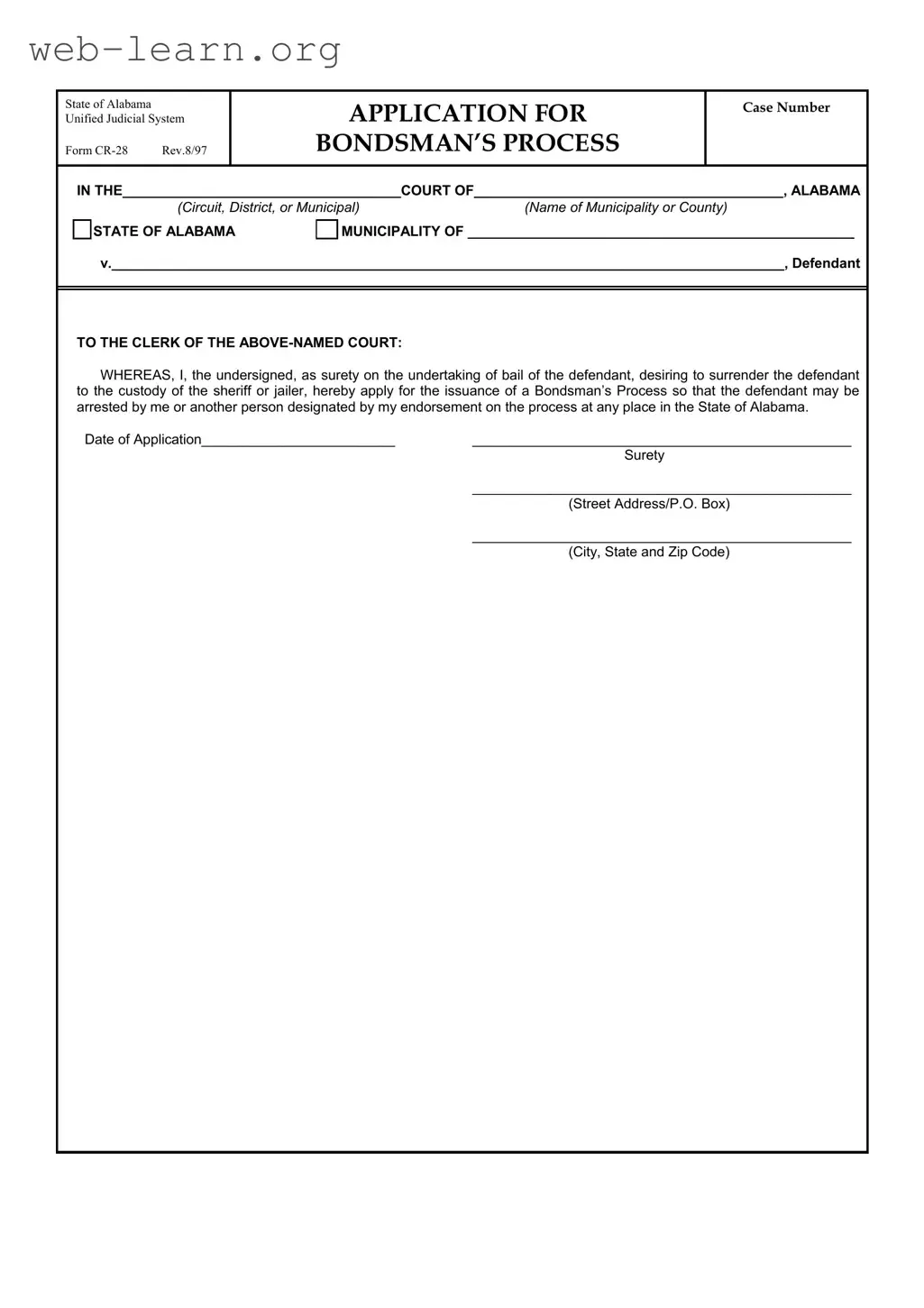
The Cr 28 Alabama form is a crucial document within the state's judicial system, specifically designed for bondsmen seeking to surrender a defendant to law enforcement. This form facilitates the process of issuing a Bondsman’s Process, which allows a surety to apprehend the defendant at any location throughout Alabama. It is used in various courts, including Circuit, District, and Municipal courts, and requires specific information such as the case number and the name of the court. The applicant must provide their details, including their address, ensuring that the court has accurate contact information. By completing this form, the surety formally requests the authority to take action against a defendant who may have violated bail conditions. This process is vital for maintaining the integrity of the bail system and ensuring that defendants fulfill their obligations to the court.

| Fact Name | Description |
|---|---|
| Form Title | The form is officially titled "APPLICATION FOR BONDSMAN’S PROCESS". |
| Governing Law | This form is governed by the laws of the State of Alabama, specifically related to bail procedures. |
| Purpose | The purpose of the CR-28 form is to allow a surety to apply for a Bondsman’s Process to surrender a defendant. |
| Application Date | The form requires the date of application to be filled out by the surety. |
| Defendant Information | It includes a section to specify the name of the defendant involved in the case. |
| Jurisdiction | The form must indicate the court type, which can be Circuit, District, or Municipal. |
| Surety Details | The surety must provide their name, address, city, state, and zip code on the form. |
| Signature Requirement | The surety is required to sign the form, affirming their intention to surrender the defendant. |
| Revocation Date | This version of the form was last revised in August 1997, indicating its long-standing use. |
Filling out the Cr 28 Alabama form requires careful attention to detail. This form is necessary for a bondsman who wishes to surrender a defendant to the authorities. The following steps will guide you through the process of completing the form accurately.
Once you have completed the form, review all entries for accuracy. Ensure that all required information is filled out clearly. After verification, the form can be submitted to the appropriate court for processing.
What is the purpose of the CR-28 form?
The CR-28 form serves as an application for a Bondsman’s Process in Alabama. It allows a surety, who has provided bail for a defendant, to formally request the court to issue a process that enables them or a designated person to arrest the defendant. This can be necessary if the defendant fails to appear in court or if the surety wishes to surrender the defendant to law enforcement.
Who can fill out the CR-28 form?
The form can be completed by the surety, who is an individual or entity that has agreed to be responsible for the defendant's bail. It is essential that the surety has a legitimate interest in ensuring the defendant's appearance in court, as they may face financial consequences if the defendant does not comply.
What information is required on the CR-28 form?
Several key pieces of information must be included on the CR-28 form:
How does the process of issuing a Bondsman’s Process work?
Once the CR-28 form is submitted to the court, the clerk will review the application. If everything is in order, the court will issue a Bondsman’s Process. This document authorizes the surety or their designated person to arrest the defendant anywhere in Alabama. The surety must then ensure that the defendant is taken into custody and brought before the court.
What happens after the Bondsman’s Process is issued?
After the issuance of the Bondsman’s Process, the surety or their designee can proceed to locate and arrest the defendant. It is crucial to act promptly, as the process is time-sensitive. Once the defendant is apprehended, they must be brought back to the court to address the original charges. Failure to do so may result in further legal complications for the surety.
Are there any fees associated with the CR-28 form?
While the CR-28 form itself does not typically have a fee, there may be associated costs involved in the overall process of bail and arrest. These can include court fees, attorney fees, or costs related to the apprehension of the defendant. It is advisable for the surety to consult with legal counsel to understand any potential financial obligations that may arise.
Filling out the Cr 28 Alabama form can be a straightforward process, but many individuals make common mistakes that can lead to delays or complications. One frequent error occurs when applicants fail to provide complete information in the designated fields. For instance, omitting the case number or the full name of the court can result in the application being rejected. Each piece of information is crucial for the court to process the request efficiently.
Another mistake involves the incorrect designation of the court type. Applicants sometimes confuse whether to indicate a Circuit, District, or Municipal court. This misstep can lead to confusion about jurisdiction and may necessitate resubmission of the form. Ensuring that the correct court type is selected helps streamline the process and avoids unnecessary complications.
Additionally, many applicants overlook the importance of providing accurate contact information. The street address, city, state, and zip code must be filled out correctly. If the court cannot reach the surety due to incorrect information, it can hinder the timely processing of the application. Clear and accurate contact details are essential for effective communication.
Some individuals also neglect to sign the form. A signature is a vital part of the application, as it confirms the surety's intention to take responsibility for the defendant. Without a signature, the form is incomplete and cannot be processed. It is always wise to double-check that all required signatures are present before submission.
Lastly, applicants may fail to keep a copy of the completed form for their records. Having a copy can be invaluable if questions arise later or if there is a need to reference the application. Keeping a personal record helps maintain transparency and accountability throughout the legal process.
The CR-28 form is an important document used in Alabama's judicial system for bondsmen seeking to surrender a defendant. Along with this form, several other documents may be necessary to ensure proper processing and compliance with legal requirements. Below is a list of commonly used forms and documents that often accompany the CR-28.
Understanding these accompanying documents can streamline the process for bondsmen and defendants alike. Each form plays a crucial role in the judicial system, ensuring that all parties are informed and that legal protocols are followed. Properly managing these documents can help avoid complications in the legal process.
The CR-28 form in Alabama is used for applying for a bondsman's process. Several other documents serve similar purposes in the legal system, particularly concerning bail and the responsibilities of sureties. Here are seven documents that are comparable:
When filling out the Cr 28 Alabama form, there are important guidelines to follow. Here’s a helpful list of things you should and shouldn’t do to ensure your application is processed smoothly.
Misconceptions about the CR-28 Alabama form can lead to confusion for those involved in the bail process. Here are six common misunderstandings:
Understanding these misconceptions can help individuals navigate the bail process more effectively. Always consider seeking legal advice if unsure about any aspect of the form or the process involved.
When dealing with the Cr 28 Alabama form, it is essential to understand its purpose and how to fill it out correctly. Here are some key takeaways:
Completing the Cr 28 form accurately is crucial to ensure a smooth legal process. Be diligent and thorough when filling it out.