In the realm of property ownership and real estate transactions, clarity and accuracy are paramount. The Corrective Deed form serves as a crucial tool for property owners who encounter errors in the original deed documentation. Whether it’s a misspelled name, an incorrect legal description, or a misidentified grantee, these discrepancies can lead to significant complications down the line. This form enables property owners to rectify such mistakes, ensuring that the public record accurately reflects the true ownership and details of the property in question. By facilitating the correction of errors, the Corrective Deed not only helps maintain the integrity of property records but also protects the rights of the owners involved. Understanding the key components of this form, including the necessary signatures, the identification of the parties, and the specific changes being made, is essential for anyone looking to navigate the complexities of real estate transactions smoothly. With the Corrective Deed in hand, property owners can move forward with confidence, knowing that their property records are accurate and legally sound.
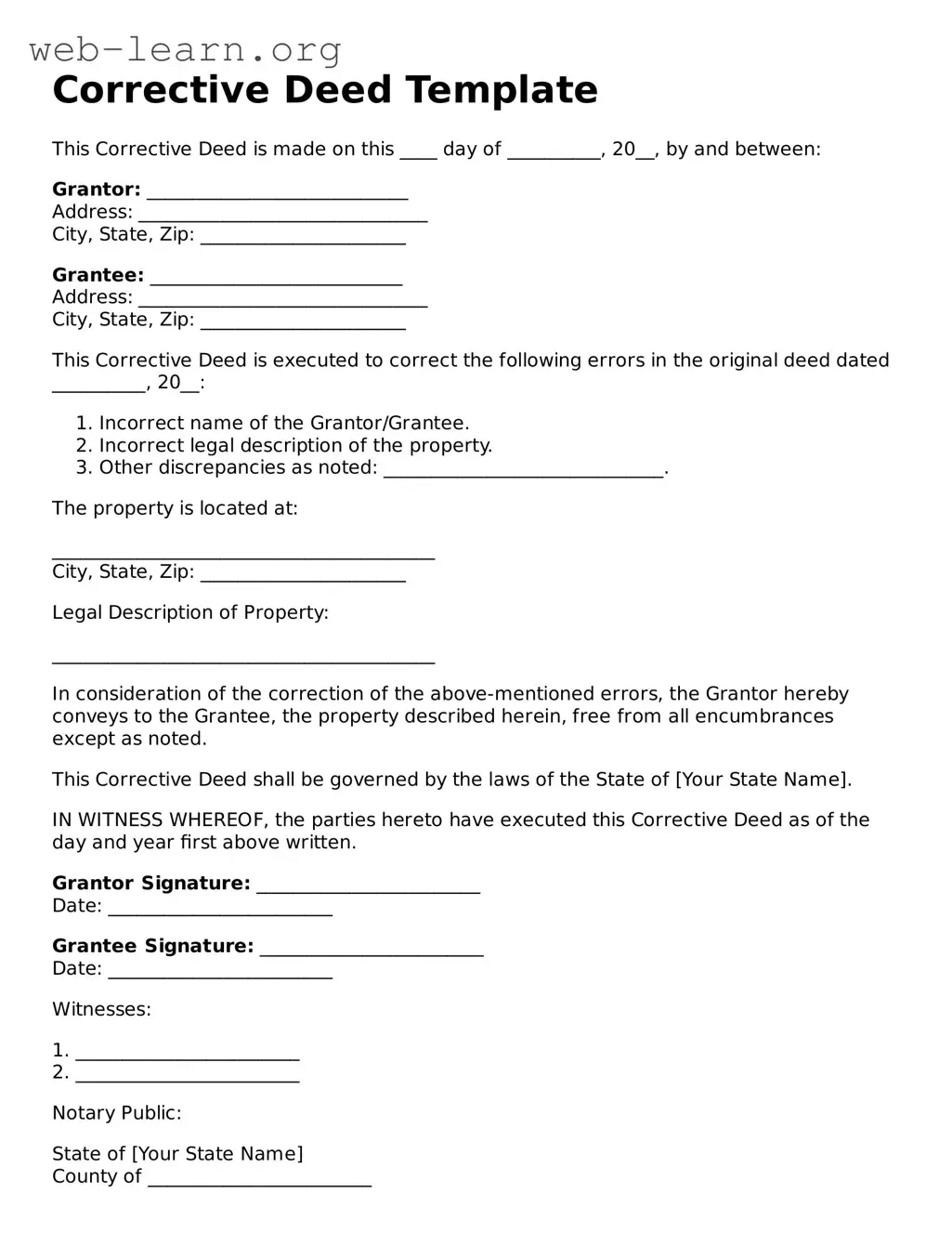
Corrective Deed Template
This Corrective Deed is made on this ____ day of __________, 20__, by and between:
Grantor: ____________________________
Address: _______________________________
City, State, Zip: ______________________
Grantee: ___________________________
Address: _______________________________
City, State, Zip: ______________________
This Corrective Deed is executed to correct the following errors in the original deed dated __________, 20__:
The property is located at:
_________________________________________
City, State, Zip: ______________________
Legal Description of Property:
_________________________________________
In consideration of the correction of the above-mentioned errors, the Grantor hereby conveys to the Grantee, the property described herein, free from all encumbrances except as noted.
This Corrective Deed shall be governed by the laws of the State of [Your State Name].
IN WITNESS WHEREOF, the parties hereto have executed this Corrective Deed as of the day and year first above written.
Grantor Signature: ________________________
Date: ________________________
Grantee Signature: ________________________
Date: ________________________
Witnesses:
1. ________________________
2. ________________________
Notary Public:
State of [Your State Name]
County of ________________________
On this ____ day of __________, 20__, before me, a Notary Public, personally appeared ________________________, known to me to be the person whose name is subscribed to this Corrective Deed, and acknowledged that they executed the same for the purposes therein contained.
Given under my hand and seal this ____ day of __________, 20__.
______________________________
Notary Public
My Commission Expires: ____________
| Fact Name | Description |
|---|---|
| Purpose | A Corrective Deed is used to correct errors in a previously recorded deed. |
| Common Errors | Errors may include misspellings, incorrect legal descriptions, or wrong names. |
| Governing Law | Each state has its own laws regarding corrective deeds. For example, in California, it is governed by California Civil Code Section 1092. |
| Execution Requirements | Typically, the corrective deed must be signed by the same parties involved in the original deed. |
| Recording | The corrective deed must be recorded in the same county where the original deed was filed. |
| Effectiveness | Once recorded, the corrective deed clarifies the original deed and is treated as part of the public record. |
| Legal Advice | It is advisable to consult with a real estate attorney before executing a corrective deed to ensure compliance with local laws. |
Filling out the Corrective Deed form is an important step in ensuring that property records accurately reflect ownership and any necessary corrections. Once you have completed the form, it will need to be submitted to the appropriate local authority for processing. Below are the steps to guide you through filling out the form correctly.
What is a Corrective Deed?
A Corrective Deed is a legal document used to amend or correct errors in a previously recorded deed. These errors may include incorrect names, misspellings, or inaccurate property descriptions. The purpose of this deed is to ensure that the public record accurately reflects the intentions of the parties involved in the transaction.
When should I use a Corrective Deed?
You should consider using a Corrective Deed when you discover mistakes in a deed after it has been recorded. Common situations include:
How do I prepare a Corrective Deed?
To prepare a Corrective Deed, follow these steps:
Do I need a lawyer to create a Corrective Deed?
While it is possible to create a Corrective Deed without a lawyer, consulting with a legal professional is advisable. A lawyer can ensure that the document is properly drafted and executed, minimizing the risk of further errors or complications.
Where do I file a Corrective Deed?
A Corrective Deed must be filed with the same office where the original deed was recorded. This is typically the county recorder's office or land registry office. Check with your local office for specific filing requirements and fees.
Will a Corrective Deed affect my property title?
Yes, a Corrective Deed can affect your property title. By correcting errors in the public record, it helps to clarify ownership and rights associated with the property. This can prevent potential disputes in the future.
Are there any fees associated with filing a Corrective Deed?
Yes, there are typically fees associated with filing a Corrective Deed. These fees vary by location and may include recording fees, administrative fees, and possibly attorney fees if legal assistance is sought. It's advisable to check with your local recording office for specific amounts.
How long does it take to process a Corrective Deed?
The processing time for a Corrective Deed can vary depending on the county and their current workload. Generally, it can take anywhere from a few days to several weeks. After filing, you should receive confirmation once the deed has been recorded.
Can a Corrective Deed be contested?
Yes, a Corrective Deed can be contested if a party believes that the corrections made are inaccurate or if they were not properly authorized. It is essential to ensure that all parties agree on the corrections to minimize the risk of disputes.
When filling out a Corrective Deed form, many people unknowingly make mistakes that can lead to complications down the road. One common error is providing incorrect names. It's crucial to ensure that the names of all parties involved are spelled correctly and match the names on the original deed. An incorrect name can invalidate the document and create confusion in property records.
Another frequent mistake is failing to include all necessary details about the property. The Corrective Deed should clearly describe the property being corrected. Omitting key information, such as the legal description or parcel number, can result in the deed being rejected or misinterpreted.
People often overlook the importance of signatures. All parties involved must sign the Corrective Deed. A missing signature can render the document ineffective. Additionally, some may forget to have the deed notarized, which is a requirement in many states to ensure the authenticity of the signatures.
Incorrectly citing the reason for the correction is another issue. The form typically requires a clear explanation of what is being corrected and why. Vague or unclear reasons can lead to questions about the validity of the deed and may require further clarification later.
Many individuals also fail to check for consistency between the original deed and the Corrective Deed. Any discrepancies can cause legal issues. It’s essential to ensure that the corrections made align with the original intent of the parties involved.
Lastly, people sometimes neglect to file the Corrective Deed with the appropriate county office. After completing the form, it must be submitted to the local land records office to be officially recognized. Failing to do this means the correction may not be legally binding.
The Corrective Deed form is commonly used to amend or correct errors in previously recorded deeds. It ensures that property records accurately reflect the intentions of the parties involved. Alongside this form, several other documents may be utilized to facilitate property transactions or address related issues. Below is a list of these documents, each serving a specific purpose in the real estate process.
Each of these documents plays a crucial role in ensuring that property transactions are conducted smoothly and legally. Understanding their purposes can help individuals navigate the complexities of real estate transactions more effectively.
When filling out the Corrective Deed form, it is important to follow specific guidelines to ensure accuracy and compliance. Here are six things you should and shouldn't do:
When it comes to the Corrective Deed form, many people have misconceptions that can lead to confusion. Here are nine common misunderstandings:
Understanding these misconceptions can help you navigate the process more confidently. If you have questions or need assistance, it's always a good idea to seek guidance.
Filling out and using a Corrective Deed form can be essential for rectifying errors in property deeds. Here are some key takeaways to consider:
Transfer on Death Deed California Common Questions - It is a powerful tool for ensuring that property remains within the family after the owner's death.
Quit Claim Deed Form Iowa - A Quitclaim Deed can be executed without the need for an attorney.
Ladybird Clause - The Lady Bird Deed can provide a sense of security for property owners regarding their estate plans.