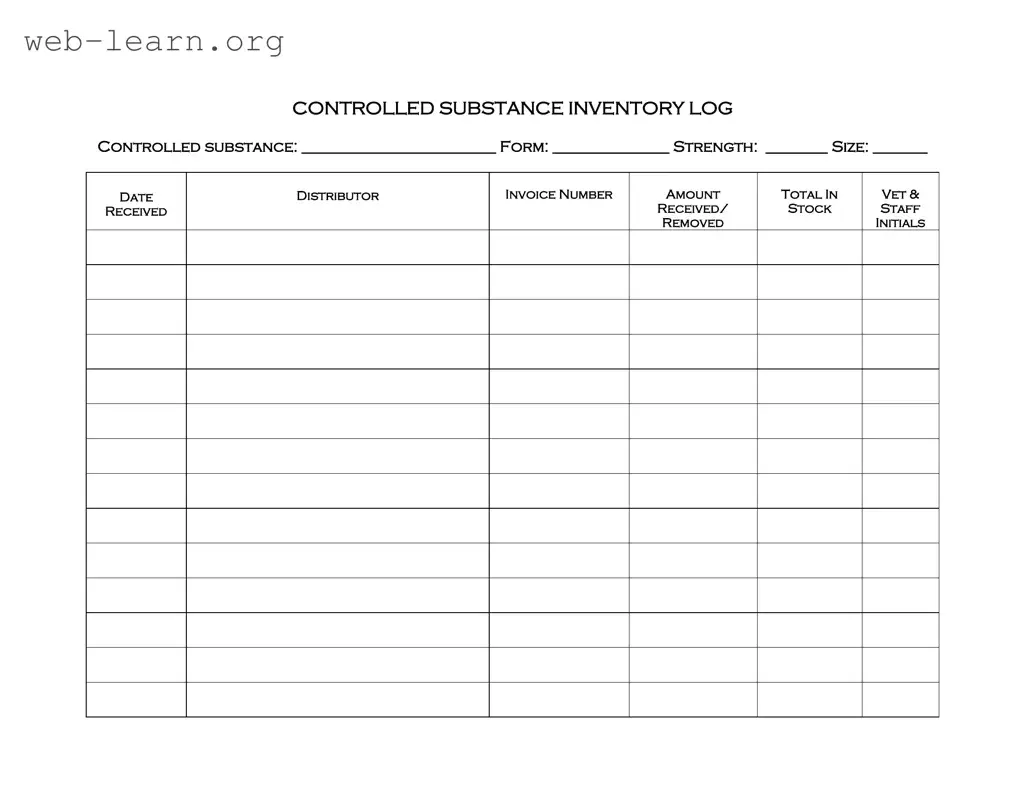
The Controlled Drug Log form serves as a critical tool for managing and tracking the use of controlled substances within various settings, particularly in veterinary practices. This comprehensive log includes essential fields that ensure accurate documentation of each controlled substance, such as the name of the drug, its specific form, strength, and size. Additionally, the form requires the date of receipt, distributor information, and invoice number, which help maintain a clear chain of custody. Users must also record the amount received and the total stock available, allowing for effective inventory management. Each entry is completed with the initials of the staff member responsible for the transaction, promoting accountability and transparency in handling these sensitive materials. By utilizing the Controlled Drug Log form, organizations can adhere to regulatory requirements while ensuring the safe and responsible use of controlled substances.
| Fact Name | Description |
|---|---|
| Purpose | The Controlled Drug Log form is used to track the inventory of controlled substances within a facility. |
| Required Information | Essential details include the controlled substance name, form, strength, size, date received, distributor, invoice number, amount received, and initials of the staff involved. |
| Legal Requirement | Maintaining a Controlled Drug Log is mandated by federal and state laws to ensure compliance with drug regulations. |
| State-Specific Laws | Each state has its own governing laws regarding controlled substances. For example, in California, the relevant law is the California Business and Professions Code Section 4160. |
| Frequency of Updates | The log must be updated each time a controlled substance is received or removed from inventory. |
| Record Retention | Records should be retained for a minimum of two years, as stipulated by federal regulations. |
| Staff Responsibility | It is the responsibility of authorized staff members to accurately complete and maintain the log to prevent misuse and ensure accountability. |
Filling out the Controlled Drug Log form is essential for maintaining accurate records of controlled substances. This ensures compliance with regulations and helps in tracking the use and distribution of these drugs. Follow the steps below to complete the form correctly.
What is the purpose of the Controlled Drug Log form?
The Controlled Drug Log form is designed to track the inventory of controlled substances within a facility. It ensures accurate record-keeping of drugs received, used, and disposed of. This log helps maintain compliance with federal and state regulations regarding the handling of controlled substances.
What information is required on the form?
The form requires the following details:
How should the log be maintained?
The log should be maintained in a secure location, accessible only to authorized personnel. It must be updated in real-time whenever drugs are received or dispensed. Regular audits should be conducted to ensure accuracy and compliance.
Who is responsible for completing the form?
Typically, licensed staff members, such as veterinarians or pharmacy technicians, are responsible for completing the log. However, any staff member authorized to handle controlled substances should be trained in proper documentation practices.
What should be done if there is a discrepancy in the log?
If a discrepancy is found, it is crucial to investigate promptly. Review the entries for errors, consult with involved staff, and correct any mistakes in the log. If the discrepancy suggests potential theft or loss, report it to the appropriate authorities immediately.
How long should the log be kept?
Generally, records should be retained for a minimum of five years. However, specific state laws may require longer retention periods. Always check local regulations to ensure compliance.
Can electronic records be used instead of a paper log?
Yes, electronic records can be used as long as they comply with legal requirements. Ensure that the electronic system is secure, accessible only to authorized personnel, and capable of generating accurate reports when needed.
What are the consequences of failing to maintain the log properly?
Failure to maintain the log can result in serious consequences, including legal penalties, loss of licenses, and increased scrutiny from regulatory agencies. Proper documentation is essential for demonstrating compliance and ensuring the safe handling of controlled substances.
Filling out the Controlled Drug Log form is crucial for maintaining accurate records of controlled substances. However, mistakes can easily occur. One common error is failing to include all required information. Each section of the form, such as controlled substance, form, and strength, must be completed. Omitting any details can lead to discrepancies and issues during audits.
Another frequent mistake is incorrect data entry. For example, writing the wrong invoice number or amount received can cause confusion. It’s essential to double-check these entries to ensure accuracy. Even a small typo can have significant consequences.
In addition, people sometimes forget to update the log promptly. Delays in recording when substances are received or removed can create gaps in the inventory. Keeping the log current helps prevent issues related to accountability and compliance.
Some individuals neglect to include their initials when substances are removed from stock. This oversight can lead to uncertainty about who accessed the controlled substances. Initials serve as a verification step, providing a clear trail of responsibility.
Another mistake involves using outdated forms. Regulations may change, and it’s important to ensure that the most current version of the Controlled Drug Log form is being used. Using an old form could result in missing sections or incorrect requirements.
Lastly, many people overlook the importance of training. Proper training on how to fill out the log can significantly reduce errors. When staff members are not adequately trained, they may not understand the importance of each section or the implications of inaccuracies.
The Controlled Drug Log form is essential for tracking the use and distribution of controlled substances within a facility. However, several other documents complement this log, ensuring compliance and proper management of these sensitive materials. Below is a list of forms and documents that are often used alongside the Controlled Drug Log form, each serving a specific purpose in the overall process.
Utilizing these forms and documents alongside the Controlled Drug Log form promotes a comprehensive approach to managing controlled substances. By maintaining accurate records and following established protocols, facilities can ensure compliance with legal requirements and promote safety in their operations.
Controlled Substance Inventory Log: This document is used to track the quantities of controlled substances on hand. Similar to the Controlled Drug Log, it records the date, amount received, and staff initials, ensuring accountability and compliance with regulations.
Prescription Log: A Prescription Log tracks the prescriptions written for controlled substances. It includes details such as the patient's name, medication prescribed, and the prescribing physician. Like the Controlled Drug Log, it helps maintain an accurate record of controlled substances.
Drug Dispensing Log: This log records the dispensing of medications to patients. It includes information such as the date, patient name, and medication dispensed. Both logs serve to monitor the distribution and usage of controlled substances, ensuring proper management.
Inventory Reconciliation Form: This form is used to compare physical inventory counts with recorded amounts. Similar to the Controlled Drug Log, it helps identify discrepancies and ensures that all controlled substances are accounted for accurately.
Incident Report: An Incident Report documents any irregularities or issues related to controlled substances, such as theft or loss. While it serves a different purpose, it is essential for maintaining compliance and addressing any concerns that arise, much like the Controlled Drug Log.
When filling out the Controlled Drug Log form, it's essential to ensure accuracy and compliance. Here are some key dos and don'ts to keep in mind:
When it comes to the Controlled Drug Log form, there are several misconceptions that can lead to confusion. Here are four common ones:
Understanding these misconceptions can help ensure proper use of the Controlled Drug Log form and promote accountability in handling controlled substances.
When managing controlled substances, accuracy and compliance are paramount. The Controlled Drug Log form serves as an essential tool for tracking these substances. Here are some key takeaways to consider when filling out and using this form:
By adhering to these guidelines, you can effectively manage controlled substances and maintain compliance with legal requirements.