Homepage Blank Control Substance Inventory Michigan Form
Outline

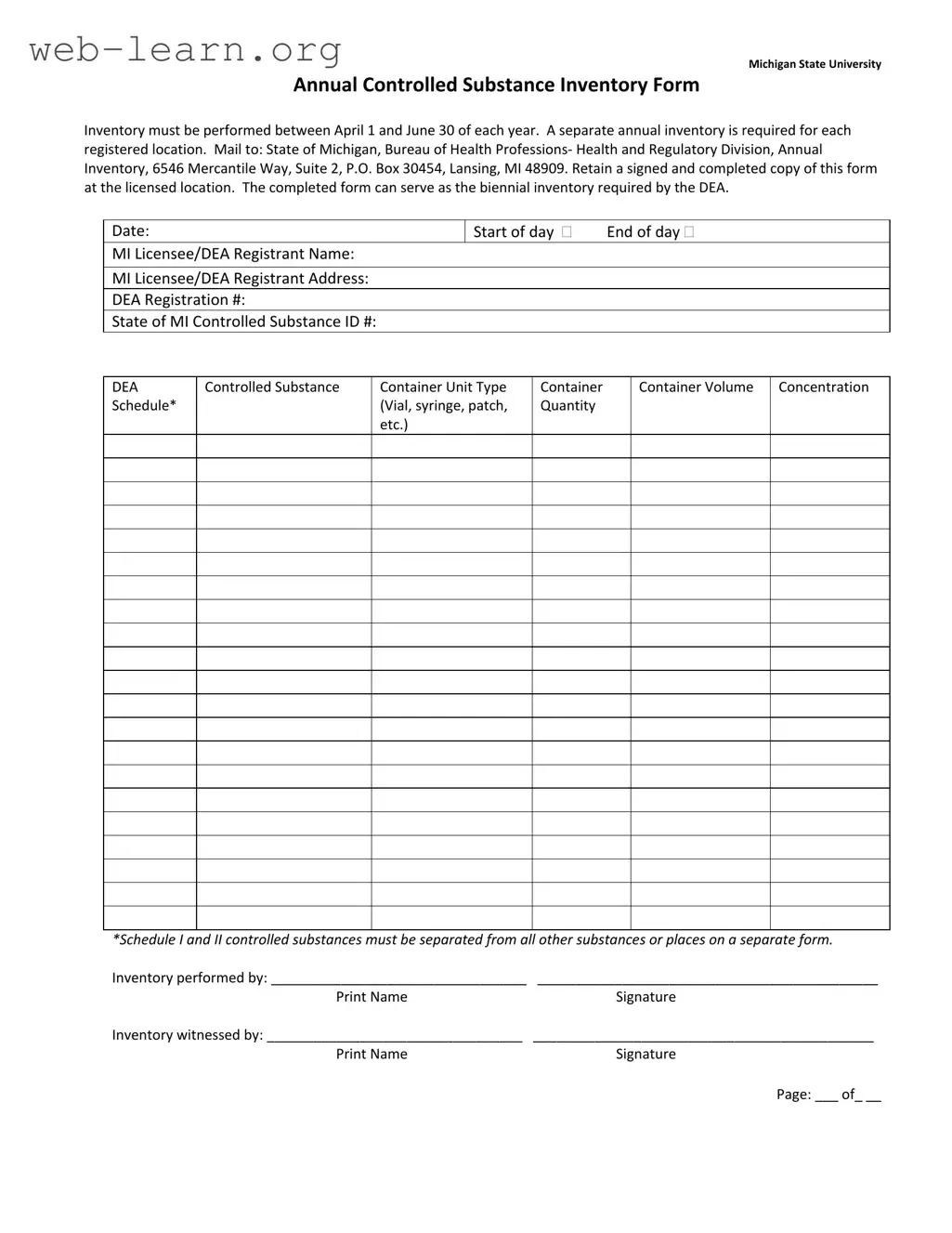
The Control Substance Inventory Michigan form is a crucial document for any facility that handles controlled substances in the state. Each year, an inventory must be conducted between April 1 and June 30, ensuring compliance with state regulations. This form requires a separate inventory for each registered location, which helps maintain accurate records and accountability. Once completed, the form should be mailed to the Bureau of Health Professions in Lansing. It is important to keep a signed copy at the licensed location for your records. Notably, this form can also fulfill the biennial inventory requirement set by the DEA, streamlining the compliance process. Key information collected includes the date of inventory, the name and address of the DEA registrant, and specific details about the controlled substances, such as their schedule classification and container types. For substances classified as Schedule I and II, special attention is required, as they must be documented separately. Additionally, the form mandates signatures from both the person conducting the inventory and a witness, further ensuring the integrity of the process.
Sample - Control Substance Inventory Michigan Form

MichiganStateUniversity
AnnualControlledSubstanceInventoryForm
InventorymustbeperformedbetweenApril1andJune30ofeachyear.Aseparateannualinventoryisrequiredforeach
registeredlocation.Mailto:StateofMichigan,BureauofHealthProfessions‐HealthandRegulatoryDivision,Annual
Inventory,6546MercantileWay,Suite2,P.O.Box30454,Lansing,MI48909.Retainasignedandcompletedcopyofthisform
atthelicensedlocation.ThecompletedformcanserveasthebiennialinventoryrequiredbytheDEA.
Date:
StartofdayEndofday
MILicensee/DEARegistrantName:
MILicensee/DEARegistrantAddress:
DEARegistration#:
StateofMIControlledSubstanceID#:
DEA
Schedule*
ControlledSubstance ContainerUnitType
(Vial,syringe,patch,
etc.)
Container
Quantity
ContainerVolume Concentration





















*ScheduleIandIIcontrolledsubstancesmustbeseparatedfromallothersubstancesorplacesonaseparateform.
Inventoryperformedby:_____________________________________________________________________________
PrintNameSignature
Inventorywitnessedby:_____________________________________________________________________________
PrintNameSignature
Page:___of___

Form Information

Fact Name Details
Inventory Period The inventory must be conducted between April 1 and June 30 each year.
Location Requirement A separate annual inventory is necessary for each registered location.
Mailing Address Send the completed form to the Bureau of Health Professions at the specified Lansing address.
Retention Policy Keep a signed and completed copy of the form at the licensed location for records.
DEA Compliance The completed form can fulfill the biennial inventory requirement set by the DEA.

Detailed Guide for Filling Out Control Substance Inventory Michigan

Completing the Control Substance Inventory Michigan form is a crucial step for maintaining compliance with state regulations. This process involves gathering specific information about controlled substances at your registered location. After filling out the form, it will need to be mailed to the appropriate state office, and a signed copy should be kept on file for your records.

  1. Determine the Inventory Period: Ensure that the inventory is conducted between April 1 and June 30 of the year.
  2. Gather Necessary Information: Collect details such as your MI Licensee/DEA Registrant Name, Address, DEA Registration Number, and State of MI Controlled Substance ID Number.
  3. Document the Date: Indicate the start and end date of the inventory period.
  4. List Controlled Substances: For each controlled substance, fill in the following:
    • DEA Schedule: Identify the schedule of the controlled substance.
    • Container Unit Type: Specify the type of container (e.g., vial, syringe, patch).
    • Container Quantity: Enter the total number of containers.
    • Container Volume: Note the volume of each container.
    • Concentration: Provide the concentration of the substance.
  5. Separate Schedules I and II: Ensure that Schedule I and II controlled substances are documented separately or on a different form.
  6. Complete the Inventory Section: Fill in the name of the person performing the inventory and have them sign the form.
  7. Witness Signature: Have another individual witness the inventory and sign the form.
  8. Page Numbering: Indicate the page number on the form.
  9. Mail the Form: Send the completed form to the State of Michigan, Bureau of Health Professions, at the provided address.
  10. Retain a Copy: Keep a signed and completed copy of the form at your licensed location for future reference.

Obtain Answers on Control Substance Inventory Michigan

  1. What is the purpose of the Controlled Substance Inventory Michigan form?

    The Controlled Substance Inventory Michigan form is used to document the annual inventory of controlled substances held by licensed facilities in Michigan. This inventory must be conducted between April 1 and June 30 each year. It ensures compliance with state regulations and helps maintain accurate records of controlled substances.

  2. Who is required to complete this inventory?

    Every facility that holds a license to manage controlled substances in Michigan must complete this inventory. Each registered location must have a separate annual inventory form. This requirement applies to various entities, including hospitals, pharmacies, and research institutions.

  3. How should the completed form be submitted?

    Once the inventory is completed, the form should be mailed to the following address:

    • State of Michigan
    • Bureau of Health Professions
    • Health and Regulatory Division
    • Annual Inventory
    • 6546 Mercantile Way, Suite 2
    • P.O. Box 30454
    • Lansing, MI 48909

    It is important to retain a signed and completed copy of this form at the licensed location for record-keeping purposes.

  4. What specific information is required on the form?

    The form requires detailed information including:

    • Date of inventory
    • Name and address of the MI Licensee/DEA Registrant
    • DEA Registration number
    • State of MI Controlled Substance ID number
    • DEA Schedule of the controlled substances
    • Container type (e.g., vial, syringe, patch)
    • Container quantity and volume concentration

    It is crucial that Schedule I and II controlled substances are recorded separately or on a different form.

  5. Can this form be used for DEA biennial inventory requirements?

    Yes, the completed Michigan Controlled Substance Inventory form can serve as the biennial inventory required by the DEA. By maintaining this documentation, facilities can ensure compliance with both state and federal regulations regarding controlled substances.

Common mistakes

Filling out the Control Substance Inventory Michigan form requires careful attention to detail. One common mistake individuals make is failing to perform the inventory within the designated time frame. The form specifies that the inventory must occur between April 1 and June 30 each year. Missing this window can lead to compliance issues.

Another frequent error involves neglecting to submit a separate inventory for each registered location. Each facility must have its own completed form, as combining inventories can create confusion and may not meet regulatory requirements. This oversight can result in significant penalties.

People often overlook the requirement to mail the completed form to the correct address. The form must be sent to the Bureau of Health Professions at the specified Lansing address. Sending it to an incorrect location can delay processing and compliance verification.

Inaccurate information about the registrant can also lead to complications. Individuals frequently forget to include their DEA Registration number or provide incorrect details for the MI Licensee/DEA Registrant Name and Address. Such inaccuracies can hinder the processing of the inventory.

Another mistake arises when individuals fail to separate Schedule I and II controlled substances from other substances. These substances must be listed on a separate form, as indicated in the instructions. Failing to do so can lead to serious compliance issues and potential legal ramifications.

Moreover, some people do not retain a signed copy of the completed form at the licensed location. This step is crucial for record-keeping and may be required during inspections or audits. Without a retained copy, proving compliance can become problematic.

Errors in detailing the controlled substances can also occur. Individuals may incorrectly list the container type, quantity, or volume. Each of these details is essential for accurate inventory tracking and compliance with state and federal regulations.

Lastly, failing to have the inventory witnessed by another individual can be a significant oversight. The form requires signatures from both the person performing the inventory and a witness. Not securing a witness can invalidate the inventory and lead to further complications.

Documents used along the form

When managing controlled substances, various forms and documents are essential to ensure compliance with state and federal regulations. Each document serves a specific purpose in the inventory and management process, helping to maintain accountability and safety. Here are some commonly used forms alongside the Control Substance Inventory Michigan form:

  • Controlled Substance Registration Application: This form is necessary for individuals or entities seeking to obtain a license to handle controlled substances. It includes details about the applicant and the intended use of the substances.
  • DEA Form 222: Used for the ordering and transferring of Schedule I and II controlled substances, this form must be completed in triplicate. It ensures that the transfer of these substances is documented and regulated.
  • Biennial Inventory Report: Similar to the annual inventory, this report is required every two years by the DEA. It provides a comprehensive overview of all controlled substances held by a registrant at a specific time.
  • Controlled Substance Disposal Form: When disposing of controlled substances, this form documents the process. It is crucial for ensuring that substances are disposed of in a manner that complies with legal requirements.
  • Incident Report Form: In the event of a theft, loss, or other incident involving controlled substances, this form is used to report the details. It is essential for tracking and responding to such occurrences.
  • Prescription Order Form: This document is used by healthcare providers to prescribe controlled substances to patients. It must include specific information to ensure compliance with regulations.
  • Controlled Substance Log: This ongoing record tracks the receipt, use, and disposal of controlled substances. It is vital for maintaining accurate inventory and accountability.
  • Training Documentation: Records of training for staff handling controlled substances are important. This documentation ensures that all personnel are aware of compliance and safety protocols.

Understanding these forms and their purposes is crucial for anyone involved in the management of controlled substances. Proper documentation not only ensures compliance with legal requirements but also promotes safety and accountability in handling these sensitive materials.

Similar forms

The Control Substance Inventory Michigan form shares similarities with several other important documents in the realm of controlled substances. Here are four of them:

  • DEA Form 222: This form is used for ordering Schedule I and II controlled substances. Like the Michigan inventory form, it requires precise documentation of the substances involved, ensuring proper tracking and accountability.
  • Biennial Inventory Form: Similar to the Michigan form, this document is required by the DEA every two years. It also mandates a thorough count of all controlled substances, helping to maintain compliance with federal regulations.
  • Controlled Substance Registration Application: This application is necessary for facilities seeking to handle controlled substances. It requires detailed information about the facility, much like the inventory form requires specifics about the substances held at each location.
  • State Controlled Substance License Renewal Application: This document is used to renew a facility’s ability to manage controlled substances. It parallels the inventory form in that it collects essential information about the facility's operations and compliance with state regulations.

Dos and Don'ts

When filling out the Control Substance Inventory Michigan form, it’s essential to follow specific guidelines to ensure accuracy and compliance. Here are some important dos and don'ts to consider:

  • Do perform the inventory between April 1 and June 30 of each year.
  • Do complete a separate annual inventory for each registered location.
  • Do retain a signed and completed copy of the form at the licensed location.
  • Do ensure that Schedule I and II controlled substances are separated from other substances or recorded on a separate form.
  • Don't forget to include your MI Licensee/DEA Registrant Name and Address on the form.
  • Don't overlook the requirement to mail the completed form to the appropriate address: State of Michigan, Bureau of Health Professions, Health and Regulatory Division, Annual Inventory, 6546 Mercantile Way, Suite 2, P.O. Box 30454, Lansing, MI 48909.
  • Don't leave the inventory witnessed section blank; both the person performing the inventory and the witness must sign.
  • Don't use the form for substances that are not classified as controlled; ensure you are only inventorying the appropriate substances.

Misconceptions

  • Misconception 1: The inventory can be completed at any time during the year.
  • This is incorrect. The inventory must be conducted specifically between April 1 and June 30 each year.

  • Misconception 2: Only one inventory form is needed for multiple locations.
  • Each registered location requires a separate annual inventory. This ensures accurate tracking of controlled substances at each site.

  • Misconception 3: The completed form does not need to be mailed to any specific address.
  • It is essential to mail the completed form to the Bureau of Health Professions at the specified Lansing address to comply with regulations.

  • Misconception 4: A copy of the inventory does not need to be retained.
  • It is important to keep a signed and completed copy of the inventory at the licensed location for your records.

  • Misconception 5: The inventory form is only for Schedule I and II substances.
  • While Schedule I and II substances have specific requirements, the form applies to all controlled substances listed in the inventory.

  • Misconception 6: Witness signatures are optional.
  • Having a witness sign the inventory is a crucial step in the process. It adds an extra layer of accountability and verification.

  • Misconception 7: The completed form does not serve any other purpose.
  • The completed inventory form can also fulfill the biennial inventory requirement set by the DEA, making it a valuable document.

  • Misconception 8: The inventory does not need to detail container types and quantities.
  • Accurate details regarding container types, quantities, and volumes are necessary for compliance and tracking purposes.

Key takeaways

When filling out and using the Controlled Substance Inventory Michigan form, keep these key takeaways in mind:

  • Timing is crucial: Inventory must be performed between April 1 and June 30 each year.
  • Separate forms for separate locations: A distinct annual inventory is necessary for each registered location.
  • Mailing address: Send the completed form to the Bureau of Health Professions at the designated Lansing address.
  • Retention requirement: Keep a signed and completed copy of the form at the licensed location for your records.
  • DEA compliance: The completed form can fulfill the biennial inventory requirement set by the DEA.
  • Detailed information is needed: Include all relevant details such as licensee name, address, DEA registration number, and controlled substance specifics.
  • Separation of substances: Schedule I and II controlled substances must be listed separately or on a different form.

By adhering to these guidelines, the inventory process will be more efficient and compliant with state and federal regulations.