Homepage Blank Connecticut W 1130 Form
Outline

The Connecticut W 1130 form is a vital document for individuals seeking assistance through the Acquired Brain Injury (ABI) Waiver program. This form serves as a request for support from the Department of Social Services, specifically designed for those who have experienced an acquired brain injury. It collects essential personal information, such as the applicant's name, address, and contact details, as well as critical data regarding their injury and medical history. Additionally, the form addresses the applicant's living preferences, allowing individuals to express their desire to remain in the community rather than transition to a nursing home or institutional setting. It also includes sections to gather information about Medicaid and Medicare benefits, ensuring that applicants receive the appropriate financial support. The form further requests details about the applicant's monthly income and total assets, which are necessary for determining eligibility for assistance. Overall, the Connecticut W 1130 form is a comprehensive tool that facilitates access to necessary services for individuals affected by acquired brain injuries, promoting their well-being and independence.

Sample - Connecticut W 1130 Form

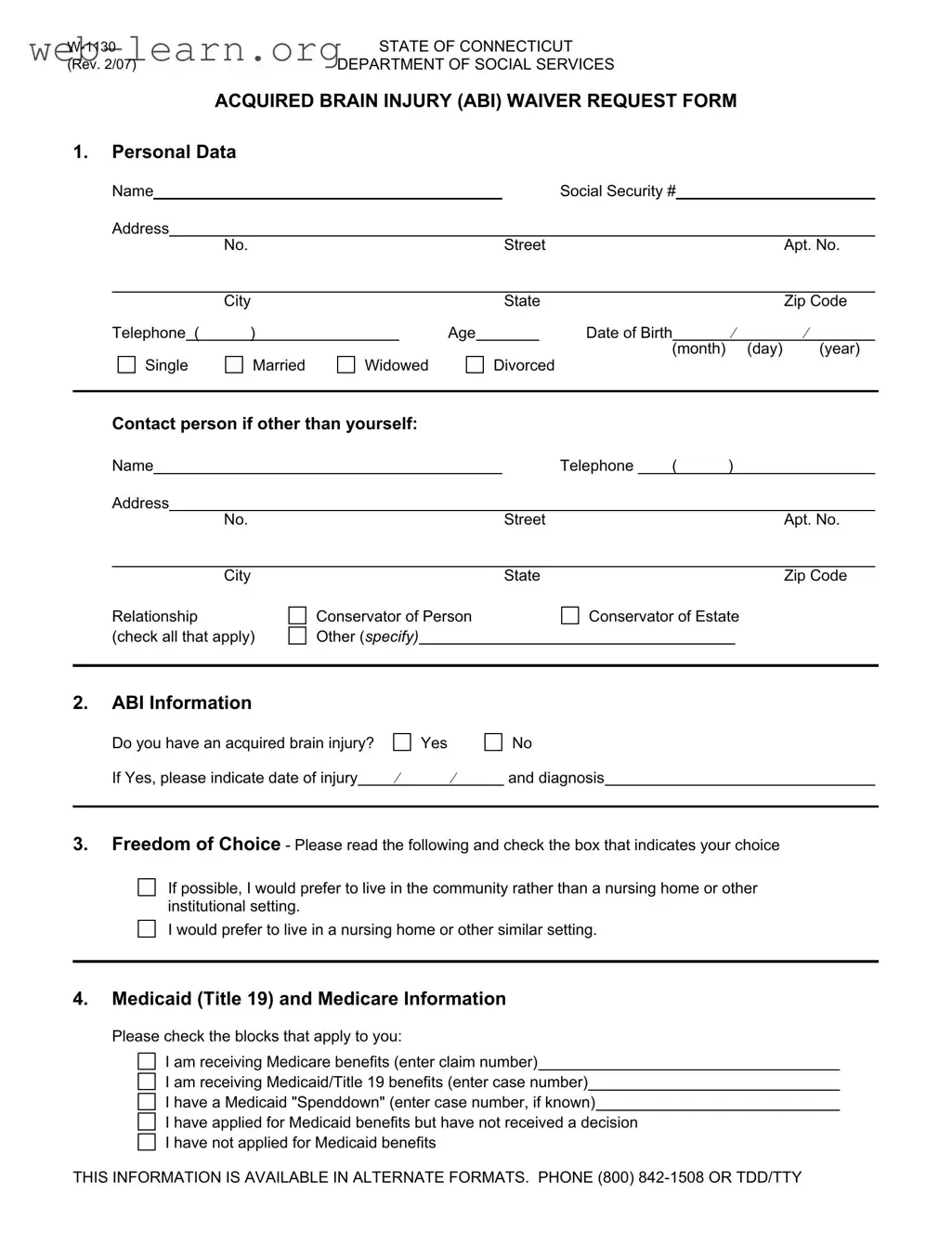
STATE OF CONNECTICUT
DEPARTMENT OF SOCIAL SERVICES
ACQUIRED BRAIN INJURY (ABI) WAIVER REQUEST FORM
1. Personal Data
Name
Social Security #
Address
No. Street Apt. No.
City State Zip Code
Telephone ( )
Age Date of Birth
(month) (day) (year)
Single Married Widowed Divorced
Contact person if other than yourself:
Name
Telephone ( )
Address
No. Street Apt. No.
City State Zip Code
Relationship
Conservator of Person Conservator of Estate
(check all that apply)
Other (specify)
2. ABI Information
Do you have an acquired brain injury?
Yes No
If Yes, please indicate date of injury and diagnosis
3. Freedom of Choice - Please read the following and check the box that indicates your choice
If possible, I would prefer to live in the community rather than a nursing home or other
institutional setting.
I would prefer to live in a nursing home or other similar setting.
4. Medicaid (Title 19) and Medicare Information
Please check the blocks that apply to you:
I am receiving Medicare benefits (enter claim number)
I am receiving Medicaid/Title 19 benefits (enter case number)
I have a Medicaid "Spenddown" (enter case number, if known)
I have applied for Medicaid benefits but have not received a decision
I have not applied for Medicaid benefits
THIS INFORMATION IS AVAILABLE IN ALTERNATE FORMATS. PHONE (800) 842-1508 OR TDD/TTY
W-1130
(Rev. 2/07)
(800) 842-4524.
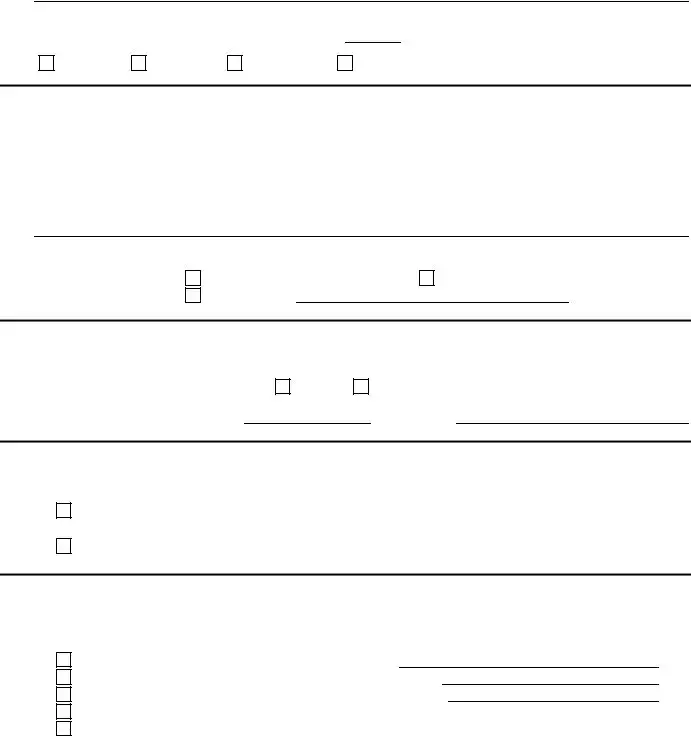
5. Financial Data
My total monthly income (for example, Social Security, SSI, disability benefits, pension benefits, Workers
Compensation, wages, contributions, income from interest or dividends, etc.) is:
Amount
Source
My total assets (for example, cash, bank accounts, IRAs, life insurance, annuities, stocks, bonds, motor
vehicles, property, etc.)
Amount
Source
Signature of Applicant Date
Signature of Conservator or Other Representative Date
Typed or Printed Name of Conservator or Other Representative Date
Return This Form To:
Department of Social Services
25 Sigourney Street
Hartford, CT 06106-5033
Attention: Social Work Services
10th Floor

Form Information

Fact Name Description
Form Purpose The W-1130 form is a request for the Acquired Brain Injury (ABI) Waiver in Connecticut.
Governing Law This form is governed by the Connecticut General Statutes, specifically Section 17b-260.
Eligibility Requirement Applicants must have a documented acquired brain injury to qualify for the waiver.
Community Preference The form allows applicants to express a preference for living in the community versus an institutional setting.
Medicaid and Medicare Applicants must provide information regarding their Medicaid and Medicare benefits, if applicable.
Submission Address The completed form should be sent to the Department of Social Services at 25 Sigourney Street, Hartford, CT 06106-5033.

Detailed Guide for Filling Out Connecticut W 1130

Completing the Connecticut W-1130 form is a straightforward process. After gathering the necessary information, you will provide personal details, information about your brain injury, and financial data. Ensure that you have all relevant documents at hand to make filling out the form easier.

  1. Personal Data: Fill in your name, Social Security number, address (including apartment number, city, state, and zip code), and telephone number. Indicate your age and marital status by checking the appropriate box. Provide your date of birth in the specified format (month/day/year). If someone else is your contact person, include their name, telephone number, address, and relationship to you. Check the boxes for Conservator of Person or Conservator of Estate if applicable.
  2. ABI Information: Answer the question about whether you have an acquired brain injury. If you answer "Yes," provide the date of injury and your diagnosis.
  3. Freedom of Choice: Read the options provided and check the box that reflects your preference for living arrangements—either in the community or in a nursing home or similar setting.
  4. Medicaid and Medicare Information: Check the boxes that apply to your situation regarding Medicare and Medicaid. If you are receiving benefits, enter the claim or case numbers as requested. Indicate if you have a Medicaid "Spenddown" or if you have applied for benefits but have not yet received a decision.
  5. Financial Data: Report your total monthly income by listing the amount and source of each income type, such as Social Security or wages. Similarly, provide details about your total assets, including cash, bank accounts, and property, along with their amounts and sources.
  6. Signatures: Sign and date the form as the applicant. If applicable, the conservator or other representative should also sign and date the form, along with printing or typing their name.
  7. Submission: Return the completed form to the Department of Social Services at the address provided: 25 Sigourney Street, Hartford, CT 06106-5033, Attention: Social Work Services, 10th Floor.

Obtain Answers on Connecticut W 1130

  1. What is the Connecticut W 1130 form?

    The Connecticut W 1130 form is a request form for the Acquired Brain Injury (ABI) Waiver. It is designed for individuals who have suffered an acquired brain injury and are seeking assistance to live in the community rather than in institutional settings. This form collects personal data, ABI information, Medicaid and Medicare status, and financial data to assess eligibility for the waiver program.

  2. Who should fill out the W 1130 form?

    The form should be completed by individuals who have an acquired brain injury. If the individual is unable to complete the form themselves, a conservator or other representative may fill it out on their behalf. It is important to ensure that all information is accurate and complete to facilitate the review process.

  3. What information is required on the form?

    The W 1130 form requires several pieces of information:

    • Personal data, including name, address, and date of birth.
    • Details about the acquired brain injury, including the date of injury and diagnosis.
    • Preference for living arrangements, indicating whether the individual prefers community living or a nursing home.
    • Medicaid and Medicare status, including any claim or case numbers.
    • Financial data, which includes total monthly income and assets.
  4. Where do I send the completed W 1130 form?

    Once the form is completed, it should be sent to the Department of Social Services at:

    Department of Social Services
    25 Sigourney Street
    Hartford, CT 06106-5033
    Attention: Social Work Services, 10th Floor.

  5. How can I obtain assistance if I have questions about the form?

    If you have questions or need assistance while filling out the form, you can contact the Department of Social Services. They can provide guidance and answer any specific questions you may have. Additionally, the information is available in alternate formats for those who require it. You can reach them at (800) 842-1508 or TDD/TTY at (800) 842-4524.

  6. What happens after I submit the W 1130 form?

    After submission, the Department of Social Services will review the application to determine eligibility for the ABI Waiver. You may be contacted for additional information or clarification during this process. It’s important to keep track of any correspondence and respond promptly to ensure a smooth review of your request.

Common mistakes

Filling out the Connecticut W-1130 form can seem straightforward, but there are common mistakes that applicants often make. Understanding these pitfalls can help ensure a smoother application process. One frequent error is neglecting to provide complete personal data. Missing information, such as the Social Security number or date of birth, can delay processing. Always double-check that every required field is filled out accurately.

Another common mistake is failing to specify the acquired brain injury (ABI) details. Applicants should indicate the date of injury and diagnosis clearly. Omitting this information may lead to misunderstandings about eligibility. It’s crucial to be thorough and precise when describing the ABI to avoid complications later in the process.

Many applicants also overlook the section regarding freedom of choice. This part of the form allows individuals to express their living preferences. Some may forget to check a box, which can result in confusion about their wishes. It’s important to take a moment to consider where one would prefer to live and indicate that choice clearly.

When it comes to Medicaid and Medicare information, applicants sometimes make the mistake of providing incomplete or inaccurate details. For instance, if receiving Medicare benefits, it’s essential to enter the correct claim number. Similarly, if applying for Medicaid, ensuring that the case number is accurate is vital. Errors in this section can lead to delays or denials of benefits.

Financial data is another area where mistakes commonly occur. Applicants may miscalculate their total monthly income or assets. This can lead to discrepancies that affect eligibility. It’s wise to gather all relevant financial documents before filling out this section to ensure accuracy.

Lastly, forgetting to sign the form is a frequent oversight. Both the applicant and any conservator or representative must provide their signatures. Without these, the application cannot be processed. Before submitting, it’s beneficial to review the entire form to confirm that all signatures are present and correct.

Documents used along the form

The Connecticut W-1130 form is used to request services under the Acquired Brain Injury (ABI) Waiver program. It collects personal, financial, and medical information about the applicant. Several other forms and documents are often required to support the application process. Below is a list of these related documents.

  • Medicaid Application Form: This form is essential for individuals seeking Medicaid benefits. It gathers detailed information about the applicant's financial situation, household composition, and medical needs to determine eligibility for financial assistance.
  • Social Security Administration (SSA) Disability Application: This application is necessary for individuals who wish to receive Social Security Disability Insurance (SSDI) or Supplemental Security Income (SSI). It requires information about the applicant's medical condition and work history to assess eligibility for benefits.
  • Physician's Statement: A physician's statement may be required to provide medical documentation of the acquired brain injury. This document typically includes the diagnosis, treatment history, and the impact of the injury on the applicant's daily functioning.
  • Authorization for Release of Information: This form allows the Department of Social Services to obtain necessary medical and financial information from third parties. It ensures that the applicant's privacy is respected while facilitating the review process.

These documents play a critical role in the application process for the ABI Waiver program in Connecticut. Proper completion and submission of these forms can help ensure that individuals receive the support and services they need.

Similar forms

The Connecticut W 1130 form is designed for individuals seeking assistance under the Acquired Brain Injury (ABI) Waiver program. Several other documents serve similar purposes in terms of collecting personal and financial information for various assistance programs. Below are six documents that share similarities with the W 1130 form:

  • Medicaid Application Form: This document gathers detailed personal, financial, and medical information to determine eligibility for Medicaid benefits, much like the W 1130 form does for ABI assistance.
  • Social Security Disability Insurance (SSDI) Application: Similar to the W 1130, this form requires information about the applicant's medical condition, work history, and financial situation to assess eligibility for disability benefits.
  • Supplemental Security Income (SSI) Application: This form also collects personal and financial data to evaluate eligibility for SSI benefits, paralleling the income and asset inquiries found in the W 1130 form.
  • Long-Term Care Application: Like the W 1130, this application assesses the need for long-term care services, requiring information about the applicant's health status and financial resources.
  • Medicare Savings Program Application: This document is used to determine eligibility for assistance with Medicare costs, similar to how the W 1130 collects information to evaluate ABI waiver eligibility.
  • Home and Community-Based Services (HCBS) Waiver Application: This form seeks personal and financial details to establish eligibility for home and community-based services, akin to the information required in the W 1130 for ABI services.

Each of these forms shares a common goal: to assess eligibility for various forms of assistance by collecting vital information from applicants. Understanding these similarities can help individuals navigate the process of applying for the support they need.

Dos and Don'ts

When filling out the Connecticut W-1130 form, there are several important dos and don'ts to keep in mind. Following these guidelines can help ensure that your application is processed smoothly.

  • Do provide accurate personal information, including your name, address, and Social Security number.
  • Do indicate whether you have an acquired brain injury and provide the date and diagnosis if applicable.
  • Do check the appropriate boxes regarding your preference for living arrangements, whether in the community or a nursing home.
  • Do clearly state your financial data, including total monthly income and assets, along with their sources.
  • Don't leave any sections blank; every part of the form is important for processing your request.
  • Don't forget to sign the form. Both the applicant and any conservator or representative must provide their signatures and dates.

By adhering to these guidelines, you can help facilitate a smoother experience with the Connecticut W-1130 form. Make sure to review your answers before submitting to avoid any delays in processing.

Misconceptions

Misconceptions can lead to confusion, especially when it comes to important forms like the Connecticut W 1130. Here are some common misunderstandings about this form that you should be aware of:

  • Only individuals with severe brain injuries can apply. Many believe that the W 1130 form is only for those with the most severe cases of acquired brain injury. However, the form is designed for a range of individuals who have experienced any acquired brain injury, regardless of severity.
  • Submitting the form guarantees immediate approval for services. Some people think that filling out the W 1130 form automatically secures benefits. In reality, the approval process involves a review and assessment of eligibility, which may take time.
  • The form can only be completed by the individual. There is a common belief that only the person with the brain injury can fill out the W 1130. In fact, a conservator or other representative can complete the form on behalf of the individual, ensuring that all necessary information is accurately provided.
  • Income and asset information is not necessary. Many applicants underestimate the importance of financial data on the form. Providing accurate income and asset information is crucial, as it directly impacts eligibility for the ABI waiver services.

Understanding these misconceptions is vital for anyone considering the W 1130 form. Taking the time to clarify these points can help streamline the application process and improve the chances of receiving the necessary support.

Key takeaways

The Connecticut W 1130 form is essential for individuals seeking assistance under the Acquired Brain Injury (ABI) Waiver program. Proper completion of this form is crucial for eligibility determination. Here are key takeaways regarding its use:

  • Personal Information: Fill out all personal data accurately, including name, address, and contact details.
  • ABI Disclosure: Indicate whether you have an acquired brain injury and provide the date and diagnosis if applicable.
  • Freedom of Choice: Clearly express your preference for living arrangements by checking the appropriate box.
  • Medicaid and Medicare Status: Provide accurate information about your Medicaid and Medicare benefits, including any claim or case numbers.
  • Financial Data: Report total monthly income and assets comprehensively, listing sources for each.
  • Signatures Required: Ensure that both the applicant and any conservator or representative sign the form, along with printed names and dates.
  • Submission Instructions: Return the completed form to the specified address to ensure timely processing of your request.
  • Alternate Formats: If needed, request information in alternate formats by contacting the provided phone numbers.

Completing the W 1130 form accurately and promptly is vital for securing necessary services. Be diligent in gathering all required information before submission to avoid delays.