Homepage Blank Connecticut Uc 2 Form
Outline

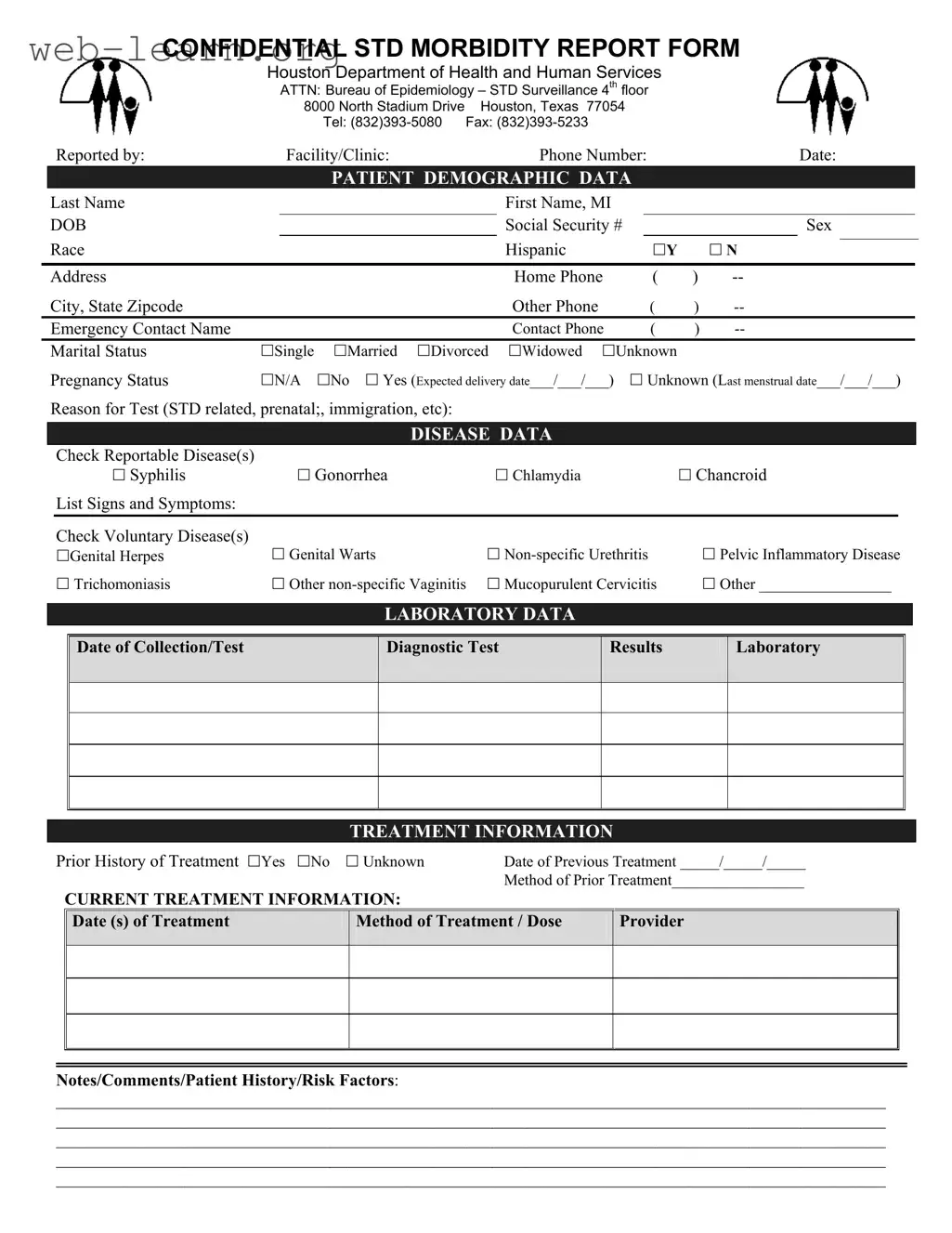
The Connecticut UC 2 form plays a crucial role in the reporting and tracking of sexually transmitted diseases (STDs) within the state. Designed to collect essential patient demographic data, the form includes sections for personal information such as name, date of birth, and contact details, ensuring that health officials can accurately identify and follow up with individuals. Additionally, it requires information about the patient's marital status and pregnancy status, which can be important for public health monitoring. The form also encompasses disease data, where healthcare providers can check off reportable diseases like syphilis, gonorrhea, and chlamydia, as well as voluntary diseases such as genital herpes and pelvic inflammatory disease. Laboratory data is captured, including the date of sample collection and diagnostic test results, which are vital for understanding the spread of STDs. Treatment information is another key aspect, detailing prior and current treatment methods, dates, and any relevant patient history. By providing a comprehensive overview of these elements, the UC 2 form aids in the effective management and prevention of STDs, ultimately contributing to better public health outcomes in Connecticut.
Sample - Connecticut Uc 2 Form

CONFIDENTIAL STD MORBIDITY REPORT FORM
Houston Department of Health and Human Services
ATTN: Bureau of Epidemiology – STD Surveillance 4
th
floor
8000 North Stadium Drive Houston, Texas 77054
Tel: (832)393-5080 Fax: (832)393-5233
Reported by: Facility/Clinic: Phone Number:
Date:
PATIENT DEMOGRAPHIC DATA
Last Name
First Name, MI
DOB
Social Security #
Sex
Race
Hispanic
Y N
Address Home Phone ( ) --
City, State Zipcode
Other Phone ( ) --
Emergency Contact Name
Contact Phone ( ) --
Marital Status
Single Married Divorced Widowed Unknown
Pregnancy Status
N/A No Yes (Expected delivery date___/___/___) Unknown (Last menstrual date
_
__/___/___)
Reason for Test (STD related, prenatal;, immigration, etc):
DISEASE DATA
Check Reportable Disease(s)
Syphilis Gonorrhea Chlamydia Chancroid
List Signs and Symptoms:
Check Voluntary Disease(s)
Genital Herpes
Genital Warts Non-specific Urethritis Pelvic Inflammatory Disease
Trichomoniasis
Other non-specific Vaginitis Mucopurulent Cervicitis Other _________________
LABORATORY DATA
Date of Collection/Test Diagnostic Test
Results Laboratory
TREATMENT INFORMATION
Prior History of Treatment Yes No Unknown Date of Previous Treatment _____/_____/_____
Method of Prior Treatment_________________
CURRENT TREATMENT INFORMATION:
Date (s) of Treatment Method of Treatment / Dose
Provider
Notes/Comments/Patient History/Risk Factors:
_________________________________________________________________________________________________
_________________________________________________________________________________________________
_________________________________________________________________________________________________
_________________________________________________________________________________________________
_________________________________________________________________________________________________

Form Information

Fact Name Description
Form Purpose The Connecticut UC 2 form is designed to collect confidential morbidity data related to sexually transmitted diseases (STDs) for public health monitoring.
Governing Law This form is governed by the Connecticut General Statutes, particularly sections related to public health and disease reporting.
Confidentiality All information provided on the UC 2 form is confidential and is used solely for health surveillance purposes.
Data Required Required data includes patient demographics, disease data, laboratory results, and treatment information.
Submission Guidelines The completed form must be submitted to the appropriate health department office as specified in the instructions.
Reporting Timeline Health care providers are required to report cases of STDs within a specific timeframe as mandated by state law.

Detailed Guide for Filling Out Connecticut Uc 2

After gathering the necessary information, you can begin filling out the Connecticut UC 2 form. Be sure to provide accurate details to ensure proper processing. Follow these steps carefully.

  1. Fill in the top section: Write the name of the facility or clinic, your phone number, and the date of the report.
  2. Enter patient demographic data: Include the patient’s last name, first name, middle initial, date of birth, social security number, sex, race, and whether they are Hispanic.
  3. Provide the patient’s address: Fill in the home address, city, state, and zip code. Also, include the home phone number and any other contact number.
  4. Emergency contact: Write the name of the emergency contact person and their phone number.
  5. Marital status: Check the appropriate box for single, married, divorced, widowed, or unknown.
  6. Pregnancy status: Indicate if applicable, and provide the expected delivery date or the last menstrual date if known.
  7. Reason for test: Clearly state the reason for the test, such as STD related, prenatal, or immigration.
  8. Reportable disease data: Check all relevant reportable diseases such as syphilis, gonorrhea, chlamydia, or chancroid. List any signs and symptoms.
  9. Voluntary disease data: Check any voluntary diseases that apply, including genital herpes, genital warts, or other specified conditions.
  10. Laboratory data: Fill in the date of collection/test, diagnostic test results, and the name of the laboratory.
  11. Treatment information: Indicate if there was a prior history of treatment and provide the date and method of previous treatment if applicable.
  12. Current treatment information: List the date(s) of treatment, the method of treatment or dose, and the provider's name.
  13. Notes/comments: Use the space provided for any additional patient history or risk factors that are relevant.

Once you have completed the form, review all entries for accuracy. After that, submit the form to the appropriate department as indicated at the top. Make sure to keep a copy for your records.

Obtain Answers on Connecticut Uc 2

  1. What is the Connecticut UC 2 form?

    The Connecticut UC 2 form is a confidential morbidity report used for reporting sexually transmitted diseases (STDs) to the appropriate health authorities. It is essential for tracking and managing public health concerns related to STDs. The form collects demographic data, disease data, laboratory information, and treatment history to ensure comprehensive reporting.

  2. Who is required to fill out the UC 2 form?

    Healthcare providers, including doctors, clinics, and hospitals, are responsible for completing the UC 2 form when they diagnose a patient with a reportable STD. This requirement helps health officials monitor the incidence of STDs and implement necessary public health interventions.

  3. What information is required on the UC 2 form?

    The form requires various details, including:

    • Patient demographic data, such as name, date of birth, and contact information.
    • Details about the STD diagnosis, including the specific disease and symptoms.
    • Laboratory data, including the date of testing and results.
    • Treatment information, covering previous and current treatments.

    Completing all sections accurately is crucial for effective disease surveillance and response.

  4. How is the information on the UC 2 form used?

    The data collected through the UC 2 form is utilized by public health authorities to monitor STD trends, identify outbreaks, and develop targeted prevention strategies. This information is vital for improving community health outcomes and ensuring that resources are allocated effectively.

  5. Is the information on the UC 2 form confidential?

    Yes, the information submitted on the UC 2 form is confidential. It is protected under privacy laws, ensuring that patient identities remain secure. Only authorized personnel within public health departments have access to this data for epidemiological purposes.

  6. Where should the completed UC 2 form be sent?

    The completed UC 2 form should be sent to the Houston Department of Health and Human Services, specifically to the Bureau of Epidemiology – STD Surveillance. The mailing address is:

    8000 North Stadium Drive, 4th Floor
    Houston, Texas 77054

    Additionally, forms can be submitted via fax at (832) 393-5233.

Common mistakes

Filling out the Connecticut UC 2 form can be a straightforward process, but there are common mistakes that can lead to delays or issues in processing. One frequent error is providing incomplete patient demographic data. Missing information such as the last name, date of birth, or social security number can cause significant setbacks. It is crucial to double-check that all fields are filled out accurately before submission.

Another mistake often made is failing to accurately report the reason for the test. This section is vital for understanding the context of the patient's visit. If the reason is unclear or not specified, it can lead to confusion for healthcare providers. Clear communication about the reason for testing is essential to ensure appropriate follow-up and treatment.

Many individuals overlook the importance of checking the reportable diseases correctly. Not marking the relevant diseases can result in incomplete data collection, which affects public health monitoring. Ensure that all applicable diseases are checked off. If unsure, it is better to consult with a healthcare provider for clarification.

In the treatment information section, people sometimes provide vague or incomplete details about prior treatments. This can hinder effective treatment planning. Specific dates and methods of previous treatments should be recorded clearly. Providing comprehensive treatment history helps healthcare professionals make informed decisions.

Lastly, neglecting to include notes or comments about patient history or risk factors can be detrimental. This section allows for additional context that may be relevant to the patient's care. Detailed notes can significantly enhance the understanding of the patient's situation, leading to better health outcomes. Always take the time to provide thorough information in this area.

Documents used along the form

When submitting the Connecticut UC 2 form, there are several other forms and documents that may be necessary to ensure comprehensive reporting and compliance with health regulations. Each of these documents serves a specific purpose and helps facilitate effective communication between healthcare providers and public health authorities.

  • Patient Consent Form: This document ensures that patients understand and agree to the testing and reporting of their STD status. It outlines the purpose of the testing and how the information will be used.
  • Laboratory Test Requisition Form: This form is used to request specific laboratory tests for the patient. It includes details about the tests needed and helps streamline the testing process.
  • Clinical History Form: This form gathers detailed information about the patient's medical history, including previous STDs, treatments, and other relevant health issues. It assists healthcare providers in making informed decisions about patient care.
  • Follow-Up Care Plan: This document outlines the recommended follow-up care for the patient after an STD diagnosis. It may include treatment options, referrals to specialists, and advice on managing health and preventing transmission.
  • Confidentiality Agreement: This agreement ensures that all parties involved in the patient's care understand the importance of maintaining confidentiality regarding sensitive health information.
  • Referral Form: If a patient needs to be referred to another healthcare provider or specialist, this form provides the necessary information to facilitate the referral process and ensure continuity of care.
  • Insurance Information Form: This document collects the patient's insurance details, which can assist in billing and reimbursement processes for the services rendered.
  • Statistical Reporting Form: This form is often used for public health reporting purposes. It helps track the prevalence of STDs in the community and informs health initiatives and resource allocation.

Utilizing these additional forms alongside the Connecticut UC 2 form can enhance the accuracy of reporting and improve patient care outcomes. Each document plays a vital role in the overall process, ensuring that patient information is managed effectively and responsibly.

Similar forms

  • CDC Form 57.140: This form is used for reporting sexually transmitted diseases (STDs) to the Centers for Disease Control and Prevention. Like the UC 2 form, it collects patient demographic information, disease data, and treatment details.
  • State Health Department STD Reporting Form: Similar to the UC 2 form, this document is utilized by state health departments to track STD cases. It requires demographic data, disease specifics, and treatment history.
  • Patient Intake Form: This form gathers essential information about a patient during their first visit. It parallels the UC 2 by collecting demographic data and medical history but may not focus solely on STDs.
  • Consent for Treatment Form: While this form secures patient consent for medical procedures, it also collects demographic information. It shares similarities with the UC 2 in terms of patient identification.
  • Lab Requisition Form: This document is used to request laboratory tests. It contains patient information and test details, akin to the UC 2 form's laboratory data section.
  • Medical History Form: This form captures a patient's past medical history and demographic data. Its focus on health information aligns with the UC 2's collection of treatment and disease data.
  • Emergency Contact Form: This document collects information about a patient's emergency contacts. It complements the UC 2 form by gathering critical contact details for patient emergencies.
  • Insurance Information Form: This form is used to collect insurance details from patients. It shares the demographic data aspect with the UC 2 form, though it focuses on financial information.
  • Referral Form: Used to refer patients to specialists, this form collects patient demographics and reason for referral. It mirrors the UC 2's structure in terms of patient information.
  • Follow-Up Care Form: This document is designed to track patient follow-up care. It includes demographic data and treatment information, similar to the UC 2 form's treatment sections.

Dos and Don'ts

When filling out the Connecticut UC 2 form, there are several important dos and don'ts to keep in mind. Following these guidelines can help ensure that the form is completed accurately and efficiently.

  • Do provide complete and accurate patient demographic data.
  • Do check all applicable reportable diseases and voluntary diseases.
  • Do include the correct date for all treatments and tests.
  • Do ensure that all contact information is current and correct.
  • Don't leave any required fields blank.
  • Don't use abbreviations that may cause confusion.
  • Don't provide incomplete medical history or treatment information.
  • Don't forget to sign and date the form before submission.

Misconceptions

Understanding the Connecticut UC 2 form can be challenging, and misconceptions often arise. Here are ten common misunderstandings about this form, along with clarifications to help you navigate the process more effectively.

  • Misconception 1: The UC 2 form is only for reporting STDs.
  • While the UC 2 form includes sections for STDs, it can also be used for other health-related reporting, such as prenatal or immigration-related tests.

  • Misconception 2: All patient information is public.
  • The information collected on the UC 2 form is confidential and is protected by privacy laws. It is only accessible to authorized personnel.

  • Misconception 3: You cannot report multiple diseases on one form.
  • The form allows for the reporting of multiple diseases. You can check all applicable reportable and voluntary diseases in the designated sections.

  • Misconception 4: The form must be filled out completely for it to be valid.
  • While it is important to provide as much information as possible, incomplete forms may still be accepted. However, providing complete data helps ensure better tracking and treatment.

  • Misconception 5: There is no need for patient consent before reporting.
  • Although the form is used for reporting, it is best practice to inform patients that their information will be reported, especially for sensitive data.

  • Misconception 6: The UC 2 form is only for healthcare providers.
  • While healthcare providers typically fill out the form, patients can also inquire about their own health information and reporting if they wish.

  • Misconception 7: The form is only for certain demographics.
  • The UC 2 form is applicable to all individuals regardless of race, gender, or age. It is designed to collect data from diverse populations.

  • Misconception 8: You need to report every single symptom.
  • It is important to note the significant signs and symptoms, but you do not need to list every minor detail. Focus on the most relevant information.

  • Misconception 9: The form can be submitted without a laboratory result.
  • Laboratory results are an essential part of the reporting process. Submitting the form without these results may delay the necessary follow-up actions.

  • Misconception 10: Treatment information is not necessary.
  • Including treatment information is crucial. It helps healthcare providers understand the patient's history and tailor future care effectively.

By clearing up these misconceptions, individuals and healthcare providers can ensure that they use the Connecticut UC 2 form accurately and effectively.

Key takeaways

When filling out and using the Connecticut UC 2 form, it is essential to keep several key points in mind:

  • Confidentiality is crucial. Ensure that all patient information is kept private and secure, as this form contains sensitive data.
  • Complete all sections accurately. Provide detailed information about the patient, including demographics, disease data, and treatment history.
  • Reportable diseases must be checked. Clearly indicate any reportable diseases such as syphilis, gonorrhea, or chlamydia by checking the appropriate boxes.
  • Laboratory data is important. Include the date of collection, diagnostic test results, and the name of the laboratory performing the tests.
  • Document treatment information thoroughly. Include details about prior and current treatments, methods used, and any relevant notes or comments about the patient’s history.