The Connecticut Transfer-on-Death Deed (TODD) serves as an innovative tool for property owners looking to streamline the transfer of real estate upon their passing. By allowing individuals to designate beneficiaries who will automatically receive ownership of the property without the need for probate, this form simplifies the estate planning process. The TODD form must be executed with specific formalities, including being signed by the property owner and notarized, to ensure its validity. Importantly, the deed remains revocable during the owner's lifetime, offering flexibility should circumstances change. Additionally, it is crucial for property owners to understand the implications of this deed on their overall estate, as it may affect tax considerations and the rights of heirs. By utilizing the Connecticut Transfer-on-Death Deed, individuals can take significant steps toward ensuring their property is passed on according to their wishes, while also minimizing the complexities often associated with estate management.
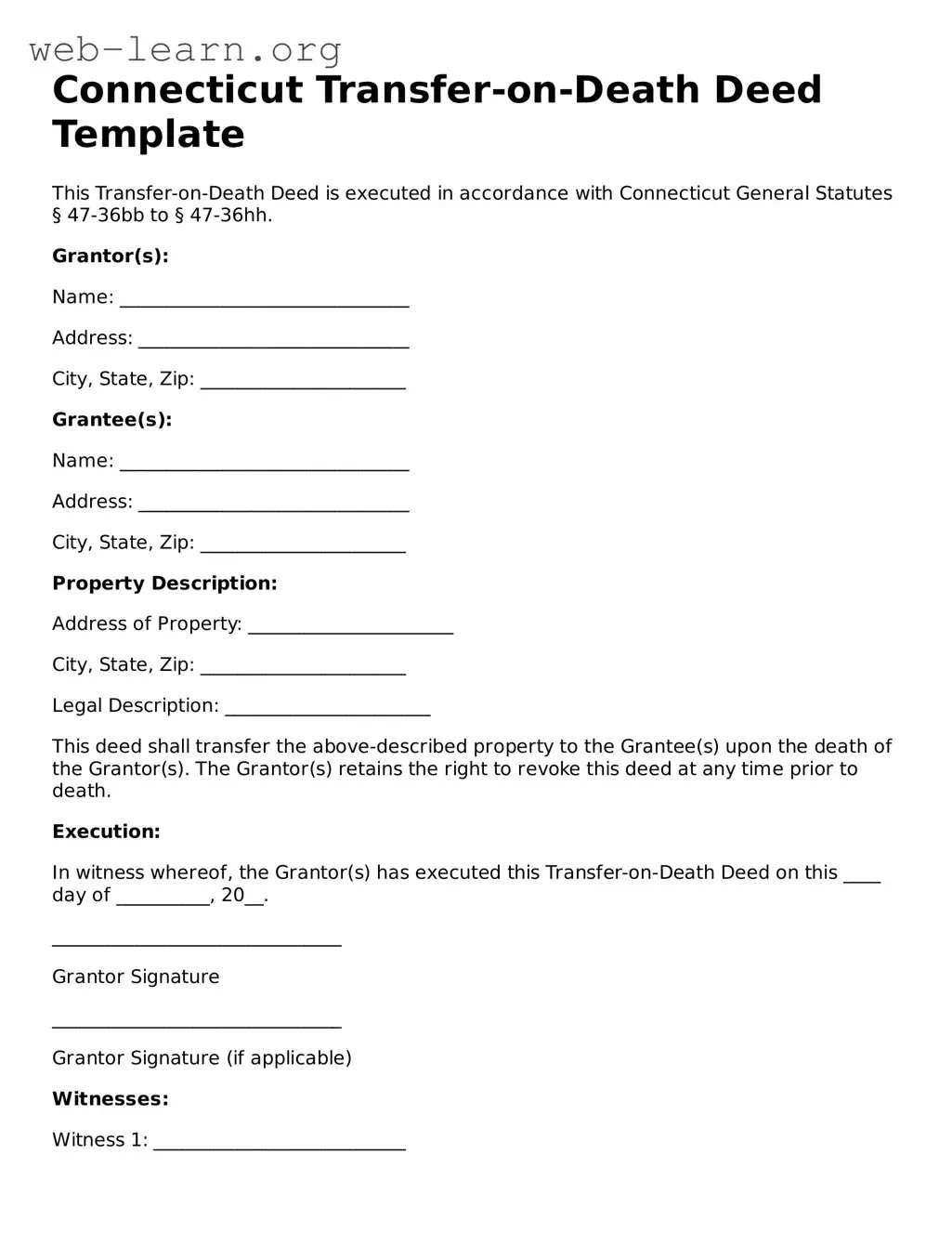
Connecticut Transfer-on-Death Deed Template
This Transfer-on-Death Deed is executed in accordance with Connecticut General Statutes § 47-36bb to § 47-36hh.
Grantor(s):
Name: _______________________________
Address: _____________________________
City, State, Zip: ______________________
Grantee(s):
Name: _______________________________
Address: _____________________________
City, State, Zip: ______________________
Property Description:
Address of Property: ______________________
City, State, Zip: ______________________
Legal Description: ______________________
This deed shall transfer the above-described property to the Grantee(s) upon the death of the Grantor(s). The Grantor(s) retains the right to revoke this deed at any time prior to death.
Execution:
In witness whereof, the Grantor(s) has executed this Transfer-on-Death Deed on this ____ day of __________, 20__.
_______________________________
Grantor Signature
_______________________________
Grantor Signature (if applicable)
Witnesses:
Witness 1: ___________________________
Witness 2: ___________________________
Notary Public:
State of Connecticut
County of ____________________________
Subscribed and sworn to before me this ____ day of __________, 20__.
_______________________________
Notary Public Signature
My Commission Expires: _______________
| Fact Name | Description |
|---|---|
| Definition | A Transfer-on-Death Deed allows an individual to transfer real property to a beneficiary upon their death without going through probate. |
| Governing Law | The Transfer-on-Death Deed in Connecticut is governed by Connecticut General Statutes § 47-36bb to § 47-36gg. |
| Eligibility | Only individuals can create a Transfer-on-Death Deed; it cannot be executed by entities such as corporations or trusts. |
| Beneficiary Designation | Multiple beneficiaries can be designated, and they can inherit the property in equal shares or in specified proportions. |
| Revocation | A Transfer-on-Death Deed can be revoked at any time before the death of the grantor by executing a new deed or a written revocation. |
| Filing Requirement | The deed must be recorded in the town clerk's office where the property is located to be effective. |
| No Immediate Transfer | Ownership does not transfer to the beneficiary until the grantor's death; the grantor retains full control of the property during their lifetime. |
| Tax Implications | Tax consequences may arise upon the transfer of property, and beneficiaries should consult a tax professional for guidance. |
| Form Requirements | The deed must be in writing, signed by the grantor, and acknowledged before a notary public. |
| Limitations | Transfer-on-Death Deeds do not affect any existing liens on the property, which may still need to be addressed by the beneficiary. |
After completing the Connecticut Transfer-on-Death Deed form, it is essential to ensure that it is properly executed and recorded to be effective. The next steps involve signing the document in the presence of a notary public and filing it with the appropriate town clerk's office.
What is a Transfer-on-Death (TOD) Deed in Connecticut?
A Transfer-on-Death Deed is a legal document that allows a property owner to transfer their real estate to a designated beneficiary upon their death, without the need for probate. This means that the property can pass directly to the beneficiary, simplifying the transfer process and potentially reducing costs associated with estate administration.
Who can create a Transfer-on-Death Deed?
In Connecticut, any individual who is the sole owner of a property or a co-owner with the right of survivorship can create a TOD Deed. It's important to note that the property must be real estate, such as a house or land, and not personal property like vehicles or bank accounts.
How do I complete a Transfer-on-Death Deed?
To complete a TOD Deed, you will need to fill out the form with specific information, including:
Once the form is filled out, it must be signed in the presence of a notary public. After notarization, the deed should be recorded in the local land records office where the property is located to be effective.
Can I change or revoke a Transfer-on-Death Deed?
Yes, you can change or revoke a TOD Deed at any time before your death. To do this, you would typically need to create a new TOD Deed that supersedes the previous one or file a revocation document with the local land records office. It's advisable to consult with a legal professional to ensure that the changes are properly executed.
What happens if the beneficiary predeceases me?
If the designated beneficiary passes away before you do, the TOD Deed will not transfer the property to that individual. Instead, the property will typically become part of your estate and will be distributed according to your will or, if there is no will, according to state intestacy laws. You may want to consider naming an alternate beneficiary in the deed to avoid complications.
Are there any tax implications associated with a Transfer-on-Death Deed?
Generally, transferring property via a TOD Deed does not trigger immediate tax consequences for the property owner. However, the beneficiary may be subject to capital gains taxes when they sell the property. It's important to consult with a tax professional for personalized advice regarding potential tax implications.
Filling out the Connecticut Transfer-on-Death Deed form is an important step for individuals looking to transfer property to beneficiaries without going through probate. However, several common mistakes can complicate this process. Understanding these errors can help ensure that the deed is executed correctly and meets the intended goals.
One frequent mistake is failing to include the full legal description of the property. The description must be precise and detailed, encompassing the exact boundaries and location. Omitting this information can lead to confusion or disputes over which property is being transferred.
Another common error involves not signing the deed in the presence of a notary public. Connecticut law requires that the deed be notarized to be valid. If the deed is not properly notarized, it may be deemed ineffective, resulting in unintended consequences for the intended beneficiaries.
People often neglect to consider the implications of existing liens or mortgages on the property. If there are outstanding debts associated with the property, these may not automatically transfer to the beneficiary. This oversight can lead to financial difficulties for the beneficiary if they are unaware of these obligations.
Additionally, some individuals forget to update the deed after significant life changes, such as marriage, divorce, or the birth of a child. Failing to revise the deed to reflect current intentions can result in unintended beneficiaries receiving the property, which may not align with the individual's wishes.
Inaccurate beneficiary information is another mistake that can occur. It is crucial to provide the full names and addresses of beneficiaries. Any ambiguity or errors in this information can lead to legal challenges or delays in the transfer process.
Lastly, individuals sometimes overlook the importance of consulting with a legal professional. While the form may appear straightforward, legal nuances can arise. Seeking guidance can help avoid mistakes that may have long-term implications for both the property owner and the beneficiaries.
By being aware of these common mistakes, individuals can take proactive steps to ensure that their Connecticut Transfer-on-Death Deed is completed accurately and effectively, ultimately providing peace of mind for themselves and their loved ones.
When considering a Transfer-on-Death (TOD) Deed in Connecticut, it's essential to understand that this document often works in conjunction with several other forms and documents. Each of these plays a crucial role in ensuring a smooth transfer of property ownership while avoiding probate. Below is a list of commonly used documents alongside the Connecticut Transfer-on-Death Deed form.
Understanding these documents can help ensure that your estate planning is comprehensive and effective. Each form has its purpose, and together they create a robust framework for managing and transferring your assets according to your wishes.
When filling out the Connecticut Transfer-on-Death Deed form, it’s important to be careful and thorough. Here’s a list of things you should and shouldn’t do:
Understanding the Connecticut Transfer-on-Death Deed (TOD) can be challenging, and several misconceptions often arise. Here are ten common misunderstandings about this legal tool:
By clarifying these misconceptions, individuals can make more informed decisions regarding their estate planning and the use of a Transfer-on-Death Deed in Connecticut.
When filling out and using the Connecticut Transfer-on-Death Deed form, consider the following key takeaways:
Hawaii Transfer on Death Deed Form - Understanding the implications of this deed can help you make informed decisions.
Arkansas Beneficiary Deed Pdf - It is important to ensure that the deed is executed correctly to avoid complications later.