Homepage Blank Connecticut Real Estate Form
Outline

The Connecticut Real Estate Purchase and Sales Agreement serves as a crucial document in the process of buying and selling property within the state. This legally binding agreement outlines the essential terms and conditions agreed upon by both the buyer and the seller. Key components include the identification of the parties involved, the property description, and the purchase price, along with payment terms. The form emphasizes the importance of deposits, financing contingencies, and the condition of the premises, ensuring that both parties understand their obligations. Furthermore, it addresses issues related to property inspections, the presence of lead-based paint, and the maintenance of the property prior to closing. By detailing the responsibilities of each party, including the seller's obligation to convey a marketable title, the agreement aims to protect the interests of both buyers and sellers. Additionally, it incorporates provisions for adjustments related to taxes and other fees, as well as the implications of default. The comprehensive nature of this form underscores the significance of legal clarity in real estate transactions, while also allowing for negotiation and customization to meet the specific needs of the parties involved.


Sample - Connecticut Real Estate Form

COPYRIGHT2012GREATERNEWHAVENASSOCIATIONOFREALTORS,INC.ALLRIGHTSRESERVED.
THISFORMWASREVIEWEDBYLEGALCOUNSELOFTHEGREATERNEWHAVENASSOCIATIONOFREALTORS,INC.Revised5/23/2012
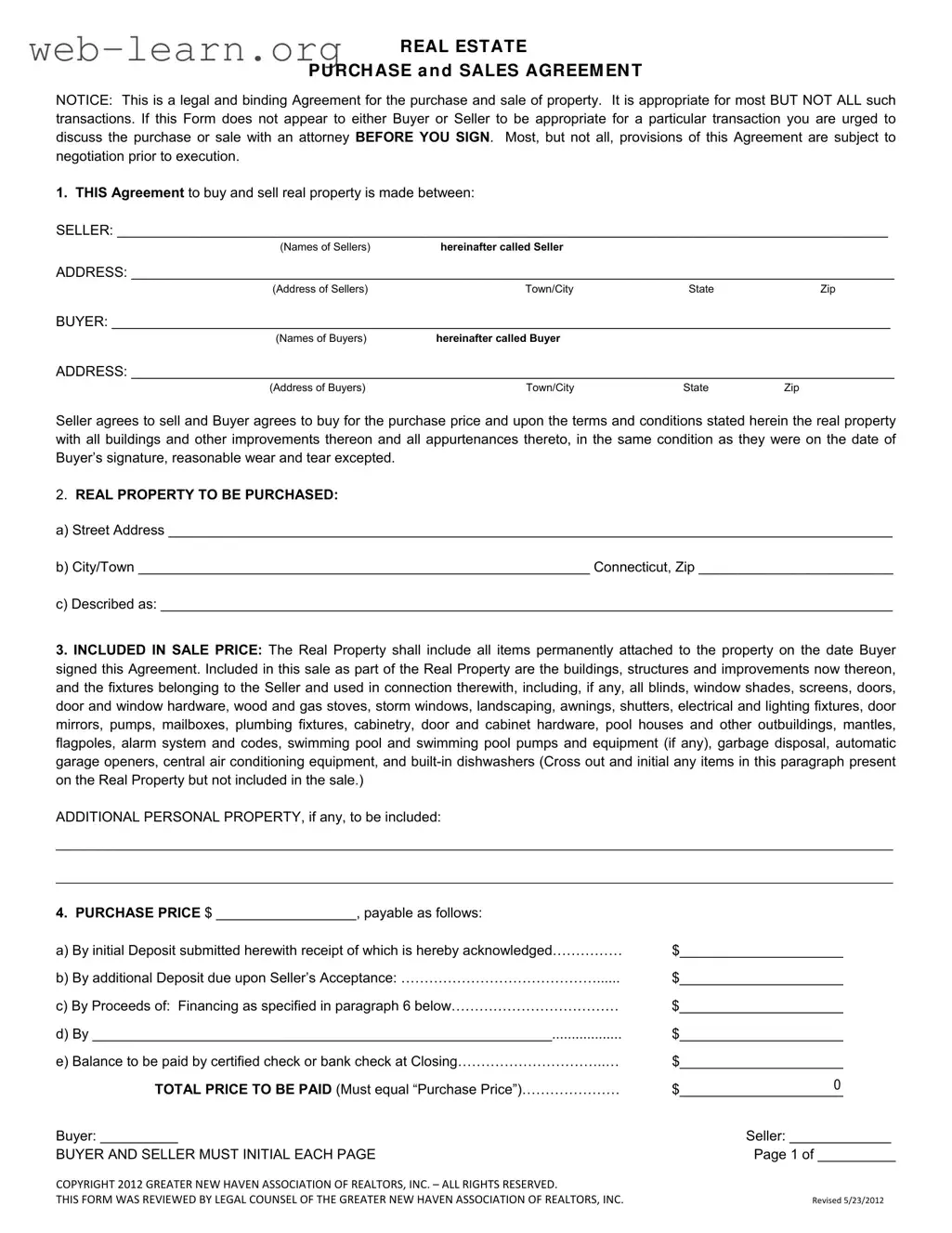
REAL ESTATE
PURCH ASE a n d SALES AGREEM EN T
NOTICE: This is a legal and binding Agreement for the purchase and sale of property. It is appropriate for most BUT NOT ALL such
transactions. If this Form does not appear to either Buyer or Seller to be appropriate for a particular transaction you are urged to
discuss the purchase or sale with an attorney BEFORE YOU SIGN. Most, but not all, provisions of this Agreement are subject to
negotiation prior to execution.
1. THIS Agreement to buy and sell real property is made between:
SELLER: ___________________________________________________________________________________________________
(Names of Sellers) hereinafter called Seller
ADDRESS: __________________________________________________________________________________________________
(Address of Sellers) Town/City State Zip
BUYER: ____________________________________________________________________________________________________
(Names of Buyers) hereinafter called Buyer
ADDRESS: __________________________________________________________________________________________________
(Address of Buyers) Town/City State Zip
Seller agrees to sell and Buyer agrees to buy for the purchase price and upon the terms and conditions stated herein the real property
with all buildings and other improvements thereon and all appurtenances thereto, in the same condition as they were on the date of
Buyer’s signature, reasonable wear and tear excepted.
2. REAL PROPERTY TO BE PURCHASED:
a) Street Address _____________________________________________________________________________________________
b) City/Town __________________________________________________________ Connecticut, Zip _________________________
c) Described as: ______________________________________________________________________________________________
3. INCLUDED IN SALE PRICE: The Real Property shall include all items permanently attached to the property on the date Buyer
signed this Agreement. Included in this sale as part of the Real Property are the buildings, structures and improvements now thereon,
and the fixtures belonging to the Seller and used in connection therewith, including, if any, all blinds, window shades, screens, doors,
door and window hardware, wood and gas stoves, storm windows, landscaping, awnings, shutters, electrical and lighting fixtures, door
mirrors, pumps, mailboxes, plumbing fixtures, cabinetry, door and cabinet hardware, pool houses and other outbuildings, mantles,
flagpoles, alarm system and codes, swimming pool and swimming pool pumps and equipment (if any), garbage disposal, automatic
garage openers, central air conditioning equipment, and built-in dishwashers (Cross out and initial any items in this paragraph present
on the Real Property but not included in the sale.)
ADDITIONAL PERSONAL PROPERTY, if any, to be included:
_________________________________________________________________________________________________________________________
_________________________________________________________________________________________________________________________
4. PURCHASE PRICE $ __________________, payable as follows:
a) By initial Deposit submitted herewith receipt of which is hereby acknowledged…………… $_____________________
b) By additional Deposit due upon Seller’s Acceptance: ……………………………………...... $_____________________
c) By Proceeds of: Financing as specified in paragraph 6 below……………………………… $_____________________
d) By ___________________________________________________________.................. $_____________________
e) Balance to be paid by certified check or bank check at Closing…………………………..… $_____________________
TOTAL PRICE TO BE PAID (Must equal “Purchase Price”)………………… $_____________________
Buyer: __________ Seller: _____________
BUYER AND SELLER MUST INITIAL EACH PAGE Page 1 of __________
0
COPYRIGHT2012GREATERNEWHAVENASSOCIATIONOFREALTORS,INC.ALLRIGHTSRESERVED.
THISFORMWASREVIEWEDBYLEGALCOUNSELOFTHEGREATERNEWHAVENASSOCIATIONOFREALTORS,INC.Revised5/23/2012
5. DEPOSITS: The Deposit(s) specified above shall be made at the stated times. All Deposits shall be made by check, payable to the
Listing Broker and shall be deposited as required under Connecticut General Statutes Section 20-324k. All checks are subject to
collection and failure of collection shall constitute a default. Except at time of closing, when the Deposit shall be delivered to Seller or
Seller’s designee, the Listing Broker shall not pay the Deposit to anyone without the written consent of all parties to this Agreement
subject to Connecticut General Statutes Section 20-324k(d). In the event any Deposit funds payable pursuant to this Agreement are
not paid by Buyer, Seller may give written notice of such failure to Buyer. If such notice is given and a period of 3 (three) days pass
without Buyer paying the Deposit owed, Seller may declare Buyer in default and shall have the remedies set forth in Paragraph 14.
6. FINANCING CONTINGENCY:
a) Amount $_______________ b) Maximum Initial Interest Rate __________%
c) Term: ____________ years d) Commitment Date: _________________________
e) Type: Conventional Fixed Variable FHA VA CHFA Other___________________________
Buyer’s obligation is contingent upon Buyer obtaining financing as specified in this paragraph. Buyer agrees to apply for such financing
immediately and diligently pursues a written mortgage commitment on or before the Commitment Date.
f) If Buyer is unable to obtain a written commitment and notifies Seller in writing by 5:00 PM on or before said Commitment Date, this
Agreement shall be null and void and any Deposits shall be immediately returned to Buyer. Otherwise, the Financing Contingency shall
be deemed satisfied and this Agreement shall continue in full force and effect.
7. CONDITION OF PREMISES: Buyer represents that Buyer has examined the Real Property and is satisfied with the physical
condition subject to the Inspection Contingency if applicable. Neither Seller nor any representative of the Seller or Buyer has made any
representation or promise other than those expressly stated herein which Buyer has relied upon in making this Agreement.
8. INSPECTION CONTINGENCY: Broker Recommends
(a) Inspections shall be completed and results reported to Seller on or before 5:00 P.M. on: _________________________.
(b) Seller agrees to permit Buyer’s designees to inspect the Real Property during the period from Seller’s acceptance until the date set
forth in (a) above. If Buyer is not satisfied with the physical condition of the Real Property and so notifies Seller in writing prior to the
time and date specified in (a) above, then Buyer may, at Buyer’s option, terminate this Agreement. Buyer may give Seller the option to
correct the conditions that are unsatisfactory to the Buyer. Should Buyer elect to terminate this Agreement or Seller is unwilling to
correct any unsatisfactory conditions, the Buyer shall notify Seller on or before 5:00 P.M. on: ________________________ of Buyer’s
election to terminate this Agreement, and if Terminated this Agreement shall be null and void and any Deposit monies paid hereunder
shall be returned immediately to Buyer and neither Buyer nor Seller shall have any claims against each other under the terms of this
Agreement. If Buyer fails to notify Seller as provided herein, this contingency shall be deemed satisfied and this Agreement shall
continue in full force and effect.
(c) If initialed below, Buyer does NOT choose to have any inspections performed and WAIVES any rights to object to any defects in
the Real Property that would have been disclosed by a full and complete inspection.
Initials __________
9. LEAD-BASED PAINT. If the Property is “target housing” under federal law (meaning, with some exceptions, housing built before
1978), Seller must permit Buyer, at Buyer’s expense, a 10-day period to conduct a risk assessment or inspection of the Real Property
for the presence of lead-based paint and/or lead-based paint hazards before Buyer is obligated under this Agreement. Buyer may
waive this right of inspection. Buyer to provide Seller or Sellers’ attorney with written notice of the presence of defective lead-based
paint or lead-based paint hazards along with a copy of the inspection and/or risk assessment within ________ days (insert “ten” or a
mutually agreed number of days) of the date of acceptance of this Agreement. If such notice is given and Seller and Buyer cannot
reach a mutually satisfactory agreement within seven (7) days of said notice regarding the defective lead-based paint or lead-based
paint hazards, either party shall have the option of terminating this Agreement and this Agreement shall be null and void.
__________ (Initial) Buyers waive the opportunity to conduct a risk assessment or inspection for the presence of lead-based paint
and/or lead-based paint hazards.
Buyer: __________ Seller: _____________
BUYER AND SELLER MUST INITIAL EACH PAGE Page 2 of __________
COPYRIGHT2012GREATERNEWHAVENASSOCIATIONOFREALTORS,INC.ALLRIGHTSRESERVED.
THISFORMWASREVIEWEDBYLEGALCOUNSELOFTHEGREATERNEWHAVENASSOCIATIONOFREALTORS,INC.Revised5/23/2012
10. PROPERTY MAINTENANCE, OCCUPANCY, POSSESSION:
(a) PROPERTY MAINTENANCE.
Seller agrees to maintain Real Property with all buildings, landscaping and other improvements thereon, all appurtenances thereto, and
any personal property included in the sale in the same condition, reasonable wear and tear excepted, as it was on the date of this
Agreement.
(b) OCCUPANCY, POSSESSION: CLOSING DATE: _________________________
Unless otherwise stated herein, Buyer shall receive exclusive possession and occupancy with keys on Closing Date. The Real
Property shall be maintained by Seller until time of Closing and shall be transferred in broom clean condition, free of debris. Buyer shall
have the right to a walk through inspection of the Property within 48 hours prior to the Closing Date. Closing shall be held at an office to
be determined by Buyer’s attorney in the county where the Real Property is located or at such place as designated by Buyer’s
mortgage lender.
11. WARRANTY DEED: Seller agrees to convey fee simple title of the Real Property to Buyer by a good and sufficient Warranty Deed
subject only to any and all provisions of any ordinance, municipal regulation, public or private law, restrictions and easements as
appear of record, if any, provided they do not affect marketability of title, current real estate taxes, water and sewer charges, and
current water and sewer assessment balance, if any; except in those cases where a fiduciary’s Deed or other form of court ordered
deed may be required to pass title. Seller warrants that Seller has no notice of any outstanding violations from any town, city or State
agency relating to the Real Property.
12. MARKETABLE TITLE: Title to be conveyed by Seller shall be marketable as determined by the Standards of Title of the
Connecticut Bar Association now in force. Seller further agrees to execute such documents as may be reasonably required by Buyer’s
title insurance company or by Buyer’s mortgage lender. Should Seller be unable to convey Marketable Title as defined herein, Buyer
may accept such Title as Seller can convey or may reject the Unmarketable Title, receive back all Deposit money, and declare this
Agreement null and void. Upon such rejection and repayment to Buyer of all sums paid on account hereof, this Agreement shall
terminate and the Parties hereto shall be released from all further claims against each other.
13. ADJUSTMENTS: Real Estate Taxes will be adjusted as of the Closing Date by the Uniform Fiscal Year basis except in the Towns
of Meriden or Wallingford where taxes will be adjusted by the Assessment Year Method. All other adjustments, including Association
fees, fuel oil, water and sewer usage, interest on sewer or water assessments, utilities, rent, if any, and issues regarding funds at
closing and unavailability of releases at closing and like matters shall be adjusted pro rata as of the Closing Date in accordance with the
Residential Real Estate Closing Customs, New Haven County, as adopted by the New Haven County Bar Association, now in force.
Rent security deposits, if any, shall be credited to Buyer by Seller on the Closing Date and shall include any interest accrued to the
tenant.
14. BUYER’S DEFAULT: If Buyer fails to comply with any Terms of this Agreement by the time set forth for compliance and Seller is
not in default, Seller shall be entitled to all initial and additional Deposit funds provided for in section 4, whether or not Buyer has paid
the same, as liquidated damages and both parties shall be relieved of further liability under this Agreement. If legal action is brought to
enforce any provision of this Agreement, the prevailing party shall be entitled to reasonable attorney’s fees.
15. RISK OF LOSS, DAMAGE: All risk of loss or damage to said Real Property by fire, theft or other casualty until delivery of Deed
shall be upon the Seller. In the event of loss or damage independently appraised at more than $10,000.00, Buyer shall have the option
to receive any insurance payment on account of said damage and take Title, or rescind this Agreement and receive back all Deposit
money paid. In such case, all rights and obligations of the parties under this Agreement shall terminate.
16. COMMON INTEREST COMMUNITY: If the property is a unit in a condominium or other common interest community, Seller will
deliver the resale documents in accordance with Connecticut General Statutes Section 47-270.
17. LISTING BROKER___________________________________________________________ PH#_________________________
Dual Agent – If the Listing Agent is acting as a Dual Agent, a CONSENT FOR DUAL AGENCY FORM SHALL BE ATTACHED to
this Agreement.
COOPERATING BROKER_______________________________________PH#__________________
Buyer Agent Sub Agent
Buyer: __________ Seller: _____________
BUYER AND SELLER MUST INITIAL EACH PAGE Page 3 of __________
COPYRIGHT2012GREATERNEWHAVENASSOCIATIONOFREALTORS,INC.ALLRIGHTSRESERVED.
THISFORMWASREVIEWEDBYLEGALCOUNSELOFTHEGREATERNEWHAVENASSOCIATIONOFREALTORS,INC.Revised5/23/2012
18. PROPERTY CONDITION REPORT: Seller and Buyer acknowledge that if a written residential property condition report is required
by statute (CT Gen. Stat. 20-327b et seq.) and Seller has not provided Buyer with the required report, Seller will credit Buyer with the
sum of $500.00 at closing.
19. EQUAL HOUSING RIGHTS: Buyer acknowledges the right to be shown any property within Buyer’s stated price range in any area
specified by Buyer which is available to Agent for Showing. This Agreement is Subject to Connecticut General Statutes prohibiting
discrimination in commercial and residential real estate transactions (Connecticut General Statutes Title 46a, Chapter 814c).
20. NO ASSIGNMENT, BINDING EFFECT: This Agreement may not be assigned by either party without the written consent of the
other, but shall be binding upon the heirs, executors, administrators and successors of the parties hereto.
21. ADDENDUM: The following attached Addenda and/or Riders are part of this Agreement:
Seller’s Property Condition Disclosure Agency Disclosure Title X Lead Based Paint Hazards Disclosure
Dual Agency Consent
Multi-family Tenant Rider
Other____________________________________________________________________________________________________
22. ADDITIONAL TERMS AND CONDITIONS: _________________________________________________________________________________________
__________________________________________________________________________________________________________________________________________
23. FAX TRANSMISSION/ELECTRONIC MAIL: The parties acknowledge that this Agreement and any addenda or modification
and/or any notices due hereunder may be transmitted between them by facsimile machine/electronic mail and the parties intend that a
faxed document or an electronic mail document containing either the original and/or copies of the parties’ signatures shall be binding
and of full effect.
24. COMPLETE AGREEMENT: This Agreement contains the entire agreement between Buyer and Seller concerning this transaction
and supersedes any and all previous written or oral agreements concerning the Property. Any extensions or modifications of this
Agreement shall be in writing signed by the parties.
25. NOTICE: Any notice required or permitted under the Terms of this Agreement by Buyer or Seller shall be in writing addressed to
the Party concerned using the address stated in Paragraph 1 of this Agreement or to such party’s attorney or to the party’s Listing
Broker or Cooperating Broker designated in paragraph 17.
26. APPLICABILITY: Buyer and Seller agree and understand that although this form has been made available by the Greater New Haven Association
of REALTORS, Inc. the Association assumes no responsibility for its content in relation to the transaction between the parties and is not a party to this
Agreement. This Agreement or parts of it may not be suitable for all transactions or conditions. The parties should determine its applicability.
27. BUYER AND SELLER acknowledges receipt of a copy of this Agreement upon their signing same.
28. TIME TO ACCEPT: Seller shall have until ________________________________________________________ to accept this
Agreement. (Date & Eastern Standard Time)
29. SIGNATURES:
______________________________________________ | ___________ _____________________________________________ | _____________
Buyer’s Signature Date Seller’s Signature Date
_____________________________________________________ | ____________ _____________________________________________________ | _______________
Buyer’s Signature Date Seller’s Signature Date
_____________________________________________________ | ____________ _____________________________________________________ | _______________
Buyer’s Signature Date Seller’s Signature Date
Buyer: __________ Seller: _____________
BUYER AND SELLER MUST INITIAL EACH PAGE Page 4 of __________

Form Information

Fact Name Details
Legal Binding Agreement This form serves as a legally binding agreement for the purchase and sale of property in Connecticut.
Seller and Buyer Information Both parties must provide their names and addresses, which are critical for the agreement's validity.
Included Property The sale includes all items permanently attached to the property, such as fixtures and improvements.
Deposit Requirements Deposits must be made by check and are subject to collection, with specific timelines outlined in the agreement.
Financing Contingency Buyer's obligation to purchase is contingent upon obtaining financing, which must be pursued diligently.
Condition of Premises Buyers must examine the property and confirm satisfaction with its condition before finalizing the agreement.
Lead-Based Paint Disclosure If the property was built before 1978, buyers have the right to inspect for lead-based paint hazards.
Governing Laws This agreement is governed by Connecticut General Statutes, including sections 20-324k and 46a, which address real estate transactions.

Detailed Guide for Filling Out Connecticut Real Estate

Completing the Connecticut Real Estate Purchase and Sales Agreement involves several steps that ensure all necessary information is accurately captured. It is important to follow each step carefully to avoid any potential issues. Below are the steps to fill out the form correctly.

  1. Identify the Parties: Fill in the names and addresses of the Seller(s) and Buyer(s) in the designated spaces at the top of the form.
  2. Property Information: Enter the street address, city or town, and zip code of the property being purchased. Provide a description of the property as needed.
  3. Included Items: List any personal property included in the sale, such as fixtures and appliances. Cross out and initial any items not included in the sale.
  4. Purchase Price: Specify the total purchase price and break it down into deposits and financing as outlined in the form.
  5. Deposits: Indicate the amounts and timing of any deposits. Ensure all checks are made payable to the Listing Broker.
  6. Financing Contingency: Fill out the financing details, including the amount, interest rate, term, commitment date, and type of financing.
  7. Condition of Premises: Confirm that the Buyer has examined the property and is satisfied with its condition, noting any contingencies if applicable.
  8. Inspection Contingency: Specify the date by which inspections must be completed and whether the Buyer waives the right to inspections.
  9. Lead-Based Paint: If applicable, acknowledge the right to inspect for lead-based paint and indicate if the Buyer waives this right.
  10. Property Maintenance: Note the responsibilities of the Seller regarding property maintenance until closing.
  11. Closing Date: Enter the anticipated closing date and any related details.
  12. Marketable Title: Acknowledge the Seller’s obligation to provide marketable title and the options available if this is not met.
  13. Adjustments: Understand how real estate taxes and other adjustments will be handled at closing.
  14. Signatures: Ensure all parties sign and date the agreement in the designated areas. Each party must also initial each page of the agreement.

After completing these steps, ensure that all parties receive a copy of the signed agreement for their records. It is advisable to consult with a legal professional if there are any uncertainties regarding the content or implications of the agreement.

Obtain Answers on Connecticut Real Estate

  1. What is the purpose of the Connecticut Real Estate Purchase and Sales Agreement?

    This agreement serves as a legal document outlining the terms and conditions under which a buyer agrees to purchase real estate from a seller. It helps ensure that both parties understand their obligations and rights throughout the transaction.

  2. Who should use this form?

    The Connecticut Real Estate Purchase and Sales Agreement is suitable for most real estate transactions. However, it may not be appropriate for every situation. Buyers and sellers are encouraged to consult with an attorney if they have questions or concerns about its applicability to their specific transaction.

  3. What information is required from the buyer and seller?

    Both parties must provide their names and addresses. This includes the full names of the sellers and buyers, along with their respective addresses, including town or city, state, and zip code. This information is crucial for identifying the parties involved in the agreement.

  4. What does the purchase price section entail?

    The purchase price section outlines the total amount the buyer will pay for the property. It includes details about initial deposits, additional deposits, financing, and the balance to be paid at closing. This section ensures transparency regarding the financial aspects of the transaction.

  5. What is the significance of the inspection contingency?

    The inspection contingency allows the buyer to have the property inspected before finalizing the purchase. If the buyer finds issues during the inspection, they can either request repairs or choose to terminate the agreement. This protects the buyer from unexpected problems with the property.

  6. What happens if the buyer fails to make the required deposits?

    If the buyer does not make the required deposits, the seller can issue a written notice to the buyer. If the buyer does not remedy the situation within three days, the seller may declare the buyer in default, which could lead to the seller retaining any deposits made as liquidated damages.

  7. What is a lead-based paint disclosure?

    If the property was built before 1978, federal law requires a lead-based paint disclosure. The seller must allow the buyer a period to inspect for lead-based paint hazards. The buyer can waive this inspection, but doing so means they forfeit any rights to object to lead paint issues later.

  8. What should be done if the property has issues at closing?

    If the property sustains damage or loss before the closing, the seller is responsible for that risk. The buyer has the option to either accept the property as is and receive any insurance payments or rescind the agreement and recover their deposits.

  9. How does the agreement address common interest communities?

    If the property is part of a condominium or common interest community, the seller must provide the buyer with necessary resale documents as required by Connecticut law. This ensures that the buyer is informed about the community’s rules and regulations before completing the purchase.

Common mistakes

Filling out the Connecticut Real Estate Purchase and Sales Agreement requires attention to detail. One common mistake is neglecting to include the full names and addresses of both the seller and buyer. This information is crucial for identifying the parties involved in the transaction. Without accurate details, legal complications may arise, potentially delaying the sale.

Another frequent error occurs when buyers fail to specify the complete street address and zip code of the property being purchased. Incomplete information can lead to confusion and disputes over which property is being sold. This mistake can complicate the transaction and create issues during the closing process.

Many people overlook the section regarding the purchase price and the breakdown of deposits. It’s essential to ensure that the total price matches the sum of the individual deposits listed. If there is a discrepancy, it could lead to misunderstandings or even defaults later in the process.

Buyers sometimes neglect to include necessary contingencies, such as financing or inspection contingencies. These contingencies protect buyers by allowing them to back out of the deal if they cannot secure financing or if the property fails to meet their inspection standards. Omitting these clauses can leave buyers vulnerable to unexpected issues.

Another mistake involves not initialing each page of the agreement. This requirement is not just a formality; it confirms that both parties have reviewed and agreed to all terms. Failing to initial can result in disputes over what was agreed upon, complicating the transaction.

Some buyers and sellers mistakenly assume that all personal property is included in the sale unless specifically excluded. This assumption can lead to disputes over items that may have sentimental or monetary value. It’s crucial to clearly outline what is included in the sale to avoid misunderstandings.

In the financing section, buyers may forget to specify the type of loan they are seeking. This detail is important, as it can affect the buyer's obligations and the seller’s expectations. Without this information, the seller may not take the buyer's offer seriously.

Another common error is not addressing the lead-based paint disclosure if the property was built before 1978. Federal law requires this disclosure, and failing to include it can lead to legal issues. Buyers should ensure they understand their rights regarding lead-based paint inspections.

Lastly, individuals often fail to consult an attorney before signing the agreement. This oversight can result in unintentional acceptance of unfavorable terms. Legal counsel can provide valuable guidance, ensuring that the agreement is appropriate for the specific transaction and protecting the interests of both parties.

Documents used along the form

The Connecticut Real Estate Purchase and Sales Agreement is a crucial document in property transactions. However, several other forms and documents often accompany it to ensure a smooth process. Below is a list of these important documents, each serving a specific purpose in the real estate transaction.

  • Property Condition Disclosure: This document requires the seller to disclose any known issues or defects with the property. It helps buyers make informed decisions about their purchase.
  • Lead-Based Paint Disclosure: For properties built before 1978, sellers must inform buyers about potential lead-based paint hazards. This is a federal requirement aimed at protecting health.
  • Agency Disclosure: This form clarifies the relationship between the buyer, seller, and real estate agents involved. It ensures all parties understand who represents whom in the transaction.
  • Financing Addendum: This document outlines the terms of financing arrangements. It details the type of financing and any contingencies related to obtaining a mortgage.
  • Inspection Contingency: This form allows buyers to conduct inspections of the property. It outlines the timeline and conditions under which the buyer can negotiate repairs or terminate the agreement.
  • Closing Disclosure: This document provides a detailed breakdown of the final costs associated with the transaction. It includes loan terms, closing costs, and other financial details.
  • Title Search Report: This report verifies the property's title history. It ensures there are no liens or legal issues that could affect ownership.
  • Warranty Deed: This legal document transfers ownership of the property from the seller to the buyer. It guarantees that the seller holds clear title to the property.
  • Settlement Statement: This document summarizes all financial transactions that occur at closing. It details the distribution of funds and outlines who pays what at the closing table.

Understanding these documents is essential for both buyers and sellers. Each plays a vital role in the real estate transaction process, helping to protect the interests of all parties involved.

Similar forms

  • Residential Purchase Agreement: Similar to the Connecticut Real Estate form, this document outlines the terms and conditions for purchasing a residential property. Both agreements include sections on purchase price, deposits, and contingencies, ensuring both parties understand their obligations.
  • Commercial Purchase Agreement: This document serves a similar purpose for commercial properties. It includes provisions for financing, inspections, and closing terms, similar to those found in the Connecticut Real Estate form, but tailored for commercial transactions.
  • Lease Agreement: While primarily for rental properties, lease agreements share similarities in outlining terms between landlords and tenants. Both documents specify payment terms, property condition, and responsibilities, ensuring clarity for all parties involved.
  • Real Estate Disclosure Statement: This document is often provided alongside purchase agreements. It requires sellers to disclose known issues with the property, similar to the Connecticut form's inspection and condition provisions, helping buyers make informed decisions.
  • Title Commitment: This document outlines the title company's findings regarding the property's title. Like the Connecticut Real Estate form, it addresses the importance of marketable title and any potential issues that may affect ownership.
  • Closing Disclosure: This document details the final terms of the loan and closing costs. It is similar to the Connecticut Real Estate form in that it summarizes financial obligations and adjustments, ensuring transparency before the transaction is completed.

Dos and Don'ts

When filling out the Connecticut Real Estate form, it is essential to approach the task with care and attention to detail. Below is a list of things you should and shouldn't do to ensure the process runs smoothly.

  • Do read the entire form carefully before filling it out.
  • Do ensure that all names and addresses are accurate and complete.
  • Do discuss any uncertainties with a qualified attorney before signing.
  • Do initial each page of the agreement as required.
  • Do include all necessary deposits and payment details clearly.
  • Don't leave any sections blank; fill in all required information.
  • Don't sign the form without understanding all terms and conditions.
  • Don't cross out or modify any terms without mutual consent.
  • Don't forget to keep a copy of the signed agreement for your records.

Misconceptions

  • All Real Estate Transactions Use the Same Form: Many believe that the Connecticut Real Estate form is a one-size-fits-all document. However, it is designed for most, but not all, transactions. Specific circumstances may require a different form or additional provisions.
  • Buyers and Sellers Cannot Negotiate Terms: A common misconception is that the terms outlined in the form are set in stone. In reality, most provisions are subject to negotiation before execution, allowing both parties to reach a mutually agreeable arrangement.
  • Deposits Are Non-Refundable: Some assume that once a deposit is made, it cannot be returned. This is not accurate. If the buyer cannot secure financing or if the agreement is terminated under certain conditions, deposits may be returned.
  • Inspections Are Optional: Many people think that inspections are not necessary if they are not explicitly mentioned in the agreement. However, buyers have the right to conduct inspections, and waiving this right can limit their ability to address any property defects.
  • Lead-Based Paint Inspections Are Not Required: It is a misconception that lead-based paint inspections are optional. For properties built before 1978, sellers must allow buyers a specified period to conduct these inspections, as mandated by federal law.
  • Closing Date Is Always Flexible: Some believe that the closing date can easily be adjusted. While it can be negotiated, the closing date is generally fixed once agreed upon, and changes may require mutual consent from both parties.
  • All Real Estate Agents Are Dual Agents: Many assume that all real estate agents represent both buyers and sellers. In fact, agents can represent only one party in a transaction unless a dual agency consent form is signed, clarifying their role.

Key takeaways

When filling out and using the Connecticut Real Estate form, keep the following key takeaways in mind:

  • Understand the Agreement: This form is legally binding. Make sure both the Buyer and Seller are clear on its terms before signing.
  • Accurate Information: Fill in all required details accurately, including names, addresses, and property descriptions. Incomplete information can lead to disputes.
  • Deposit Requirements: Be aware of the deposit amounts and timelines. All deposits must be made by check and follow the state regulations.
  • Financing Contingency: If financing is needed, ensure to specify the type and terms clearly. The Buyer must apply for financing promptly.
  • Inspection Contingency: Buyers should conduct inspections within the specified timeframe. If issues arise, notify the Seller promptly to discuss possible resolutions.